

From Awareness to Accountability: Rethinking Sustainability on Earth Day
April 22, 2025
•
5 mins read
As we mark Earth Day 2025, it’s clear we’re at a defining moment. Despite decades of activism and innovation, the ecological crisis continues to accelerate, driven by climate change, biodiversity loss, and unsustainable resource use. But alongside this growing threat is a growing opportunity: the ability to harness artificial intelligence (AI) and data to drive more responsible business practices and environmental stewardship.
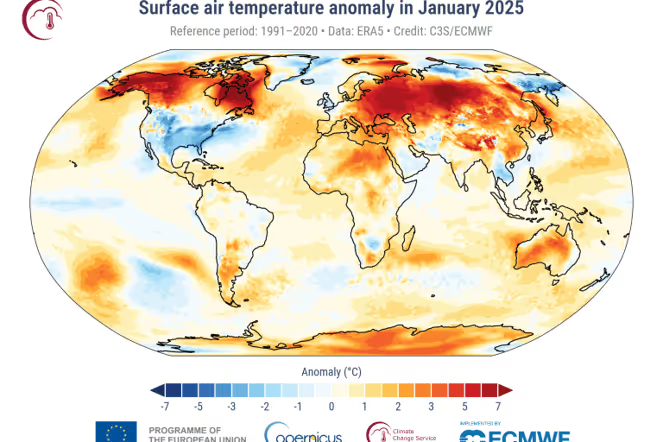
The warning signs are everywhere. By early 2025, Earth’s average surface temperature reached 13.0°C (55.4°F)—pushing us closer to climate tipping points. The first three months of this year were among the hottest on record, with unprecedented temperature anomalies in both the Arctic and Antarctic regions.
Global greenhouse gas emissions reached 37.8 billion metric tons in 2024, driven largely by fossil fuel use, agriculture, and industrial output. Meanwhile, biodiversity is in sharp decline, with over 46,000 species threatened with extinction due to climate-related stressors like habitat loss, pollution, and extreme weather.
Plastic waste continues to acidify oceans, while urban sprawl and overconsumption accelerate deforestation. From fast fashion to factory farming, human activity is pushing planetary boundaries—and the consequences are becoming harder to ignore.
The Human Toll: Environmental Anxiety on the Rise
This crisis isn’t just environmental—it’s deeply personal. Younger generations are increasingly affected by eco-anxiety, a psychological response to fears of environmental collapse. Studies warn that by 2050, billions could face water scarcity, food system disruption, and mass migration from climate-affected regions. Overheated ecosystems, wildfires, and resource scarcity are not abstract threats—they’re the lived reality of millions.
The Role of AI and ESG in the Fight for a Livable Planet
Fortunately, powerful tools are emerging. Artificial intelligence is transforming how we track and respond to environmental, social, and governance (ESG) risks. Natural language processing (NLP) can detect greenwashing, monitor corporate behavior, and surface early warning signals of environmental harm. AI is also helping companies reduce emissions, optimize energy use, and act on regulatory and reputational risks in real time.
By integrating ESG strategy with AI-powered insights, businesses are no longer passive observers but active players in shaping a sustainable future.
Hope for Change
Despite the scale of the crisis, momentum is building. From robotic wildlife conservation to AI-enabled recycling innovations, new technologies offer hope. Companies are aligning with the UN Sustainable Development Goals (SDGs), and governments are responding with new ESG regulations and global climate pledges. But regulation and innovation are not enough—collective action is still key.
Conclusion
There’s no better time than Earth Day to commit to change. Whether it’s supporting environmental nonprofits, reducing your consumption, investing in sustainable products, or advocating for better policies, every action counts. Our window to act is narrowing, but it’s still open.
In recent years, consumers have become increasingly conscious about the impact of their purchases on the environment and society. As a result, many companies have jumped on the bandwagon of sustainability and green initiatives to attract consumers who prioritize ethical and environmentally friendly products. However, not all companies are authentic in their claims and practices, leading to a phenomenon known as greenwashing. In the first article of this two-part series, we gave an in-depth analysis of reputational laundering and greenwashing. In this article, we will explore the prevalence of greenwashing across various industries. We will also study the case of a company practicing greenwashing and a genuinely sustainable company.
Reputational Laundering by Industry
Reputational laundering is a common practice across various industries. Traditionally, the ‘Oil and Gas’ and ‘Financial’ industries have been identified as the main culprits. However, we have recently observed a substantial increase in the frequency of mentions in the ‘Food & Drug Retail’ industry, surpassing all other sectors by a significant margin. To evaluate this trend, we calculated the percentage of reputational laundering mentions in relation to the total number of mentions for each industry.
Reputational laundering over time
We looked at the last three years to find how each industry has evolved. Most industries have remained fairly static within a reasonable range. However, ‘Industrials’ have seen a significant decrease in mentions. Conversely, ‘Oil and Gas’ and ‘Food & Drug Retail’ significantly increased in 2023.
‘Food & Drug Retail’ more than tripled its mentions percentage due to a large number of mislabeled eco-friendly products (Walmart & Kohl’s) and green initiatives claims (Coca-Cola, Unilever, Amazon…).
The ‘Oil and Gas’ industry ranked second, and its recent spike can be associated mainly with greenwashing on actions such as their direct negative impact on the environment and the impact on local communities (TotalEnergies - Uganda & Tanzania). Another example is related to sportswashing with ‘Oil and Gas’ advertising heavily in sports events and even sponsoring sports clubs.
Figure 1: Reputation laundering by industry over time.
When examining the prevalence of reputational risks across sectors, greenwashing is the predominant concern in most industries. This is particularly evident in sectors like Industrials, Oil & Gas, and Financials, where greenwashing mentions are especially prominent. On the other hand, Telecommunications & Social Media stands out as an exception, with the bulk of its mentions skewing towards colorwashing, which encompasses specific practices such as blackwashing and sportswashing (Netflix accused of 'blackwashing' new docu-series Queen Cleopatra by casting black British actress).
Figure 2: Reputational laundering breakdown by industry.
The financial industry's footprint in reputational laundering might not be the most pronounced in terms of direct mentions, but its influence stretches wide via its investment activities in other sectors. This means the ripple effect of the financial sector's actions can be substantially more impactful than those in other industries. Our investigation into this phenomenon included a rigorous examination of the frequency with which financial institutions are cited in discussions of greenwashing. Additionally, we assessed their efforts in driving positive impact initiatives. We scrutinized a group of 144 financial entities, arranging them on a scale from the greatest to the least number of greenwashing mentions in proportion to their overall volume of mentions.
Top financial firms by greenwashing claims
Below, we listed the financial firms with the highest relative volume of greenwashing mentions. Beyond the first two institutions on the list, which are related and had a big scandal in 2022, we can see many very recognizable names, such as Blackrock (investing in fossil fuels), JP Morgan (for fossil fuel investment policies), and HSBC (false advertising green claims) making our top ten list.
Case Study: DWS Group
The DWS Group, previously known as Deutsche Asset Management, found itself in the spotlight for all the wrong reasons in 2022 and 2023. The scandal landed them at the top of our list, a position highlighted by the significant number of mentions they received — a figure that is an order of magnitude higher than that of any other entity on the list.
As a German asset management firm under the umbrella of Deutsche Bank, DWS was embroiled in severe greenwashing allegations. The last two years were marked by high-drama events: starting with greenwashing allegations at the end of 2021, their offices were searched in May 2022, which led to the resignation of the DWS chief in June 2022. The saga concluded with a substantial $25 million fine paid to U.S. regulators in September 2023.
The accompanying chart provides a visual representation of the timeline for these events, contrasting the number of absolute mentions with those specifically related to greenwashing. The alignment in the timing and scale of these mentions with the unfolding events is unmistakable.
Figure 3: DWS Group relative greenwashing mentions.
Best-in-class companies
In our effort to wrap up our study on an optimistic note, it's important to recognize that the heightened scrutiny of greenwashing and its associated initiatives ultimately serves a beneficial role by significantly raising our collective consciousness about crucial ESG issues.
While it's true that numerous companies have come under fire for greenwashing, it's equally important to highlight those that are genuinely advancing initiatives with positive environmental and social repercussions across the globe.
Employing the same method used to scrutinize financial firms implicated in greenwashing, we focused on the same group of 144 companies, honing in on the top 10 that stood out based on normalized mentions of their positive environmental actions.
The findings are quite encouraging: mentions of these positive initiatives dwarf those of negative impacts when viewed as a proportion of total mentions. Brookfield Asset Management (Brookfield) shines as the most notable, garnering almost double the mentions of its closest peer.
Also noteworthy is BlackRock's appearance on this list. Despite its presence on the greenwashing list, BlackRock has made strides in positive efforts, too. The company's initiatives—some counterbalancing the negative—have received more attention for their positive impact than for greenwashing, suggesting a complex but proactive ESG engagement.
Furthermore, companies like EQT, Berkshire Hathaway, and Standard & Poor's have actively engaged in initiatives that drive positive impact, earning them significant—and rightfully so—media coverage.
Figure 4: Brookfield sentiment vs environmental initiatives.
In terms of visibility, these environmental initiatives represent a significant portion of the company’s profile, surpassing 50% of total mentions in September 2022. This highlights the dominant role these actions play in the public discourse surrounding Brookfield.
The company’s polarity(1) — a measure of sentiment in mentions — shows a steady and positive trajectory beginning in late 2021. This trend points to a growing positive reputation and increased positive online discussions regarding the company.
Web Sentiment Analysis: Financial Industry vs. DWS & Brookfield
Figure 5: Sentiment over time.
When assessing the landscape of ESG engagement within the financial sector, we consider the comparative reputations of two key players: the leader in positive impact initiatives against the firm with the highest number of greenwashing mentions. How do they stack up against the broader sentiment within the financial industry?
The finance industry at large grapples with a challenging reputation shaped by various issues, including regulatory shortcomings, perceived corporate greed, opacity, and environmental impacts, among others.
Against this backdrop, we observe that:
DWS: The company's reputation trajectory is on a downward slope compared to the industry average, with the aftereffects of recent controversies culminating in a reputation low as of October 2023.
Brookfield: In contrast, Brookfield's commitment to the environment appears to buoy its reputation, maintaining a consistently positive trend that surpasses the market standard. Notably, from January 2023 onward, there is a discernible uptick in positive sentiment.
Conclusion
While the prevalence of greenwashing poses a considerable challenge within the corporate sphere, our study reveals a silver lining. The intensive scrutiny and debate surrounding environmental, social, and governance (ESG) issues have led to heightened awareness and, more importantly, action. Amidst the cacophony of claims, our analysis has found a discernible pattern of positive ESG initiatives overshadowing negative impacts, indicating a shift towards genuine sustainability efforts.
Particularly encouraging is the performance of certain frontrunners like Brookfield Asset Management, which has emerged as a beacon of positive action, outpacing its peers in driving meaningful change. This illustrates the potential for firms to lead by example and underscores the importance of rigorous analysis in distinguishing substantive ESG commitments from superficial ones.
Ultimately, this study underscores the transformative power of informed scrutiny and the pivotal role that advanced analytical tools play in propelling the ESG agenda forward. As the financial community continues to refine its approaches to evaluating ESG metrics, we can remain cautiously optimistic about the journey from mere green-tinted narratives to deeply rooted, impactful corporate practices.
(1) Polarity aggregates positive and negative sentiment (opinions, reviews) on a company. It ranges from -1 to 1. A 0 score means that positive and negative sentiment are equal. Well-regarded brands generally have polarity scores over 0.5.
At SESAMm, we used AI to study billions of articles and analyze greenwashing trends. Download this comprehensive ebook for an in-depth understanding of the evolving landscape of reputational laundering, notably greenwashing, and dive into its trends in the corporate world.
SESAMm’s AI Technology Reveals ESG Insights
Discover unparalleled insights into ESG controversies, risks, and opportunities across industries. Learn more about how SESAMm can help you analyze millions of private and public companies using AI-powered text analysis tools.
Forced labor remains among the most pressing human rights challenges for companies worldwide. Despite stronger regulations and corporate pledges, millions remain trapped in exploitative conditions, often deep within complex global supply chains.
As new laws increase scrutiny and liability, the cost of blind spots is rising. Investors, corporates, and private equity firms alike must now demonstrate active due diligence or face legal, financial, and reputational consequences.
In this whitepaper, SESAMm explores:
The tightening global regulatory landscape on forced labor
Exclusive data-driven insights from SESAMm’s AI platform on labor-related controversies
Real-world case studies revealing how risks can remain hidden despite compliance efforts
Download the report to learn how data and AI are transforming the fight against forced labor - and how organizations can move from reactive to proactive risk management.
Researching and analyzing investment opportunities can be challenging for asset management—private equity and hedge fund portfolio managers, researchers, and analysts—because, of course, you want to make sure that you're a good steward of your client's investments.
And when you find and source data, such as traditional or alternative data, you also want to make sure it's reliable and that the methods used to gather it are tried and true.
This article aims to give you an inside look into SESAMm's knowledge graph—one of the key reasons SESAMm's NLP-derived alternative data is reliable and trusted. We'll explain what a knowledge graph is, why it's important, how it works, and what makes SESAMm's knowledge graph unique.
What is a knowledge graph?
A knowledge graph is a digital representation of a network of real-world entities, the foundation of a search engine or question-answering service. This structured data model puts the schema in context through linking and semantic metadata, providing a framework for data integration, analytics, unification, and sharing. In other words, it's like a map and legend, with the legend labeling the concepts, entities, and events and the map connecting and identifying their relationships. These details are stored in a graph database and visualized as a graph representation, hence the term knowledge graph.
Fun fact: The expression, knowledge graph, gained popularity after Google used it in 2012 to name their semantic network.
Two types of knowledge graphs
There are two general types of knowledge graphs: open and private. Open knowledge graphs are open to the public. They're created and made available by organizations such as Wikidata, DBpedia, and Yago. Private knowledge graphs are often only used by organizations that create them, like Google, WolframAlpha, Facebook, and SESAMm (of course). Some offer them up for a fee or subscription, such as Crunchbase and OpenCorporates.
Why a knowledge graph is important
Knowledge graphs are important because they equip us with a model to see how everything relates from a big-picture view, creating new knowledge. Its benefits include:
Incorporating disparate data sources, avoiding data silos
From a data science and artificial intelligence (AI) perspective, knowledge graphs provide machine-readable details, adding context and depth to data-driven AI techniques such as machine learning. Using knowledge graphs and machine learning models together improves system accuracy and extends the range of machine learning capabilities for better explainability and trustworthiness.
How a knowledge graph works
The core of a knowledge graph is its knowledge model, a collection of interconnected descriptions of concepts, entities, events, and relationships known as an ontology. This model provides a framework for statements or taxonomy. Each statement consists of a subject, predicate, and object (Figure 1)—known as a triple model—and each subject or object is represented only once in the context of the other subjects and their relationships. For example, in this simple sentence, "The boy kicks the ball," The boy is the subject, and kicker is the predicate because he kicks the ball, the object.
Figure1: Apple is the subject, chief executive officer is the predicate, and Tim Cook is the object.
Likewise, each statement consists of three components: nodes, edges, and labels. A node, or vertice, represents an entity, which can be anything existing in the real world, such as a person, company, or object. For instance, in this example (Figure 2), Barack Obama is the subject node, Malia and Sasha are object nodes, and the edges, or relationships, are labeled as father or sibling, respectively.
Figure 2: How the relationships between nodes can be labeled.
What makes SESAMm's knowledge graph unique?
SESAMm uses open and private datasets with custom, curated information to create our proprietary knowledge graph. As a result, the knowledge graph is a vast map connecting and integrating over 70 million related entities and their keywords, relating each organization to its brands, products, associated executives, names, nicknames, and exchange identifiers in the case of public companies from a data repository made up of more than 18 billion articles and messages and growing.
The knowledge graph is updated regularly
Entities within the knowledge graph are updated weekly and tagged to ensure we correctly track their changes. For instance, the CEO of a company today might not be its CEO tomorrow. And brands might be bought and sold, changing the parent company with each sale. So, weekly updates within the knowledge graph ensure the system is aware of these changes.
NLP-driven accuracy
At SESAMm, named entity disambiguation (NED), a natural language processing (NLP) technique, identifies named entities based on their context and usage. Text referencing "Elon," for example, could refer indirectly to Tesla through its CEO or to a university in North Carolina. Only the context allows us to differentiate, and NED considers that context when classifying entities. This method is superior to simple pattern matching, which limits the number of possible matches, requires frequent manual adjustments, and can't distinguish homophones.
SESAMm uses three other NLP tools to identify entities and create actionable insights: lemmatization, embeddings, and similarity. The lemmatization process normalizes a word into its base form (morphology) to help identify and aggregate entities. Embedding assigns the entity a numerical value to help analyze how words change meaning depending on context and understand the subtle differences between words that refer to the same concept. Similarity measures whether two words, sentences, or objects are close to one another in meaning.
SESAMm tailored its knowledge graph to find, extract, and analyze data about public or private entities, which isn't readily available from the web or standard rating firms. This unique implementation of a knowledge graph provides insights to give you an edge when researching, analyzing, and submitting recommendations to the portfolio manager or clients.
SESAMm's premiere platform, TextReveal®, allows you to leverage NLP-driven insights fully and receive high-quality results through data streams, modular API and dashboard visualization, and signals and alerts. It's perfect for many quantitative, quantamental, and ESG investment use cases.
Learn how SESAMm can support you in your investment decision-making and request a demo today.
Stay ahead with the latest in ESG and AI intelligence
Join our mailing list to receive new reports, event invites, and updates from SESAMm directly to your inbox.