
October's Anti-Competitive Practices: A Market Analysis
November 11, 2025
•
5 mins read
As regulatory scrutiny intensifies across industries, several major corporations faced significant legal challenges related to anti-competitive behavior in October 2025. Using SESAMm's AI-powered controversy data, we analyzed corporate activity to identify the companies most involved in anti-competitive practices during the month. The results reveal a pattern of regulatory action spanning tech giants, financial services, and food production sectors.
#1: Alphabet: Mounting Regulatory Pressure
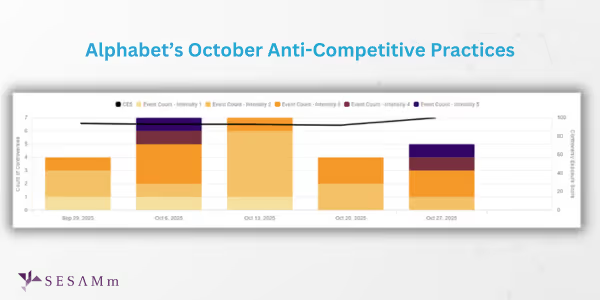
Alphabet continues to face unprecedented legal challenges across multiple jurisdictions. The company is facing a substantial $8.3 billion lawsuit from Klarna, alleging anti-competitive practices in the Android market. The situation intensified when the U.S. Supreme Court denied Google's request to delay mandated changes that would open Google Play to rival app stores.
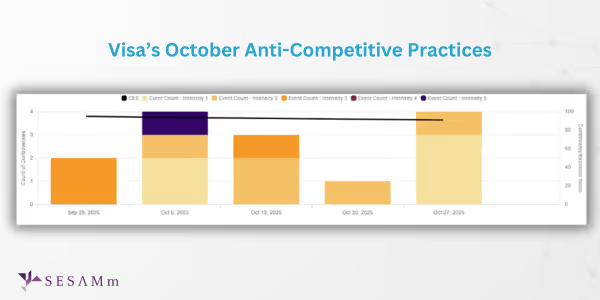
Visa continues to face legal and regulatory pressures across multiple jurisdictions. In the United States, the long-running merchant fee antitrust litigation (MDL 1720) remains active, with ongoing appeals and challenges to proposed settlements. Several merchant groups that opted out of earlier agreements have been permitted by the courts to continue pursuing their claims, extending Visa’s legal exposure.
The company's $5.3 billion acquisition of Plaid has drawn intense scrutiny from the U.S. Department of Justice, reflecting growing concern about consolidation in the fintech sector. Meanwhile, across the Atlantic, the UK Competition Appeal Tribunal delivered a landmark ruling against both Visa and Mastercard, determining that their Multilateral Interchange Fees violate competition laws; a significant victory for European merchants and a potential precedent for future cases.
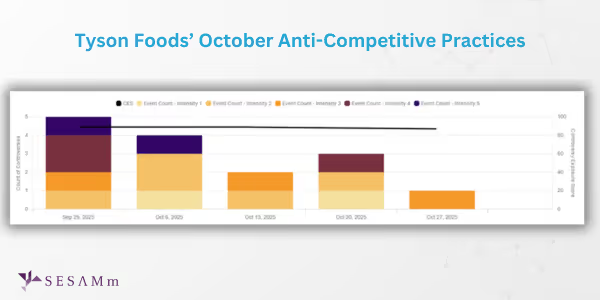
Beyond beef, Tyson reached an even larger $85 million settlement in a separate antitrust case concerning pork price inflation, the largest settlement to date in ongoing litigation against major U.S. meat producers.
Conclusion
The findings from October 2025 underscore a critical moment in corporate regulation, as authorities worldwide demonstrate an increased willingness to challenge anti-competitive practices in sectors ranging from technology and finance to food production. The substantial fines, denied appeals, and ongoing investigations signal a regulatory environment that is actively reshaping market dynamics.
For investors and market observers, these cases highlight the material financial and operational risks associated with anti-competitive behavior. As enforcement mechanisms strengthen and legal precedents solidify, companies across all sectors should anticipate heightened scrutiny of market practices, particularly those involving platform dominance, merger activities, and pricing coordination.
Reach out to SESAMm
TextReveal’s web data analysis of over five million public and private companies is essential for keeping tabs on ESG investment risks. To learn more about how you can analyze web data or to request a demo, reach out to one of our representatives.

The European Union is trying to tackle a big problem: imported goods that drive deforestation. A new Deforestation Law, planned to take effect at the end of 2025, would require companies to prove that products like cocoa, coffee, soy, and timber are not linked to forest loss. It’s an ambitious effort to make supply chains more sustainable and to hold global companies accountable. But not everyone is on board.
Why the Law Matters
The law is rooted in a clear goal. Agriculture and forestry are responsible for the vast majority of global deforestation, and many of the products linked to this destruction end up in European markets. The EU hopes to slow forest loss, protect biodiversity, and reduce climate impact by tightening import standards. The regulation also reflects growing demand from consumers and investors who want more responsible sourcing and transparency.
Who’s Pushing Back and Why
Over the past few weeks, opposition has gained steam from both industry leaders and EU governments.
On the corporate side, food companies like Mondelez, Mars, and Hershey are asking the EU to delay the rollout. They argue that the regulation could raise costs, cause supply disruptions, and hurt competitiveness. With cocoa prices already hitting record highs, many producers say they lack the tools and infrastructure to meet the new requirements.
This growing pushback highlights a real tension. On one hand, the EU wants to lead on environmental issues and use its market power to drive global change. On the other hand, companies and governments are warning that good intentions could come with serious trade-offs.
The next few months will be key. If the EU weakens the law too much, it could undermine its climate credibility. But if it presses ahead without flexibility, it risks creating economic strain and cutting off small producers from the European market.
SESAMm’s AI Technology Reveals ESG Insights
Discover unparalleled insights into ESG controversies, risks, and opportunities across industries. Learn more about how SESAMm can help you analyze millions of private and public companies using AI-powered text analysis tools.
Controversial business involvement screening is moving beyond its origins as a compliance exercise.
Under frameworks like SFDR and the EU Taxonomy, investors must prove that their portfolios not only promote sustainability but also exclude activities fundamentally at odds with environmental, social, or ethical principles. This marks a shift from static disclosure toward dynamic accountability, and it has broadened both the scope and ambition of ESG screening.
Historically, exclusions focused on a narrow range of activities - weapons, tobacco, or fossil fuels - and primarily applied to public equities. Today, that universe has expanded dramatically. Private markets, secondaries portfolios, and private credit exposures are now expected to undergo the same scrutiny as listed assets. This reflects not only regulatory alignment but also diversifying investor expectations, as institutions incorporate reputational, cultural, and mission-based constraints into their investment frameworks.
Modern exclusion policies increasingly include areas not yet covered by regulation but relevant to ethics, faith, or social impact. Examples range from pork-related activities in Sharia-compliant portfolios to emerging debates over cryptocurrency mining and trading, and even biotechnology topics such as human cloning or genetic manipulation that raise profound ethical questions. These additions illustrate how business involvement screening is evolving from a rule-based checklist into a reflection of each investor’s worldview and stakeholder commitments.
This evolution, however, brings complexity. Private assets and novel sectors often lack standardized data or public disclosures. ESG, compliance, and deal teams must process incomplete information, document decisions, and adapt quickly to new mandates - all without expanding headcount. The result is a growing need for automation that can adapt to human nuance.
SESAMm’s AI-powered business involvement screening meets that need. By allowing investors to screen based on their own exclusion categories and thresholds, it translates varied mandates - from regulatory to reputational - into a single, automated process.
Automating Controversial Business Involvement Screening in Public and Private Assets
SESAMm’s platform uses a new AI agent approach that scans and analyzes vast amounts of information. Below, we provide an overview of SESAMm’s business involvement screening capabilities and how they address investors’ needs for automation, thresholding, and flexible outputs.
Comprehensive Coverage through Big Data
SESAMm utilizes its AI engine to monitor over 30 billion articles and 10 million new documents daily from various sources, including news sites and NGOs. This extensive data collection spans multiple languages and local outlets, enabling it to detect obscure references to companies and raise alerts for issues such as misconduct. SESAMm's coverage encompasses millions of public and private companies, enabling users to conduct thorough screenings of any entity, including private companies and subsidiaries.
Customizable Exclusion Frameworks
SESAMm’s business involvement screening gives investors control over what to screen and how to classify it. Users can request customization of exclusion categories to mirror their own policy, whether based on regulation (e.g., SFDR, EU Taxonomy) or internal mandates (e.g., faith-based or reputational constraints). In addition to standard ESG categories like fossil fuels or weapons, investors can add custom topics. This flexibility allows ESG, compliance, and secondaries teams to tailor the tool to their precise needs,.
Threshold-Based Classification
SESAMm’s business involvement screening module is built around the concept of threshold-based flags. The AI utilizes structured data and unstructured signals to determine involvement levels. The output for each company is a clear classification: No Involvement, Limited Involvement, or Significant Involvement for each category. These classifications correspond to thresholds – limited might mean some involvement but below the exclusion threshold, significant means above the threshold or its a core business. By encoding the thresholds in the system, SESAMm ensures consistency with the investor’s policy. This is crucial for automation: rather than an analyst manually checking revenue percentages and news, the system does it automatically and provides clear justification.
Rapid Portfolio Screening Process
The system is designed for fast, self-contained screening. A user simply uploads a list or portfolio, and within hours receives a complete file summarizing involvement across all exclusion categories. The output includes company-level classifications, summaries of supporting evidence, and references to sources. This enables investors to integrate the results directly into due diligence workflows, risk committees, or regulatory reporting, with no ongoing manual data maintenance required.
Cost and Resource Efficiency
Automating this process saves substantial analyst time, particularly for rating agencies and secondaries investors managing high volumes of entities. Rating agencies can use the pre-classified results as a baseline input for their own ESG or credit assessments, reducing the manual data-gathering burden. LPs and GPs can run large private company universes in-house without additional research teams. In secondaries, where a full portfolio review can take days of analyst effort, SESAMm’s workflow compresses that timeline to just a few hours, enabling ESG validation to fit seamlessly into transaction schedules.
Auditability and Verification
Each classification is fully transparent. Analysts can drill down into the evidence behind a flag, including links to original articles, filings, or corporate statements, and verify the AI’s reasoning. Automatic translation ensures accessibility across languages. This transparency builds trust in the results and provides auditable documentation for LP reporting or regulator reviews.
As ESG investing matures, the leaders will be those who can implement exclusions transparently, efficiently, and in alignment with evolving norms. The next frontier is no longer just regulatory compliance - it is the ability to anticipate what clients and society will expect tomorrow, and to operationalize those expectations across all asset classes. SESAMm’s technology makes that possible: a platform that keeps pace with both policy evolution and moral expectations, bringing consistency and clarity to an increasingly complex ESG landscape.
After months of hard work from our team, we closed on a €35 million Series B2 funding round led by Elaia and Opera Tech Ventures (BNPP), which followed a €7.5M B1 round led by New Alpha and Carlyle in January 2021. That means we can now pursue the next phase of SESAMm’s growth.
We want to accomplish many things with this investment, and I’m incredibly grateful to all of our investors, partners, and clients who helped us during this process. But before I talk about them and SESAMm’s future, I can’t help but think about how the company started.
Academic beginnings
It’s still hard to believe that SESAMm sprouted from an idea, an academic project, and three college students. I still remember Pierre Rinaldi asking me to develop the first algorithms that used social media to analyze financial markets while in school. Pierre worked at a bank trading desk while finishing his studies and doing a research internship at a behavioral finance lab, where the idea came up for the project. I studied engineering and was passionate about AI already, so I started coding, and the first project was born.
Eventually, this project outgrew my capabilities. The volume of data involved needed hardcore algorithms to process them, the kind of algorithms Florian Aubry could build. Florian was the best developer in my engineering school, and lucky for us, he was also my friend.
From left to right: COO Pierre Rinaldi, CEO Sylvain Forté, and CTO Florian Aubry.
Before long, we started renting servers, optimizing code, and building signals based chiefly on Twitter data, reproducing research papers that also used text data to generate sentiment indicators for financial markets. You could say that this project had become more than academic at this point. But it really only became a company once we won our first startup award.
The award that sparked the launch of a company
We participated in a competition organized by local incubator SEMIA with support from Société Générale as a way to gain credibility for the project, and would you know, we won. The award was monetary, and we could receive it on one condition: that we launch an actual company.
You probably already know that starting a business is a big decision, at least it was for Pierre, Florian, and me. After all, we were still in school, trying to finish our degrees and looking to start new careers. Our choices could be life-altering. Pierre, for instance, planned to take a full-time job at the bank he was working at.
In the end, we chose SESAMm. Pierre didn’t take the job at the bank. I did my end-of-study internship at SESAMm, which allowed me to focus on the company 100% while finishing my degree. And Florian dedicated all his time and energy to the startup, too. In other words, we were all in, and our school project had officially become a business.
Pressure to build
Setting up a company was relatively easy. Building a business, as it turns out, is way harder. How would we take SESAMm’s product and put it to work? Pierre’s contacts, that’s how.
One by one, Pierre called on everyone he knew from school that worked in trading, offering them a chance to be the first to test the latest AI innovation: using social media for financial analysis. Back then, Pierre had more of a sales role. He’s now COO and head of HR, in case you were wondering.
Our first client was a trader from London. He put $50,000 into a strategy based on SESAMm’s signals. With our signals, the trader grew his portfolio with such performance that he began to raise capital, including for a hedge fund. Ultimately, he was trading $50 million from the strategy. It was the kind of success and track record we needed in the finance industry to take SESAMm to the next level.
Compelled to move…literally
Having demonstrated success, an investment firm, a venture firm called Fonds Venture Numérique Lorrain, reached out to us with interest in investing in SESAMm’s first round of funding. But they had two conditions:
SESAMm must move to Metz, a startup-friendly hub in the Lorraine region in France.
SESAMm must seek additional funding from other investors.
At the time, SESAMm was based in Strasbourg because that’s where Florian and I studied. And for all intents and purposes, we hadn’t planned on moving.
Also, aside from Pierre reaching out to school acquaintances to try our solution, we had never pitched anyone to fund our company before. Pierre, Florian, and I faced a serious choice and challenge.
What did we do, and how did we fare?
We reached out to business angels and pitched numerous times while continuing to work on the product and starting to plan the first recruitments. We learned a lot during this initial period about how to structure a company and present it to investors. At the time, startups were less common in the region and using online content from YC and other accelerators was invaluable for us.
SESAMm’s headquarters is now in Metz, and we currently have offices in Paris, London, Tunis, New York, and Tokyo. We’ve also diversified our technology and clientele, particularly in ESG and corporate spaces. In other words, we faced the challenge, moved our headquarters, and grew and evolved a lot!
Our first sign, our first footprint, our first home office in Metz.
Series B2 funding round challenges
That brings us to the recent past. We’ve grown our company so much that it was time for another funding round, and the timing wasn’t the best. Our teamwork and ability to communicate effectively across regions and cultures were vital in tackling this latest fundraising round. We decided to run the entire process in-house as it was important to us to not only demonstrate our ability to do so but also to build our own VC relationships.
Moreover, we’ve had a unique previous fundraising experience. Having been funded by FinTech venture capital firm NewAlpha Asset Management and a large private equity firm like Carlyle Group Inc. in earlier rounds helped us improve our processes and standardize our communications. We felt ready for this challenge.
Frankly speaking, though, between the COVID-19 pandemic and the Russia-Ukraine war, startup funding had become a much bigger challenge. Things weren’t popping like they were a couple of years ago, so we needed to be cautious and conservative yet bold and compelling. Regardless, we dug deep and stuck with the plan, with a focus on our numbers and our vision.
To achieve our goal, we created an internal team, onboarded two advisors, and created a scalable process. The internal team included SESAMm’s C-suite: CEO (Sylvain Forté), COO (Pierre Rinaldi), CTO (Florian Aubry), CFO (Marie-Charlotte Deucher), CMO (Jorge Alvarez), and CDO (Eric Sionnet). Our advisors provided guidance around strategy, gave feedback, and supplied operational help when needed. And from our pitch deck variations to our storage and sharing policies, we established a fine-tuned communication and project management process to keep us on task and on time. It was a good process, and it really helped us manage things efficiently while maintaining control over day-to-day operations. I can’t say it enough: process is always the key.
Fundraising wasn’t easy, but the process was worthwhile. And all this to say that I couldn’t be happier to announce that SESAMm has wrapped up its Series B2 funding round. With this money, we plan to further expand into the U.S. and Asian markets and continue SESAMm’s exponential growth. We’ll also seek key talent to sustain this growth and support the development of our AI technology.
Pleased, grateful, and excited for what comes next
Today, SESAMm is a healthy and fast-growing company. And as COO, CTO, and CEO, respectively, Pierre, Florian, and I are now more than a scrappy group of students. We’re a crew with the support of many contributors, consisting of more than 100 employees across many offices and cultures. It’s because of the teamwork and collaboration that SESAMm is where it is today. And I’m immensely grateful for all our team’s effort and the tremendous support we get from clients, investors, and advisors every day.
Paris, France, September 2022: Many of the 100+ SESAMmers gathered for a company retreat.
Thank you for being a part of our journey, and see you at SESAMm’s next milestone. Cheers!