SESAMm Incorporates Generative AI to Enhance ESG Risk Mitigation and Process Efficiency in the Finance Sector
July 12, 2023
•
5 mins read
SESAMm Incorporates Generative AI to Enhance ESG Risk Mitigation and Process Efficiency in the Finance Sector
FOR IMMEDIATE RELEASE
PARIS, France - July 12, 2023 - SESAMm, a leading player in financial technology, announces a transformative initiative to incorporate Generative AI solutions into its operations and product offerings. This strategic move is geared towards assisting financial firms in enhancing risk mitigation focused on ESG controversies and streamlining their processes.
The implementation of Generative AI follows a three-pronged strategic approach. This comprises the integration of large language models into their tech stack, the development of a client-facing conversational agent, and fostering a culture of AI utilization across all teams.
"With Generative AI, we are not only enhancing our internal processes but also focusing on the development of new features that redefine industry standards," stated Sylvain Forté, CEO & Co-founder of SESAMm. "These include intuitive dashboards, automated ESG/SDG event analysis tools, and a client interaction chatbot - all created to streamline data interaction and boost efficiency in risk management."
The integration of Generative AI has significantly enhanced SESAMm's product functionality already. This includes quicker and more intuitive interaction with data and introducing new features, such as ESG/SDG event summarization and automatic competitor searches for public and private companies.
SESAMm is also employing Generative AI for advanced risk mitigation. "Our innovative approach provides our clients a virtual team of ESG analysts and experts for detecting risk and ESG controversies, enhancing their risk mitigation strategies in a robust and comprehensive manner," Forté added.
SESAMm is preparing to launch a suite of AI-powered features later this year. "These new features, powered by Generative AI, reinforce our commitment to developing solutions that enhance risk mitigation and streamline processes for financial firms," Forté emphasized.
To explore more about SESAMm's Generative AI solutions and how they can boost your firm's operations, watch the video below:
Also, make sure you join our upcoming webinar, where Sylvain Forté will discuss live the future of fintech with Generative AI and how SESAMm is incorporating Generative AI into its processes and products. To register for the webinar, click here.
About SESAMm
SESAMm is a leading artificial intelligence and NLP (natural language processing) technology company serving global investment firms, corporations, and investors, such as asset managers, banks, private equity firms, hedge funds, and index providers. With over 100 employees and six offices worldwide, SESAMm celebrated its 9th anniversary in 2023.
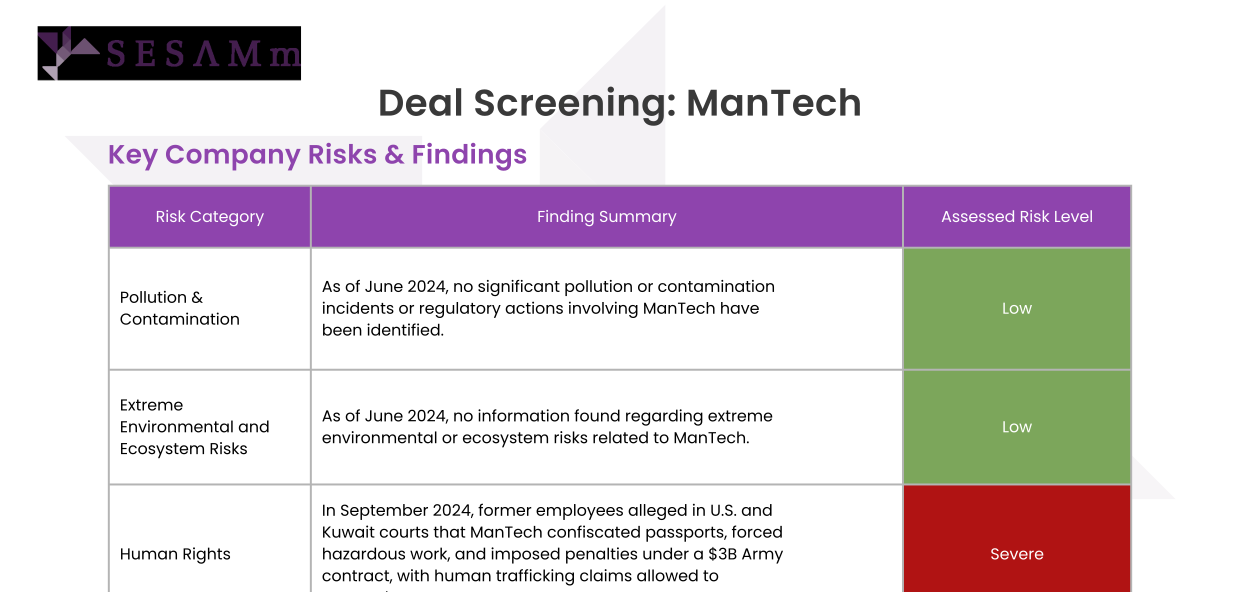
This is from SESAMm’s Deal Screening AI report. These reports are usually used by private equity deal teams and M&A teams to conduct pre-commercial due diligence on any company or project in minutes, and they contain insights and risks on the target company as well as a full competitive and market analysis.
ManTech International Corporation is a U.S.-based defense contractor specializing in cybersecurity, data analytics, and systems engineering solutions for national security and government agencies. Founded in 1968 and headquartered in Herndon, Virginia, the company operates globally. It primarily serves U.S. defense, intelligence, and homeland security clients, delivering technology services that support mission-critical operations such as cybersecurity protection, artificial intelligence and analytics, and intelligence, surveillance, and reconnaissance capabilities.
The broader defense and intelligence services market in which ManTech operates is expanding rapidly due to rising global defense spending, geopolitical tensions, and increasing demand for advanced digital and cyber capabilities. Within this context, ManTech has recently secured several growth signals, including a $200 million cybersecurity contract with the National Oceanic and Atmospheric Administration, partnerships to deploy secure AI technologies, and major analytics and systems contracts with the U.S. Army, reflecting continued demand for its technical expertise.
The report identifies several legal and reputational risks that could be relevant in a due diligence context. The most significant relate to labor and human rights issues, including allegations by former employees that the company confiscated passports and imposed hazardous working conditions under a U.S. Army contract in Kuwait, with a U.S. court allowing human-trafficking claims to proceed. Other previous issues include whistleblower retaliation claims linked to military contract billing practices and a civil fraud settlement involving misrepresentation of security clearance status. Environmental risks appear limited, with no major pollution or climate-related incidents identified.
In the competitive landscape, ManTech operates alongside firms such as Booz Allen Hamilton, Leidos, CACI International, SAIC, and General Dynamics Information Technology. While not the largest player in the sector, it is regarded as a capable provider of secure IT and cybersecurity solutions for classified government missions. Overall, the report concludes that ManTech benefits from strong demand for defense technology and cyber capabilities but faces reputational exposure primarily tied to labor practices and contract-related compliance risks.
Reach out to SESAMm
SESAMm’s AI Deal Screening Reports analyze web data across over five million public and private companies to help investors quickly identify legal, ESG, and reputational risks during due diligence. To learn more about how you can generate these reports or to request a demo, reach out to one of our representatives.
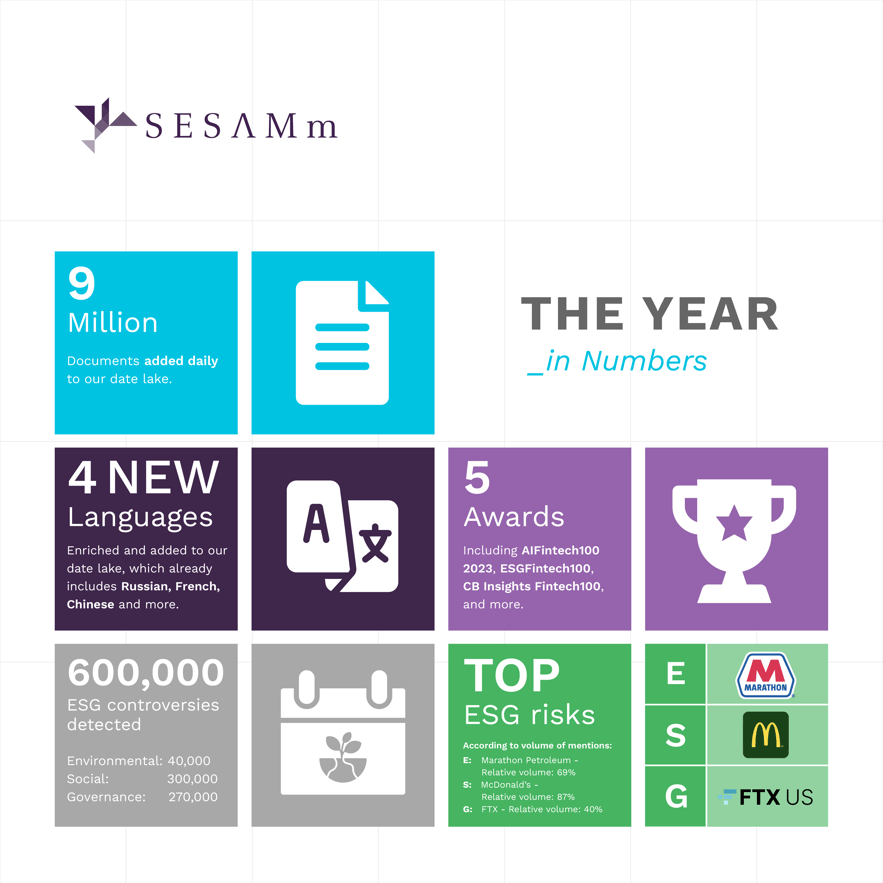
It’s been an action-packed year at SESAMm, and being the data lovers that we are, we ran the numbers and found that we:
Added 9 million documents to our data lake...every day!
Identified 600,000 ESG controversies
Enriched and added 4 new languages (Albanian, Serbian, Croatian, and Hungarian) to the data lake, which already includes Chinese, Russian, French, and more.
Check out this infographic below for more stats.
SESAMm’s AI Technology Reveals ESG Insights
Discover unparalleled insights into ESG controversies, risks, and opportunities across industries. Learn more about how SESAMm can help you analyze millions of private and public companies using AI-powered text analysis tools.
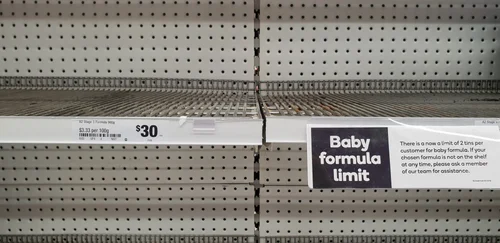
Imagine finding out you've run out of milk immediately after pouring a bowl of cereal. Or maybe realizing you don't have eggs while in the middle of baking a cake. We've all been there, and it's frustrating, to say the least. And this scene has been playing around the globe over the last couple of years for many foods and products. One day it's microchip shortages, and the next, it's baby formula.
Unfortunate as it is, it's one thing for consumers to cope with an empty car lot because of chip shortages. It's another to cope with a hungry infant because store shelves that once contained baby formula are now bare. For those parents and caretakers, their emotions are beyond feeling frustrated. They feel anger and panic, the sort of emotions that they share with their friends and colleagues on social media and forums. The kind of expression that can change the public's sentiment about a company, which in turn can move markets.
This Alternative Data Trends post will examine web data concerning the baby formula shortage. We'll analyze articles, social media, and forum conversations culminating in the U.S. crisis as the news reaches national exposure. We'll also highlight red flags investors could've seen had they monitored the situation with an AI-powered text analysis tool like SESAMm's TextReveal®.
Early warnings: When baby formula supplies began to run dry vs. when it became a national crisis
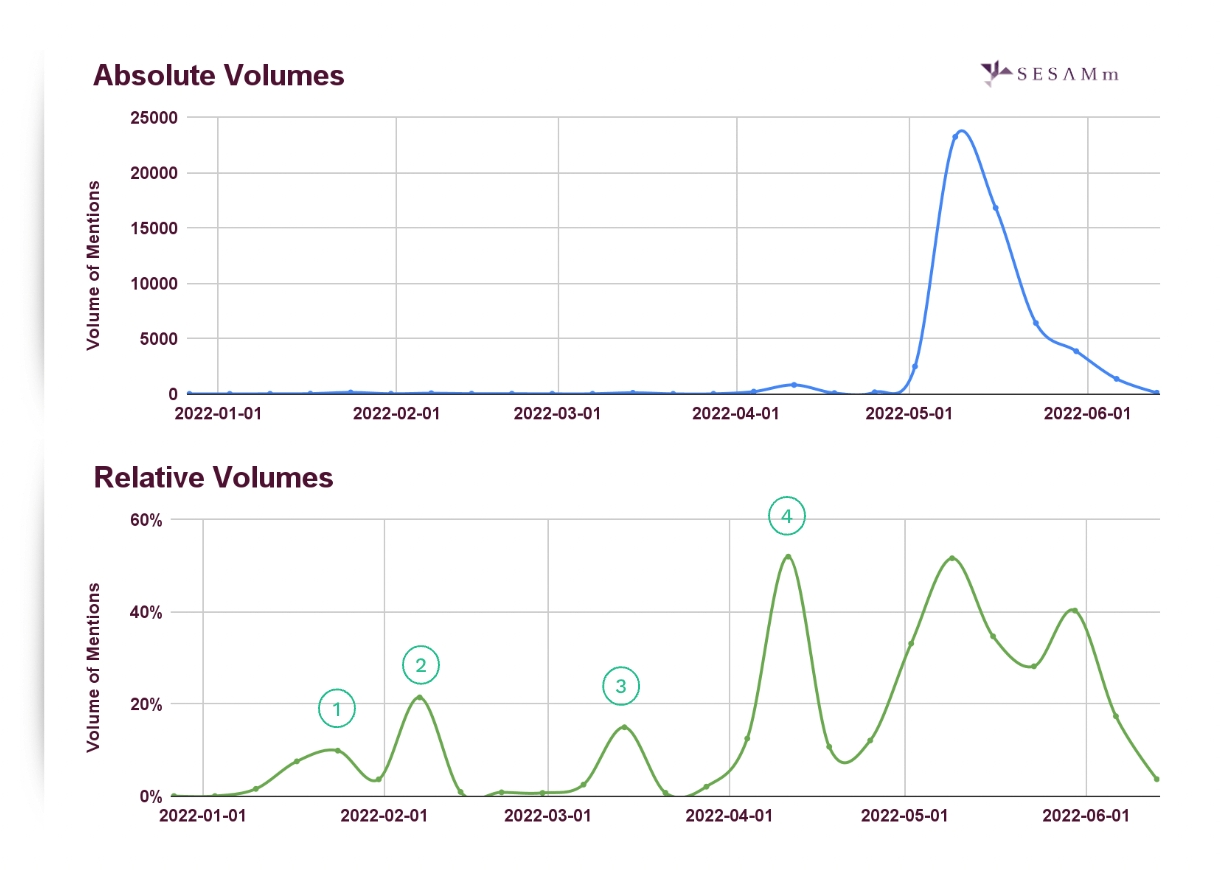
If we compare absolute and relative volumes—relative being mentions about the topic compared to our entire data lake—the term "formula milk market" yields parallel results. Mentions spike in May when the crisis reaches national coverage (see Figure 1).
Figure 1: Absolute and relative mention volumes for “formula milk market” match.
However, comparing absolute and relative volumes for the term "formula milk shortage," we find red flags as early as January 2022, four months before the crisis receives national attention (see Figure 2). Relative mentions spike on three occasions before absolute volumes register any significant noise. The fourth instance matches a ripple on the absolute chart.
Figure 2: Relative mention volumes for “formula milk shortage” show possible controversies.
These articles provide an example of the content published around the times of those rises in mentions:
Analyzing the sentiment and polarity of the formula milk market
In short, the e-reputation of the formula milk market has been negative since the beginning of 2022 (see Figure 3). Positive sentiment drops and reflects the opposing negative sentiment almost exactly until May, when the news about the crisis breaks. Likewise, polarity trends downward over the same period.
Note: Polarity represents a company's aggregate of positive and negative sentiment (opinions, reviews), ranging from -1 to 1. A zero score means that there is as much positive as negative sentiment. High e-reputation brands can have polarity scores of more than 0.5.
Figure 3: “Formula milk market” sentiment analysis and polarity moved negatively over time
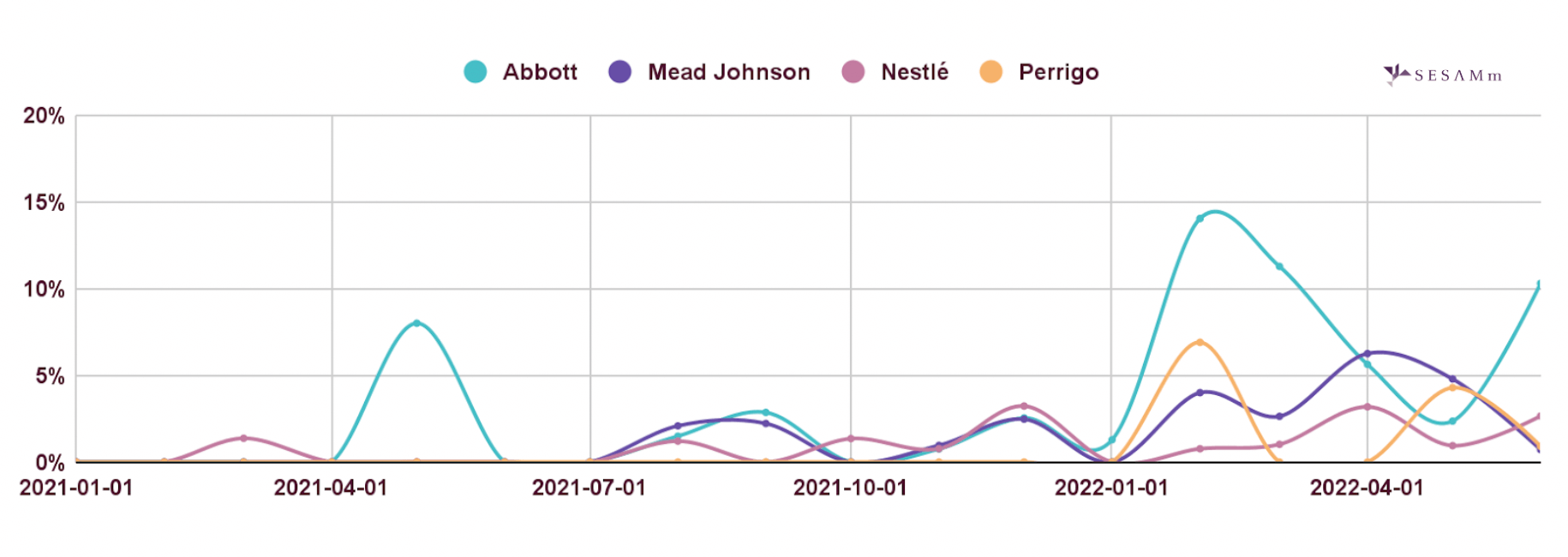
In the U.S., four brands produce the bulk of formula milk: Abbott, Mead Johnson, Nestlé, and Perrigo. Abbott and Nestlé hold the largest share of the formula milk market.
Figure 4: Abbott gains more than 75% of mention volume share in Q1 2022.
When we group these four brands' mentions from January 2021 to June 2022, we can see how their mention volumes compare (Figure 4). For example, at the beginning of the graph, we can see that Abbott and Nestlé have more mention-volume relative to their market share. However, at the end of 2021, Mead Johnson and Abbott experience spikes in mentions due to lawsuits against their formulas. Then, in Q1 2022, Abbott mentions increased drastically after its formulas were recalled due to possible contamination, taking more than 75% of the mention volume.
The baby formula market in the U.S. has been volatile for many reasons, which we won't get into in this article. However, this volatility could be seen and planned for. In this case, here are some tactics you can take to minimize your investment risks:
Employ a tool like SESAMm’s TextReveal to evaluate web data for insights into your investments. With premiere NLP technology, you can uncover sentiment and ESG insights about your industry, portfolio companies, or current investments.
Expand your research term for deeper insights. In this study, the term "formula milk market" had matching absolute and relative volumes. From this view, nothing looks out of place, and there aren't any red flags. However, when we expanded our research with the term "formula milk shortage," we found many controversies before the crisis gained national attention.
Dig into the controversies' causes. It's not enough to acknowledge a red flag. It would be best if you looked into what the potential reason is. Is the controversy caused by external factors or internal ones? Maybe both? Is the issue a one-time occurrence, or is it a pattern? So it's essential to avoid black-box tools. With solutions such as TextReveal that allow you to see beyond, you can access the underlying articles triggering the red flags.
Stay in touch with SESAMm
Thanks for reading this issue of Alternative Data Trends. Be sure to catch the next issue by subscribing to our blog. And if you'd like a TextReveal demo, send us a message via the form.
Stay ahead with the latest in ESG and AI intelligence
Join our mailing list to receive new reports, event invites, and updates from SESAMm directly to your inbox.










.png)