From Risks to Opportunities: SESAMm's Approach to Technology in the Financial Sector
February 7, 2024
•
5 mins read
In a recent interview, Jose Salas, Head of Partnerships and Strategy at SESAMm, alongside Kiet Tran and Kat Tatochenko, shared how SESAMm is transforming the landscape of AI-powered text analysis. SESAMm excels in extracting valuable insights from diverse data sources, addressing key issues like ESG controversies and SDG impacts for clients, which include private equity firms and financial institutions.
Salas highlighted SESAMm's distinct approach to technology, emphasizing its role in identifying risks and opportunities for investors. The company's future plans involve embracing generative AI to refine our data analysis further, promising even sharper insights for our clients. SESAMm's innovative strategies demonstrate our commitment to turning complex data into actionable intelligence, paving the way for smarter investment decisions in the financial sector.
Watch the full interview here:
SESAMm’s AI Technology Reveals ESG Insights
Discover unparalleled insights into ESG controversies, risks, and opportunities across industries. Learn more about how SESAMm can help you analyze millions of private and public companies using AI-powered text analysis tools.
Discussions around nuclear weapons and defense have recently highlighted how differently investors interpret weapons exclusions. In particular, Russia’s invasion of Ukraine has brought security considerations back into focus across Europe and prompted some investors to revisit long-standing exclusion policies.
At the same time, regulatory frameworks such as the Sustainable Finance Disclosure Regulation (SFDR) encourage investors to screen portfolios for controversial activities and disclose how those risks are managed. However, these frameworks do not impose a single global definition of weapons exposure. As a result, policies can vary widely between institutions.
Controversial Weapons
What Do We Mean by Controversial Weapons?
In responsible investment policies, the term “controversial weapons” has a relatively clear meaning. It refers to weapons that are prohibited or heavily restricted under international conventions because of their indiscriminate or humanitarian impacts. Typical examples include:
cluster munitions
anti-personnel landmines
chemical weapons
biological weapons
nuclear warheads
Because these weapons are banned or widely condemned under international treaties, investors usually apply strict zero-tolerance exclusions. Any company involved in producing these weapons, or supplying critical components for them, is typically excluded from ESG-focused portfolios.
What Counts as Weapons Exposure?
The broader category of weapons exposure is more complex and is where investor interpretations often begin to diverge. Recent discussions across Europe’s sustainable finance community have focused on whether defense companies should remain excluded from ESG portfolios, particularly in light of renewed security concerns following Russia’s invasion of Ukraine.
Many exclusion frameworks distinguish between controversial weapons and other forms of military-related activity. Companies may be involved in conventional weapons manufacturing, such as firearms, missiles, bombs, or military electronics. Others produce defense systems and equipment, including radar, communications technology, or aircraft components. Civilian firearms are also frequently treated as a separate category within exclusion policies.
In these cases, investors often rely on revenue thresholds rather than absolute bans. A company may be excluded if more than five to ten percent of its revenue comes from weapons manufacturing, while smaller or indirect exposure may still be permitted depending on the investor’s mandate.
A key challenge in these screenings is that a company’s weapons exposure is not always obvious from its core business description. A firm may supply components, software, or materials used in weapons systems or operate as part of a broader defense supply chain. This is particularly difficult to identify in private markets, where companies are not required to disclose detailed segment revenues or defense-related contracts.
As a result, defining and detecting weapons exposure requires clear policy definitions and structured screening logic. What counts as weapons involvement, and where the exclusion threshold lies, ultimately depends on each investor’s mandate and risk tolerance.
What's Different Now?
These questions are no longer abstract. Since Russia's invasion of Ukraine, major asset managers have visibly shifted their positions. Allianz Global Investors, for instance, updated its Article 8 fund policies in 2025 to allow defense companies. Global Trading UBS and Franklin Templeton made similar moves, each removing revenue-based weapons thresholds that had been standard practice for years. At the regulatory level, Hortense Bioy, Head of Sustainable Investing Research at Morningstar Sustainalytics, noted that "since the start of the war in Ukraine in 2022, it has become increasingly clear that geopolitics plays a more significant role in shaping the boundaries of sustainable investing than ethics." What these shifts share is a common thread: the thresholds and definitions that once felt settled are now being redrawn, which is precisely why screening frameworks need to be flexible enough to reflect each investor's current policy, whatever that may be.
Customizable Screening
Because exclusion policies are defined at different levels, it’s rarely as simple as establishing a generic exclusion list. Limited partners often impose their own restrictions or revenue thresholds, which general partners must apply alongside the fund’s internal ESG policy and regulatory restraints. In some cases, LP requirements may further restrict or override the fund’s baseline approach.
As a result, acceptable levels of exposure to activities such as conventional weapons can vary significantly across portfolios.
Screening frameworks, therefore, need to adapt to the investor’s policy rather than forcing the policy to adapt to the tool.
In this case, SESAMm’s AI-generated exclusion screening report can be customized to match each investor’s requirements. Threshold-based classifications help identify different levels of involvement, allowing investors to distinguish between companies with no exposure, limited exposure, or significant involvement in controversial activities. Each classification is supported by underlying evidence and source documentation, allowing analysts to verify the reasoning behind the flag.
This approach makes it possible to apply a consistent methodology across both public and private companies while remaining aligned with the investor’s specific exclusion framework.
Discussions around defense and responsible investment will continue to evolve as geopolitical and regulatory contexts shift. Recent debates around nuclear deterrence and defense participation illustrate how differently investors can interpret weapons exclusions, even when they operate under the same regulatory frameworks.
For investors, the challenge is therefore not only defining exclusion policies but ensuring that those policies can be applied consistently and transparently across portfolios. As definitions of weapons exposure vary, and as supply chains and private market structures add further complexity, screening frameworks must be capable of translating policy into clear, operational rules.
As generative AI has grown from a fledgling concept to a force disrupting most industries, its broader implications have come under scrutiny. Public perception of generative AI has also evolved significantly due to its association with various Environmental, Social, and Governance (ESG) factors. In this article, we’ll offer an extensive ESG analysis of generative AI, focusing on how different industries react to it, the ESG risks it potentially fuels, and the ESG positive impact events it has given rise to.
Generative AI: Public Perception Since Launch
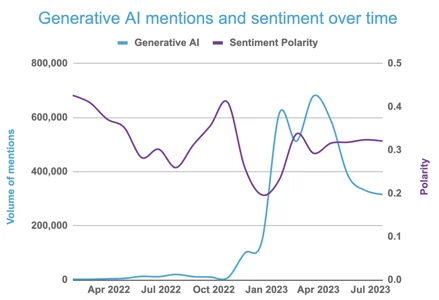
Generative AI was initially met with widespread enthusiasm as the next evolutionary step in artificial intelligence. OpenAI's ChatGPT garnered significant attention quickly upon its release in 2022, as it amassed 100 million monthly active users in just two months post-launch. However, as its capabilities have become more powerful and universal, many ESG controversies have emerged, impacting the public sentiment towards the technology. A notable drop in sentiment polarity was observed from October to December of ‘22, going from 0.4 to 0.22. The decline in polarity was attributed to some critical topics, notably the environmental toll of its energy consumption and the ethical difficulties posed by its potential to disseminate false information.
* Polarity, a proprietary metric developed by SESAMm, ranging from -1 to 1, represents the aggregate of positive and negative sentiment.
Generative AI and its Implications on ESG
In What Industries Is Generative AI Mentioned More Often?
As expected, the IT industry was initially the most mentioned, along with Generative AI. However, as the technology became more widespread, other sectors have garnered more attention among web publications and social media. In particular, the communication and finance sectors are capturing a substantial share of the attention. In particular, data privacy in finance and communications are the main concerns, and fraud for finance is also being widely discussed on the web.
ESG Controversies Fueled by Generative AI
When we looked at ESG controversies and risks in detail, we found that most of the attention and mentions are related to social risks, particularly Human Rights (right to privacy), labor rights, and customer relations (customer privacy). Governance has also gotten its fair share of ESG controversies, primarily focused on anticompetitive practices (copyright infringement). On the environmental side, controversies are concentrated on water consumption (by Gen AI tools) and climate change, specifically energy consumption. However, the number of mentions and controversies has decreased considerably.
Data Breaches: The Focal Point
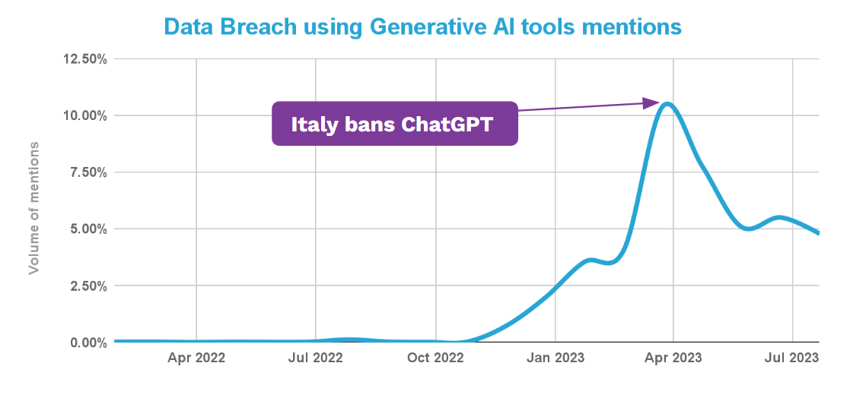
By far, the lion's share of ESG controversies and mentions gravitate towards social risks, specifically data breaches. From Italy banning Chat GPT in April to Samsung’s alleged data leak in August, controversies around data privacy have been among the most concerning topics surrounding Chat GPT ESG risks. In just five months, mentions of data breaches went from virtually 0% to over 10% of total mentions.
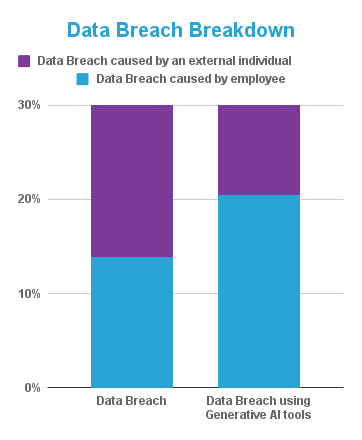
Digging deeper into data breaches at companies, we found that the number of breaches did increase significantly after generative AI tools became available. In particular, we see that the number of internal (employees) vs. external (non-company affiliated) data breaches increased by almost 50% when using generative AI tools from 14% to 21%.
The Silver Lining: ESG Initiatives Generated by Generative AI
Despite all the risks and controversies emerging, generative AI is also an enabler of positive ESG initiatives. Interestingly, on the positive impact side, we see a similar volume of mentions of initiatives on the three ESG dimensions.
Generative AI has shown promise in optimizing energy use, reducing waste, and even modeling and mitigating the impacts of climate change. On the environmental side, we see a rapid increase in mentions related to its applications in efficiency and productivity, asset reliability, operational safety, lower energy consumption, and reduced environmental impact.
The technology also has the potential to revolutionize healthcare by enabling more accurate and early diagnosis, thereby contributing to social well-being. Generative AI could also transform web surfing and make it easier for users to navigate the internet and find or generate information.
Conclusion
As our analysis shows, generative AI is bringing unprecedented capabilities and complex ESG risks and controversies. We expect to see it evolving, with public sentiment shifting and industries grappling with its ESG implications. But we are still in the very early stages of this new trend and will continue monitoring its evolution.
SESAMm’s AI Technology Reveals ESG Insights
Discover unparalleled insights into ESG controversies, risks, and opportunities across industries. Learn more about how SESAMm can help you analyze millions of private and public companies using AI-powered text analysis tools.
Barcelona, QuantMinds International, November 2022
CEO Sylvain Forté joins QuantMinds correspondent Joanna Simpson in an interview highlighting the use of AI in ESG Investing and how we use it to detect greenwashing practices.
Below is an approximation of this video’s audio content. Watch the video for a clearer understanding of the topics discussed during the interview.
Joanna: I'm Joanna Simpson here at QuantMinds International in Barcelona. Joining me now is Sylvain Forté, CEO of SESAMm. Thank you very much for being here.
Sylvain:Thank you.
Joanna: Tell me, how does it feel to be here at QuantMinds International?
Sylvain:It feels very good, actually. We've been to the conference a couple of times already, so it's not our first year, and this time we brought several people from our team. We're all here together, presenting our technology and discussing some of the novelties in the space. It's very exciting and personalized.
Joanna: Great. And what role does artificial intelligence have to play in the future of ESG and ESG investing, in particular?
Sylvain:ESG is a massive trend in the industry right now, not just in asset management and the quant space but also in private equity, in corporate space like tracking suppliers, clients, etc. And one of the key problematic themes that we see is data gaps. There's a lack of data in terms of coverage; small caps, mid caps, or even private firms are not well covered. The frequency of information tends to be lagging. There's a very low frequency, like quarterly updates or so. There's also a lack of transparency and the like.
So, I believe that AI is primarily a tool that can help build that information gap and, for example, cover millions of companies instead of just a few tens of thousands of companies manually. What we do at SESAMm is leverage a technology called natural language processing (NLP), where we screen text automatically to understand potential ESG controversies or positive impact events. This leads us to have a coverage of around 5 million companies, meaning every publicly listed company out there and private firms that no one else would cover otherwise. This enables many use cases.
There's also frequency; you can generate indicators every single day, more like a quantitative time series that people are used to, and this enables clients to get access to information even locally, like Raiffeisen, one of our clients, is tracking clients in Poland, in Austria, in Germany, or in Ukraine using NLP which would not be possible with traditional ESG metrics. I think that the key topic of AI is expanding the use, expanding the coverage in terms of ESG data, and making sure that data is systematic, follows a good process, and is transparent.
Joanna: What examples are there of ESG investing being enhanced by AI?
Sylvain:We see two primary use cases.
The first one is more quantitative, where people are looking to leverage ESG NLP data in their systematic trading process. It's either for alpha generation; for example, we work with LFIS, an asset manager in France that created a fund based on ESG NLP data. Their primary goal is to enhance their strategy to generate outperformance, which is really a good use case in that space. This is the quantitative use case where you can use higher frequency data like daily data to leverage ESG like any other kind of alternative dataset and derive superior returns.
Then we have more discretionary use cases where we see large asset managers or private equity shops which are looking to perform risk management tasks or help their team prioritize the scoring of assets. Say they have a team that does their own proprietary scoring on assets with regards to ESG, but how do I prioritize? I have 3000 assets to follow, I need some kind of alert on that whole universe to make sure that I focus on the assets that could be most controversial today. That's one of the things that we provide; daily alerts using natural language processing where people can say okay, there is a massive shift right now; as an ESG analyst, I'm going to make a decision to look at this asset specifically to help cover it and update the score.
Joanna:Can AI help with greenwashing in ESG investing, and if so, how?
Sylvain:Yes, it's one of the other kinds of problems that you have in ESG is the lack of transparency on the methodology creates some anomalies in some cases. And one of the big anomalies is that there's this averaging effect where a firm that has both positive actions and negative topics is going to be, on average, neutral, which is really problematic.
We had a big example like this in France recently with Orpea, a listed company of nursing homes exposed to a massive scandal with regards to mistreating patients—so more like social washing than greenwashing. And the problem is their scores were pretty high because, at the same time, they had some positive impact. They were implementing new diversity policies and the like, so it was averaging up.
At SESAMm, we leverage NLP to completely differentiate positive and negative topics. So if a firm is doing good stuff that is aligned with SFDR, and they have positive actions, etc., great! That's going to be one score. But if, at the same time, they have very negative topics, there are a lot of risks we're going to still detect that's not going to be averaged. It's going to be very specifically focused on.
Joanna: Sylvain Forté, thank you for your time.
Sylvain: Thank you very much.
To learn more about how SESAMm uses Text Reveal to find ESG data, contact a representative today.
Stay ahead with the latest in ESG and AI intelligence
Join our mailing list to receive new reports, event invites, and updates from SESAMm directly to your inbox.



-converti-depuis-png.webp)

.png)
.png)


.png)