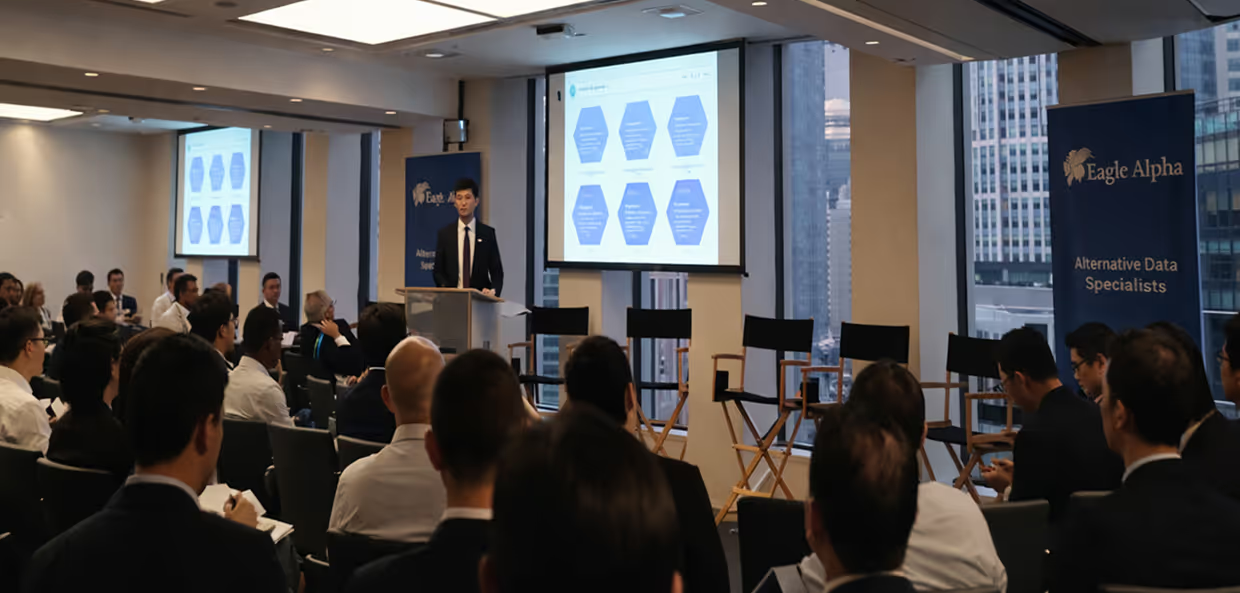
On 5 December in New York, SESAMm was selected to take part in The BIG Alternative Data Showcase Event, one of the major events focused on alternative data applied to the asset management industry. Organised by our partner Eagle Alpha, this very first step in the US market for SESAMm represented a unique opportunity: to bring our expertise and solutions to the biggest asset managers globally.
Since September, SESAMm’s business has been growing steadily. In addition to the ongoing discussions we have with several significant asset managers, two major groups have signed a contract with us: one of the top 5 asset managers in Japan that has more than $100 billion of assets under management; and one of the top 10 asset managers in France with more than $50 billion under management.
In addition to this great news, we recently signed partnerships with two major data providers in the USA, one of them with Eagle Alpha. Shortly after our agreement, from a list of 450 data vendors, Eagle Alpha selected 12 of them to be part of the BIG Alternative Data Showcase Event, SESAMm being the only French company chosen. This event in New York City represents the biggest one globally on alternative data applied to asset management. That was an opportunity for our company to present for the very first time L’Humeur des Marchés and our expertise in the United States.
Sponsored by Deloitte, Lowenstein Sandler, S&P Global Market Intelligence and CRUX, Eagle Alpha’s event showed us how unique and exceptional the US market is in terms of business opportunities for SESAMm. Gathering renown international hedge funds, investment banks but also major companies from other sectors with needs in Artificial Intelligence and Data Analysis, this event proved to be one of the most interesting and exciting we have attended so far.
Following this event, with the multiple contacts and leads for both partnerships and business contracts that have been gathered, our journey home only strengthens our intention to plan future business trips in the United States and our entry on this market.
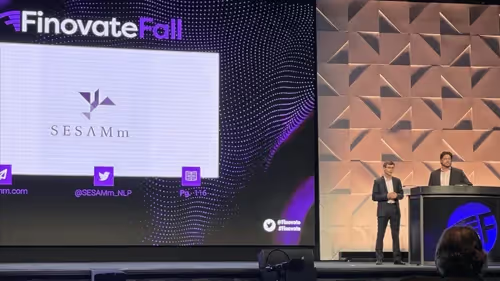
Below is an approximation of this video’s audio content. Watch the video for a better view of graphs, charts, graphics, images, and quotes the presenter might be referring to in context.
Intro to SESAMm
Thank you very much, Greg. Thank you, everyone, for listening to this presentation. I’m Sylvain. I’m CEO and co-founder of SESAMm. SESAMm is an AI company. We extract billions of articles and messages from the web in order to identify critical insights related to financial institutions and corporates. We’re a team of close to a hundred people. And what we aim to show you today is our new product that helps financial institutions and corporates identify ESG controversies in the form of alerts on all of their investments, on all of their clients, and all of their suppliers.
So there are more than 23 million companies in the world right now. These companies are your investments, your suppliers, your clients, and no one is actually tracking them. Most of these companies are never tracked day to day. SESAMm’s solution aims at automatically identifying controversies on these companies and finding the critical information that you’re missing.
See a dashboard example
So let’s take a quick example first. Here we have dashboards where we analyze a company called Wirecard. Wirecard is a fintech company—German—that went bankrupt a few years ago due to a two billion fraud scandal. That company was heavily embedded into the financial sector, working with a lot of banks, a lot of corporates worldwide.
On our dashboards, we can immediately identify all of the key controversies and all of the key risks on the companies. And we have a score called a virality score that helps assess the severity of each ESG event so as to understand whether that company should be excluded from your list of suppliers, for example, or even discussed as a client.
SESAMm solution benefits
There are key benefits to providing this information and to the way that this product is brought to the market. First, SESAMm covers more companies than anyone else. We cover close to five million firms, whereas most ESG providers have coverage limited to 50,000 firms in total. In addition to that, we’re able to detect controversies in real time and generate daily alerts where normally a bank, for example, would have to go through that process manually and update it just a few times a year instead of receiving that live information.
In addition to that, as you can see on the demo here, we have information for more than 14 years of data. So anytime you onboard a new supplier, anytime you check for information—ESG information, on a new client, or on an investment—you’ll automatically be able to go back in history and understand whether that company was exposed to issues in the past.
Trusted by major financial institutions
SESAMm solutions are already adopted by major banks such as Raiffeisen or Nomura, for example, in this industry, major private equity firms such as Carlyle. And what’s interesting in this solution is that we’re seeing specific interests from commercial banks that are missing the solution in order to track ESG risk on their suppliers and their clients. And it makes sense. Most of these suppliers and clients are small firms, local firms that no one else is going to track. And AI is enabling us to automate the process of monitoring these firms and making sense of that data in real time.
SESAMm's solution in action
So now, let’s go to the second part of the demo. We want to take an actual life example. So let’s take a company like Twilio, for example. So you may know Twilio communications, API, messaging services, phone services, and the like. This company is a typical provider of banks or of financial institutions or any other corporates in the world.
So you see on the left, we immediately identify all of the information related to Twilio. And we can rank this based on negative sentiment so as to understand what are the key critical topics that I should care about and that I should evaluate before actually working with Twilio or in the context of already working with Twilio. We go through that process by handling more than 20 billion articles and messages from more than four million sources worldwide. So that’s an insanely large amount of information.
And on Twilio—say Twilio is one of your suppliers or one of your clients—we immediately identify a large controversy related to a data breach and cybersecurity issue, and we identified both in news but also in some of the specialized cybersecurity websites. In addition to that, we can go in even more granularity and look transparently at the content themselves, read the contents from the platform, and not just rely on a numeric rate saying that “Hey! This company is problematic.” We can actually read the underlying content and understand how the controversy emerged.
SESAMm solution benefits
So the key benefits and the real advantages of that solution is getting information immediately. You don’t have to wait for a due diligence for someone to check for someone to send a questionnaire to the company. You just type in the name, get the information in a few seconds wherever the company is, and however local that company is. It could be the most obscure company. And as you can see our system also covers many different languages, including Asian languages that are monitored automatically.
The second part is that we have access to millions of sources, including very industry-specific sources. I was mentioning cyberthreats. We also have access to NGO websites that identify these types of ESG issues in real time.
So this is really the information that is aimed at helping you monitor controversies and ESG events in just one place on any number of companies, public and private, whether they are your suppliers, your clients, or your investments. You can make sense of that data in real time using AI.
Presentation summary
I’ll finish this presentation a bit early, and we’ll actually bring the point to three calls to action. The first one is, first, please come to our booth. We’re actually on the left of the exhibit hall right when you come in. The second one is, please visit our website. It’s spelled SESAMm, sesamm.com, and you can get a free trial from the website. And finally, come talk to our amazing team with Dave and the rest of our team at our booth. And please ask us for a free POC—whether you’re a bank, an asset manager, or a fintech company—and help us help you track all of the ESG controversies on millions of companies.
Raiffeisen Bank International’s (RBI) Advanced Analytics and AI Tribe is crucial to the bank’s operations. The team delivers, maintains, and operates AA&AI (digital) solutions allowing Retail and Whole-Sale Banking to increase revenues (and to fulfill their role as the first line of defense). They are pioneers in using cloud-based infrastructure. With more than 50 data scientists, data engineers, machine learning engineers, and cloud engineers, they play a crucial role in transforming RBI into a data-driven company.
The AA&AI tribe at RBI recognized a significant opportunity in SESAMm, a leading AI-powered analytics, and data solutions provider. SESAMm’s solutions offer access to an extensive range of web-based information, which is otherwise challenging to obtain. This data is critical for RBI’s operations, enabling the bank to stay ahead of the curve regarding market trends, consumer preferences, and industry insights.
Key successes for RBI after working with SESAMm include:
Generated analytics on clients to specifically monitor companies exposed to the Ukraine war, enabling the bank to proactively identify potential risks and minimize its exposure to geopolitical events.
Integrated specific languages within RBI’s core market, including Russian, Romanian, Slovak, Czech, and Polish, improving the bank’s ability to analyze and understand regional data.
Integrated SESAMm’s data with RBI’s internal visualization dashboard, allowing the bank to leverage the insights generated by SESAMm’s AI-powered analytics to improve decision-making and drive business growth.
Why RBI chose SESAMm: Coverage, early warning signals, and customizability
Raiffeisen Bank International decided to partner with SESAMm due to several key factors:
SESAMm’s excellent coverage, including that of the CEE market, is a crucial need for RBI. This coverage enables RBI to obtain critical data and insights that help inform the bank’s decision-making process.
SESAMm’s product, TextReveal API, provides data and the underlying natural language processing (NLP) capabilities, enabling RBI to analyze data at a deeper level. This capability is significant for the bank’s operations in the CEE region, where multiple languages are spoken.
The relationship built between SESAMm and the RBI team during the proofs-of-concept (PoCs) brought confidence in the quality of SESAMm’s products and the potential value they could bring to the bank.
Overall, the combination of SESAMm’s excellent coverage of the CEE market, NLP capabilities, and positive relationship with the RBI team made them the ideal partner for the bank’s data and analytics needs.
The Collaboration
After SESAMm and Raiffeisen Bank International agreed to collaborate, SESAMm began working with David Eschwé, the Head of Group Advanced Analytics at RBI. SESAMm onboarded the RBI team on TextReveal API and opened dashboards and API access to RBI. This access allowed RBI to generate historical datasets. SESAMm worked with the RBI team to define the roadmap and key milestones, particularly for integrating Central and Eastern European languages. This enabled RBI to access critical information efficiently that could help their internal teams generate early warning signals to better mitigate potential risks that can harm the bank. By working closely together, SESAMm and RBI achieved key milestones, demonstrating the value of the collaboration to both parties.
The results
By leveraging SESAMm’s solutions, RBI was able to monitor more than 1,000 clients, generating analytics on companies exposed to the Ukraine war and creating early warning signals to mitigate better potential risks that could harm the bank. Additionally, SESAMm’s solutions provide substantial yearly savings in raw-data-related costs, allowing RBI to allocate resources more efficiently and effectively. Through this collaboration, SESAMm helped RBI achieve more significant insights into their data, improve their risk management processes, and achieve considerable cost savings.
"Our partnership has been a great success. Thanks to SESAMm, we can now answer business-relevant questions within days, including those related to the critical topic of ESG” —David Eschwé, Head of Group Advanced Analytics in RBI.
About Raiffeisen Bank International
Raiffeisen Bank International AG (RBI) is a leading Austrian banking group that operates across Central and Eastern Europe. It is headquartered in Vienna, Austria. RBI offers a wide range of banking and financial services, including corporate and investment banking, retail banking, leasing, and asset management. With a focus on sustainability and social responsibility, RBI is committed to providing high-quality banking services while supporting the communities in which it operates.
Reach out to SESAMm
Whether you’re a financial institution, an asset manager, or a data-driven company looking to gain insights into your data, SESAMm’s technology and team of experts can help you achieve your goals.
SESAMm has been spotlighted in Elaia's 2023 Sustainability Report as a key innovator driving positive change through AI technologies. This inclusion underscores SESAMm's role in advancing ESG principles within its operations and the financial industry.
Elaia, a prominent venture capital firm, has recognized SESAMm for its advanced AI-driven solutions which significantly enhance ESG data analysis, providing useful insights that empower investors to make more informed, responsible decisions. The report highlights how SESAMm’s cutting-edge technologies help firms navigate the complex landscape of ESG investing, turning over 25 billion articles and social forums in more than 100 languages into actionable intelligence using AI.
SESAMm's commitment goes beyond mere compliance; it is about leadership and responsibility in shaping the future of sustainable investing. By leveraging natural language processing and machine learning, SESAMm enables its clients to swiftly identify and act on ESG risks and opportunities, thereby contributing to more sustainable global markets.
This accolade from Elaia celebrates SESAMm’s achievements and sets a benchmark for sustainability in tech. It encourages continuous innovation and ethical practices that lead to a better, more sustainable future.
To learn more about SESAMm’s role in advancing sustainable finance, we invite you to download the full report.
Reach out to SESAMm
TextReveal’s web data analysis of over five million public and private companies is essential for keeping tabs on ESG investment risks. To learn more about how you can analyze web data or to request a demo, reach out to one of our representatives.
Stay ahead with the latest in ESG and AI intelligence
Join our mailing list to receive new reports, event invites, and updates from SESAMm directly to your inbox.






.png)