


By Sylvain Forté (SESAMm) and Mariya Peykova (Scientific Climate Ratings)
Picture two infrastructure assets.
The first carries obvious physical exposure, sitting right where the climate is changing fastest. The second is operationally robust and is considered sustainable, but it generates a steady stream of fines, local opposition, and headlines.
Which one is riskier to investors?
The answer depends on which question you're asking.
Viewed through a climate model lens, the first asset appears more exposed. Viewed through real-time controversy monitoring, the second demands more immediate attention. Neither assessment is wrong. Each captures a different dimension of risk.
That's why leading infrastructure investors increasingly rely on multiple perspectives rather than a single measurement. Climate risk doesn't reduce to a single definitive answer. It unfolds across different time horizons, different datasets, and different types of evidence. Looking through multiple lenses provides a richer understanding of an asset's resilience and the risks that may shape its performance throughout the investment lifecycle.
Four complementary lenses help build that picture: physical, transition, controversy, and regulatory.
The first two, physical and transition, are forward-looking. They use models and scenarios to estimate how climate change and the low-carbon transition may affect an asset over years and decades. The other two, controversy and regulatory, are grounded in today's reality, tracking emerging events, stakeholder concerns, enforcement actions, and changing policy as they happen.
Together, these lenses provide a more complete understanding of risk. Physical and transition analysis explain where an asset is heading over the mid and long term. Controversy and regulatory monitoring reveal what is happening today and how quickly new issues are emerging. Rather than competing, they complement one another.
We explored exactly this approach during a recent live session co-led by Sylvain Forté, CEO of SESAMm, and Mariya Peykova, Sales Director at Scientific Climate Ratings, where they put a real infrastructure asset, a coal-fired power plant operated by LEAG, through each of the four lenses. The session demonstrated how decision makers can integrate Scientific Climate Ratings’ and SESAMm’s products to capture climate risk from all angles. Below, we’ve recapped key takeaways from that analysis.
The Long View: Physical and Transition
Start with the lenses that look across the life of the asset: physical and transition. Both are the domain of Scientific Climate Ratings, which translates climate science into financial metrics that investors can act on. Its Climate Exposure Rating runs on a standardized A to G scale (A is climate-resilient, G is structurally vulnerable), combines physical and transition components, and is forward-looking offering various time horizons from 2035 to the end of an asset's operational life. Each grade is benchmarked against a stable universe of more than 6,000 private infrastructure assets across 25 countries, and the methodology is deliberately transparent, with no black boxes.
The physical lens asks what a changing climate does to the asset itself. For the Schwarze Pumpe plant, the answer is reassuring. Its headline physical exposure rating is A, the most resilient grade, with asset-equivalent damage of just 0.09%. What little exposure there comes mainly from manageable flood risk, with heat stress limited.
However, the model flags one hazard that needs monitoring: drought. It rates F, with water demand projected to be four times the available supply and drought conditions covering three months of the year, for an asset that, like much heavy industry, depends on water. That signal does not yet include a financial damage figure because a peer-reviewed drought damage function is still being developed, but it is a real exposure that the model is flagging for the future.
The transition lens asks a different question: how does the asset perform as the economy decarbonizes? Here, the same plant tells a starkly different story. Under a net-zero pathway toward 2035, it rates G, the worst grade on the scale. The pressure intensifies sharply from around 2030, driven by Germany's legislated coal phase-out under the KVBG, with projected revenue approaching near-total devaluation. Both sub-components sit at the bottom of the scale: direct carbon costs, as carbon prices climb toward roughly $700 a tonne under net zero, up from today's levels near $76, and market demand, which collapses to the point of total demand destruction. On this trajectory, the asset is, in effect, stranded.
To be fair to LEAG, this is not a company simply waiting to shut down. Backed by the federal government, it is already planning an 850-megawatt hydrogen-ready gas plant at the same site to replace half of the retiring coal capacity. That is a genuine transition story, and exactly the kind of forward plan the modeled lenses are built to weigh.
These grades are not abstract scores. They translate physical and transition exposure into comparable financial metrics, such as annualized expected damage and revenue at risk, projected forward to 2050 and beyond, so one asset can be weighed against thousands of others on the same terms.
Taken together, these long-term perspectives paint a nuanced picture. The Schwarze Pumpe plant is physically resilient today, yet its economic model faces a steep, policy-driven decline within the decade.
What they don't capture is what may already be unfolding around the asset right now.
Scientific Climate Ratings already offers Climate Risk Ratings (CRR), the next step beyond the Climate Exposure Rating (CER) featured here. Where the CER quantifies climate exposure and potential average annualized damage, the CRR translates it directly into impact on key financial metrics: revenues, cash flows, probability of default, and enterprise value. The step from 'how exposed is this asset?' to 'what does this cost?' in the financial language that investment committees can act on.
The Signal View: Controversy and Regulatory
Now switch to the lenses that focus on the present: controversy and regulatory.
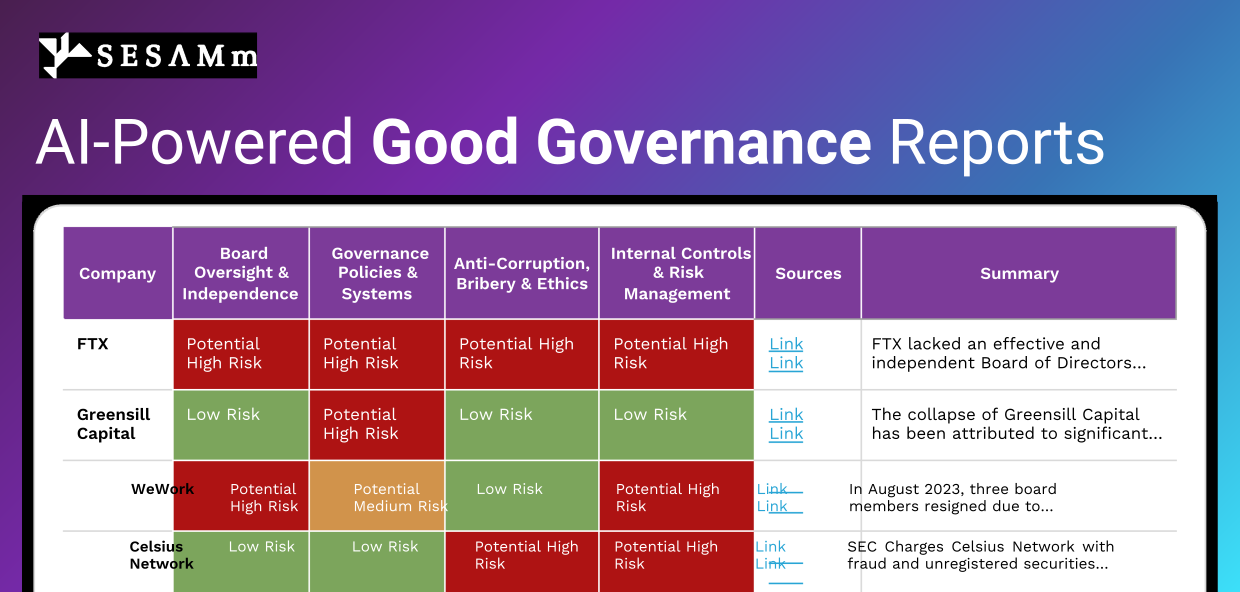
Both are the domain of SESAMm, which uses AI to detect ESG controversies on private assets, often before they surface in traditional ratings. Drawing on one of the industry's largest data lakes, it reads more than 35 billion documents (news, regulatory filings, local press, NGO, and court reports) and distills them into a Controversy Exposure Score on a 0 to 100 scale. Individual events are aggregated into cases, each with a timeline, its sources, and a severity rating that reflects how material the issue is: financially, legally, and by the number of stakeholders affected.
The controversy lens, then, monitors how the outside world is responding to an asset in real time, surfacing meaningful developments as they emerge.
For LEAG, that real-time read is substantial. The operator carries a high Controversy Exposure Score spanning environmental, social, and legal topics. There is proven legal action against one of its mining operations, flagged at the highest severity as a potential UN Global Compact violation, alongside criminal complaints over environmental breaches and a record of legal, regulatory, and community pressure built up over the years. A notable cluster of those signals concerns water, both consumption and pollution, including challenges and complaints over groundwater pumping and water permits.
That last point is telling. Recall the drought exposure the physical model flagged but could not yet price. Here it is, already materializing as legal and community pressure on the ground, picked up in real time. None of this appears in a physical climate model or a transition scenario, yet each development can influence permitting timelines, financing conditions, operational flexibility, or reputation.
This is where real-time signals become especially valuable. Controversies often emerge long before they are reflected in annual ratings or financial models. Public opposition, regulatory investigations, and stakeholder disputes can develop over months or even years before they result in fines, project delays, or impairments.
Alongside controversy monitoring sits the regulatory lens, which captures how policy is evolving and being enforced on the ground. For infrastructure investors, this may include relicensing requirements, water rights, environmental compliance, or expanded disclosure obligations such as the CSRD. In many ways, the regulatory perspective bridges long-term transition trends with today's operational reality.
These lenses answer a different set of questions from climate models. Rather than forecasting where the asset is heading decades from now, they reveal what requires attention today.
Four Lenses, One Richer Understanding
The Schwarze Pumpe plant is, at the same time, physically resilient, economically stranded on a net-zero path, and under active legal, regulatory, and community pressure today.
Each lens highlights a different aspect of the same asset, operating across different timescales and using different types of information. Physical and transition analysis explain long-term structural resilience and exposure. Controversy and regulatory monitoring reveal how emerging issues are unfolding in real time.
It's tempting to combine these perspectives into a single score, but doing so risks losing the context that makes each valuable. The four lenses aren't multiple measurements of the same phenomenon. They're answers to different questions.
Viewed together, however, they become considerably more powerful. The drought finding captures it: a hazard the physical model can flag but not yet price, becomes far easier to weigh once real-time monitoring shows the water-related legal and community pressure already building around the asset. Long-term climate modeling helps investors understand whether a controversy reflects a temporary challenge or an early signal of structural risk. Conversely, real-time controversy and regulatory monitoring provide context for long-term scenarios by indicating whether projected risks are already beginning to materialize.
No single lens tells the whole story.
Together, they provide a far clearer picture of infrastructure risk.
[SESAMm and Scientific Climate Ratings operate as independent platforms. This analysis reflects a collaborative session designed to illustrate how complementary approaches to climate risk can be combined to provide a holistic risk assessment across both short-term and signals and long-term risks.]


.avif)


.png)