
The ESG Scorecard: A Deep Dive into The Biotech Industry
January 8, 2026
•
5 mins read
The biotech industry faces significant ESG risks, particularly in governance. Social and operational risks are less common but still material.
Across the sector, companies like Cassava Sciences, BrainStorm Cell Therapeutics, and Anavex Life Sciences frequently face governance controversies, including shareholder and class action litigation, security fraud, SEC investigations, and more. While social risks are generally secondary, they are notable in areas such as workforce reductions, layoffs following acquisitions, and labor disputes, with patient-safety considerations emerging in therapies with adverse effects.
What are the most pressing ESG challenges currently facing the biotech sector? Read on to find out.
Cassava Sciences: Governance and Transparency Concerns
Cassava Sciences has a high Controversy Exposure Score, the result of its involvement in several severe ESG controversies. The company has faced class action and shareholder litigation, resulting in settlements of $31M and $40M over allegedly misleading statements related to its Alzheimer’s drug, Simufilam. Governance concerns are further amplified by allegations of manipulating trial data and scientific misconduct, which have attracted both SEC investigations and reports of criminal probes. Additional legal controversies include malicious prosecution and defamation lawsuits filed in response to alleged “short and distort” campaigns. On the social side, Cassava has faced a 33% reduction in its workforce, reflecting operational restructuring.
Anavex Life Sciences: Lawsuits and Regulatory Scrutiny
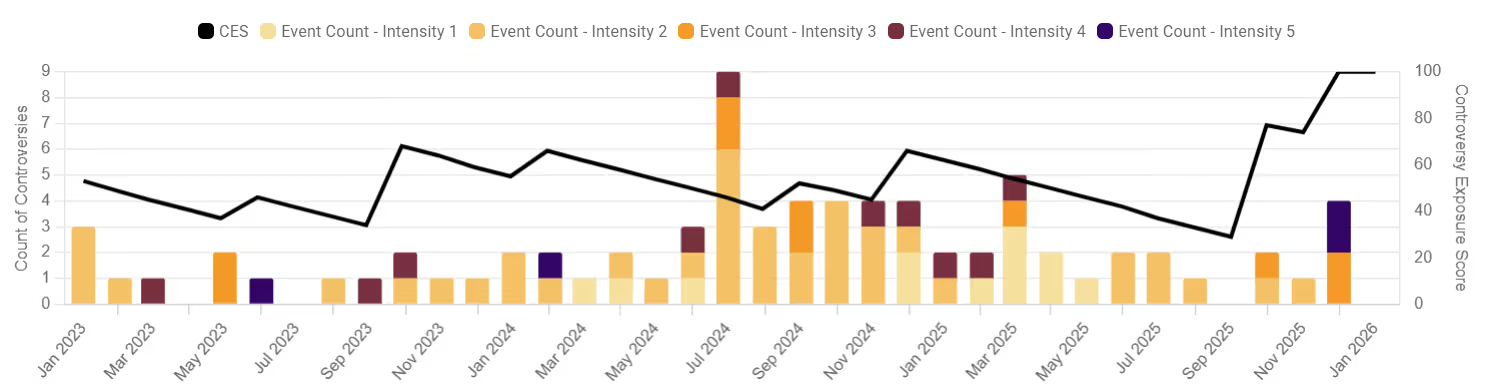
Anavex Life Sciences faces notable governance risks, primarily stemming from shareholder litigation and concerns regarding the integrity of its clinical trials. Multiple class action lawsuits allege misrepresentation and deceptive practices, particularly in reporting outcomes for Rett syndrome and Alzheimer’s disease trials. Governance concerns are compounded by data inconsistencies, changes in trial evaluation criteria, and regulatory scrutiny, including the EU’s rejection of its Alzheimer’s drug.
BrainStorm Cell Therapeutics: Fraud and Credibility Allegations
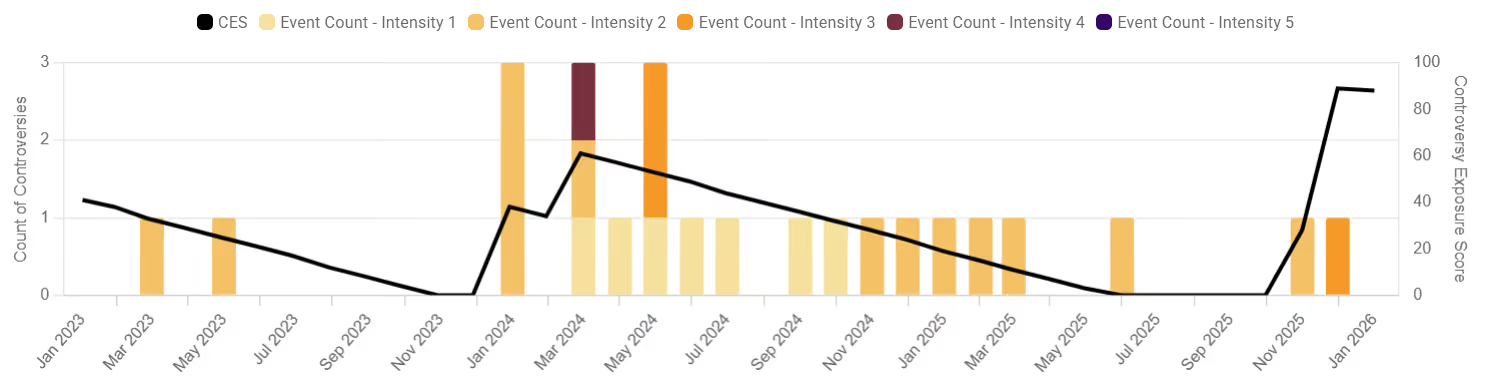
BrainStorm Cell Therapeutics exhibits a concentrated governance risk profile, with issues spanning several aspects. Class action lawsuits and securities fraud claims allege investor harm from misstatements, while the company faces lawsuits for overstating FDA feedback and misrepresenting the efficacy of its ALS therapy, NurOwn. These allegations are reinforced by FDA panel and reviewer concerns, raising questions about its scientific credibility. BrainStorm is also facing delisting from Nasdaq and a breach of contract lawsuit. On the social front, the company’s ESG exposure stems from plant shutdowns, workforce restructuring, and job cuts, raising labor practice concerns.
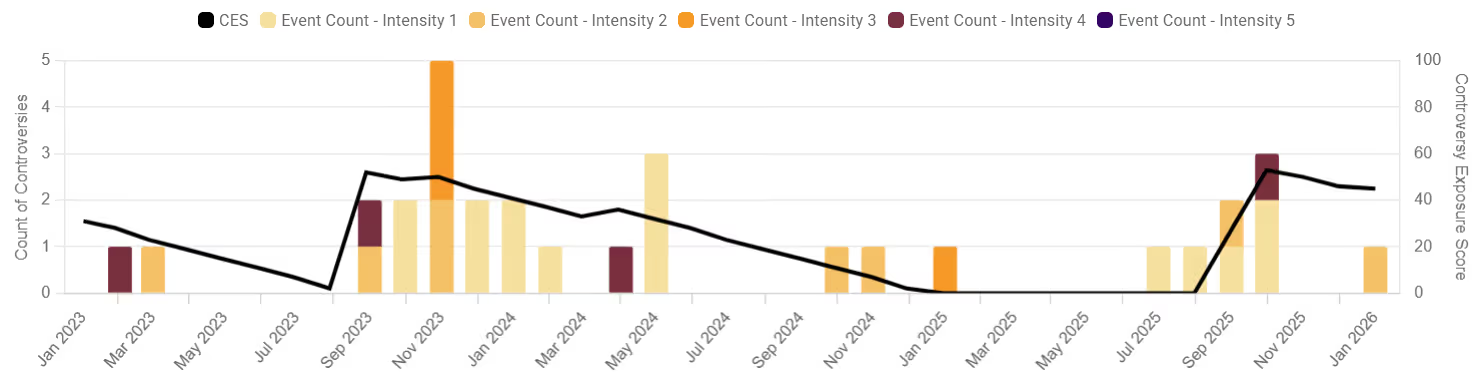
The biotech industry’s ESG profile is increasingly shaped by governance-related controversies, particularly around transparency, litigation, and regulatory scrutiny. Companies like Cassava Sciences exemplify how unresolved allegations, ranging from trial data manipulation to securities fraud, can significantly shake stakeholder trust and financial stability. While social and operational risks appear less frequently, workforce reductions, safety concerns, and labor disputes highlight broader vulnerabilities tied to the sector’s rapid pace and scientific complexity. As the industry continues to innovate, managing these ESG risks will be crucial not only for compliance but also for long-term credibility and sustainable growth.
Reach out to SESAMm
TextReveal’s web data analysis of over five million public and private companies is essential for keeping tabs on ESG investment risks. To learn more about how you can analyze web data or to request a demo, reach out to one of our representatives.

Controversial business involvement screening is moving beyond its origins as a compliance exercise.
Under frameworks like SFDR and the EU Taxonomy, investors must prove that their portfolios not only promote sustainability but also exclude activities fundamentally at odds with environmental, social, or ethical principles. This marks a shift from static disclosure toward dynamic accountability, and it has broadened both the scope and ambition of ESG screening.
Historically, exclusions focused on a narrow range of activities - weapons, tobacco, or fossil fuels - and primarily applied to public equities. Today, that universe has expanded dramatically. Private markets, secondaries portfolios, and private credit exposures are now expected to undergo the same scrutiny as listed assets. This reflects not only regulatory alignment but also diversifying investor expectations, as institutions incorporate reputational, cultural, and mission-based constraints into their investment frameworks.
Modern exclusion policies increasingly include areas not yet covered by regulation but relevant to ethics, faith, or social impact. Examples range from pork-related activities in Sharia-compliant portfolios to emerging debates over cryptocurrency mining and trading, and even biotechnology topics such as human cloning or genetic manipulation that raise profound ethical questions. These additions illustrate how business involvement screening is evolving from a rule-based checklist into a reflection of each investor’s worldview and stakeholder commitments.
This evolution, however, brings complexity. Private assets and novel sectors often lack standardized data or public disclosures. ESG, compliance, and deal teams must process incomplete information, document decisions, and adapt quickly to new mandates - all without expanding headcount. The result is a growing need for automation that can adapt to human nuance.
SESAMm’s AI-powered business involvement screening meets that need. By allowing investors to screen based on their own exclusion categories and thresholds, it translates varied mandates - from regulatory to reputational - into a single, automated process.
Automating Controversial Business Involvement Screening in Public and Private Assets
SESAMm’s platform uses a new AI agent approach that scans and analyzes vast amounts of information. Below, we provide an overview of SESAMm’s business involvement screening capabilities and how they address investors’ needs for automation, thresholding, and flexible outputs.
Comprehensive Coverage through Big Data
SESAMm utilizes its AI engine to monitor over 30 billion articles and 10 million new documents daily from various sources, including news sites and NGOs. This extensive data collection spans multiple languages and local outlets, enabling it to detect obscure references to companies and raise alerts for issues such as misconduct. SESAMm's coverage encompasses millions of public and private companies, enabling users to conduct thorough screenings of any entity, including private companies and subsidiaries.
Customizable Exclusion Frameworks
SESAMm’s business involvement screening gives investors control over what to screen and how to classify it. Users can request customization of exclusion categories to mirror their own policy, whether based on regulation (e.g., SFDR, EU Taxonomy) or internal mandates (e.g., faith-based or reputational constraints). In addition to standard ESG categories like fossil fuels or weapons, investors can add custom topics. This flexibility allows ESG, compliance, and secondaries teams to tailor the tool to their precise needs,.
Threshold-Based Classification
SESAMm’s business involvement screening module is built around the concept of threshold-based flags. The AI utilizes structured data and unstructured signals to determine involvement levels. The output for each company is a clear classification: No Involvement, Limited Involvement, or Significant Involvement for each category. These classifications correspond to thresholds – limited might mean some involvement but below the exclusion threshold, significant means above the threshold or its a core business. By encoding the thresholds in the system, SESAMm ensures consistency with the investor’s policy. This is crucial for automation: rather than an analyst manually checking revenue percentages and news, the system does it automatically and provides clear justification.
Rapid Portfolio Screening Process
The system is designed for fast, self-contained screening. A user simply uploads a list or portfolio, and within hours receives a complete file summarizing involvement across all exclusion categories. The output includes company-level classifications, summaries of supporting evidence, and references to sources. This enables investors to integrate the results directly into due diligence workflows, risk committees, or regulatory reporting, with no ongoing manual data maintenance required.
Cost and Resource Efficiency
Automating this process saves substantial analyst time, particularly for rating agencies and secondaries investors managing high volumes of entities. Rating agencies can use the pre-classified results as a baseline input for their own ESG or credit assessments, reducing the manual data-gathering burden. LPs and GPs can run large private company universes in-house without additional research teams. In secondaries, where a full portfolio review can take days of analyst effort, SESAMm’s workflow compresses that timeline to just a few hours, enabling ESG validation to fit seamlessly into transaction schedules.
Auditability and Verification
Each classification is fully transparent. Analysts can drill down into the evidence behind a flag, including links to original articles, filings, or corporate statements, and verify the AI’s reasoning. Automatic translation ensures accessibility across languages. This transparency builds trust in the results and provides auditable documentation for LP reporting or regulator reviews.
As ESG investing matures, the leaders will be those who can implement exclusions transparently, efficiently, and in alignment with evolving norms. The next frontier is no longer just regulatory compliance - it is the ability to anticipate what clients and society will expect tomorrow, and to operationalize those expectations across all asset classes. SESAMm’s technology makes that possible: a platform that keeps pace with both policy evolution and moral expectations, bringing consistency and clarity to an increasingly complex ESG landscape.
With all the buzz around Generative AI, it’s easy to forget that artificial intelligence (AI) has been driving innovation across industries for years. Environmental, Social, and Governance (ESG) and risk management are no different. However, at the rate AI is advancing and as the amount of raw data available for analysis continues to expand, the need to understand AI is more pressing than ever.
AI is transforming ESG, turning complex data into predictive insights and reshaping our approach to risk. But what does this mean for the industry, and how can professionals leverage this technology to maintain a competitive edge? The future of AI in ESG and risk management is not just a matter of technological advancement but a narrative of how we evolve with it.
This ebook dives into how AI works when applied to ESG, shares a few practical examples of what it looks like in real life, and offers a few predictions for what comes next.
Dive deeper into the mechanics of how AI works in ESG and equip your organization with the insights needed to enhance your ESG practices. Fill out the form below to access your copy.
The modern world is in a peculiar place right now. We’ve got the technology and resources to improve our planet, but we often don’t know how to use them despite our best intentions. Or, at the very least, we don’t know where to put our efforts. Consequently, some investors are looking into Sustainable Development Goals (SDGs). Not only do they want their investments to earn more, but they also want them to do good. If you’re also interested in doing good with your investments, it’s essential to understand the SDGs and their meaning for your portfolio. In this article, we’ll break down the SDG basics, SDG scores, their relevance to investing, and how SESAMm can help you get and read SDG metrics. But first, a quick review of SDGs.
What SDG means
SDGs, or Sustainable Development Goals, are a set of 17 goals that the United Nations set in 2015 to be achieved by the year 2030, a framework that “provides a shared blueprint for peace and prosperity for people and the planet, now and into the future.” The global goals and the 2030 Agenda for Sustainable Development cover issues such as human rights, poverty, health, education, gender equality, and environmental sustainability, and they were designed to be universal across countries and continents worldwide. Here are the 17 UN Sustainable Development Goals:
SDG 1: No Poverty: Striving to end poverty in all its forms everywhere. This goal underscores the importance of equitable resource distribution and access to basic needs.
SDG 2: Zero Hunger: Aiming to end hunger, achieve food security, improve nutrition, and promote sustainable agriculture, thereby ensuring that everyone, everywhere, has enough quality food to lead a healthy life.
SDG 3: Good Health and Well-being: It emphasizes the need for universal healthcare access, including reproductive, maternal, and child healthcare, and combats health threats by supporting research and development of vaccines and medicines.
SDG 4: Quality Education: Envisioning inclusive and equitable quality education and lifelong learning opportunities for all, this goal recognizes education as the foundation of empowerment and prosperity.
SDG 5: Gender Equality: Achieving gender equality and empowering all women and girls to participate fully in societal, economic, and political spheres
SDG 6: Clean Water and Sanitation: This goal aims to ensure the availability and sustainable management of water and sanitation for all, recognizing the essential role of water resources in sustaining life and ecosystems.
SDG 7: Affordable and Clean Energy: Promoting access to affordable, reliable, sustainable, and modern energy for all; this goal underscores the critical nature of energy in achieving other SDGs and the transition towards renewable energy sources to combat climate change.
SDG 8: Decent Work and Economic Growth: It focuses on promoting sustained, inclusive economic growth, full and productive employment, and decent work for all, highlighting the role of the private sector in initiating impactful initiatives.
SDG 9: Industry, Innovation, and Infrastructure: Aiming to build resilient infrastructure, promote inclusive and sustainable industrialization, and foster innovation, this goal recognizes the importance of a robust infrastructure and an innovative ecosystem as drivers of economic growth and development.
SDG 10: Reduced Inequalities: This goal seeks to reduce inequality within and among countries, focusing on policies designed to achieve greater equity and involve stakeholders from all sectors of society in decision-making processes.
SDG 11: Sustainable Cities and Communities: It aims to make cities and human settlements inclusive, safe, resilient, and sustainable, emphasizing the need for green public spaces, improved urban planning, and sustainable construction practices.
SDG 12: Responsible Consumption and Production: Focusing on promoting resource and energy efficiency, sustainable infrastructure, and providing access to a better quality of life for all, this goal underscores the importance of adopting sustainable practices and reducing waste.
SDG 13: Climate Action: Taking urgent action to combat climate change and its impacts, this goal underscores the necessity for countries, stakeholders, and the private sector to collaborate in reducing emissions and enhancing renewable energy usage.
SDG 14: Life Below Water: Aimed at conserving and sustainably using the oceans, seas, and marine resources for sustainable development, this goal addresses the critical importance of our aquatic ecosystems.
SDG 15: Life on Land: Protecting, restoring, and promoting sustainable use of terrestrial ecosystems, sustainably managing forests, combating desertification, halting and reversing land degradation, and halting biodiversity loss.
SDG 16: Peace, Justice, and Strong Institutions: Promoting peaceful and inclusive societies for sustainable development, providing access to justice for all, and building effective, accountable, and inclusive institutions at all levels.
SDG 17: Partnerships for the Goals: This goal recognizes the importance of revitalizing the global partnership for sustainable development and the role of strong partnerships in achieving the SDGs, involving governments, the private sector, civil society, and others.
The UN’s 17 Sustainable Development Goals. Image courtesy of UN.org.
What are SDG scores?
Each Sustainable Development Goal has specific targets or indicators that help measure progress toward achieving those targets over time. SDG scores are numerical values given to each entity (country, company, person, etc.) based on their performance in meeting specific targets or indicators for each particular goal. Incorporating these evaluations into the decision-making process is crucial for stakeholders across various sectors, including the private sector, healthcare, financial services, and more. These stakeholders can leverage insights from SDG scores to prioritize initiatives that address critical issues like climate change, emissions reduction, and ecosystem preservation.
How do SDGs relate to ESG?
The environmental, social, and governance (ESG) framework is a tool to achieve and comply with the SDG goals. From a company’s perspective, ESG and SDG frameworks emphasize the importance of measuring and reporting progress. Companies incorporating ESG criteria into their operations often report on their sustainability performance, which can directly show their contribution towards achieving specific SDGs. For investors, ESG metrics provide a tangible way to evaluate companies' potential risks and opportunities related to sustainability, which can also align with the broader objectives of the SDGs.
The SDGs primarily focus on global challenges such as poverty, inequality, climate change, and environmental degradation, which represent the environmental and social pillars of ESG.
Within the same principles, several of these goals directly relate to the governance pillar of ESG. On the one hand, goal 16 aims to reduce corruption and bribery, develop effective and transparent institutions, and ensure inclusive and representative decision-making. On the other hand, goal 17 strives to enhance international cooperation, encourage effective public, public-private, and civil society partnerships, and ensure that policies are coherent and integrated, all of which are governance-related issues.
While the SDGs might not explicitly label these aspects as 'governance' in the way the ESG framework and regulatory landscapes do, the inclusion of these goals demonstrates a clear recognition of the importance of governance in achieving sustainable development. SDGs and ESG also have different purposes. ESG measures companies’ environmental, social, and governance performance risks and initiatives, while SDGs evaluate any entity’s performance in reaching its goals. Put another way, SDGs represent the goals, while ESG concerns methodology and processes.
At the company level, SDGs help align corporate strategy with society’s needs. Because the UN designed SDGs to be measurable, countries, companies, and people can hold themselves accountable for progress toward achieving them. And because the goals are measurable, we can score a company’s efforts, giving you an indicator to invest responsibly by aligning your portfolios with SDGs.
According to a publication by McKinsey & Company, sustainable investing appears to have a positive effect, if any, on returns. In other words, investors care about SDGs not only because they benefit society but also because they measurably support better investment decisions. For example, by incorporating SDGs into company assessments, investors can identify well-run businesses that are better positioned to benefit from the positive effects of improved social and economic conditions. SDGs also allow investors to make better-informed decisions within a defined investment time horizon by focusing on a company’s business exposure toward them. Investors can thus better measure and track a company’s opportunity exposure as a result of its achievement of the SDGs.
How to measure an entity’s SDG score
There are tools available to measure progress toward each goal—and those tools will play an essential role in helping investors decide which entities they want to invest in and which ones they don’t want to support. For example, SESAMm’s platform, TextReveal®, can analyze web data to generate SDG scores for virtually any entity in our data lake.
How SESAMm provides SDG scores
SESAMm provides SDG scores through its platform, TextReveal, a platform that allows investors to gain insights into companies, people, or topics. Specifically, we use artificial intelligence (AI) to track entities’ contributions toward SDGs, including public and private companies.
We track the 17 Sustainable Development Goals and the 169 underlying targets to detect negative news and positive events, using a similar algorithm we use for ESG alerts and gathering alternative data. Each UN SDG item displays a score from 0 to 5 to show the intensity of the company’s positive impact. Then, we translate the information into multiple languages.
This dashboard view example shows some SDG scores for Aker Carbon Capture.
We queried the Norwegian carbon capture company, Aker Carbon Capture, using our SDG positive impact dashboard over the past three years. As you might notice, Aker contributes to the goals associated with Partnerships, Climate Action, Clean Energy, and Sustainability. Maybe they could do more regarding Decent Work and Economic Growth, and Responsible Consumption and Production, but overall, the company’s online data shows a positive contribution.
See how SESAMm can help you with your SDG research
SESAMm is the leading provider of AI solutions and analytics for investment firms and corporations.
Analyzes text in billions of web-based articles and messages
Generates investment insights, ESG and SDG analysis used in systematic trading, fundamental research, risk management, and sustainability analysis
Enables a more quantitative approach to leveraging the value of web data that’s less prone to human bias
Addresses a growing need in public and private investment sectors for robust, timely, and granular sentiment and SDG data
SESAMm’s AI Technology Reveals ESG Insights
Discover unparalleled insights into ESG controversies, risks, and opportunities across industries. Learn more about how SESAMm can help you analyze millions of private and public companies using AI-powered text analysis tools.
Stay ahead with the latest in ESG and AI intelligence
Join our mailing list to receive new reports, event invites, and updates from SESAMm directly to your inbox.