Top 5 ESG Controversies: Diving Deep into the Top 5 Social Controversies of the Year
December 6, 2023
•
5 mins read
As we reflect on the year 2023, it's important to highlight the most significant ESG controversies that made headlines. Our last article in this series focused on the environmental aspect. This time, we turn our attention to the social pillar of ESG, focusing on issues such as strikes, layoffs, human rights violations, and discrimination against minority groups. We emphasize the need for accountability and action to address these pressing social issues and promote social responsibility.
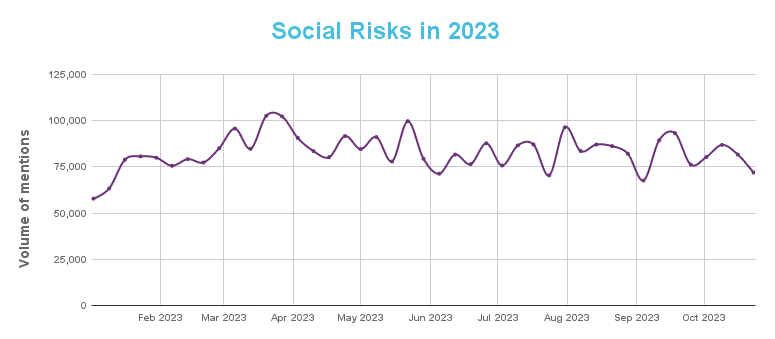
Social Risks: Focus 2023
In 2023, social risks were the most significant, with layoffs and strikes gaining significant attention. It's crucial to acknowledge these social risks and take accountability and action to address them, as they underscore the urgent issues facing society.
Figure 1: Social risks in 2023.
Social Controversies of 2023
Social risks have taken the forefront in 2023, with notable web mentions increasing significantly. Here are the most relevant controversial topics:
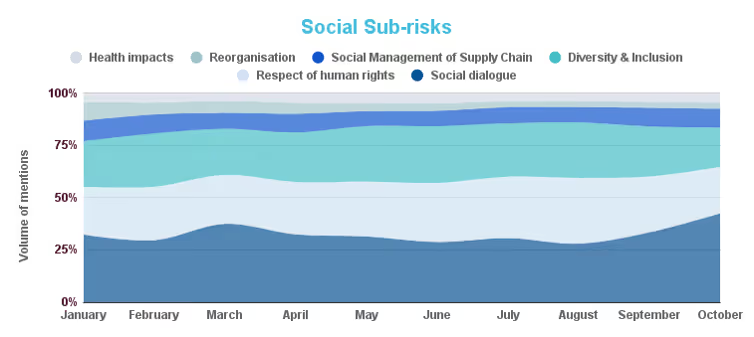
Social Dialogue
Social discourse intensified at the start of the year, with news of widespread strikes in various sectors, including aviation and education, primarily driven by pay disputes. The wave of layoffs in several tech companies was the talk of the town, especially during the first quarter of the year.
Discrimination against minority groups, including the LGBTQ community and people of color, and age-based discrimination became a significant topic of discussion in 2023.
Figure 2: Top social sub-risks in 2023.
Top 5 Social Controversies
These controversies are ranked by relative volume*.
McDonald's
Volume of mentions: 8,903
Relative volume: 87%
McDonald's faced substantial social risks in 2023 due to significant layoffs of its corporate staff in April. The move led to public concern and discussions around the company's employment practices and stability. (source)
Google
Volume of mentions: 13,504
Relative volume: 43%
Google found itself in the spotlight as it faced challenges related to major layoffs in January and October of 2023. These layoffs contributed to almost half of the social risk mentions associated with the tech giant. (source)
Meta
Volume of mentions: 10,965
Relative volume: 38%
Meta, formerly known as Facebook, also faced scrutiny as 38% of the company's social risk mentions revolved around layoffs that took place in March and October 2023. (source)
Microsoft
Volume of mentions: 6,060
Relative volume: 28%
Microsoft faced challenges due to disruptions caused by cyberattacks in early June. In addition, the company had to navigate through controversies related to layoffs, contributing to its social risks. (source)
X (formerly Twitter)
Volume of mentions: 7,246
Relative volume: 8%
X/Twitter experienced a global outage, which was followed by significant layoffs. These events led to considerable public discussions and social risks for the company. (source)
Conclusion
In summary, environmental risks remain a major concern for ESG, but the social pillar of ESG has become increasingly critical, especially in 2023. As we move forward, it's important for companies to acknowledge and address social risks, such as layoffs, strikes, human rights violations, and diversity and inclusion issues. By promoting social responsibility, companies can make a positive impact on society, create a more sustainable future, and enhance their reputation as socially responsible organizations.
Click here to learn about the top environmental and governance controversies in 2023.
Relative volume*: Relative to the total volume of E, S, or G risks for the company during the same period.
SESAMm’s AI Technology Reveals ESG Insights
Discover unparalleled insights into ESG controversies, risks, and opportunities across industries. Learn more about how SESAMm can help you analyze millions of private and public companies using AI-powered text analysis tools.
It’s a phrase that’s been thrown around for the last two or three decades—maybe too much in some cases. But it’s a short, catchy phrase. It sums up how we want to describe the amount of data we produce and have to deal with today.
To be clear, when we say “big data,” we mean big data analytics. It’s so much data that we can’t possibly grasp it in any human way, at least not reasonably. It’s coming from everywhere, growing exponentially, and coming at us faster and faster every day. In other words, the person-power it would take to process and analyze big data wouldn’t be feasible or affordable. So, we need help. We need data science. And we need a different type of intelligence: artificial intelligence. But more on that later.
Obviously, the use of big data comes with challenges. But big data initiatives are worth the cost and effort because what we can extract and analyze from it helps us understand the world and how it works at a macro-level. It also helps us dig into details and understand what’s happening at a micro-level. For example, businesses create lots of data in the Finance and Insurance industry. So extracting and analyzing big data can provide insights for investors when making investment decisions.
What is big data in finance?
Big data in finance is the immense amounts of diverse and complex data that banks, financial institutions, and investors use to understand consumer behavior, gain insight into possible investments, and create investment strategies. In other words, this data is primarily used by and for the financial services sector.
How big is big data anyway?
How big big data is depends on the amount of data being sourced, also known as data mining. If we were to consider how much data volume the world produces, it’s “at least 2.5 quintillion bytes of data” daily, according to CloudTweaks. That’s 2,500,000,000,000,000,000 bytes.
We usually measure big data—structured and unstructured data—in petabytes (PB) and terabytes (TB). A petabyte is 1024TB or a million gigabytes (GB). To put this amount of data into perspective, let’s use the newest iPhone as an example. Today’s iPhone can store up to 1TB of data. That means 1PB would equal the amount of data 1024 iPhones can store.
Other big-data challenges
Managing big data’s size is an obvious challenge, but big data comes with even more challenges. For example, any origin that produces or stores data can be a big data source, including social media. Thus, we often gather data from disparate sources.
Big data is also ever-growing. So in dealing with an ever-growing amount of data, we must ensure proper data processing, data management, and data integrity. Our data scientists, for instance, spend a good chunk of their time curating and preparing the data to make sure it’s valuable and clean.
Finally, after we’ve ensured data quality, we need AI to help us make sense of the data we’ve curated. In our case, we use natural language processing (NLP) to read more than 20 billion articles, messages, and forums to make sense of the textual data to enable our clients with multiple use cases, including signals for investment strategies, due diligences on private companies, and ESG controversy monitoring, among others.
How big data is used in the finance industry
Big data is used in many sectors and industries, and in some cases, it’s changing financial business models. However, big data technology has been used in the financial services industry in three key ways: to gain stock market insights, to detect and prevent fraud, and accurately analyze risk.
For instance, through machine learning—using computer algorithms to find patterns in massive amounts of data—data scientists can conduct a deeper data analysis in the financial markets beyond stock market data like stock prices, considering factors such as social and political trends. In some cases, this big data analysis can be provided in real time.
Machine learning also helps with fraud detection. It helps mitigate security risks through monitoring and analyzing customer data like buying patterns around credit cards, for example.
Further, machine learning helps with risk management. Investors can rely on machine learning’s unbiased output from alternative and financial data to predictive analytics, helping identify potential risks or great investment opportunities. Banks use these strategies to analyze business borrowers’ potential defaults, for example.
Other areas big data can provide a competitive advantage in the fintech industry:
Algorithmic trading
Chatbots and robotic process automation
Customer segmentation
Customer satisfaction
SESAMm leverages AI and big data for better investment decisions
SESAMm is a leading NLP technology company, and we serve global financial organizations, corporations, and investors, such as private equity firms, hedge funds, and other asset management firms. We provide datasets or NLP capabilities to enable our clients to generate their own alternative data for use cases, such as ESG and SDG, sentiment, private equity due diligence, corporation studies, and more. With access to SESAMm’s massive data lake, made up of more than 20 billion articles, forums, and messages, our clients can improve their decision-making process.
Request a TextReveal® demo to see how you can leverage big data for your investment decisions today.
PARIS, FRANCE, le 1er mars 2023 — SESAMm, leader du traitement automatique des langues, un domaine de pointe de l'intelligence artificielle, a annoncé aujourd'hui la clôture d'une levée de fonds en série B2 de 35 millions d'euros (37 millions de dollars US). L’objectif : accélérer sa croissance et son développement international.
Cette opération permettra à SESAMm de poursuivre son expansion notamment aux Etats-Unis et en Asie, et de soutenir ses développements technologiques en intelligence artificielle pour l’analyse ESG (critères Environnementaux, Sociaux et de Gouvernance des entreprises) et de sentiment. En complément, cette levée de capitaux permettra de recruter des talents clés en ESG, développement informatique et intelligence artificielle, ventes et marketing.
Ce nouveau tour de table a été mené conjointement par Elaia, une société de venture capital spécialisée dans la deep tech, et Opera Tech Ventures, fonds de capital-risque de BNP Paribas (BNPP). Cette levée de fonds bénéficie également de la participation du gestionnaire d'actifs Unigestion, de la banque Raiffeisen Bank International (RBI) à travers son entité de venture capital Elevator Ventures, d’AFG Partners, de CEGEE Capital ainsi que des investisseurs historiques de SESAMm, incluant Carlyle (CG) et New Alpha Asset Management, qui ont participé à la précédente série B1. Cette opération porte le total des fonds levés par SESAMm à 50 millions d'euros.
"Nous sommes ravis de soutenir les ambitions de SESAMm, qui exploite une technologie de pointe pour créer des données d’analyse et de suivi de tendances ESG. Nous sommes très impressionnés par la qualité et l’expertise de son équipe de direction, opérant d’ores et déjà sur tous les continents et pour des clients institutionnels de premier rang au niveau mondial.
La vision d’apporter ces indicateurs ESG technologiques à l’industrie financière et aux grandes entreprises représente un réel changement de paradigme et nous sommes très heureux de faire partie de cette aventure aux côtés de l’équipe de SESAMm", a déclaré Pauline Roux, Partner chez Elaia.
"Dans un contexte où il est de plus en plus critique d’accompagner la prise de décision grâce à des sources de données pertinentes, nous avons trouvé le produit de SESAMm très efficace pour aider à identifier, filtrer et évaluer des informations clés, tant sur de petites sociétés privées que sur des plus grandes entreprises. Nous partageons pleinement la vision de son équipe et sommes très fiers de soutenir SESAMm dans son développement", a déclaré Thibaut Schlaeppi, Managing Director d'Opera Tech Ventures.
SESAMm est un fournisseur de données leader dans l’utilisation du traitement automatique des langues, et qui compte parmi ses clients les plus grandes sociétés de private equity, banques et gestionnaires d’actifs, ainsi que des entreprises de tous secteurs. Grâce à son data lake de plus de 20 milliards de documents, en croissance de 20 % chaque année, SESAMm fournit des données et technologies pour générer des analyses innovantes. Les cas d'utilisation sont multiples et incluent la détection de controverses, les scores réputationnels, les indicateurs ESG et ODD (Objectifs de Développement Durable), le due diligence d'investissement ou encore le suivi automatisé de fournisseurs.
"Depuis que nous avons commencé à travailler avec SESAMm en tant qu’investisseur et client il y a plus de deux ans, nous avons été impressionnés à la fois par la croissance de l'entreprise et par ses indicateurs de pointe qui ont appuyé nos processus de recherche de sociétés, de due diligence et de création de valeur pour les sociétés de notre portefeuille", a déclaré Matt Anderson, Chief Digital Officer de Carlyle. "Nous sommes ravis de renforcer notre partenariat avec SESAMm en participant à ce nouveau tour de table."
Le CEO de SESAMm Sylvain Forté, son COO Pierre Rinaldi et son CTO Florian Aubry ont cofondé SESAMm en 2014. Avec leur équipe de près de 100 experts de la donnée, ils travaillent sur de grandes quantités d'informations textuelles issues du web, des sites d'actualités aux rapports d’ONG en passant par les médias sociaux, pour les transformer en puissantes informations pertinentes et rapidement exploitables.
Sylvain Forté, CEO et cofondateur de SESAMm, a partagé: "Nous sommes heureux et reconnaissants d’avoir finalisé cette levée de fonds de 35 millions d'euros pour poursuivre notre croissance et nous étendre sur de nouveaux marchés internationaux tels que Singapour. Lever ce montant important dans des conditions de marché tendues est une validation supplémentaire de la pertinence des deux tendances clés qui sont au cœur de SESAMm : l'intelligence artificielle et l’ESG. Nos outils permettent ainsi à toutes les entreprises de prendre de meilleures décisions et de combler les manques de données, notamment dans l’ESG, sur les entreprises publiques et privées."
À propos de SESAMm
SESAMm est une société d'intelligence artificielle de premier plan, au service des sociétés d'investissement et des entreprises du monde entier. SESAMm analyse plus de 20 milliards de documents en temps réel afin notamment de détecter automatiquement les controverses sur les investissements, les clients et les fournisseurs, calculer des scores ESG et d'impact positif, améliorer le due diligence et le sourcing en private equity et analyser le sentiment sur les actifs financiers.
À propos d'Elaia
Elaia est une société de venture capital spécialisée dans le financement des entreprises technologiques en phase d'amorçage. La société se focalise sur les startups des secteurs du logiciel, du web et des médias numériques et a démontré sa capacité à soutenir des entreprises devenant performantes et rentables. L'équipe d'Elaia est composée d'investisseurs et d'entrepreneurs expérimentés qui apportent des conseils et un soutien précieux aux startups de leur portefeuille. En s'attachant à aider les entreprises à croître et se développer, Elaia est un partenaire de choix pour tout entrepreneur qui souhaite lancer une entreprise technologique.
À propos d'Opera Tech Ventures de BNP Paribas
Opera Tech Ventures est la branche VC de BNP Paribas, lancée en 2018 avec l'objectif d'investir dans des startups qui transforment l'industrie financière. Le fonds est géré par BNP Paribas Asset Management France, au sein de sa division Private Assets, dédiée à la gestion d'actifs privés. Avec une dimension globale, Opera Tech Ventures soutient les entrepreneurs qui construisent des entreprises ambitieuses, de la série A à la série C, avec des investissements allant de 3 à 15 millions d'euros.
À propos de Carlyle
Carlyle (NASDAQ : CG) est une société d'investissement mondiale possédant une expertise sectorielle approfondie et qui déploie des capitaux privés dans trois secteurs d'activité : Global Private Equity, Global Credit et Global Investment Solutions. Avec 373 milliards de dollars d'actifs sous gestion au 31 décembre 2022, l'objectif de Carlyle est d'investir judicieusement et de créer de la valeur au nom de ses investisseurs, des sociétés de son portefeuille et des communautés dans lesquelles nous vivons et investissons. Carlyle emploie plus de 2 100 personnes dans 29 bureaux répartis sur cinq continents. Pour plus d'informations, consultez le site www.carlyle.com. Suivez Carlyle sur Twitter @OneCarlyle.
Tokio Marine & Nichido Fire Insurance Co., Ltd. (TMNF) tapped SESAMm for a joint research venture to predict future stock price movements. SESAMm provided various NLP indicators, such as digital sentiment calculated for single stocks or indices (seen as an entity), as well as its experience in machine learning to work on this task.
These studies concluded with two key findings:
Relationships exist between NLP data from news and social networking sites and investor behavior under specific circumstances. Researchers and investors can use the “digital sentiment” as an indicator of investor sentiment to anticipate price changes. They can then use this anticipation for a specific company or, more generally, any entity that can be isolated in a text (like an index).
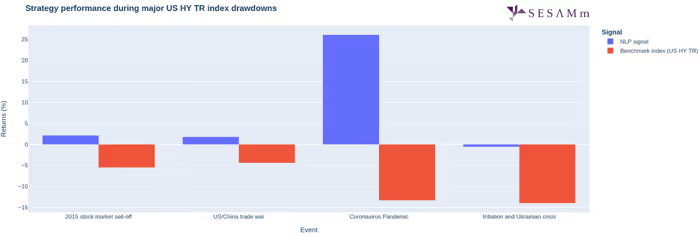
By focusing on more stressed situations, like the 2015 market sell-off, the U.S.-China trade war, the coronavirus pandemic, and the start of the Ukrainian crisis, we could show that digital sentiment is beneficial in times of significant stress in the market. Digital sentiment more accurately reflects the stress level in these complicated situations. It, therefore, helps to predict stock price movements more accurately in these stressed cases, providing a tail hedge. It’s not biased by an excess of confidence linked to the “central banks put” for instance.
Providing safety and security since 1879
Tokio Marine Insurance Company was first established in 1879. Over the years, it has added products and services, acquired other businesses, and merged with other companies to eventually become Tokio Marine & Nichido Fire Insurance Co., Ltd. Commonly called Tokio Marine Nichido today, the company is a property and casualty insurance subsidiary of Tokio Marine Holdings, the largest non-mutual private insurance group in Japan. Its products and services provide safety and security to its clients and partners, contributing to more fulfilling lifestyles and business development.
One of the company’s philosophies is to be a good corporate citizen and fulfill its social responsibilities, including protecting the global environment, promoting human rights, creating a responsible working environment, and contributing to society and individual local communities. Recently, the Emperor of Japan awarded Tokio Marine Holdings, Inc. the Medal with Dark Blue Ribbon for donating to the Japan Student Services Organization to support students who face financial difficulty during the
COVID-19 pandemic. Individuals, corporations, or organizations are awarded the Medal with Dark Blue Ribbon for their outstanding contributions to the public.
Transforming and accepting the challenge to grow
According to TMNF, “The business environment surrounding the insurance industry is changing at a faster pace than ever due to changes in demographics, advances in technologies, such as autonomous driving and AI, and longer-term trends, such as the intensification and frequent occurrence of natural disasters, as well as further progress in digitalization due to the COVID-19 pandemic.”
“The business environment surrounding the insurance industry is changing at a faster pace than ever…”
“While these changes in the business environment pose a threat, we consider them to be excellent opportunities for transformation and the creation of new value.” So they’ve adopted the concept, “Transformation (“X”) and Challenge to Growth 2023: Aiming to be the company most chosen for quality and its passion.” Ultimately, it strives to support customers and local communities in times of need while contributing to social responsibility. Five social issues that it will prioritize are:
Global climate change and the increase in natural disasters
The increased burden of long-term care and healthcare due to the aging of society and advances in medical technology
Technological innovation and its effects on the environment
Symbiotic society and responding to the novel coronavirus
Industrial infrastructure and how it supports economic growth and innovation
Leveraging a partner with the right technology
To secure and protect its clients’ assets while elevating social issues, Tokio Marine Nichido sought out an edge in the stock market. Under these circumstances, it was fortunate that TMNF discovered SESAMm in 2020 through the Plug and Play Japan program, a platform with an event that connects Japan to markets abroad. SESAMm had presented its NLP alternative data solution, TextReveal®, to which TMNF considered the platform for access to alternative data and sought collaboration with the SESAMm team for a research project.
“SESAMm has the technology to extract sentiment from news data with a neural network.” – Tokio Marine & Nichido Fire Insurance Co. Ltd representative
Extracting relations between NLP data and the financial market
In 2021, Tokio Marine Nichido Insurance began collaborating with SESAMm to develop an AI analytics model for alternative data. It models the effect of news and social networking data on investor behavior for stock and bond markets. In other words, it structures text information into knowledge usable by TMNF.
Monitor risks and topics
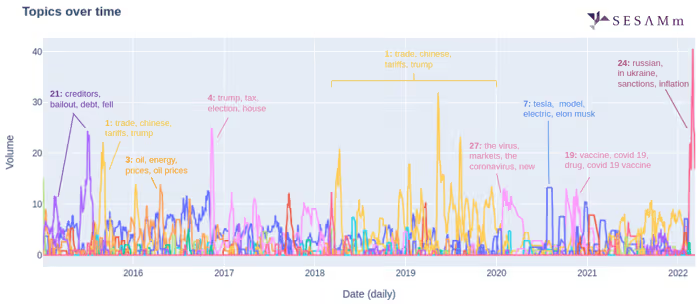
NLP data can improve the understanding of the market’s behavior by exhibiting the most important topics over time, with a direct indication of the importance of the topics through the text volume (Figure 1).
Figure 1: Automatic detection of the main topics in the U.S. market since 2015, thanks to topic modeling.
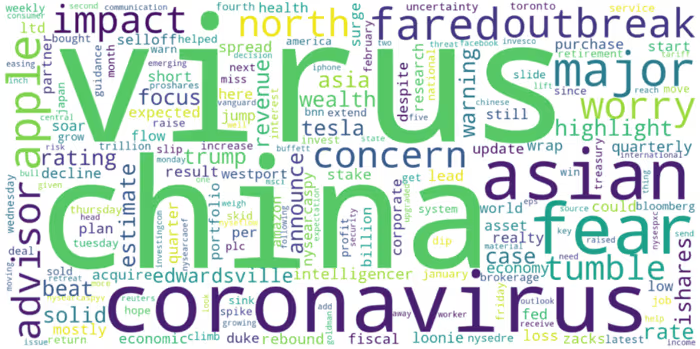
Researchers can also use it to focus on a specific topic or a certain period. For instance, a short analysis of the most frequent keywords in the press, which preceded the market fall during the COVID-19 pandemic, showed the significant predominance of pandemic-related terms (Figure 2).
Figure 2: Most frequent keywords in English S&P 500-related articles between 17 Jan. 2020 and 19 Feb. 2020.
Focusing on the equity market
NLP tools provide specific data, like sentiment, to get more detailed information at the company level and for many underlyings. Indicators for equity indices, for instance, can be calculated and provide a clean sentiment to monitor markets.
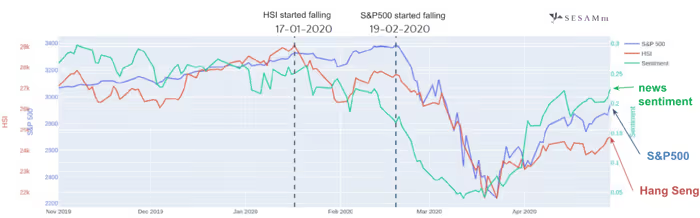
In many situations of stress over recent years, such sentiment proved to be an early indicator of the market’s future degradation. For example, there was a time lag of as long as a month between the time COVID-19 became the main news focus and the time it affected the U.S. stock market. By using SESAMm’s technology to analyze news data during this period, the team found that the U.S. digital sentiment had already deteriorated sharply before stock prices reacted (Figure 3).
Figure 3: In 2020, U.S. news sentiment falls ahead of the stock market in response to COVID-19 concerns.
This sentiment deterioration occurred because of the fear of the coronavirus’s spread’s effect on the global economy (see Figure 2). Even with an all-time high S&P 500, U.S. investors didn’t initially consider this risk. In comparison, HSI companies were closer to the coronavirus spread risk. So as a result, HSI investors reacted ahead of their U.S. counterparts. In other words, by using natural language data, it was possible to capture a risk overlooked by U.S. investors but related in the publicly available texts and take action ahead of the market deleveraging.
Generalizing the results to the credit market
Tokio Marine Nichido also expanded the scope of the research to U.S. high-yield bonds index trade. In the credit market, a high yield has a high beta, which makes its risk comparable to the equity market.
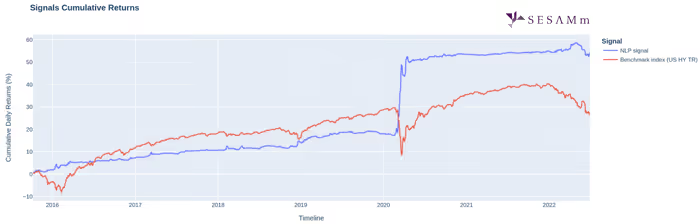
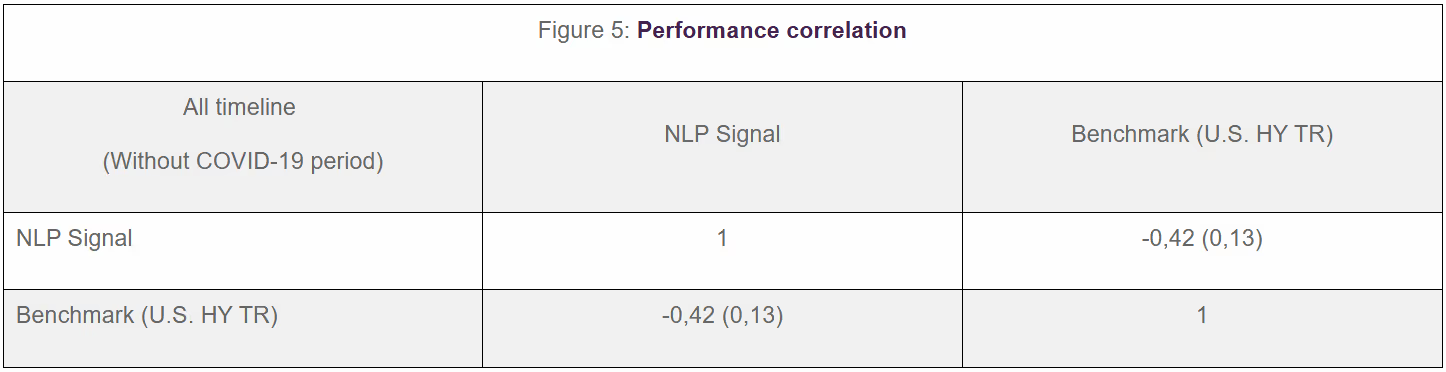
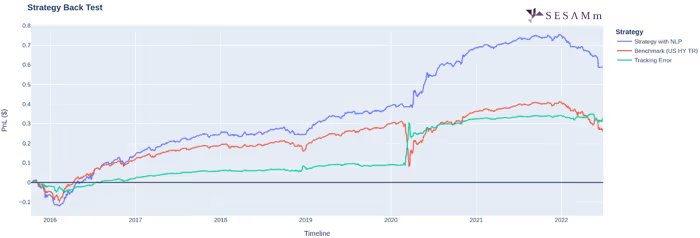
Research shows that, on a risk-adjusted basis, the NLP-data-built signal has a positive and consistent performance through the timeline compared to the U.S. HY T.R. index benchmark (Figure 4). Its performance has a low correlation with the index (Figure 5), so the sentiment is diversifying. It not only acts as a diversifier but delivers higher returns than the benchmark when the U.S. High Yield market sold off (Figure 6). As such, the NLP signal diversifies, hedges, and protects against adverse periods. It provides a mechanical pick-up in risk-adjusted return when running alongside traditional strategy.
Figure 4: An NLP-informed signal has positive and consistent performance. The volatility level is the same for both curves.
Figure 5: The NLP signal and market daily performances are de-correlated.
Figure 6: The NLP signal delivers higher performance during adverse periods.
The NLP signal outperforms the index in realistic backtest conditions, including long allocation only, turnover constraints, and trading fees (Figure 7). The quantitative model integrates some macro indicators, but the previous NLP signal induces the main source of outperformance and risk mitigation.
Figure 7: An NLP-informed high-yield strategy outperforms the U.S. high-yield total return index.
TMNF is also applying the research to estimate the Fed’s stance—hawkish or dovish—using natural language data, too. It hypothesizes that the market will be focused on the Fed’s stance on interest rate hikes in the next few years.
“The model developed in collaboration with SESAMm is simple in structure, yet, it’s an orthodox and robust model that uses valid data as input.”
Summarizing the collaboration
In developing models, Tokio Marine Nichido believes it’s essential to consider “what data to consider” and to keep it simple. And TMNF achieved these tenets. The model developed in collaboration with SESAMm is simple in structure, yet, it’s an orthodox and robust model that uses valid data as input which is preferable to a risky over-fitting by increasing complexity.
Get in touch with SESAMm
To learn more about Tokio Marine Nichido’s case study or to request a TextReveal demo, reach out to us.
Stay ahead with the latest in ESG and AI intelligence
Join our mailing list to receive new reports, event invites, and updates from SESAMm directly to your inbox.








.png)