


Unveiling the Top 5 ESG Controversies of 2023: A Closer Look at Environmental Impacts
November 29, 2023
•
5 mins read
Environmental, social, and corporate governance practices have been under scrutiny for the past year. In this article, we focus on the most significant ESG controversies related to the environment. Our research provides a detailed overview of the top environmental issues that surfaced during the year, highlighting the most talked-about controversies and the companies involved. We dive into each of these issues, analyzing their impact on the environment.
Environmental Risks: Focus 2023
We outlined the prominent risks in 2023: social risks, with layoffs and strikes gaining attention; environmental risks, marked by wildfires and oil spills; and governance risks, where tax evasion and ethical violations like bribery were in focus. Each risk category underscores the urgent issues facing society and the need for accountability and action.
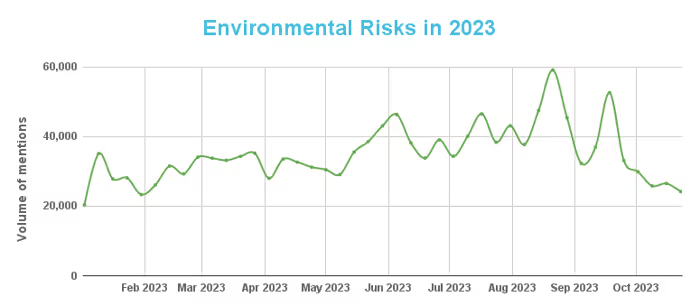
Figure 1: Environmental risks in 2023.
Environmental Controversies of 2023
Environmental risks may not match the sheer number of mentions that social risks receive, but their presence in discussions has steadily grown over the year, particularly in the third quarter. Let's explore the most common controversies that have emerged.
Climate Change and Policy
Climate change dominated environmental discussions in 2023. A noticeable peak in mentions arose in the latter half of the year, particularly around heatwaves and debates surrounding climate policies.
Atmospheric Emissions
September saw increased discussions about atmospheric emissions, notably due to the emissions from volcanic eruptions, hybrid cars, and the discovery of toxic metals in food products.
Impact on Biodiversity
The wildfires that spread in June sparked significant debates around their impact on biodiversity, leading to increased mentions and concerns related to environmental preservation.
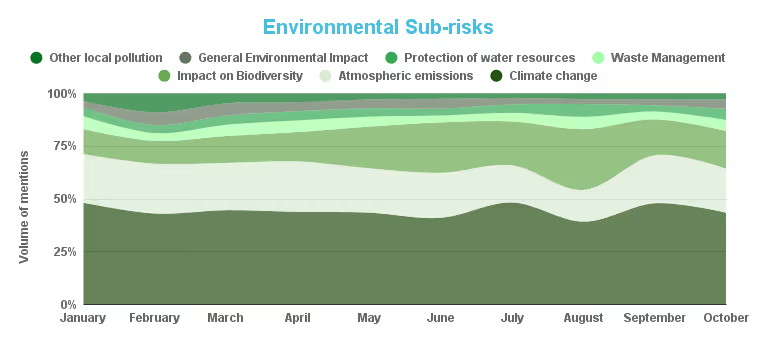
Figure 2: Top environmental sub-risks in 2023.
Top 5 Environmental Controversies
These controversies are ranked by relative volume*.
Marathon Petroleum
Volume of mentions: 62
Relative volume: 69%
A significant portion of environmental risk discussions surrounding Marathon Petroleum was due to its chemical leak in Garyville. This incident led to massive fires, so large they could be observed from space. (source)
Nestlé
Volume of mentions: 30
Relative volume: 54%
Nestlé faced scrutiny in 2023, with over half of its environmental risk mentions associated with drought controversies. The company was urged to cease its water mining activities following severe droughts in France. (source)
Coca-Cola
Volume of mentions: 178
Relative volume: 53%
Coca-Cola garnered attention due to a hydrochloric acid leak in January 2023, leading to significant environmental concerns. (source)
ExxonMobil
Volume of mentions: 571
Relative volume: 31%
Exxon, along with Guyana’s environmental agency, was implicated in breaches of oil spill insurance policies. (source)
Shell
Volume of mentions: 872
Relative volume: 23%
An oil spill from a Shell pipeline adversely affected farms and a river in a region of Nigeria already grappling with pollution. (source)
Conclusion
Environmental risks remain a significant concern for companies in various industries. The top 5 environmental controversies in 2023 were not only related to oil and gas companies but also included companies in other industries, such as Nestlé and Coca-Cola. These incidents underscore the importance for businesses to prioritize sustainability and take responsibility for their impact on the environment. By adopting sustainable practices and reducing their environmental footprint, companies can mitigate future risks and ensure long-term success. Make sure to read the full article, which includes top controversies for social and governance topics here.
Relative volume*: Relative to the total volume of E, S, or G risks for the company during the same period.
SESAMm’s AI Technology Reveals ESG Insights
Discover unparalleled insights into ESG controversies, risks, and opportunities across industries. Learn more about how SESAMm can help you analyze millions of private and public companies using AI-powered text analysis tools.

Below is an approximation of this video’s audio content. Watch the video for a better view of graphs, charts, graphics, images, and quotes the presenter might be referring to in context.
Intro to SESAMm
Thank you very much, Greg. Thank you, everyone, for listening to this presentation. I’m Sylvain. I’m CEO and co-founder of SESAMm. SESAMm is an AI company. We extract billions of articles and messages from the web in order to identify critical insights related to financial institutions and corporates. We’re a team of close to a hundred people. And what we aim to show you today is our new product that helps financial institutions and corporates identify ESG controversies in the form of alerts on all of their investments, on all of their clients, and all of their suppliers.
So there are more than 23 million companies in the world right now. These companies are your investments, your suppliers, your clients, and no one is actually tracking them. Most of these companies are never tracked day to day. SESAMm’s solution aims at automatically identifying controversies on these companies and finding the critical information that you’re missing.
See a dashboard example
So let’s take a quick example first. Here we have dashboards where we analyze a company called Wirecard. Wirecard is a fintech company—German—that went bankrupt a few years ago due to a two billion fraud scandal. That company was heavily embedded into the financial sector, working with a lot of banks, a lot of corporates worldwide.
On our dashboards, we can immediately identify all of the key controversies and all of the key risks on the companies. And we have a score called a virality score that helps assess the severity of each ESG event so as to understand whether that company should be excluded from your list of suppliers, for example, or even discussed as a client.
SESAMm solution benefits
There are key benefits to providing this information and to the way that this product is brought to the market. First, SESAMm covers more companies than anyone else. We cover close to five million firms, whereas most ESG providers have coverage limited to 50,000 firms in total. In addition to that, we’re able to detect controversies in real time and generate daily alerts where normally a bank, for example, would have to go through that process manually and update it just a few times a year instead of receiving that live information.
In addition to that, as you can see on the demo here, we have information for more than 14 years of data. So anytime you onboard a new supplier, anytime you check for information—ESG information, on a new client, or on an investment—you’ll automatically be able to go back in history and understand whether that company was exposed to issues in the past.
Trusted by major financial institutions
SESAMm solutions are already adopted by major banks such as Raiffeisen or Nomura, for example, in this industry, major private equity firms such as Carlyle. And what’s interesting in this solution is that we’re seeing specific interests from commercial banks that are missing the solution in order to track ESG risk on their suppliers and their clients. And it makes sense. Most of these suppliers and clients are small firms, local firms that no one else is going to track. And AI is enabling us to automate the process of monitoring these firms and making sense of that data in real time.
SESAMm's solution in action
So now, let’s go to the second part of the demo. We want to take an actual life example. So let’s take a company like Twilio, for example. So you may know Twilio communications, API, messaging services, phone services, and the like. This company is a typical provider of banks or of financial institutions or any other corporates in the world.
So you see on the left, we immediately identify all of the information related to Twilio. And we can rank this based on negative sentiment so as to understand what are the key critical topics that I should care about and that I should evaluate before actually working with Twilio or in the context of already working with Twilio. We go through that process by handling more than 20 billion articles and messages from more than four million sources worldwide. So that’s an insanely large amount of information.
And on Twilio—say Twilio is one of your suppliers or one of your clients—we immediately identify a large controversy related to a data breach and cybersecurity issue, and we identified both in news but also in some of the specialized cybersecurity websites. In addition to that, we can go in even more granularity and look transparently at the content themselves, read the contents from the platform, and not just rely on a numeric rate saying that “Hey! This company is problematic.” We can actually read the underlying content and understand how the controversy emerged.
SESAMm solution benefits
So the key benefits and the real advantages of that solution is getting information immediately. You don’t have to wait for a due diligence for someone to check for someone to send a questionnaire to the company. You just type in the name, get the information in a few seconds wherever the company is, and however local that company is. It could be the most obscure company. And as you can see our system also covers many different languages, including Asian languages that are monitored automatically.
The second part is that we have access to millions of sources, including very industry-specific sources. I was mentioning cyberthreats. We also have access to NGO websites that identify these types of ESG issues in real time.
So this is really the information that is aimed at helping you monitor controversies and ESG events in just one place on any number of companies, public and private, whether they are your suppliers, your clients, or your investments. You can make sense of that data in real time using AI.
Presentation summary
I’ll finish this presentation a bit early, and we’ll actually bring the point to three calls to action. The first one is, first, please come to our booth. We’re actually on the left of the exhibit hall right when you come in. The second one is, please visit our website. It’s spelled SESAMm, sesamm.com, and you can get a free trial from the website. And finally, come talk to our amazing team with Dave and the rest of our team at our booth. And please ask us for a free POC—whether you’re a bank, an asset manager, or a fintech company—and help us help you track all of the ESG controversies on millions of companies.
SESAMm is proud to announce the launch of our latest solution: TextReveal® ESG Alerts. TextReveal ESG Alerts identifies ESG risks1 and positive impact coverage2 in over 100 languages by tracking mentions of your entire portfolio across 20 billion historical articles with millions of new ones added daily in near real-time.
1 Inspired by SASB and other major standards. 2 Based on UN SDGs.
Why use TextReveal ESG Alerts for your portfolio
Environmental, social, and governance (ESG) ratings have become a conventional measure of a company’s risk against those business areas. They are also increasingly critical as legislation and stakeholders focus on sustainability, positive impact initiatives, and corporate social responsibility (CSR). So with the practice of ESG rating, investors have been able to use those scores to make decisions about their portfolios. Of course, investors are committed to a greener future, too.
Unfortunately, traditional ESG ratings come with challenges. For example, according to Andrew McLaughlin, a contributor to The Globe and Mail, many ESG rating providers are “popping up like dandelions,” and “each uses its own methodologies to rank and score publicly traded companies based on their purported environmental, social and governance risk and performance.” Further, you might have access to ratings, but they’re only updated once per quarter or once yearly.
With SESAMm’s TextReveal ESG Alerts, you can access consistent, timely daily data on five million public and private companies to better assess risks and receive early warnings.
Figure 1: In 2020, U.S. news sentiment falls ahead of the stock market in response to COVID-19 concerns.
The model can calculate sentiment for each company by analyzing the news of individual companies. It’s also possible to create a composite to measure the sentiment related to a stock index. The sentiment data also helps management and investor relations because it provides a quantitative means of understanding the extent to which investors are concerned about certain news about their company.
Verifying the results
Verification using Japanese has revealed that the timing of bottoming and ceiling of text sentiment precedes those of stock prices. The collaborating team compared the performance of:
A model that uses only orthodox financial and economic data as inputs
A model that considers NLP and financial and economic data, confirming that the latter could generate higher alpha
ESG controversy monitoring can alert you to potential risks before market-moving events occur. Illustrated: Tesla ESG scores for pollutants, ethical standards, discrimination, and environmental impact.
The TextReveal ESG Alerts edge
Broad coverage
Access five million private and public companies of all sizes, including micro-caps, to identify risks in over 100 languages.
Expertise
Leverage ninety pre-built yet taxonomy-adaptable ESG risk categories such as SASB standards, UN Global Compact, and UN SDG-based positive impact statistics coverage.
Transparency
Gain insights with deeper analysis, seeing specific articles driving your alerts.
Timeliness
View live web data for forward-looking scores and insights.
TextReveal ESG Alerts features
Because we trained them on a representative corpus selected from billions of articles from prestigious news organizations, local news, and discussion forums, our NLP tools can understand finance and interpret slang, misspellings, and textspeak.
Get an ESG and UN SDG dashboard view of your portfolio.
The best part is that you can receive alerts and monitor scores in the way that works best for you. ESG and UN SDG‐based positive impact statistics can be accessed and delivered via:
Email Alerts
CRM and cloud based integration
Live dashboards
API and data files
ESG studies
Get the SESAMm edge from TextReveal ESG Alerts
Save time vetting your current investments and evaluating new ones while providing higher quality, objective results compared with manual monitoring, black-box ratings, or self-reported questionnaires.
Reach out to a SESAMm representative for a personal demo today.
The modern world is in a peculiar place right now. We’ve got the technology and resources to improve our planet, but we often don’t know how to use them despite our best intentions. Or, at the very least, we don’t know where to put our efforts. Consequently, some investors are looking into Sustainable Development Goals (SDGs). Not only do they want their investments to earn more, but they also want them to do good. If you’re also interested in doing good with your investments, it’s essential to understand the SDGs and their meaning for your portfolio. In this article, we’ll break down the SDG basics, SDG scores, their relevance to investing, and how SESAMm can help you get and read SDG metrics. But first, a quick review of SDGs.
What SDG means
SDGs, or Sustainable Development Goals, are a set of 17 goals that the United Nations set in 2015 to be achieved by the year 2030, a framework that “provides a shared blueprint for peace and prosperity for people and the planet, now and into the future.” The global goals and the 2030 Agenda for Sustainable Development cover issues such as human rights, poverty, health, education, gender equality, and environmental sustainability, and they were designed to be universal across countries and continents worldwide. Here are the 17 UN Sustainable Development Goals:
SDG 1: No Poverty: Striving to end poverty in all its forms everywhere. This goal underscores the importance of equitable resource distribution and access to basic needs.
SDG 2: Zero Hunger: Aiming to end hunger, achieve food security, improve nutrition, and promote sustainable agriculture, thereby ensuring that everyone, everywhere, has enough quality food to lead a healthy life.
SDG 3: Good Health and Well-being: It emphasizes the need for universal healthcare access, including reproductive, maternal, and child healthcare, and combats health threats by supporting research and development of vaccines and medicines.
SDG 4: Quality Education: Envisioning inclusive and equitable quality education and lifelong learning opportunities for all, this goal recognizes education as the foundation of empowerment and prosperity.
SDG 5: Gender Equality: Achieving gender equality and empowering all women and girls to participate fully in societal, economic, and political spheres
SDG 6: Clean Water and Sanitation: This goal aims to ensure the availability and sustainable management of water and sanitation for all, recognizing the essential role of water resources in sustaining life and ecosystems.
SDG 7: Affordable and Clean Energy: Promoting access to affordable, reliable, sustainable, and modern energy for all; this goal underscores the critical nature of energy in achieving other SDGs and the transition towards renewable energy sources to combat climate change.
SDG 8: Decent Work and Economic Growth: It focuses on promoting sustained, inclusive economic growth, full and productive employment, and decent work for all, highlighting the role of the private sector in initiating impactful initiatives.
SDG 9: Industry, Innovation, and Infrastructure: Aiming to build resilient infrastructure, promote inclusive and sustainable industrialization, and foster innovation, this goal recognizes the importance of a robust infrastructure and an innovative ecosystem as drivers of economic growth and development.
SDG 10: Reduced Inequalities: This goal seeks to reduce inequality within and among countries, focusing on policies designed to achieve greater equity and involve stakeholders from all sectors of society in decision-making processes.
SDG 11: Sustainable Cities and Communities: It aims to make cities and human settlements inclusive, safe, resilient, and sustainable, emphasizing the need for green public spaces, improved urban planning, and sustainable construction practices.
SDG 12: Responsible Consumption and Production: Focusing on promoting resource and energy efficiency, sustainable infrastructure, and providing access to a better quality of life for all, this goal underscores the importance of adopting sustainable practices and reducing waste.
SDG 13: Climate Action: Taking urgent action to combat climate change and its impacts, this goal underscores the necessity for countries, stakeholders, and the private sector to collaborate in reducing emissions and enhancing renewable energy usage.
SDG 14: Life Below Water: Aimed at conserving and sustainably using the oceans, seas, and marine resources for sustainable development, this goal addresses the critical importance of our aquatic ecosystems.
SDG 15: Life on Land: Protecting, restoring, and promoting sustainable use of terrestrial ecosystems, sustainably managing forests, combating desertification, halting and reversing land degradation, and halting biodiversity loss.
SDG 16: Peace, Justice, and Strong Institutions: Promoting peaceful and inclusive societies for sustainable development, providing access to justice for all, and building effective, accountable, and inclusive institutions at all levels.
SDG 17: Partnerships for the Goals: This goal recognizes the importance of revitalizing the global partnership for sustainable development and the role of strong partnerships in achieving the SDGs, involving governments, the private sector, civil society, and others.
The UN’s 17 Sustainable Development Goals. Image courtesy of UN.org.
What are SDG scores?
Each Sustainable Development Goal has specific targets or indicators that help measure progress toward achieving those targets over time. SDG scores are numerical values given to each entity (country, company, person, etc.) based on their performance in meeting specific targets or indicators for each particular goal. Incorporating these evaluations into the decision-making process is crucial for stakeholders across various sectors, including the private sector, healthcare, financial services, and more. These stakeholders can leverage insights from SDG scores to prioritize initiatives that address critical issues like climate change, emissions reduction, and ecosystem preservation.
How do SDGs relate to ESG?
The environmental, social, and governance (ESG) framework is a tool to achieve and comply with the SDG goals. From a company’s perspective, ESG and SDG frameworks emphasize the importance of measuring and reporting progress. Companies incorporating ESG criteria into their operations often report on their sustainability performance, which can directly show their contribution towards achieving specific SDGs. For investors, ESG metrics provide a tangible way to evaluate companies' potential risks and opportunities related to sustainability, which can also align with the broader objectives of the SDGs.
The SDGs primarily focus on global challenges such as poverty, inequality, climate change, and environmental degradation, which represent the environmental and social pillars of ESG.
Within the same principles, several of these goals directly relate to the governance pillar of ESG. On the one hand, goal 16 aims to reduce corruption and bribery, develop effective and transparent institutions, and ensure inclusive and representative decision-making. On the other hand, goal 17 strives to enhance international cooperation, encourage effective public, public-private, and civil society partnerships, and ensure that policies are coherent and integrated, all of which are governance-related issues.
While the SDGs might not explicitly label these aspects as 'governance' in the way the ESG framework and regulatory landscapes do, the inclusion of these goals demonstrates a clear recognition of the importance of governance in achieving sustainable development. SDGs and ESG also have different purposes. ESG measures companies’ environmental, social, and governance performance risks and initiatives, while SDGs evaluate any entity’s performance in reaching its goals. Put another way, SDGs represent the goals, while ESG concerns methodology and processes.
At the company level, SDGs help align corporate strategy with society’s needs. Because the UN designed SDGs to be measurable, countries, companies, and people can hold themselves accountable for progress toward achieving them. And because the goals are measurable, we can score a company’s efforts, giving you an indicator to invest responsibly by aligning your portfolios with SDGs.
According to a publication by McKinsey & Company, sustainable investing appears to have a positive effect, if any, on returns. In other words, investors care about SDGs not only because they benefit society but also because they measurably support better investment decisions. For example, by incorporating SDGs into company assessments, investors can identify well-run businesses that are better positioned to benefit from the positive effects of improved social and economic conditions. SDGs also allow investors to make better-informed decisions within a defined investment time horizon by focusing on a company’s business exposure toward them. Investors can thus better measure and track a company’s opportunity exposure as a result of its achievement of the SDGs.
How to measure an entity’s SDG score
There are tools available to measure progress toward each goal—and those tools will play an essential role in helping investors decide which entities they want to invest in and which ones they don’t want to support. For example, SESAMm’s platform, TextReveal®, can analyze web data to generate SDG scores for virtually any entity in our data lake.
How SESAMm provides SDG scores
SESAMm provides SDG scores through its platform, TextReveal, a platform that allows investors to gain insights into companies, people, or topics. Specifically, we use artificial intelligence (AI) to track entities’ contributions toward SDGs, including public and private companies.
We track the 17 Sustainable Development Goals and the 169 underlying targets to detect negative news and positive events, using a similar algorithm we use for ESG alerts and gathering alternative data. Each UN SDG item displays a score from 0 to 5 to show the intensity of the company’s positive impact. Then, we translate the information into multiple languages.
This dashboard view example shows some SDG scores for Aker Carbon Capture.
We queried the Norwegian carbon capture company, Aker Carbon Capture, using our SDG positive impact dashboard over the past three years. As you might notice, Aker contributes to the goals associated with Partnerships, Climate Action, Clean Energy, and Sustainability. Maybe they could do more regarding Decent Work and Economic Growth, and Responsible Consumption and Production, but overall, the company’s online data shows a positive contribution.
See how SESAMm can help you with your SDG research
SESAMm is the leading provider of AI solutions and analytics for investment firms and corporations.
Analyzes text in billions of web-based articles and messages
Generates investment insights, ESG and SDG analysis used in systematic trading, fundamental research, risk management, and sustainability analysis
Enables a more quantitative approach to leveraging the value of web data that’s less prone to human bias
Addresses a growing need in public and private investment sectors for robust, timely, and granular sentiment and SDG data
SESAMm’s AI Technology Reveals ESG Insights
Discover unparalleled insights into ESG controversies, risks, and opportunities across industries. Learn more about how SESAMm can help you analyze millions of private and public companies using AI-powered text analysis tools.
Stay ahead with the latest in ESG and AI intelligence
Join our mailing list to receive new reports, event invites, and updates from SESAMm directly to your inbox.