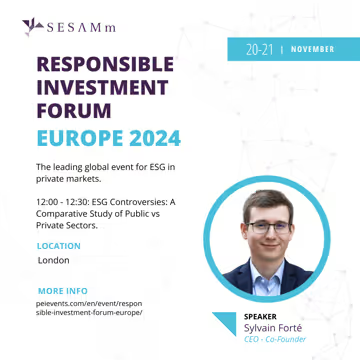


Find us in London on November 20–21 for PEI RIF 2024, where SESAMm’s CEO, Sylvain Forté, will give a presentation on “ESG Controversies: A Comparative Study of Public vs Private Sectors.” He will explore ESG controversies in public vs. private sectors, comparing their performance, SDG, and UNGC compliance. Our representatives, Andrew Bernstein and Valentin Aguillon, will also attend the conference. For more information, feel free to stop by our booth and chat with them. Event details: https://www.peievents.com/en/event/responsible-investment-forum-europe/home/
We’re in Paris on December 3rd for Hub Institute’s Impact Paris Summit. Come and chat with our representatives, Sylvain Forté and Kevin Ozadanir. Event details: https://www.impact.paris/fr 📅 December 3rd 📍 La Maison des Travaux Publics, Paris 8
Stay connected
Want to stay up-to-date with the latest event information? Connect with us on social media:

Identifying environmental, social, and governance (ESG) controversies is a complex challenge. The large amount of data that is added to the web daily makes it difficult to analyze, leaving important insights hidden among irrelevant information. Traditional risk identification methods struggle with this, making it difficult to uncover critical issues that could impact investments.
This article explores the intricacies of ESG data trends. As businesses worldwide strive to adopt more sustainable and ethical practices, the importance of ESG metrics has risen to the forefront of strategic planning and public discourse.
Identifying Controversies with AI
Traditional controversy detection methods often need help uncovering hidden risks buried within unstructured sources like social media, local news, and niche industry reports. This section explores the advantages of using AI tools—such as natural language processing and machine learning—to detect these risks more accurately and efficiently. By leveraging AI, firms can gain deeper insights and respond proactively to emerging ESG issues, ensuring more robust risk management and informed investment decisions.
Key Challenges in Identifying ESG Controversies
In the finance world, especially when dealing with small companies, sometimes private, identifying ESG controversies presents significant challenges. These companies often lack extensive public records, and the data that is available can be sparse, fragmented, or hidden within vast amounts of irrelevant information. Traditional methods of risk identification struggle to navigate this sea of digital noise, making it difficult for private equity firms to uncover critical issues that could impact their investments.
One of the primary hurdles is the lack of valuable, structured data on smaller firms. Unlike large corporations, which are often required to disclose detailed financial and operational information, small private companies might operate with minimal public visibility. This opacity complicates the identification of potential ESG risks, as relevant data is often buried in unstructured sources like social media, local news, or niche industry reports. The challenge is not just about finding information but also about extracting meaningful insights from a diverse array of sources that may not adhere to standardized reporting practices.
Additionally, the diversity in language and terminology used by smaller firms further complicates the identification of ESG controversies. Risks are often discussed in context-specific ways, using industry jargon or localized expressions that do not easily translate into a standard risk assessment framework. This linguistic variation can lead to misunderstandings or even the complete overlooking of critical ESG issues. Therefore, private equity firms require advanced tools capable of interpreting and standardizing this information to ensure comprehensive risk identification.
Artificial Intelligence vs. Traditional Methods
Artificial Intelligence (AI) has emerged as a game-changing tool for identifying ESG controversies, offering significant advantages over traditional methods. While conventional approaches rely heavily on structured data from formal reports and disclosures, AI technologies, such as natural language processing (NLP) and machine learning, can analyze vast amounts of unstructured data from diverse sources. This capability is particularly crucial for private equity firms focused on small companies, where relevant information may be scattered across social media posts, obscure local news articles, and other non-traditional outlets.
Traditional methods often fall short in dealing with the unstructured and fragmented nature of data related to smaller firms. These methods might miss emerging controversies discussed informally in niche blogs or industry-specific forums. In contrast, AI-powered tools can continuously monitor these sources in real time, identifying potential ESG risks before they escalate. This proactive approach allows firms to address issues early, providing a more comprehensive and nuanced understanding of the risks associated with their investments.
Moreover, AI's ability to process and analyze diverse languages and terminology offers a significant edge. By decoding industry-specific jargon and translating localized expressions into a standardized risk framework, AI helps private equity firms overcome the linguistic barriers that traditional methods struggle with. This capability ensures that no critical ESG controversy is overlooked due to language differences, thereby enhancing the accuracy and effectiveness of risk assessments.
To sum it up, while traditional methods have their place, AI technologies provide a more robust, dynamic, and precise approach to identifying ESG controversies. By leveraging AI, private equity firms can better navigate the complexities of data sourcing, interpretation, and risk management, ultimately leading to more secure and informed investment decisions.
Streamlining ESG Controversy Detection with AI
Detecting ESG controversies with AI involves several crucial steps, each contributing to the precise identification of potential risks. The attached diagram illustrates a generalized AI-driven approach to detecting ESG controversies.
Step 1: Data Collection
The first step in this AI process is collecting vast amounts of web-based information to create a comprehensive data lake. This data lake acts as a repository, storing raw data in its original format. AI systems thrive on large datasets to enhance accuracy, and the data lake ensures that this requirement is met by allowing real-time data ingestion. By preserving historical information, the system can perform trend analyses that are crucial for identifying emerging controversies.
Step 2: Organizing & Cleaning the Data
Once collected, the data undergoes an essential organization and cleaning process. This step involves standardizing and categorizing the data to make it more accessible for analysis. By filtering out irrelevant information and tagging essential data points, the system can quickly and efficiently process large datasets. This organization allows for faster analysis and ensures that only the most relevant information is considered, eliminating the noise that can obscure critical insights.
Step 3: Connecting the Dots
With the data organized, the AI system creates a Knowledge Graph (KG) that maps the relationships between key entities, topics, and themes. This step is crucial for understanding how different companies, products, and brands are interconnected. The Knowledge Graph is continuously updated to reflect new data, ensuring that the system remains accurate and relevant in its analysis.
Step 4: Adding Contextual Understanding
The AI system then moves on to interpret the text, employing various techniques such as Named Entity Recognition (NER) and lemmatization. These tools help the system identify and classify key elements within the data, allowing it to grasp the context and main points of the information. This step is vital for accurately understanding the specific topics and issues related to each company, enabling the system to group related articles and monitor the evolution of controversies.
Step 5: Analyzing with Algorithms
In this step, the AI applies sophisticated algorithms to the organized and contextualized data. These algorithms focus on uncovering insights such as sentiment analysis, ESG controversies, and impacts of Sustainable Development Goals (SDGs). The system continuously refines these algorithms to maintain high levels of accuracy and performance, ensuring that the analysis remains relevant as new data becomes available.
Step 6: Turning Analysis into Actionable Insights
Finally, the AI system transforms the analysis into actionable insights. By delivering these insights in a fast and easy-to-understand format, the system empowers users to make informed decisions quickly. For example, a controversy intensity score might be used to prioritize which issues require immediate attention, allowing users to focus on the most significant risks in their portfolios.
This AI-driven process, depicted in the attached diagram, showcases the streamlined approach to detecting ESG controversies, providing private equity firms with the tools they need to manage risks effectively and maintain a competitive edge in the market. For more detailed information on how SESAMm identifies insights with AI, please efer to this document.
Conclusion
To sum up, identifying ESG controversies, particularly in smaller, less visible companies, presents significant challenges for traditional risk assessment methods. However, integrating artificial intelligence offers a transformative solution. AI tools can effectively analyze vast amounts of unstructured data, revealing hidden risks and enabling informed investment decisions. As the demand for sustainable and ethical practices grows, leveraging AI will enhance risk management and foster responsible investment approaches, allowing firms to navigate the complexities of ESG data more effectively.
Reach out to SESAMm
TextReveal’s web data analysis of over five million public and private companies is essential for keeping tabs on ESG investment risks. To learn more about how you can analyze web data or to request a demo, reach out to one of our representatives.
As the 2022 United Nations Climate Change Conference wraps up, governments and, by proxy, companies are charged with fulfilling new recommendations, especially for non-State entities to commit with integrity to Net-Zero. COP27, as the conference is also called, is the time and place where we claim as a united society at the world's center to make change for the better.
But COP27 is over. Now what? Do we go back to business as usual? Do we wait and see if we stick to any of these new agreements? Or worse, do we say we'll make changes but fall short of making those changes?
I say no. We can do better, and here's why…
We need to talk about climate change
Climate change effects are more than global warming. Global warming consequences include:
Rising sea levels
Stronger and more intense hurricanes
More droughts and heat waves
Longer wildfire seasons
And more
Why do I bring these up? Because all of these effects will impact your business in one way or another.
For example, did you know that the Rhine River, one of Europe's major rivers, is suffering from drought? Water levels are so low that barges are limited, and it's disrupted river cruises because levels are currently 38 centimeters below the minimum required.
The same goes for the Mississippi River in the U.S. The Mississippi River has dropped to the lowest levels they've ever been in 34 years, driving up shipping costs. This challenge is also a big deal because the river carries 92% of agricultural exports.
Also, in the past year, damaging hurricanes and typhoons have damaged infrastructure in South Korea, South Africa, China, Japan, and the U.S., to name a few countries, affecting crops, manufacturing operations, supply chains, and much more across the globe.
I could go on about how each effect influences enterprise, but the bottom line is climate change is bad for business. And supporting companies that enable climate change is also bad for business, which brings us to the topic of environmental, social, and governance (ESG) measures.
We need to talk about ESG
ESG has become mainstream since the UN shared a report in 2006, a joint initiative by a group of financial institutions to develop policies and guidance on how to better incorporate ESG issues in securities brokerage services, asset management, and associated research functions. This introduction has helped industries establish goals through:
Managing ESG risks
Anticipating regulatory action or accessing new markets
Contributing to the sustainable development of their societies
However, with ESG policies come ESG data challenges. For example, ESG measuring, its data, and how companies report them are inconsistent. ESG data providers deal with "data gaps" differently, so their approaches can lead to discrepancies. And as ESG data becomes available publicly, how ESG data providers interpret the data varies, too.
We need to talk about greenwashing
In simplest terms, greenwashing occurs when a company misleads its stakeholders, investors, and consumers about its environmental practices, specifically by communicating positive environmental performance contrary to its actual, less flattering execution.
On the surface, you might think, "What's the big deal? We all exaggerate, right?" But as sustainability awareness among investors and eco-conscious customers grows, so has their scrutiny over business conduct to disclose information about a company's performance and its "environmental-friendly" products. Their scrutiny, coupled with the growing number of companies reporting their environmental footprints, reveals that many companies misreport and publish information about their ecological impacts, which regulators consider misleading or deceptive.
How do we know? Let's take a look at greenwashing mentions by industry.
We analyzed greenwashing mentions in web data. On the X-axis, we list the industries. The Y-axis measures the ratio of greenwashing mentions by N° of companies per industry (N=1166 companies) since 2015; this extraction method corrects sampling bias. Each industry is defined by a significant sample of large- and mid-capitalization-sized companies in developed countries.
This greenwashing mention chart clearly shows that the Energy industry has the highest ratio of greenwashing allegations. While many fossil fuel companies claim to be transitioning into clean energy, most mentions link these companies to advertisements and campaigns that don't align with the Paris Agreement goals. In contrast, fossil fuel companies are growing their carbon-intensive operations and products. It's a concerning trend because according to The Intergovernmental Panel on Climate Change (IPCC) report, "Climate Change 2021: The Physical Science Basis.", the data shows that emissions from fossil fuels are the primary cause of global warming, contributing up to 91% of global carbon dioxide emissions in 2018 as an example.
Second, on this chart is the Financial industry. It has fallen short of its commitments to climate action while continuing to finance fossil fuels. According to eMarketer, financial institutions have allocated $4.6 trillion for fossil fuels while promoting sustainable finance and supporting global energy transition.
Further, the mentions volume has grown year over year since 2015—when it was almost zero—to more than 1500 present day.
Clearly, this greenwashing problem is getting worse. So what can we do about it?
We need to talk about a solution
We don't have any control over what companies will do to fulfill their agreements, but we can understand their ESG data better and make better investment and portfolio decisions.
How? With AI.
AI, specifically natural language processing (NLP) algorithms, help us read billions of news articles, forums, and web text and extract unstructured data for analysis. With SESAMm's TextReveal®, we can see an entity's ESG controversies or events in near real time, providing a unique perspective to ESG data and details, filling the data gaps more accurately.
So when Company A reports on its ESG goals, we can help verify if the results are accurate and find any potential controversies that didn't make the report. We also don't need to wait until ESG reports come out; we can extract this data from the web on an as-needed basis. Moreover, we can look at all types of companies across the globe, public or private. As long as web data exists for an entity (or concept), we can analyze it.
My final thoughts
COP27 might be over, but our agreements and commitments carry on. We have an opportunity today to make a positive difference toward climate change while still maintaining profits. In fact, I think we can be even more profitable if we support green and sustainable initiatives.
I'd like to hear your thoughts; feel free to reach out on LinkedIn and share them with me.
About Alexandre Tiesset
Alexandre Tiesset is the Head of ESG at SESAMm. He's worked in finance for seven years in various ESG-related roles, such as Credit Analyst, Sustainable Investing Specialist, Index Product Specialist, and more. He holds a Master of Science degree in Finance and Financial Analysis. His passion lies in the intersection of finance and general knowledge and making new connections.
Reach out to SESAMm
SESAMm is a leading NLP technology company serving global investment firms, corporations, and investors, such as private equity firms, hedge funds, and other asset management firms, by providing datasets or NLP capabilities to generate their own alternative data for use cases, such as ESG and SDG, sentiment, private equity due diligence, corporation studies, and more.
To learn how you can generate NLP-enhanced ESG data for your firm, or to request a demo, reach out today.
It's a word that most of us in the U.S. despise, almost as much as the word taxes. It's probably because, like taxes, we can't escape its wallet-draining effect when it increases. Maybe the way we feel about it is because the last time the U.S. economy deflated—giving us relief from it—was in the 1930s, when "Prices dropped an average of nearly 7% every year between the years of 1930 and 1933," according to Investopedia. But I digress.
We won’t go into how inflation works, but how the government calculates it—and how its categories affect it—has always been consistent. At least it was until the COVID-19 pandemic hit, that is.
What NLP text mining reveals about the U.S. economy inflation-rate factors and the online conversations about them
To ensure we're on the same page about how we came to the forthcoming information in this use case, let's cover a couple of basics on NLP text mining and inflation rate indexes.
What are NLP and text mining?
Natural language processing (NLP), an A.I. technology, automates the data analysis of mined textual, unstructured data. It includes natural language understanding and natural language generation to simulate a human’s ability to create language, and it’s a component of text mining that performs a special kind of linguistic analysis by deep learning algorithms so a machine can “read” text. Apps like Grammarly or Wordtune analyze text to improve a written text, for example, and chatbots use this technology to interact with customers. Text mining, or text analytics, is the process of examining big data document collections. It’s a computer science discipline that converts unstructured text data in documents and databases into normalized, structured data and datasets for analysis by machine learning models. Deep learning machine-learning algorithms then analyze this data, analyzing semantics and grammatical structures, to gain new insight or aid research from human language. Together, NLP and text mining are like a search engine on steroids.
The Consumer Price Index (CPI)
According to this Forbes Advisor article, "The two most frequently cited indexes that calculate the inflation rate in the U.S. are the Consumer Price Index (CPI) and the Personal Consumption Expenditures Price Index (PCE)." For this article, however, we'll only use the Bureau of Labor Statistics (BLS) method of CPI inflation calculation as a reference. CPI observes a specific group of commonly-purchased goods and services to gauge how prices fluctuate. These foods and services include:
Apparel: Women's and men's clothes, jewelry, etc.
Alcoholic beverages: Beers, wine, liquor, etc.
Energy and commodities: Gasoline, natural gas, electricity, etc.
Food: Items bought by the average consumer, such as breakfast cereal, milk, meat, fruits, vegetables, etc.
Housing and shelter: Rent, housing insurance, bedroom furniture, hotel or motel accommodation costs, etc.
Medical care services: Physicians' services, prescription drugs, medical supplies, etc.
New and used vehicles: Trucks, vans, sedans, SUVs, etc.
Tobacco and smoking products: Tobacco-related items, such as cigarettes, cigars, bidis, kreteks, loose tobacco, etc.
Transportation services: Airline fares, vehicle insurance, etc.
NLP text-mining process: web mentions matched to CPI categories
Using SESAMm's web text analysis engine TextReveal®, we analyzed textual data relating to the inflation topic within the U.S. from 2017 until now. For this analysis, we defined co-mentions as the articles and social media posts that mention "inflation" and at least one of the CPI categories. Note: Although we can analyze more than 100 languages, we focused on English in this case. Also, we didn’t conduct a sentiment analysis from the information extraction.
Figure 1: Inflation co-mentions by category and percentage.
From 2017 to 2019, inflation co-mentions within the U.S. are relatively stable (see Figure 1). But this trend changes with the first shift in 2020, continuing its rapid growth and peak by the end of 2021 due to this surge of inflation reaching record levels.
What was one of the main drivers of the inflation surge? Used cars.
3 used-car and inflation trends uncovered through NLP Text Mining
According to the U.S. Bureau of Labor Statistics, the cost of used vehicles was one of the main drivers of the inflation spike. How did used cars contribute to inflation? The chain of events occurred like so: The increased used-car demand was fueled by a new-vehicle supply shortage caused by a chip shortage generated by supply-chain interruptions due to the COVID-19 pandemic.
As the pandemic-induced supply-chain interruption unfolded, used-car trends developed. Here are three we found in our data mining research:
Trend 1: Co-mentions percentage for used vehicles more than doubled
Figure 2: Used vehicles co-mentions increase percentage-wise.
Based on the percentage of co-mentions compared to other topics, the used-car topic moves from the number eight spot to the number four spot in 2021 (see Figure 2).
Figure 3: Used-car co-mentions begin in early 2021 and exceed those for new cars.
Before 2020, mentions were relatively steady. However, we observe an increase in used-vehicles mentions caused by disruptions in supply chains leading to chip shortages (see Figure 3) as early as January 2020. These shortages led to a decrease in new vehicle inventory. The Statista report, indicating an increase of the used vehicle value index by 49 points compared to the price index recorded in 2020, supports our findings.
Trend 2: Used vehicle prices rose with used-car co-mentions
Figure 4: In 2020, inventory spikes as production and sales plummet, affecting inflation.
Because of the pandemic, car production nearly stopped along with the sale of cars, which created two situations: 1. high inventory to sales ratio and 2. historically low car production (see Figure 4). Vehicles sales picked up later, but car production was still suffering because of supply-chain disruption. That meant the inventory to sales ratio dropped to virtually zero.
So consumers with little-to-no options for new vehicles turned to used cars, increasing their demand and therefore increasing their prices. We confirm this hypothesis with increasing mentions within the used-vehicles topic, coinciding with an inventory volume decrease. All in all, used-vehicle prices rose 40.5%.
Trend 3: The COVID-19 pandemic and new vehicle inventory shortage increased demand
A smaller new-vehicle inventory wasn't the only reason consumers sought out used vehicles. They also wanted used cars because of the pandemic.
Figure 5: The pandemic and new-vehicle supply shortage became bigger reasons for consumers to seek out used cars over cost.
For 2020, we observe that consumers avoided public transportation by rising co-mentions between pandemic-related mentions and the demand for secondhand vehicles (see Figure 5).
Used-car and inflation trends summary
We can summarize the used-car and inflation trends with one phrase: It's a used-car seller's market. For example, online retailers like Carvana have leveraged these factors to grow significantly. In contrast, due mainly to significant supply chain disruptions, motor companies have had the opposite effect, with the Automotive industry projected to lose $210 Billion. Judging by the number of mentions in public web forums and social media, the chip shortage and used-car boom affected General Motors, Ford, and Toyota the most (see Figure 6).
Figure 6: General Motors, Ford, and Toyota suffered pandemic-related shortages the most based on co-mentions.
About SESAMm and TextReveal’s® NLP Text-mining Capabilities
SESAMm is a leading company in alternative data and artificial intelligence, delivering global investment firms and corporations descriptive, prescriptive, or predictive investment analytics worldwide. TextReveal is SESAMm's premiere NLP text-mining product, a solution that allows you to fully leverage NLP-driven insights and receive high-quality results through data streams, modular API and dashboard visualization, and signals and alerts. In other words, we organize, categorize, and capture relevant information from raw data for you.