

S&P 500 ESG Index Drops Tesla: This Analysis Supports the Decision
July 6, 2022
•
5 mins read
May 2, 2022. The S&P 500 ousts Tesla, Inc. from the S&P 500 ESG Index. Tesla is widely recognized as the firm that ushered electric vehicle making into the mainstream. So the index’s move seems unreasonable or possibly made in error to many, raising some interesting questions:
How does an environmentally-friendly corporation like Tesla get dropped from an ESG index?
Why does a potentially non-environment-friendly company like Exxon make the ESG index and remain on it?
What do these moves mean about the integrity and validity of ESG scores and ratings?
Global industry group peers pushed Tesla’s S&P DJI ESG Score further down the ranks in the GICS industry group: Automobiles & Components.
A decline in criteria level scores related to Tesla’s low carbon strategy and codes of business conduct contributed to its 2021 S&P DJI ESG Score.
A media and stakeholder analysis identified "two separate events centered around claims of racial discrimination and poor working conditions at Tesla’s Fremont factory."
The analysis also highlights "the handling of the NHTSA investigation after multiple deaths and injuries were linked to its autopilot vehicles, affecting the company’s S&P DJI ESG Score at the criteria level, and its overall score."
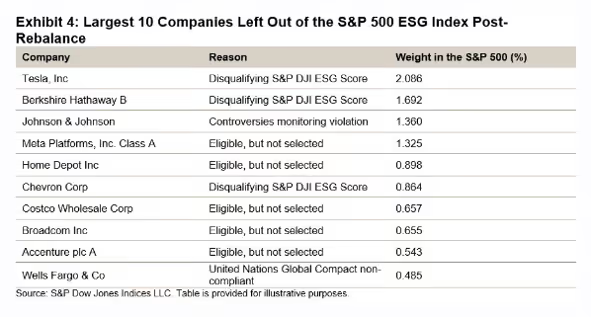
Companies, including Tesla, left out of the S&P 500 ESG Index post-rebalance. Image courtesy of Indexology Blog.
The S&P blog post summarizes their case about dropping Tesla, "While Tesla may be playing its part in taking fuel-powered cars off the road, it has fallen behind its peers when examined through a wider ESG lens." And in this statement lies the crux of why the index dropped Tesla and why others are still on.
Analyzing Tesla’s web data
SESAMm’s TextReveal® insights suggest that the S&P 500’s decision to remove Tesla could be justified based on increasing controversy levels concerning discrimination, ethical standards, and work health and safety. By analyzing text related to ESG topics across the web, we picked up trends for the following subtopics:
climate_change_atmospheric_pollution
ethical_standards
discrimination_racism_sexism
labor_standards
health_and_safety_at_work
general_environmental_impact
Tesla’s ESG scores (six subtopics)
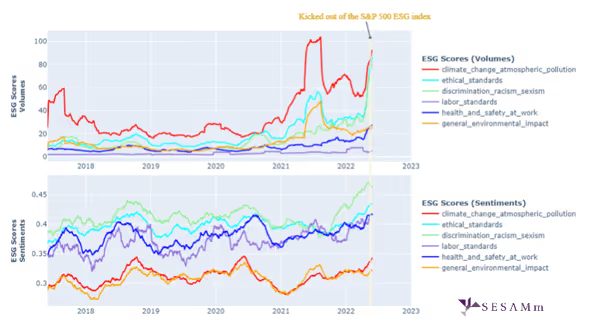
Figure 1: Tesla ESG scores for volumes and sentiments (1-year moving average), all source types.
Regarding the volume features (Figure 1), we observed a significant increase in the scores related to ethical standards, discrimination, and atmospheric pollution for Tesla before the controversy. The conclusions are mostly the same for ESG sentiment (negative) scores. An interesting note is that the negative score of health and safety at work slightly increased in the months before the removal of Tesla from the index.
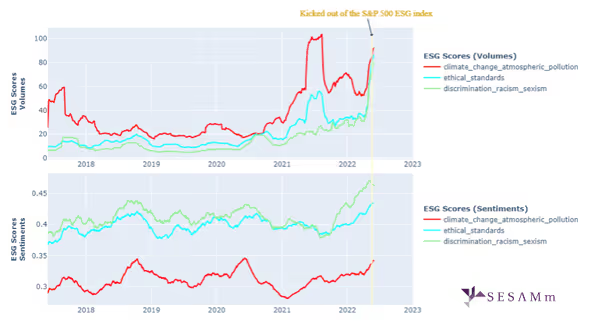
Figure 2: Tesla ESG scores for volumes and sentiments (1-year moving average), all source types, select subtopics.
Comparing Tesla’s sentiment with other S&P 500 ESG Index companies
To see how Tesla’s ESG sentiment scores compared with other companies, we must rescale them with respect to a large universe of companies. This process means that for a given company, we use percentiles of the distribution of each subtopic’s ESG score to do a rescaling to the S&P 500 ESG constituents list after the 2022 rebalancing. Rescaling allows us to compare the companies with each other because the rescaled score indicates how bad the company is compared to the others, according to a specific ESG subtopic.
The following graphs show different sets of subtopics, plotting the mean of the respective rescaled scores if several topics are considered. Here are the companies considered.
Companies removed from the index:
Tesla
Delta Air Lines
Chevron Corporation
Companies that joined the index after the 2022 rebalancing:
American International Group
Expedia Group
Companies still part of the index:
Exxon Mobil
Apple
Amazon
Tesla, Delta, Chevron, AIG, and Expedia compared
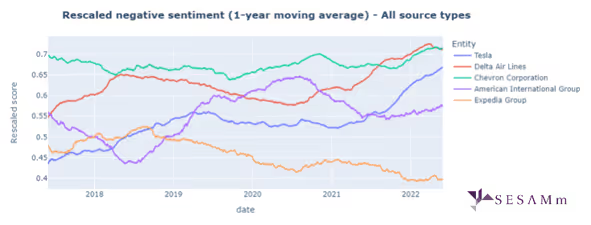
Figure 3: Six-subtopic rescaled scores for Tesla, Delta, Chevron, AIG, and Expedia.
Apple, Amazon, and Exxon compared
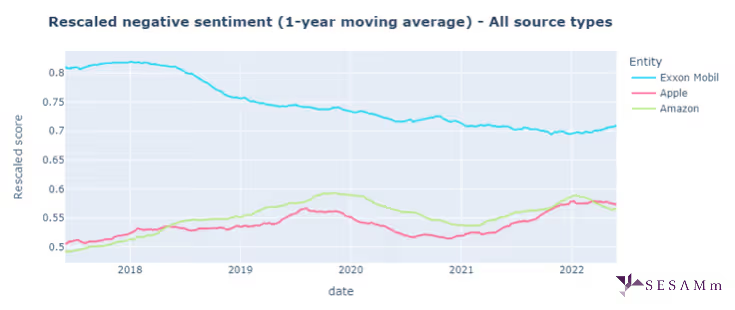
Figure 4: Six-subtopic rescaled scores for Apple, Amazon, and Exxon.
The S&P 500’s choice is reasonable
Our analysis shows that the S&P 500’s decision to oust Tesla from the ESG index is reasonable. We found significant subtopic volumes and negative sentiment that support the S&P 500’s claims of racial discrimination, poor working conditions, and other controversies.
Thanks for reading this quick analysis. For a more detailed report, including Chevron’s and Delta’s ESG scores, reach out to a representative today.
SESAMm’s ready-to-use alternative data
Leverage our alternative data streams to incorporate systematic insights into your alpha signals or risk monitoring your entire portfolio. From tracking global sentiment to analyzing retail communities like WallStreetBets and integrating ESG alternative data into your systems, our solutions will make generating value from web insights easy.

Private markets are changing fast. From new ESG regulations to advances in AI, the forces shaping investment decisions are multiplying.
Join Clarity AI and SESAMm as we explore the biggest shifts redefining private-market investing in 2026 and how data and technology are transforming due diligence, risk management, and deal flow.
Watch this replay to explore:
What shaped private markets in 2025 - and what’s ahead in 2026
How AI is transforming due diligence, risk monitoring, and value creation
What these changes mean for deal-flow, risk, and competitive advantage
Paris, France – le 1er décembre 2025 – SESAMm, leader mondial des données de controverses ESG et réputationnelles, est heureux d’annoncer que la Caisse d’Epargne Rhône Alpes, grande institution bancaire régionale française, a sélectionné la plateforme SESAMm pour renforcer son évaluation des risques ESG et son suivi des controverses dans le cadre de ses activités de financement et d’investissement.
Présente dans l’une des régions les plus dynamiques de France, la Caisse d’Epargne Rhône Alpes accompagne les particuliers, les entreprises et les collectivités locales avec des solutions de financement, des produits d’investissement et des initiatives en faveur d’un développement régional à long terme. Dans le cadre de son engagement en faveur d’une finance responsable et durable, la banque évalue systématiquement les entreprises et organisations qu’elle finance sur les risques environnementaux, sociaux et de gouvernance, ainsi que les projets qu’elle mène. Elle s’appuiera désormais sur les données de controverses ESG de SESAMm pour identifier les manquements réglementaires, les incidents environnementaux, les cas de corruption, les violations des droits humains et d’autres indicateurs de risque.
« Cette collaboration reflète notre travail croissant avec les groupes bancaires français et les institutions régionales », déclare Sylvain Forté, CEO et cofondateur de SESAMm. « Nous sommes particulièrement fiers d’accompagner la Caisse d’Epargne Rhône Alpes grâce à une couverture renforcée des entreprises locales et non cotées, un domaine dans lequel les jeux de données traditionnels manquent souvent de profondeur. Nos outils d’intelligence artificielle permettent de révéler les risques ESG les plus pertinents pour le financement et le développement régional. »
Grâce à SESAMm, les équipes de la Caisse d’Epargne Rhône Alpes bénéficient d’une visibilité en temps réel sur les risques ESG et réputationnels concernant les entreprises de la région Rhône-Alpes et du marché français au sens large. La plateforme offre un accès transparent aux sources à l’origine de chaque controverse détectée et propose un tableau de bord intuitif qui facilite les processus de due diligence. Des alertes automatisées permettent également d’identifier plus rapidement les risques émergents, renforçant ainsi la cohérence et l’efficacité des évaluations de projets.
« SESAMm a démontré une forte capacité à identifier les risques ESG concernant des entreprises locales et non cotées, un domaine dans lequel nous avons besoin d’une visibilité complète », déclare Sylvain Brissot, Directeur de la Coordination de la Transition Climatique, Caisse d’Epargne Rhône Alpes. « Nous prévoyons que les analyses de SESAMm amélioreront l’efficacité de nos évaluations ESG sur un large éventail de projets régionaux. »
À propos de la Caisse d’Épargne Rhône Alpes
La Caisse d’Epargne Rhône Alpes est une banque commerciale, régionale et coopérative de plein exercice présente sur cinq départements (Ain, Isère, Rhône, Savoie et Haute-Savoie) et sur tous les métiers de la banque. Elle agit au quotidien pour le développement de son territoire. Elle compte 1,4 million de clients, 445 000 sociétaires, 3 000 collaborateurs, 280 agences, 8 centres d'affaires.
À propos de SESAMm
SESAMm est un leader mondial des données sur les controverses, utilisant l’IA générative pour détecter rapidement les risques ESG, réputationnels et liés aux fournisseurs. Sa plateforme, propulsée par l’IA, fournit des informations en temps réel, même dans les marchés à faible niveau de transparence, sur des millions d’entreprises et de projets d’infrastructure. Elle permet ainsi de prendre des décisions plus éclairées, de renforcer la due diligence et de répondre aux exigences réglementaires à grande échelle. SESAMm collabore avec des acteurs majeurs tels que Carlyle, Warburg, Natixis, RBI, Sustainable Fitch, Oddo et bien d’autres. La société a levé 50 millions de dollars auprès d’investisseurs de premier plan et est présente sur quatre continents. Plus d’informations sur www.sesamm.com.
English
Caisse d’Epargne Rhône Alpes Chooses SESAMm to Strengthen ESG Risk Evaluation Across Regional Projects
Paris, France – December 1st, 2025 – SESAMm, a leading provider of AI-powered ESG controversy data, is pleased to announce that Caisse d’Epargne Rhône Alpes, a major French regional banking institution, has selected SESAMm’s platform to strengthen ESG risk assessment and controversy monitoring across its financing and investment activities.
Operating in one of France’s most dynamic regions, Caisse d’Epargne Rhône Alpes supports individuals, businesses, and local authorities with financing solutions, investment products, and initiatives that promote long-term regional development. As part of its commitment to responsible banking and sustainable growth, the bank systematically evaluates the companies and organizations it finances for environmental, social, and governance risks, including the projects they carry out. Caisse d’Epargne Rhône Alpes will now leverage SESAMm’s ESG controversy data to identify regulatory breaches, environmental incidents, corruption cases, human-rights violations, and other relevant risk indicators.
“This collaboration reflects our growing work with French banking groups and regional institutions,” said Sylvain Forté, CEO and co-founder of SESAMm. “We are especially proud to partner with Caisse d’Epargne Rhône Alpes by providing stronger coverage of local and non-listed French companies, an area where traditional datasets often lack depth. Our AI helps uncover ESG risks that matter most for regional financing and development.”
Using SESAMm, Caisse d’Epargne Rhône Alpes teams gain real-time visibility into ESG and reputational risks affecting companies across the Rhône-Alpes region and the wider French market. The platform provides transparent, source-level access to all detected controversies and an intuitive dashboard that simplifies due diligence workflows. Automated alerts also help teams identify emerging issues early, improving the consistency and efficiency of project evaluations.
“SESAMm demonstrated strong capabilities in identifying ESG risks among local and non-listed firms, an area where we require comprehensive visibility,” said Sylvain Brissot, Director of Climate Transition Coordination, Caisse d’Epargne Rhône Alpes. “We expect SESAMm’s insights to enhance the efficiency of our ESG risk assessments across a wide range of regional projects.”
About Caisse d’Epargne Rhône Alpes
Caisse d’Epargne Rhône Alpes is a full-service, regional cooperative bank operating across five departments (Ain, Isère, Rhône, Savoie, and Haute-Savoie) and covering all areas of banking. The bank works daily to support the development of its territory. It serves 1.4 million clients, has 445,000 cooperative shareholders, employs 3,000 people, and operates 280 branches and 8 business centers.
About SESAMm
SESAMm is a global leader in controversy data, leveraging advanced large language models and generative AI to uncover ESG, reputational, and supplier risks in seconds. Our AI-powered platform surfaces real-time insights, even in low-disclosure markets, on millions of companies and infrastructure projects, supporting more informed decisions, enhanced due diligence and regulatory alignment at scale. We work with leading firms including Carlyle, Warburg, Natixis, RBI, Sustainable Fitch, Oddo, and others. SESAMm has raised $50M from renowned investors and operates across four continents. Learn more at www.sesamm.com
The European Union stands at the forefront of global efforts to promote environmental, social, and governance (ESG) accountability. As the world becomes increasingly ESG-aware, the EU has developed a comprehensive regulatory framework designed to ensure transparency and accountability across all sectors.
These regulations represent the EU's commitment to sustainable development and responsible business practices. However, the regulatory landscape is evolving, with the February 2025 EU Omnibus Proposal introducing potential modifications aimed at reducing the regulatory burden on businesses. However, these proposals come at the risk of substantially undercutting the impact of the regulations.
This article recaps the current ESG regulatory framework in the EU, explores the changes proposed by the Omnibus, analyzes the potential impacts of these modifications, and discusses how financial institutions can navigate this evolving landscape while maintaining compliance.
The ESG Regulatory Landscape in the EU
The EU is advancing sustainability through a framework of regulations that enhance corporate accountability and reporting on ESG impacts. These measures aim to promote genuine sustainable practices and address international trade and emissions challenges. Though comprehensive, these regulations are also, at times, confusing in the way they overlap and impact each other. To get started, let’s examine the EU Taxonomy, SFDR, and CSRD—a triad of interconnected regulations designed to streamline and strengthen sustainable investing practices.
EU Taxonomy
The EU Taxonomy provides a classification system for environmentally sustainable economic activities, offering clear criteria to determine whether an economic activity can be considered "green."
Key Aspects of the EU Taxonomy
Defines criteria for environmentally sustainable economic activities
Requires companies subject to CSRD to report on Taxonomy alignment
The Taxonomy helps channel investment toward genuinely sustainable projects and businesses by creating a common language for sustainable activities.
Status
The EU Taxonomy has been operational since January 2022 with phased implementation. As of March 2025, companies subject to CSRD must disclose their taxonomy alignment percentages.
Sustainable Finance Disclosure Regulation (SFDR)
The SFDR focuses specifically on the financial sector, requiring financial market participants to disclose how they integrate ESG risks into their investment decisions and the sustainability impact of their financial products.
Key Aspects of SFDR
Requires disclosure of ESG risks in investment processes
Classifies financial products based on their sustainability characteristics
Aligns with EU Taxonomy criteria for sustainable investments
Aims to prevent greenwashing in financial products
The SFDR plays a crucial role in bringing transparency to the rapidly growing sustainable investment market.
Status
Fully implemented since March 2021, with enhanced Level 2 requirements since January 2023. All EU financial market participants must classify products under Articles 6, 8, or 9. Current market data shows that 28% of EU funds are compliant with Article 8 and 5% with Article 9, with a significant trend of reclassification from Article 9 to 8 due to stricter interpretations.
The CSRD stands as a cornerstone of the EU's ESG regulatory framework, requiring companies to report comprehensively on their environmental, social, and governance impacts. This directive mandates alignment with the EU Taxonomy, ensuring standardized reporting of sustainability metrics.
Key Aspects of CSRD
Requires detailed reporting on ESG impacts
Aligns with EU Taxonomy criteria for sustainability
Currently applies to companies with 250+ employees
Enhances corporate transparency on sustainability issues
The CSRD represents a significant step forward in standardizing sustainability reporting across the EU, providing investors, consumers, and regulators with comparable information on corporate sustainability performance.
Status
The CSRD, adopted in November 2022, replaces the Non-Financial Reporting Directive (NFRD). The transition to CSRD reporting was originally slated to begin in 2025 and would expand the number of companies subject to reporting requirements to 49,000 (vs 11,700 under NFRD). However, as we’ll see later, the Omnibus may push back the timing of CSRD.
Outside of the EU Taxonomy, SFDR, and CSRD, the Omnibus Proposal highlights two other key ESG regulations: CSDDD and CBAM. These regulations relate to corporate accountability for supply chains and to limiting carbon leakage.
Corporate Sustainability Due Diligence Directive (CSDDD)
The CSDDD focuses on corporate accountability throughout global supply chains, requiring companies to identify, prevent, and mitigate human rights and environmental risks associated with their operations.
Key Aspects of CSDDD
Requires companies to identify and mitigate human rights and environmental risks
Applies to full supply chains, ensuring comprehensive oversight
Applies to EU companies with 1,000+ employees and €450 million+ global turnover and non-EU companies with over €450 million EU turnover
Mandates regular monitoring and reporting on due diligence efforts
Strengthens corporate accountability for sustainability across operations
This directive acknowledges that a company's sustainability impact extends beyond its direct operations, encompassing its entire value chain.
Status
CSDDD was adopted in April 2024. Its phased implementation is slated to start in June 2026 and be completed by June 2028. The timing and scope of CSDDD is subject to change following the Omnibus Proposal.
Carbon Border Adjustment Mechanism (CBAM)
The CBAM is an innovative approach to preventing carbon leakage. It levies a carbon tax on imports to ensure that the EU's ambitious climate policies do not simply shift carbon-intensive production outside its borders.
Key Aspects of CBAM
Imposes a carbon tax on imported goods
Requires importers to report emissions data
Ensures payment for embedded carbon costs in imported products
Aims to prevent carbon leakage to regions with weaker climate policies
This mechanism aims to create a level playing field for EU producers subject to carbon pricing while encouraging global partners to implement similar carbon pricing mechanisms.
Status
The transitional phase for CBAM began in October 2023, with full implementation scheduled for January 2026. It currently covers cement, iron and steel, aluminum, fertilizers, electricity, and hydrogen. The certificate requirements will phase in gradually from 30% in 2026 to 100% by 2034. It’s expected to apply to 1.8 million EU importers and generate €5-14 billion in annual revenue when fully implemented.
The February 2025 EU Omnibus Proposal
Purpose and Goals
The EU Omnibus Proposal represents a significant recalibration of the EU's regulatory approach, seeking to balance sustainability ambitions with business competitiveness concerns.
The primary objectives of the Omnibus focus on alleviating regulatory burdens faced by businesses, simplifying compliance requirements, and streamlining reporting obligations. These efforts aim to enhance business competitiveness while addressing regulatory complexity concerns. By minimizing these challenges, the goal is to create a more favorable environment for businesses to thrive. However, this push for simplification could come at the expense of transparency and accountability, especially in sectors where regulation plays a protective role.
Impact Analysis: How the Omnibus Changes ESG Compliance
Below, we’ll take a closer look at each regulation and the changes proposed by the Omnibus Proposal.
EU Taxonomy Modifications and Implications
The Omnibus Proposal suggests a Level 2 modification to the application of the EU Taxonomy, reducing the number of companies required to report taxonomy alignment.
Key Changes:
Taxonomy alignment reporting is limited to companies subject to CSDDD
Voluntary reporting option for companies not required to comply
Possible Implications:
Reduced availability of standardized sustainability data
Increased difficulty in verifying "green" business claims
Higher risk of greenwashing in financial markets
Less reliable information for sustainable investors
These modifications would potentially undermine the Taxonomy's role in creating a common language for sustainable activities.
CSRD Modifications and Implications
The Omnibus Proposal significantly narrows the scope of the CSRD, reducing the number of companies required to report on ESG impacts.
Key Changes:
Threshold increase from 250+ to 1,000+ employees
Optional reporting for SMEs
A two-year delay in reporting obligations for some companies
Possible Implications:
80% reduction in companies required to report
Decreased transparency in corporate sustainability performance
Fewer sustainability data available to investors and regulators
Potential challenges in tracking sustainability progress
These modifications would substantially reduce the regulatory burden on smaller companies but raise concerns about the availability of comprehensive sustainability data.
CSDDD Modifications and Implications
The Omnibus includes significant modifications to CSDDD, with a narrowed scope and reduced monitoring requirements.
Key Changes:
Due diligence is limited to direct suppliers with over 500 employees, not full supply chains
Monitoring frequency reduced from annual to every 5 years
Delayed enforcement for one year for the first batch (Companies with 1.5 billion in turnover and 5000 employees)
Possible Implications:
Weakened corporate accountability for supply chain sustainability
Increased risk of undetected human rights and environmental violations
Reduced monitoring of global supply chain impacts
Extended timeline before full implementation
These changes would significantly reduce companies' compliance burdens but come at the risk of removing the essence of the directive, which is eliminating child labor, forced labor, etc.
SFDR Modifications and Implications
While not directly modified, changes to other regulations, particularly the EU Taxonomy, indirectly affect the SFDR.
Indirect Impacts:
Reduced availability of reliable ESG data
Challenges in differentiating truly sustainable investments
Potential increase in greenwashing risk
These indirect effects could undermine the SFDR's effectiveness in bringing transparency to sustainable investment products.
CBAM Modifications and Implications
The Omnibus Proposal simplifies CBAM compliance, particularly for smaller importers.
Key Changes:
Small importers (under 50 metric tons/year) are exempted
Reduced reporting burden for over 182,000 businesses
Possible Implications:
Simplified compliance for small businesses
Potential loophole risk if companies split shipments to stay under the threshold
Maintained coverage of 99% of emissions despite exemptions
These modifications would maintain the CBAM's effectiveness while reducing the administrative burden on smaller importers.
The Debate: Perspectives on the Omnibus Proposal
Arguments in Favor
Proponents of the Omnibus Proposal emphasize its benefits for business competitiveness and regulatory efficiency. They highlight the reduced administrative burden, especially for small and medium-sized enterprises (SMEs), which often struggle with complex regulations. Additionally, the changes aim to simplify compliance requirements, making it easier for businesses to adhere to regulations. By aligning with global standards, the proposal helps maintain the EU's economic competitiveness while promoting a more efficient allocation of resources across industries. Together, these factors create a more streamlined and supportive environment for businesses to thrive.
As BusinessEurope Director General Markus J. Beyrer stated: "Doing better with fewer and clearer norms is what European companies of all sizes are asking for. By reducing unnecessary reporting and regulatory burdens, the first Omnibus will allow companies to contribute more effectively to the EU's sustainability objectives while also preserving the EU economy's competitiveness."
European Commission President Ursula von der Leyen also expressed support for the proposal, stating: "EU companies will benefit from streamlined rules. This will make life easier for our businesses while ensuring we stay firmly on course toward our decarbonization goals."
Criticisms and Concerns
Critics raise significant concerns about the potential undermining of the EU's sustainability ambitions. They argue that the Omnibus Proposal may lead to unintended consequences, including reduced transparency in corporate sustainability performance, weakened supply chain accountability, and regulatory uncertainty during transition periods. Additionally, it could undermine sustainability objectives and increase the risk of greenwashing. As Mariana Ferreira from WWF European Policy Office commented:
"The Commission's sudden urge to destroy laws that are crucial for the achievement of the EU Green Deal is a perilous approach that is forcing Europe into a time of regulatory uncertainty. Under the guise of 'simplification,' the Commission put forward a proposal that will hinder economic and business success."
"The Omnibus proposal erodes EU's corporate accountability commitments and slashes human rights and environmental protections."
While the European Parliament debates the Omnibus Proposal, the fact remains that even if the regulations are delayed or loosened, the need for risk management remains unchanged. Investors require transparency, and companies must manage supplier risk effectively.
Navigating ESG Risks with SESAMm
SESAMm’s cutting-edge AI solutions empower investors, financial institutions, and corporations to navigate the complexities of ESG compliance with confidence. Leveraging an industry-leading data lake and state-of-the-art AI, SESAMm uncovers hidden risks in supply chains and target companies, providing real-time insights that drive proactive decision-making. By transforming regulatory challenges into opportunities for responsible and sustainable growth, SESAMm helps businesses stay ahead of evolving ESG requirements while mitigating risk and enhancing transparency.
SESAMm’s AI Technology Reveals ESG Insights
Discover unparalleled insights into ESG controversies, risks, and opportunities across industries. Learn more about how SESAMm can help you analyze millions of private and public companies using AI-powered text analysis tools.
Stay ahead with the latest in ESG and AI intelligence
Join our mailing list to receive new reports, event invites, and updates from SESAMm directly to your inbox.