EthiFinance and SESAMm create EthiMonitor powered by SESAMm
November 30, 2022
•
5 mins read
Monitoring controversies is key in the analysis of ESG company performance. Information on social climate, company reputation, incidents, and accidents is now crucial to enable banks, financial institutions, and insurers primarily to monitor the risk in their client companies' portfolios (credit risk, claims risk, reputation risk, etc.).
Since the official announcement of their partnership on controversy-detection and scoring of listed companies in December 2021, EthiFinance, the European specialist in risk analysis and financial and ESG rating, has partnered with SESAMm, an innovative company specializing in alternative data and artificial intelligence for investment, to launch EthiMonitor powered by SESAMm.
With EthiMonitor, these two industry-leading companies have together developed a co-branded ESG controversy analysis solution for any SME universe.
EthiMonitor will access SESAMm’s ever-growing data lake through its proprietary NLP technology to provide timely ESG information. The EthiMonitor product categorizes information and highlights a company’s risk and compliance with international standards (e.g., UNGC Principles, OECD Guidelines, etc.) based on EthiFinance’s controversy assessment methodologies.
The solution provides tailored coverage to clients who need to monitor controversies in SME universes (banks and financial institutions, insurance companies, asset managers, local governments, corporations, ESG associations, or regulatory bodies).
"With EthiMonitor, we bring to the market a rigorous, proprietary, and unique SME controversy analysis solution that secures risk monitoring and decision-making for all types of counterparties and stakeholders, including but not limited to financial institutions, insurers, and investors. EthiMonitor strengthens EthiFinance's ability to inform decisions that help build a sustainable economy," said Xavier Leroy, Head of Advisory Services at EthiFinance.”
“Working with EthiFinance has been a great experience as we have been able to marry our cutting-edge technology to their deep expertise in ESG,” said Sylvain Forté, CEO of SESAMm “The synergy attained by the two companies is evident in how much value EthiMonitor, powered by SESAMm offers to our mutual clients.”
Who to contact about the new EthiMonitor powered by SESAMm
SESAMm is an innovative company specializing in alternative data and artificial intelligence for investment. Its team builds analytics and indicators, such as Sentiment Analytics, ESG Indicators, and investment signals, by analyzing billions of web articles and messages using natural language processing and machine learning. With its NLP platform TextReveal®, SESAMm addresses the entire value chain of alpha research. With six offices, including Paris, New York, London, and Tokyo, SESAMm works with major hedge funds, banks, private equity firms, and corporate and asset management clients worldwide for fundamental or quantitative investment use cases, market analysis, and competitive insights.
About EthiFinance
EthiFinance is an independent European financial and non-financial consulting, research, and rating services group. EthiFinance is recognised for its methodological rigour and its original approach to double materiality, and promotes informed decision-making. EthiFinance creates trust between investors, stakeholders, and companies to support them in their societal and environmental transformations.
"EtthiFinance, a guarantee of trust for a sustainable economy."
Locations: Paris, Lyon, Madrid, and Granada - More than 100 employees - More than 300 clients worldwide
Accelerate due diligence and uncover hidden risks across your supplier network with reliable, source-backed insights.
Following the successful launch of our ESG Assessment and Secondaries & Credit Screening reports, SESAMm is excited to unveil the third report in our growing suite of AI-generated screening solutions: Supply Chain Screening.
This report is designed specifically for procurement teams, compliance officers, and risk managers who need a fast, scalable way to screen suppliers against exclusion lists, whether for onboarding, third-party due diligence, or ongoing monitoring.
With just a list of company names, the report flags potential involvement in restricted or high-risk business activities, helping you identify potential exposure to sensitive sectors such as:
Fossil Fuels & Nuclear
Weapons & Military Equipment
Predatory Lending
Gambling & Betting
Adult & Violent Content
Severe Human Rights & Labor Violations
Tobacco, Alcohol & Recreational Drugs
Each result is backed by cited sources and a clear explanation of why the company was flagged, bringing transparency to your decision-making process. Delivered in a structured, easy-to-share format, the report helps teams move beyond static exclusion lists and legacy classifications to surface material and reputational risks across their supplier network.
Supply chain complexity is growing - and so is scrutiny from regulators, customers, and investors. With SESAMm’s Supply Chain Screening Report, you can meet this challenge head-on.
As AI continues to reshape how risk and compliance teams operate, we’re expanding our report offerings to cover even more use cases and industries. Stay tuned for what’s next.
Want to see the report in action?
Contact us to learn more or request a sample tailored to your needs.
Globally, ethics and sustainability are important, but the retail industry faces intense scrutiny over supply chain integrity. This spotlight shines on SHEIN and TEMU, two giants in the fast fashion and e-commerce sectors, known for their vast reach yet marred by controversies around labor practices and environmental impacts. This article explores their supply chain strategies, examining how current and emerging legislation, like the CSDDD initiative, aims to tackle the ethical dilemmas plaguing global retail. Through a comparison of SHEIN and TEMU, we assess the effectiveness of regulatory frameworks in addressing these critical issues. By analyzing their ESG controversies and comparing their responses, we assess how well current and future legislation, particularly the CSDDD initiative, addresses ethical issues in global supply chains.
Specialized Retail: The Case of SHEIN and TEMU
SHEIN and TEMU are compelling use cases due to their past controversies and the focus on their supply chain practices. Both companies have come under scrutiny for their labor practices, environmental impacts, and ethical issues, making them ideal subjects for analysis. By studying their supply chain challenges, we aim to assess the effectiveness of current legislation and predict the potential impact of future regulatory frameworks, particularly in the context of the CSDDD initiative.
While both companies operate with a similar business model, SHEIN is an established player entangled in numerous supply chain controversies. On the other hand, TEMU, a newcomer since 2022, faces similar issues. Comparing them helps us evaluate the effectiveness of existing supply chain legislation and determine whether increased regulatory scrutiny has improved compliance or merely raised awareness of these controversies within the industry.
Note:
Size bias mitigation:
We normalized the data for both companies to ensure an equal basis of comparison, accommodating the difference in operational history—SHEIN since 2008 and TEMU since 2022— to eliminate discrepancies in web attention.
Risk analysis:
It’s worth noting that the figures presented here specifically relate to supply chain risks, as that is the primary focus of our analysis.
Examining Supply Chain Controversies
We analyzed ESG risks in the supply chains of SHEIN and TEMU over the past four years, adjusting data volumes for comparative analysis. SHEIN's supply chain risks have significantly increased since 2021, peaking in 2022 and continuing to rise in 2023, reflecting a growing online focus on its issues. Meanwhile, TEMU, despite only being established in 2022, has quickly come under intense scrutiny. The company faces frequent criticism for its supply chain practices, including condemnations for inaction and ongoing human rights violations.
Examining Social Sub-risks
In our analysis of social risks within the supply chains of TEMU and SHEIN, we discovered that fundamental human rights and labor rights are the most and second most prevalent issues, respectively. Notably, despite TEMU's more recent establishment compared to SHEIN, its supply chain has a relatively higher proportion of human rights controversies.
Both companies have faced serious allegations related to their supply chain practices. TEMU and SHEIN are scrutinized for using Chinese cotton potentially linked to slave labor, with insufficient efforts to mitigate forced labor risks. Allegations include child slavery, privacy issues related to sharing user data, and environmental neglect, including the use of carcinogens in products. Despite their efforts to boost their public image through aggressive marketing and influencer engagements, both companies have been criticized for their approach to environmental responsibility and labor practices.
Political calls for investigations into the use of Uyghur slave labor in both companies underscore their ethical challenges. Neither company has shown rigorous compliance with anti-forced labor laws, lacking stringent programs to audit supplier compliance. This highlights significant gaps in their corporate responsibility efforts.
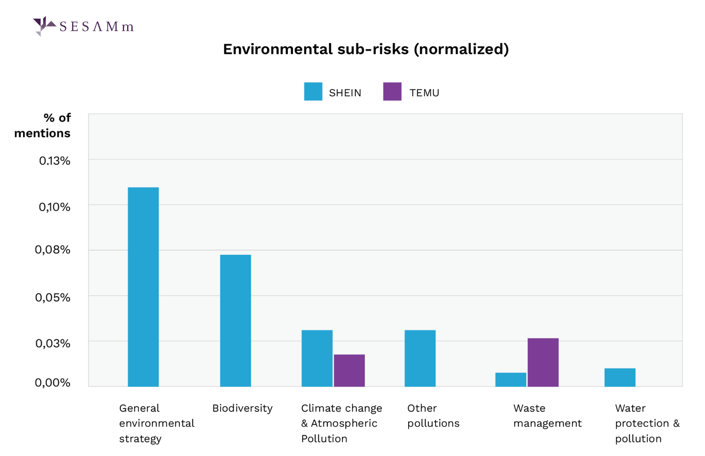
It's evident that social risks, particularly human rights breaches and labor rights controversies, have received significantly more attention than environmental risks. Despite the severity of environmental events, they represent a lower percentage in comparison. This highlights the prioritization of addressing social issues within these companies' operations.
SHEIN experiences extensive scrutiny, leading to a wealth of data on its practices. Conversely, TEMU, despite facing environmental controversies, has been less transparent about its environmental footprint, with Greenpeace reports highlighting this lack of clarity. This disparity underscores that SHEIN’s environmental impacts are more thoroughly documented than TEMU’s.
These environmental and health issues gained attention during SHEIN’s attempts to launch IPOs in the US and UK, spotlighting the company's ethical and environmental practices. Despite SHEIN's pledges to donate towards solving textile waste problems, critics label these actions as greenwashing, calling for significant alterations to its business model to address the underlying issues effectively.
Supply Chain Dynamics: SHEIN vs TEMU
While TEMU doesn't have its own brand like SHEIN, it operates under a comparable business model. It acts as an intermediary, managing shipments for products it doesn't manufacture. Despite their distinct approaches, both companies frequently engage in disputes, drawing attention to their supply chains. Additionally, policymakers often group them with similar firms, subjecting their fast fashion practices to heightened scrutiny.
These events highlight the growing scrutiny surrounding the supply chain practices of both SHEIN and TEMU. Senator Rubio's call for an investigation into allegations of Uyghur slave labor usage by both companies, additionally, mentions of Congressional attention has also focused on these companies, with reports exposing violations of U.S. tariff laws and evasion of human rights reviews on imports, shedding light on systemic issues within their operations.
Increasing Sustainability Awareness
We studied the mentions of both ESG initiatives associated with the brands and detected that over the analyzed time frame, SHEIN has been associated with significantly more initiatives than TEMU.
We analyzed the sustainability initiatives of these companies, finding that SHEIN's efforts outpace TEMU's significantly.
SHEIN focused on circular economy practices, exemplified by partnerships like that with Queen of Raw to reuse excess industry inventory and launches such as EvoluSHEIN and SHEIN Exchange, also boosting Product safety mentions, which promote recycled materials and resale of used products, respectively.
Throughout our analysis period, we noted that 2022 was a turning point for SHEIN's sustainability efforts, sparked by several mentions of breaches related to the Modern Slavery Act and child labor allegations in the previous year, which subsequently increased the company’s sustainability-related mentions. By 2023, as SHEIN prepared for potential IPOs in the US and UK and with the release of a controversial documentary, the company faced heightened scrutiny, with more allegations surfacing in its supply chain concerning various acts and legislations, such as the Modern Slavery Act, Uyghur Forced Labor Prevention Act, and others. Despite these challenges, mentions of SHEIN’s ESG initiatives also rose, although they remained less prominent than risk-related mentions due to controversies typically gaining more attention online. However, from 2024 to the present, we have observed more initiatives than risks, suggesting that, despite some acts and legislations being non-binding or not directly applicable to SHEIN, the potential reputational impacts drive the company toward positive change.
It's worth noting that we've observed discussions linking SHEIN with the recent EU Corporate Sustainability Due Diligence Directive, also referred to as CSDDD or CS3D. These discussions underscore the view that governments should refrain from incentivizing fast fashion companies like SHEIN. As the CSDDD is expected to bring about significant changes, forcing businesses to identify, prevent, or mitigate adverse impacts of their operations on human rights and the environment. Notably broader in scope compared to previous legislation, this directive will apply to all EU companies surpassing a certain revenue threshold. Consequently, fast-fashion retailers like SHEIN will face increased requirements to take action and ensure compliance.
The absence of enforceable regulations allows companies like TEMU to continue operating, but SHEIN's actions, particularly as it moves towards an IPO, raise questions about whether its efforts to improve practices are driven by the scrutiny associated with preparing for a public offering or by a sincere commitment to compliance with laws and regulations.
To conclude, our analysis underscores the dynamic landscape of supply chain regulations, ESG risks, and sustainability initiatives within the specialized retail sector, particularly in the fast-fashion industry. A focus on SHEIN and TEMU reveals a rise in both ESG initiatives and identified breaches. SHEIN's proactive initiatives suggest a response to regulatory pressures. Additionally, our findings suggest that even without binding legal requirements, companies may still choose to comply to enhance their reputation or respond to heightened scrutiny.
Reach out to SESAMm
TextReveal’s web data analysis of over five million public and private companies is essential for keeping tabs on ESG investment risks. To learn more about how you can analyze web data or to request a demo, reach out to one of our representatives.
This is from SESAMm’s Deal Screening AI report. These reports are usually used by private equity deal teams and M&A teams to conduct pre-commercial due diligence on any company or project in minutes, and they contain insights and risks on the target company as well as a full competitive and market analysis.
ManTech International Corporation is a U.S.-based defense contractor specializing in cybersecurity, data analytics, and systems engineering solutions for national security and government agencies. Founded in 1968 and headquartered in Herndon, Virginia, the company operates globally. It primarily serves U.S. defense, intelligence, and homeland security clients, delivering technology services that support mission-critical operations such as cybersecurity protection, artificial intelligence and analytics, and intelligence, surveillance, and reconnaissance capabilities.
The broader defense and intelligence services market in which ManTech operates is expanding rapidly due to rising global defense spending, geopolitical tensions, and increasing demand for advanced digital and cyber capabilities. Within this context, ManTech has recently secured several growth signals, including a $200 million cybersecurity contract with the National Oceanic and Atmospheric Administration, partnerships to deploy secure AI technologies, and major analytics and systems contracts with the U.S. Army, reflecting continued demand for its technical expertise.
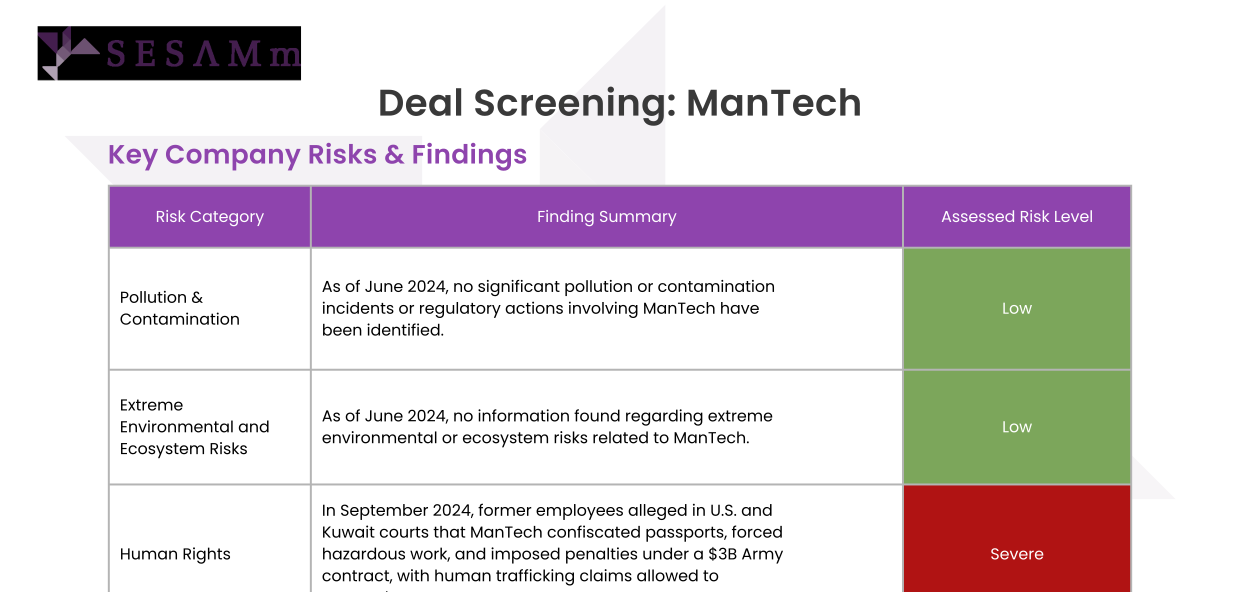
The report identifies several legal and reputational risks that could be relevant in a due diligence context. The most significant relate to labor and human rights issues, including allegations by former employees that the company confiscated passports and imposed hazardous working conditions under a U.S. Army contract in Kuwait, with a U.S. court allowing human-trafficking claims to proceed. Other previous issues include whistleblower retaliation claims linked to military contract billing practices and a civil fraud settlement involving misrepresentation of security clearance status. Environmental risks appear limited, with no major pollution or climate-related incidents identified.
In the competitive landscape, ManTech operates alongside firms such as Booz Allen Hamilton, Leidos, CACI International, SAIC, and General Dynamics Information Technology. While not the largest player in the sector, it is regarded as a capable provider of secure IT and cybersecurity solutions for classified government missions. Overall, the report concludes that ManTech benefits from strong demand for defense technology and cyber capabilities but faces reputational exposure primarily tied to labor practices and contract-related compliance risks.
Reach out to SESAMm
SESAMm’s AI Deal Screening Reports analyze web data across over five million public and private companies to help investors quickly identify legal, ESG, and reputational risks during due diligence. To learn more about how you can generate these reports or to request a demo, reach out to one of our representatives.
Stay ahead with the latest in ESG and AI intelligence
Join our mailing list to receive new reports, event invites, and updates from SESAMm directly to your inbox.



.webp)
.webp)

.png)
.png)
.png)




.png)