


Alternative Data Trends: NLP Analysis on Commercial Real Estate
July 21, 2022
•
5 mins read
Housing and construction fees have skyrocketed over the past few years. This increase goes back to multiple factors: economic unrest, raw materials disruption, and labor shortage, to name a few. What does web data have to say about all this?
In this week’s “Alternative Data Trends” issue, we’ll talk about commercial real estate, unveiling the industry’s ESG and SDG conformity and the effects of COVID-19 on the supply chain and labor.
Commercial real estate volume of mentions
While analyzing web data dealing with commercial real estate, we detected an evident increase in the industry’s volume of mentions. This trend spiked in April 2020 and was initially hindered by the COVID pandemic, which resulted in a drop in sentiment polarity. Still, it witnessed a rapid recovery leveraging digitalization and e-solutions (Figure 1).
Figure 1: Commercial real estate market mentions Feb 2015 to Mar 2022.
Case study: Unibail-Rodmaco-Westfield
To further understand the commercial real estate industry, we studied Unibail-Rodamco-Westfield and its competitors. Unibail-Rodmaco, a French commercial real estate company, acquired Westfield, a U.S. company, in December 2017. This acquisition accentuated its market share and grew its web voice share compared to its competitors (Figure 2).
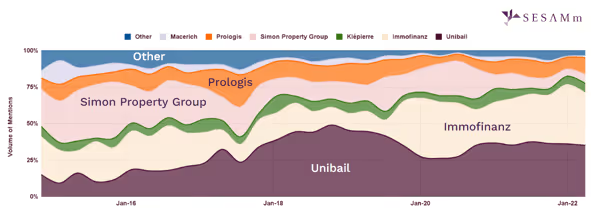
Figure 2: Unibail volume of mentions compared to the market.
The chart in Figure 3 shows that the company’s volume of mentions has been increasing ever since the acquisition occurred. However, a negative sentiment polarity has been steadily increasing due to social ESG risks related to collective health crises during COVID and security-disrupting threats. In addition, the company faced difficulties collecting rent from retailers leading to lawsuits.
The arrows in this chart indicate Unibail ESG risks in time. The first arrow points to the social risks generated by security threats, in 2016, and the second arrow points to the issue of unpaid rent and lawsuits filed regarding the matter, in 2020.
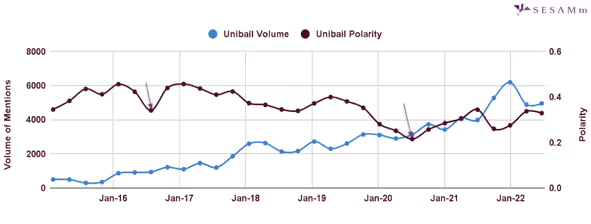
Figure 3: Unibail ESG risks.
According to web data, Unibail has the second highest volume of sustainability mentions among analyzed groups. The company was notably related to sustainable development goals number 8* and number 12**. This volume is manifested in their initiatives to help unemployed people and maintain sustainable ethics and practices when launching their malls and shopping centers (Figure 4).
* Social development goal for decent work and economic growth.
** Social development goal for responsible consumption and production.
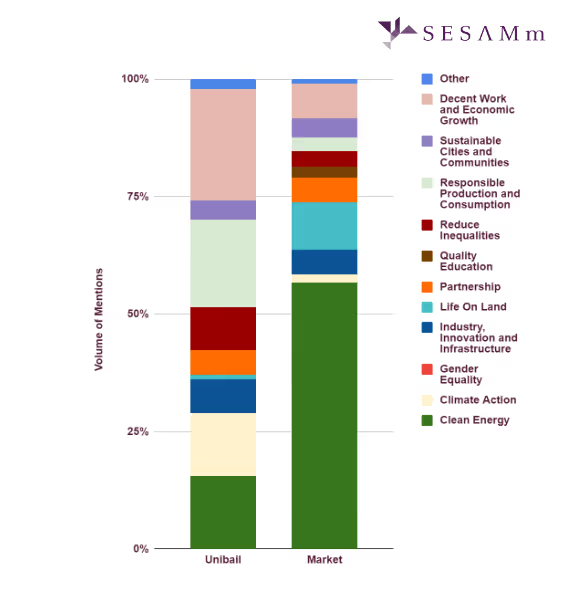
Figure 4: Unibail SDG volume of mentions compared to the market.
The impact of COVID on the emerging commercial real estate market
As previously mentioned, COVID had several effects on the industry, both negative and positive. Furthermore, it reshaped the market and its work policies. Some companies, as well, chose to switch to remote work and digitalization. In Figure 5, we can see that sentiment related to remote work policies has steadily improved since the pandemic started. However, in the last few months, we’ve seen a sharp decline, potentially signaling a negative reaction to some companies requiring employees back to their offices.
Figure 5: Remote work policies’ volume of mentions.
In addition, the pandemic has resulted in labor shortage and supply chain disruption, eventually leading to tremendous inflationary pressure. Raw materials prices, including oil, gas, iron, and wood, have witnessed a drastic increase and a disequilibrium between the volume of demand and the quantity available (Figure 6).
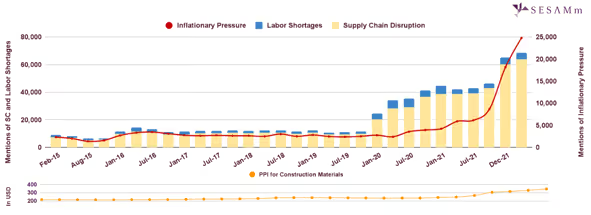
Figure 6: Labor shortage and supply chain disruption Feb 2015 - Dec 2021.
Data source
To produce this analysis, we combined natural language processing with billions of textual web data related to the real estate market, commercial real estate in particular. Using NLP-powered models gives us an edge as we can extract ESG, SDG, and financial insights that aren’t necessarily obvious or easy to detect. These insights help investors make better investment decisions.
SESAMm leverages artificial intelligence and machine learning to help you decipher and understand timely sentiments, trends, and ESG metrics on a wide range of public and private companies.
Stay in touch with SESAMm
Thanks for reading this issue of Alternative Data Trends. Be sure to catch the next issue by subscribing to our blog. And if you'd like a TextReveal® demo, send us a message via the form.

Identifying environmental, social, and governance (ESG) controversies is a complex challenge. The large amount of data that is added to the web daily makes it difficult to analyze, leaving important insights hidden among irrelevant information. Traditional risk identification methods struggle with this, making it difficult to uncover critical issues that could impact investments.
This article explores the intricacies of ESG data trends. As businesses worldwide strive to adopt more sustainable and ethical practices, the importance of ESG metrics has risen to the forefront of strategic planning and public discourse.
Identifying Controversies with AI
Traditional controversy detection methods often need help uncovering hidden risks buried within unstructured sources like social media, local news, and niche industry reports. This section explores the advantages of using AI tools—such as natural language processing and machine learning—to detect these risks more accurately and efficiently. By leveraging AI, firms can gain deeper insights and respond proactively to emerging ESG issues, ensuring more robust risk management and informed investment decisions.
Key Challenges in Identifying ESG Controversies
In the finance world, especially when dealing with small companies, sometimes private, identifying ESG controversies presents significant challenges. These companies often lack extensive public records, and the data that is available can be sparse, fragmented, or hidden within vast amounts of irrelevant information. Traditional methods of risk identification struggle to navigate this sea of digital noise, making it difficult for private equity firms to uncover critical issues that could impact their investments.
One of the primary hurdles is the lack of valuable, structured data on smaller firms. Unlike large corporations, which are often required to disclose detailed financial and operational information, small private companies might operate with minimal public visibility. This opacity complicates the identification of potential ESG risks, as relevant data is often buried in unstructured sources like social media, local news, or niche industry reports. The challenge is not just about finding information but also about extracting meaningful insights from a diverse array of sources that may not adhere to standardized reporting practices.
Additionally, the diversity in language and terminology used by smaller firms further complicates the identification of ESG controversies. Risks are often discussed in context-specific ways, using industry jargon or localized expressions that do not easily translate into a standard risk assessment framework. This linguistic variation can lead to misunderstandings or even the complete overlooking of critical ESG issues. Therefore, private equity firms require advanced tools capable of interpreting and standardizing this information to ensure comprehensive risk identification.
Artificial Intelligence vs. Traditional Methods
Artificial Intelligence (AI) has emerged as a game-changing tool for identifying ESG controversies, offering significant advantages over traditional methods. While conventional approaches rely heavily on structured data from formal reports and disclosures, AI technologies, such as natural language processing (NLP) and machine learning, can analyze vast amounts of unstructured data from diverse sources. This capability is particularly crucial for private equity firms focused on small companies, where relevant information may be scattered across social media posts, obscure local news articles, and other non-traditional outlets.
Traditional methods often fall short in dealing with the unstructured and fragmented nature of data related to smaller firms. These methods might miss emerging controversies discussed informally in niche blogs or industry-specific forums. In contrast, AI-powered tools can continuously monitor these sources in real time, identifying potential ESG risks before they escalate. This proactive approach allows firms to address issues early, providing a more comprehensive and nuanced understanding of the risks associated with their investments.
Moreover, AI's ability to process and analyze diverse languages and terminology offers a significant edge. By decoding industry-specific jargon and translating localized expressions into a standardized risk framework, AI helps private equity firms overcome the linguistic barriers that traditional methods struggle with. This capability ensures that no critical ESG controversy is overlooked due to language differences, thereby enhancing the accuracy and effectiveness of risk assessments.
To sum it up, while traditional methods have their place, AI technologies provide a more robust, dynamic, and precise approach to identifying ESG controversies. By leveraging AI, private equity firms can better navigate the complexities of data sourcing, interpretation, and risk management, ultimately leading to more secure and informed investment decisions.
Streamlining ESG Controversy Detection with AI
Detecting ESG controversies with AI involves several crucial steps, each contributing to the precise identification of potential risks. The attached diagram illustrates a generalized AI-driven approach to detecting ESG controversies.
Step 1: Data Collection
The first step in this AI process is collecting vast amounts of web-based information to create a comprehensive data lake. This data lake acts as a repository, storing raw data in its original format. AI systems thrive on large datasets to enhance accuracy, and the data lake ensures that this requirement is met by allowing real-time data ingestion. By preserving historical information, the system can perform trend analyses that are crucial for identifying emerging controversies.
Step 2: Organizing & Cleaning the Data
Once collected, the data undergoes an essential organization and cleaning process. This step involves standardizing and categorizing the data to make it more accessible for analysis. By filtering out irrelevant information and tagging essential data points, the system can quickly and efficiently process large datasets. This organization allows for faster analysis and ensures that only the most relevant information is considered, eliminating the noise that can obscure critical insights.
Step 3: Connecting the Dots
With the data organized, the AI system creates a Knowledge Graph (KG) that maps the relationships between key entities, topics, and themes. This step is crucial for understanding how different companies, products, and brands are interconnected. The Knowledge Graph is continuously updated to reflect new data, ensuring that the system remains accurate and relevant in its analysis.
Step 4: Adding Contextual Understanding
The AI system then moves on to interpret the text, employing various techniques such as Named Entity Recognition (NER) and lemmatization. These tools help the system identify and classify key elements within the data, allowing it to grasp the context and main points of the information. This step is vital for accurately understanding the specific topics and issues related to each company, enabling the system to group related articles and monitor the evolution of controversies.
Step 5: Analyzing with Algorithms
In this step, the AI applies sophisticated algorithms to the organized and contextualized data. These algorithms focus on uncovering insights such as sentiment analysis, ESG controversies, and impacts of Sustainable Development Goals (SDGs). The system continuously refines these algorithms to maintain high levels of accuracy and performance, ensuring that the analysis remains relevant as new data becomes available.
Step 6: Turning Analysis into Actionable Insights
Finally, the AI system transforms the analysis into actionable insights. By delivering these insights in a fast and easy-to-understand format, the system empowers users to make informed decisions quickly. For example, a controversy intensity score might be used to prioritize which issues require immediate attention, allowing users to focus on the most significant risks in their portfolios.
This AI-driven process, depicted in the attached diagram, showcases the streamlined approach to detecting ESG controversies, providing private equity firms with the tools they need to manage risks effectively and maintain a competitive edge in the market. For more detailed information on how SESAMm identifies insights with AI, please efer to this document.
Conclusion
To sum up, identifying ESG controversies, particularly in smaller, less visible companies, presents significant challenges for traditional risk assessment methods. However, integrating artificial intelligence offers a transformative solution. AI tools can effectively analyze vast amounts of unstructured data, revealing hidden risks and enabling informed investment decisions. As the demand for sustainable and ethical practices grows, leveraging AI will enhance risk management and foster responsible investment approaches, allowing firms to navigate the complexities of ESG data more effectively.
Reach out to SESAMm
TextReveal’s web data analysis of over five million public and private companies is essential for keeping tabs on ESG investment risks. To learn more about how you can analyze web data or to request a demo, reach out to one of our representatives.
SESAMm is pleased to announce the appointment of Steven Carroll to its Advisory Board. Over a career spanning more than 25 years, Steven has built a uniquely broad perspective on financial data, having operated at a senior level across every major corner of the industry, from quant analytics and content to AI-powered research tools and global data platforms.
A Career at the Heart of Financial Data
Steven has seen financial data from every angle: quant analytics at StarMine, content and indices at Thomson Reuters, and AI-powered search at AlphaSense. At Refinitiv and then LSEG, he took on progressively broader remits, culminating in his role as Head of Customer Strategy and Execution, where he was responsible for go-to-market across Workspace, Data and Feeds, FTSE Russell, and Risk Intelligence and Analytics. Throughout, Steven's roles have sat at the intersection of product, marketing, and sales, spanning multiple geographies, including Australia, Singapore, the UK, and the United States.
Deep Roots in the Institutions and Workflows SESAMm Serves
Steven is a subject-matter expert on the content sets and workflows that underpin institutional investment and risk management, including fundamental data, estimates, broker research, ESG, sentiment, and credit analytics. He has also worked closely with the firms that consume this data, from private equity and asset managers to commercial banks and insurers, giving him a first-hand understanding of how they evaluate, adopt, and integrate new data and analytics tools into their processes.
Expanding SESAMm's Reach Across Global Financial Markets
Steven's appointment comes as SESAMm continues to expand its AI-powered risk intelligence platform and deepen its relationships with private equity firms, asset managers, commercial banks, insurers, and financial institutions globally. His perspective will provide valuable insight, bringing a practitioner's understanding of how financial data businesses grow and scale.
Steven is also the founder of CCAS (Carroll Consulting and Advisory Services), a London-based advisory practice supporting startups and established vendors across the information services ecosystem. He is a Fellow of the Chartered Management Institute and the Institute of Consulting, a member of the Institute of Directors and the CFA Institute, and serves on the Board of Governors at Greenwich Waldorf School.
We're thrilled to welcome Steven to SESAMm's Advisory Board and look forward to working together as we continue advancing AI-powered risk intelligence for investment firms and corporations worldwide.
The aerospace and defense industry is essential to global technology and transportation, playing a crucial role in maintaining international security and connectivity. However, this sector faces intense scrutiny due to its significant impact on environmental, social, and governance (ESG) factors. Amidst challenges like safety lapses and whistleblower revelations, stakeholders are increasingly relying on advanced AI technologies to gain insights into potential controversies. Such technologies have enabled a deeper understanding of the complex ESG issues that permeate the industry, revealing not only the specific challenges faced by companies like Boeing but also providing a broader view of the sector's commitment to corporate responsibility and sustainability. This article explores the aerospace industry and its ESG challenges, backed up by a case study of industry giant Boeing. It also explains how we used SESAMm’s AI-powered tools to detect these controversies beforehand.
This article is a preview of the webinar entitled "The Boeing Scandal: Can AI Predict Controversies Before Traditional Tools?" based on SESAMm's proprietary research. Sylvain Forté, CEO and Cofounder, and Emna Abid, Research and Analytics Team Lead at SESAMm, will lead the webinar and will share SESAMm's findings in detail on the Boeing case and the use of AI to detect these types of controversies ahead of time.
Aerospace and Defense Market Mentions
The top market players in the aerospace and defense industry command 8.3% of the overall market's online mentions. This sector is increasingly scrutinized for its ESG practices amidst technological advancements and global policy shifts.
Overview
Our study processed our large data lake to identify key aerospace players: Northrop Grumman, Lockheed Martin, General Dynamics, Airbus, and Boeing, from 2015 onwards. It found a surge in online mentions, especially after Boeing's plane crashes post-2018. Both Airbus and Boeing saw increased attention, highlighting the competitive and evolving aerospace industry, where online presence correlates with market position shifts and significant events.
Polarity, indicating a company's mix of positive and negative opinions, ranges from -1 to 1. A zero score shows equal positive and negative sentiment. Brands with high e-reputation often score above 0.5. The aerospace market experiences significant highs and lows. Lockheed Martin has seen a positive impact from new contracts and technological advancements, particularly between 2016 and 2018, boosting its reputation and value. In contrast, Boeing faces significant challenges due to safety lapses, including 737 MAX crashes, legal issues, and whistleblower claims, negatively affecting its perception and highlighting the industry's vulnerability to reputational risks.
Deep Dive: Boeing
The aerospace industry has faced increasing scrutiny over its ESG practices. Among the key players, the American aerospace company Boeing has been prominently featured in media discussions, not only due to its market distinction but also because of its ESG challenges that have sparked significant controversy.
Boeing Word Cloud
The word cloud displays key topics about Boeing, particularly the 737 Max controversies, including safety issues and FAA oversight. "737 Max," "Boeing," "safety," "death," and "FAA" are the main terms that show their prominence in discussions. The visualization also touches on "lawsuits," "Senate hearings," and "missed inspections," indicating the wide range of concerns surrounding Boeing's regulatory, safety, and ethical challenges.
Conclusion
These incidents underscore the aerospace industry's urgent need for reforms to prioritize safety and ethics over profit. SESAMm's TextReveal® platform plays a key role in detecting such ESG controversies early by analyzing vast amounts of data and helping stakeholders understand and address the intricacies of corporate accountability and regulatory compliance.
Reach out to SESAMm
TextReveal’s web data analysis of over five million public and private companies is essential for keeping tabs on ESG investment risks. To learn more about how you can analyze web data or to request a demo, reach out to one of our representatives.
Stay ahead with the latest in ESG and AI intelligence
Join our mailing list to receive new reports, event invites, and updates from SESAMm directly to your inbox.