
SESAMm Introduces its Latest AI Report: The Good Governance Report for Faster, Defensible Risk Assessment
•
5 mins read
Verify governance alignment and uncover early warning signs with AI-generated insights.
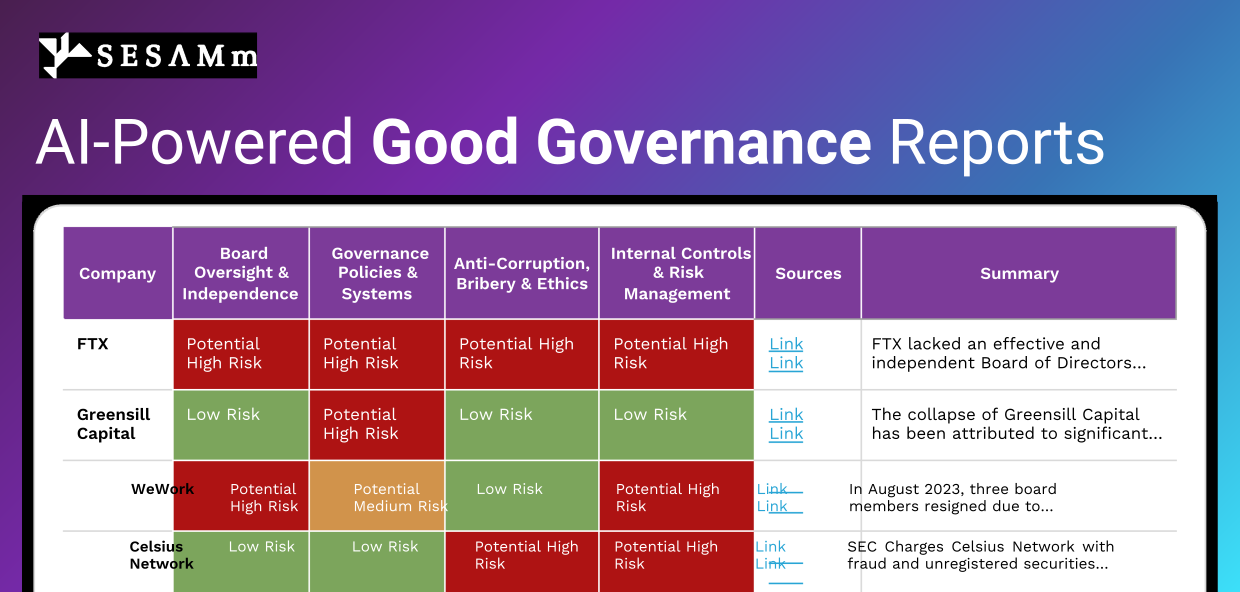
With rising regulatory expectations and increased scrutiny on corporate governance, investors need fast, reliable ways to assess governance risk. SESAMm’s Good Governance AI-generated report delivers a rapid, data-driven assessment of governance alignment and structural risk indicators. It helps professionals verify regulatory requirements and detect early warning signs before they escalate.
Accelerating Governance Risk Assessment
As scrutiny around corporate governance intensifies, particularly under the Sustainable Finance Disclosure Regulation (SFDR), investors are expected to demonstrate robust good governance checks. Traditional governance analysis often requires time-consuming reviews of disclosures, board composition, NGO reports, and news.
SESAMm’s Good Governance Report automates this process. Our technology analyzes millions of documents and news sources to surface governance-related risks across millions of public and private companies worldwide.
Each report is generated automatically in minutes and includes:
A clear risk level
A structured summary of findings
Verifiable source references for transparency and audit readiness
This ensures governance assessments are fast, explainable, and defensible.
Strengthening Governance Checks at Every Stage
The Good Governance Report supports professionals across pre-investment, transaction, and ongoing monitoring workflows:
Carry out SFDR governance checks: Accelerate mandatory good governance checks for Articles 8 and 9
Early warning signals: Identify signs of board dysfunction, weak oversight, unethical practices, or financial mismanagement before they escalate.
Accelerated due diligence: Provide a fast, structured view of risks, reducing manual screening time.
Consistent, scalable assessments: Every company is evaluated using the same methodology, ensuring comparability across portfolios.
By combining AI-powered text analysis with structured risk categorization, SESAMm enables professionals to go from question to insight - and from risk to response - faster than ever.

Forced labor remains among the most pressing human rights challenges for companies worldwide. Despite stronger regulations and corporate pledges, millions remain trapped in exploitative conditions, often deep within complex global supply chains.
As new laws increase scrutiny and liability, the cost of blind spots is rising. Investors, corporates, and private equity firms alike must now demonstrate active due diligence or face legal, financial, and reputational consequences.
In this whitepaper, SESAMm explores:
The tightening global regulatory landscape on forced labor
Exclusive data-driven insights from SESAMm’s AI platform on labor-related controversies
Real-world case studies revealing how risks can remain hidden despite compliance efforts
Download the report to learn how data and AI are transforming the fight against forced labor - and how organizations can move from reactive to proactive risk management.
As the year closes, it's time to reflect on some of your favorite pieces of content, so we've compiled a list of the top 8 blog posts highlighting the most popular and insightful content we've published. From investor guides to detecting greenwashing practices, these posts have resonated with you, our readers, and hopefully, continue to provide valuable information and inspiration. Join us as we look back at the top 8 posts of the year and see what made them stand out.
This piece explains the pivotal role of knowledge graphs in enhancing text analysis for investors. It clarifies how these graphs contribute to a more nuanced understanding of data, aiding in investment decisions. Readers appreciated the clear, practical insights into how knowledge graphs strengthen SESAMm’s cutting-edge AI technology.
In this article, Sylvain Forté presents an optimistic view of the future of AI in the financial sector, focusing on the rapid advancements in AI. He discusses how these technologies are evolving and what this means for investors and companies alike. Readers were captivated by the forward-looking perspective and practical implications of these innovations.
This article serves as a guide on the relationship between Sustainable Development Goals (SDGs) and AI. It explains how AI facilitates the identification and tracking of SDG-aligned investment opportunities. Our audience found the straightforward approach and practical examples particularly enlightening for understanding the intersection of sustainability and technology.
Highlighting SESAMm's innovative approach, this piece details the incorporation of generative AI into ESG risk mitigation. It underscores the significant improvements in process efficiency and accuracy, which resonated well with our audience, particularly those keen on technological advancements in finance.
This guide offers a practical look at how AI is revolutionizing and simplifying ESG data for investors. It provides real-world examples and strategies, making it a favorite among readers for its direct application in their investment processes.
This article addresses the increasingly relevant issue of greenwashing, showcasing how AI tools are employed to detect and mitigate it. The relevance of this topic in today’s sustainability-focused investment landscape made this article highly popular among our readers.
This comprehensive ebook gained popularity for its detailed exploration of AI’s role in distinguishing between genuine and deceptive sustainability initiatives. It provided readers with a deeper understanding of the intricacies involved in evaluating sustainability claims, making it a valuable resource. Download the ebook.
Topping our list is the announcement of SESAMm’s Series B2 funding. This milestone article not only signifies SESAMm's growth and success but also reflects the increasing importance of ESG and sentiment analysis in the financial world. The article’s blend of business success and industry relevance made it the year’s highlight for our readers.
Thank you for reading through this year's eight most popular blog posts. Which is your favorite, and how would you rate them?
Today, environmental, social, and governance (ESG) criteria have become critical in shaping companies' operational and strategic directions. As organizations strive to align with the United Nation’s sustainable development goals (SDG), understanding the variances in ESG performances across different geographical regions becomes crucial. This article explores ESG discrepancies in North America, Latin America, Europe, Australia, Asia Pacific, and Emerging Countries. By dissecting the prevalent ESG risks and illustrating the distribution of SDG adverse behaviors within these regions, we aim to provide a granular analysis that not only highlights regional challenges but also paves the way for tailored strategic frameworks. This nuanced approach facilitates an informed assessment of disparities, empowering stakeholders to craft effective and regionally nuanced strategies.
ESG Overview: A Regional Perspective
Upon standardizing data across the examined regions, our analysis unveiled a predominance of social risks across the board. Yet, the regional specificities unveil the complexity of global ESG landscapes.
Fig 1: ESG Risks by region
Upon standardizing data across the examined regions, our analysis unveiled a predominance of social risks across the board. Yet, the regional specificities unveil the complexity of global ESG landscapes.
Europe emerges as a hotbed for governance-related risks, particularly emphasizing influence strategy and communication. European companies find themselves at the correlation of controversies ranging from greenwashing and emissions cheating to governance failures, spotlighting the complex governance terrain they navigate.
While grappling with governance risks, North America and Australia exhibit unique profiles. North American firms face various governance challenges, from securities fraud to greenwashing, painting a complex picture of corporate governance in the region. Australian companies are likewise embroiled in governance concerns, predominantly linked to senior management and regulatory compliance, reflecting the governance trials specific to the Australian context.
This multifaceted overview underscores the broad spectrum of ESG risks while illuminating the distinctive challenges faced by each region.
UNSDG Adverse Behaviors: Regional Breakdown
When looking at UNSDG adverse behaviors for the same regions, we find regional trends and more generalized ones. For example, Goal 1, “End Poverty,” displays one of the highest breach rates of all the goals. Whereas Goal 6 - Clean Water and Sanitation, displays interesting discrepancies, mainly exposing differences between developed and developing countries.
The table below provides a detailed comparison of SDG adverse behaviors across regions, categorizing them by specific goals to highlight regional differences in SDG challenges.
Fig 2: SDG breach/region
Goal 1, "End Poverty," is the most prevalent SDG issue across all areas. Europe is experiencing the most significant impact due to various factors, including labor rights issues, human capital concerns, governance challenges, anti-competitive practices, and tax controversies.
Similarly, Goal 16, "Peace, Justice, and Strong Institutions," underscores significant issues in North America related to human rights, labor, management integrity, anti-competitive actions, tax strategies, corruption, and shareholder matters, driven largely by flaws in the criminal justice system, including over-incarceration, racial bias, and police misconduct. These problems undermine public trust and equality, highlighting the need for governance improvements despite North America's strong institutional base.
Emerging countries face the greatest challenges with Goals 3 and 11, "Health & Well-being" and "Sustainable Cities," respectively, due to inadequate healthcare infrastructure, disease prevalence, limited healthcare access, poor sanitation, pollution, overcrowding, and substandard urban planning. Addressing these issues requires substantial healthcare, sanitation, and sustainable urban development investments to mitigate risks.
UNGC Controversies: A Regional Analysis
Our exploration extends to aligning ESG controversies with their respective regions and assessing the proportion of these risks aligning with breaches of the United Nations Global Compact (UNGC) principles.
Fig 3: UNGC breaches by region
Latin America emerges as the frontrunner in this evaluation, demonstrating a noteworthy prevalence of breaches, particularly within the environmental pillar. Notably, the focal point centers on environmental damages attributed mostly to mining and metals companies.
Australia is marked by a significant number of controversies surrounding human rights violations. These encompass various instances, ranging from privacy breaches and infringements on the right to security and dignity and diversity & inclusion. These incidents have garnered considerable attention, contributing to the heightened significance of regional human rights breaches.
In North America, despite a considerable share of human rights breaches, it distinguishes itself by exhibiting the highest prevalence of labor rights violations. In contrast to other regions, North America faces a substantial number of lawsuits related to employment, particularly concerning diversity and inclusion breaches, including harassment lawsuits and instances of racial bias.
European companies distinguish themselves through notable instances of Anti-corruption pillar breaches, including multiple failures in money laundering investigations, legal actions resulting in lawsuits and fines, as well as settlements for bribery allegations and accusations of kickbacks.
Latin America's environmental controversies, Australia's human rights challenges, North America's labor rights issues, and Europe's anti-corruption breaches each tell a part of the global ESG narrative, demonstrating the diverse facets of regional ESG controversies.
Leveraging SESAMm for Insightful ESG Analysis
SESAMm's technology identifies and analyzes potential risks and controversies through our advanced AI-powered text analysis tool, providing essential insights for stakeholders. This capability is invaluable for organizations, particularly private equity firms and financial institutions, aiming to navigate ESG complexities. By leveraging SESAMm's insights, businesses can adapt their ESG strategies to their regional contexts' unique challenges and opportunities, ensuring global sustainable and responsible operations.
Conclusion
To summarize, this analysis underscores significant regional differences in ESG factors, with social risks emerging as a common concern worldwide. Yet, regional distinctions are evident: Latin America is particularly impacted by environmental issues, Europe grapples with governance risks, and emerging nations face a surge in social controversies. The detailed analysis of SDG adverse behaviors, organized by goals for each region, highlights these differences further. It is imperative for companies to recognize and adapt to these regional nuances in their ESG strategies, ensuring approaches are finely tuned to address the distinct risks and challenges prevalent in their specific operational environments.
SESAMm’s AI Technology Reveals ESG Insights
Discover unparalleled insights into ESG controversies, risks, and opportunities across industries. Learn more about how SESAMm can help you analyze millions of private and public companies using AI-powered text analysis tools.
Stay ahead with the latest in ESG and AI intelligence
Join our mailing list to receive new reports, event invites, and updates from SESAMm directly to your inbox.