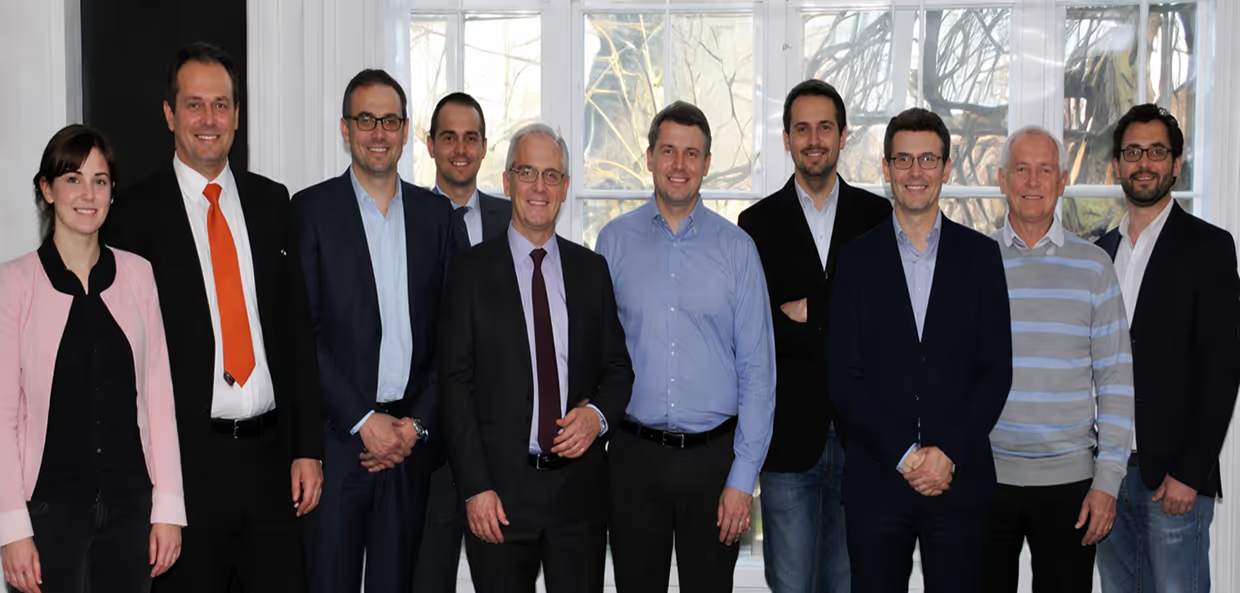

FinTech and Big Data for financial markets – SESAMm raises €2.6 million Euros. Objective: to accelerate its international development!
SESAMm – a specialist in the exploitation of applied Big Data to asset management – has just finalized a capital raise representing a new acceleration phase of its growth. The company is aiming to become a leader in the fields of alternative data and artificial intelligence for the financial markets.
Innovative and powerful solutions to forecast the markets
SESAMm, with its offices in Metz, Paris and Luxembourg, developed two highly innovative asset management solutions to forecast the markets. The first solution, since 2014, is the Data Stream Premium, a predictive trading signal generation service based on Big Data and artificial intelligence. It enables the alternative Investment Funds and the Hedge Funds to generate outperformance in the financial markets, and this first solution attracted major players in the sector.
In 2017, L’Humeur des Marchés was launched, a data visualization platform as well as an API access (Programming Interface), which offers alternative analysis and data on many thousands of assets, available in 8 languages including Chinese and Japanese. This perfectioning of the algorithms and tools, which improves the arbitration decisions, the research and exploitation of market opportunities, increases the international notoriety of SESAMm.
“The American multinationals are interested in us, this is very promising.” reveals Sylvain Forte, co-founder and CEO of SESAMm. “In one year, we have almost doubled our staff and we plan to hire more than a dozen of new employees until the end of 2018 in fields such as data science, software development, automatic language processing, and quantitative analysis. We have the objective of doubling our turnover for the year 2018 and we are aiming €20 millions of turnover by 2021.“
An expanding Startup
Today, the startup SESAMm has offices in 3 cities in France and Luxembourg; SESAMm has 18 employees and relies on top profiles in the fields of artificial intelligence and quantitative analysis. Its commercial activity is booming, with the recent signing of two big agreements with Nikko Global Wrap (one of the subsidiaries of Sumitomo Mitsui Asset Management, a major asset manager in Japan) managing JPY 1.7 trillion and La Française Investment Solutions, a subsidiary of the Group La Française (in the top 10 of asset management in France, managing $64 billion).
“Our objective is to enhance our positioning in France and then in Europe, particularly in the beginning of this year with a new subsidiary in London. Our development will also go through the United States. The growth prospects of our market are strong: from $67 billion in 2014, the market for software for asset management should grow to nearly $104 billion in 2019 according to MarketsAndMarkets”, stated Sylvain Forte.
Capital raising: confidence and growth
The bank “Caisse d’Epargne Lorraine Champagne-Ardenne” and the fund “Fonds Venture Numérique Lorrain” are the main investors in this capital raising in which BPI, the bank “Banque Populaire de Lorraine”, the network of “Bourgogne Angels” and other national and international business angels have confirmed and renewed their support and participation. And thanks to their supports, SESAMm can accelerate its national and international growth.
“We are proud for being the first investors to believe in the potential of SESAMm and we are looking forward to this new capital raising,” explains Marie Tribout, chairman of the fund “Fonds Venture Numérique Lorrain”. “We participate in this capital raise for two main reasons: first, our conviction about the relevance of the SESAMM project and its team excellence; secondly, this participation is part of our Neobusiness system extension, which is based on supporting closely the growth of startups in our region.” said Benoît Mercier, chairman the bank “Caisse d’Epargne Lorraine Champagne- Ardenne”.
“Our partners trust is precious” explains Pierre Rinaldi, co-founder and COO of SESAMm.” It validates the excellent performance of our technologies, which are improved continuously by our R & D center. We have new applications in the works.”
For this fundraise, SESAMm has been helped by Eric Bezard, specialist in administrative and financial management and equity capital markets, from the financial consulting firm TMA. SESAMm was also helped by the Parisian business lawyers firm Orrick with a team led by George Rigo, associate, with his collaborators Olivier Vuillod and Cécile Renaud.
Unique and innovative technologies
“SESAMm is a valuable partner for Eagle Alpha”, said Hugh O’Connor, the director of Data Sourcing and Partnerships at Eagle Alpha. “The SESAMm products provide a level of scientific rigor, transparency and flexibility that distinguishes the company from other market players.”
“The French Investment Solutions is collaborating with the SESAMm team in order to explore potential investment approaches based on artificial intelligence. The LFIS (La Française Investment Solutions) uses SESAMm technologies in order to exploit the Big Data in the field of quantitative management “, said Guillaume Garchery, the portfolio manager and head of the quantitative research R&D at La Française Investment Solutions.

Sustainability trends have become ubiquitous in the business world, mainly due to the attention ESG is receiving. To state the obvious, this is a positive trend as it helps push companies to consider their impact on the environment, employees, and customers and ensure their governance practices are sound. However, it also incentivizes actors in the business world to try to game the system through marketing campaigns to improve their reputation.
Through the use of artificial intelligence and other technologies, we embarked on a mission to analyze the sentiment on the web and uncover to what extent companies are incurring reputational laundering techniques to deceive investors, customers, and other stakeholders but also to identify the ones that are actually performing actions to have a positive impact around them.
This analysis dives into the concept of greenwashing and reputational laundering. It reveals the nuanced interplay between genuine sustainability efforts and deceptive practices, offering a new lens to distinguish genuine from false corporate sustainability claims.
Beyond Greenwashing: Reputational Laundering
Let’s start with some definitions. Reputational laundering is deliberately hiding unethical behavior with highly visible positive actions. Greenwashing is just one component of reputational laundering. Another component is the social aspect of it, and it includes various forms of color washing such as purplewashing, pinkwashing, purpose washing, etc. So far, in 2023, greenwashing accounted for 55% of all the volume of reputational laundering mentions on the web. So, the remaining 45% represents color-washing.
TerraChoice defines greenwashing as “the act of misleading consumers regarding the environmental practices of a company or the environmental performance and positive communication about environmental performance."
Colorwashing, on the other hand, refers to a strategy used by organizations to create a positive public image by associating themselves with specific causes, ethics, or moral standpoints.
Beyond the conventional understanding of deliberate greenwashing, there’s a more nuanced concept and less discussed: unintentional greenwashing, where companies inadvertently convey misleading environmental claims. This can occur due to a lack of understanding of the true impact of their products or services, unverified claims, overlooking hidden consequences, unintentional confusion in marketing materials, or insufficient transparency. While these companies may not have malicious intent, their actions can inadvertently misrepresent their environmental efforts and mislead consumers about their commitment to sustainability.
Reputational laundering at a glance
Figure 1: Reputation laundering mentions.
Over the past eight years, reputational laundering mentions have increased steadily. However, from 2021 onwards, they’ve grown a staggering 3.3x. The mentions of reputational laundering are coming from different topics, from false advertising, and misleading practices to lawsuits regarding greenwashing. Furthermore, we have observed a growing number of references regarding the declining trust of the public in corporate pledges, such as those related to 'net-zero' climate goals.
This increase can be attributed to two main reasons: the actual increase in reputational laundering and, more interestingly, the growing awareness from stakeholders (i.e., Investors and eco-conscious consumer base).
According to a report published by the UN Environment Programme (UNEP), climate change lawsuits have continuously surged over the past five years. Consequently, we analyze mentions of lawsuits related to environmental breaches and detect a significant increase in 2021 – which continues to the present day.
While greenwashing often dominates the conversation around reputational risks, it's crucial not to overlook the social dimension, which tends to receive less attention from the public. Since 2020, we've observed a significant uptick in mentions of greenwashing and its less-discussed counterpart, colorwashing.
Historically, up until 2020, the distribution of mentions leaned toward one-third greenwashing compared to two-thirds colorwashing. However, post-2021, this pattern has shifted. We've witnessed a rise in the frequency of greenwashing mentions, surpassing those of colorwashing and signaling an evolution in the focus of reputational laundering concerns.
Figure 3: Breakdown by type of washing.
During the COP27 conference at the end of 2022, a call was made to verify carbon and other environmental claims and show zero greenwashing tolerance. As a result, there has been a rise in scrutiny, and data now shows an increase in the number of allegations related to greenwashing. Here are a few examples:
In analyzing advertisements, we found instances of reputational laundering through various means. Some companies engaged in social washing, while others used sportwashing to bolster their reputation. The mining and energy industries were particularly guilty of this practice. Meanwhile, the communication industry, including companies such as Netflix and Disney, was associated with black and whitewashing.
Inspecting the Regulatory Landscape
To analyze the regulatory environment of reputational laundering, we studied the effects of different legal frameworks and government organizations on greenwashing and other forms of reputational laundering. We measured the influence of legal frameworks and regulatory bodies on greenwashing by analyzing the quarterly growth of greenwashing mentions over the study period.
In this analysis, we define the concept of legal frameworks by capturing references related to the 'Green Claims' directive, Sustainable Finance Disclosure Regulation, EU Taxonomy, Green Product Certification, Fair Labeling and Advertising Act, Non-Financial Reporting Directive, FTC Act, FTC Green Guides, etc.
Concepts of Regulation bodies are defined by references to governments and Supranational entities (i.e., US government, FTC, SEC, Chinese government, Japanese government, etc.) or regulatory agencies established to safeguard the environment (United Nations Environment Programme (UNEP), Environmental Protection Agency (EPA), European Environment Agency (EAA), Intergovernmental Panel on Climate Change (IPCC), etc.)
Figure 4: Anti-greenwashing regulation vs greenwashing growth.
There has been a slight increase in the mentions of regulatory bodies over the years, mainly due to the growing interest in greenwashing, which has peaked during events like COP26 and COP27. Legal frameworks and regulatory bodies have played a significant role in the fight against greenwashing. Although there is no decrease in the mentions of this topic, the growth rate has reduced significantly. In fact, the quarter-on-quarter growth for greenwashing web mentions has been decreasing lately.
The trends reveal an interesting fact that there is a negative correlation between the growth in mentions of frameworks, laws, and regulatory bodies and the growth in mentions of greenwashing. Though the mentions of greenwashing are still increasing, the growth rate has significantly decreased from a 75% quarterly growth rate to 10% in the last year (except for spikes related to controversial events such as Greta Thunberg labeling COP26 as a “greenwash festival,” and not attending COP27).
Conclusion
As we navigate the landscape of corporate sustainability, it becomes evident that distinguishing genuine efforts from greenwashing is not just a matter of skepticism but a necessity. This exploration underscores the importance of vigilant analysis and the role of AI in unmasking deceptive practices. It calls for a collective commitment to transparency and accountability, empowering stakeholders to make informed decisions and advocating for a future where corporate responsibility aligns authentically with sustainable development.
At SESAMm, we used AI to study billions of articles and analyze greenwashing trends. Download this comprehensive ebook for an in-depth understanding of the evolving landscape of reputational laundering, notably greenwashing, and dive into its trends in the corporate world.
SESAMm’s AI Technology Reveals ESG Insights
Discover unparalleled insights into ESG controversies, risks, and opportunities across industries. Learn more about how SESAMm can help you analyze millions of private and public companies using AI-powered text analysis tools.
SESAMm's ESG data shows FIFA's Controversy Exposure Score has stayed High to Very High since 2020. See why continuous monitoring beats the four-year cycle.
With the 2026 World Cup now underway, FIFA is back in the global spotlight, and its risk profile is once again being narrated in four-year cycles, as though controversy arrives with the tournament and recedes with the closing ceremony. The data points to a different pattern. Across the period from January 2020 to June 2026, the large majority of FIFA's most serious controversies were recorded outside any World Cup window. Tournaments concentrate global attention on FIFA's existing liabilities, but the evidence suggests they do not drive the underlying volume. Many of the substantive events, including court verdicts, regulator rulings, fund decisions, and bid matters, occur in the periods between tournaments.
For investors, sponsors, and anyone screening exposure to football's governing body, this distinction matters. If controversy were cyclical, it could be assessed around the calendar. Because the data indicates it is closer to continuous, it is better suited to ongoing monitoring. To examine this, the analysis below draws on SESAMm's controversy data, which captures and classifies FIFA's reputational, regulatory, and operational controversies.
Context: How FIFA's Structure Shapes Its Risk
Controversy Exposure Over Time
*Unsolicited ratings - produced from public sources, not commissioned by the rated company. For more information, visit here.
It helps to start with how FIFA is organized, because its governance structure has a direct bearing on the type of risk it carries. As a Swiss-law association, FIFA answers to a membership rather than to shareholders or a securities regulator, and its decision-making body, the FIFA Council, is composed of representatives from the regional confederations whose commercial interests the Council also oversees. This means the regulatory functions of sanctioning, eligibility, and integrity sit close to the commercial function of awarding and selling tournaments. Arrangements of this kind tend to produce a steady stream of governance-related questions as part of normal operations, which is consistent with SESAMm’s controversy data.
One useful illustration is procedural rather than criminal. The Blatter and Platini proceedings span the entire time period without reaching a clear resolution, running from a 2020 complaint through a fraud indictment, an acquittal, a prosecutorial appeal, and a second acquittal, before Platini opened a fresh action against FIFA and Infantino in June 2026. As a corruption narrative, the sequence is inconclusive. As a governance observation, it illustrates a broader dynamic in which matters are litigated and re-litigated over long periods, in part because resolution often depends on external courts operating on their own timelines. The result is a long-running procedural footprint rather than discrete, time-bound events.
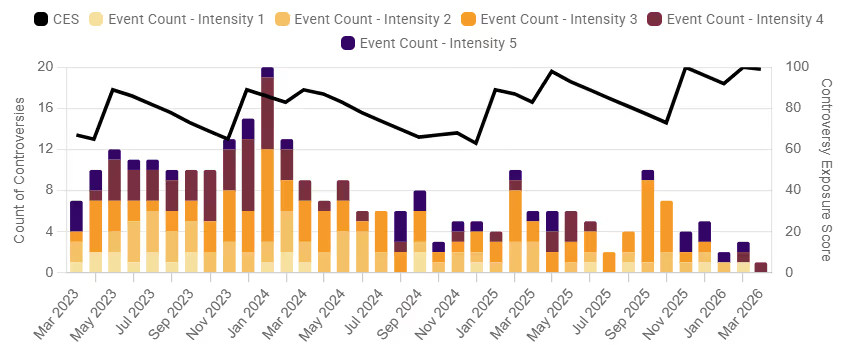
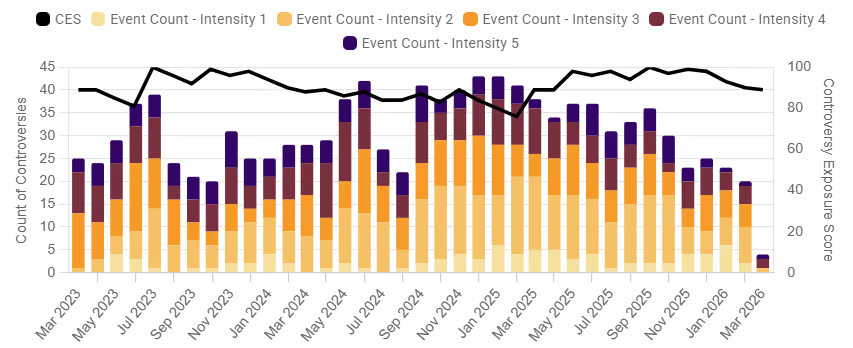
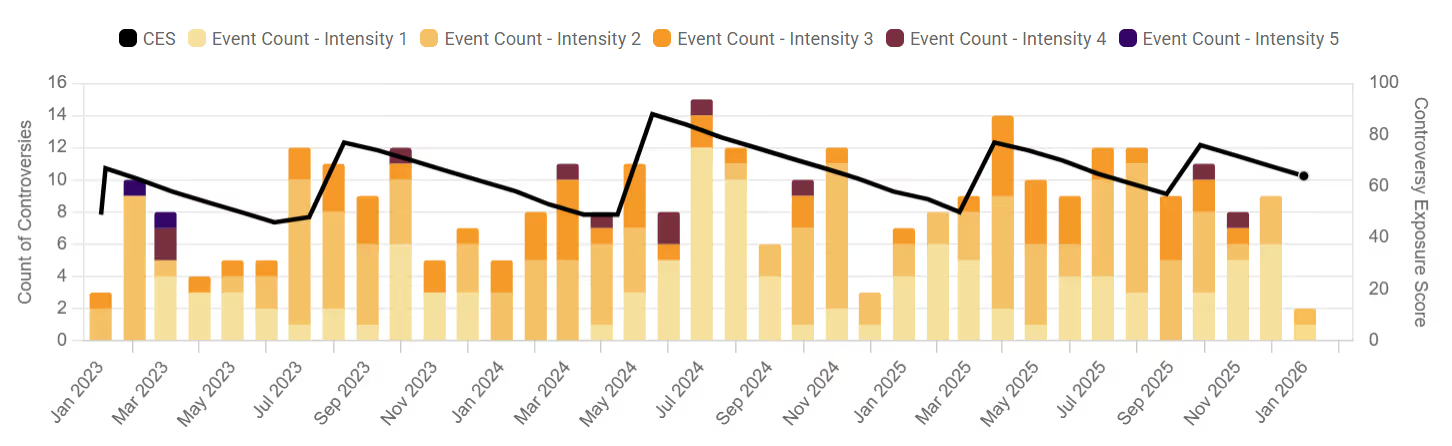
The CES is an aggregate, entity-level score (0–100) that measures an entity's overall exposure to ESG controversies over time. It's built from individual ESG events and their intensities, synthesizing both event volume and severity into a single trackable figure. The intensity score, by contrast, operates one level down: it's applied at the event level, measuring how severe or important each individual ESG event is on a scale from 1 (least severe) to 5 (most severe). In short, the CES tells you how exposed an entity is overall, while the intensity score tells you how serious each underlying event is.
ESG Risk Over Time
This chart tracks FIFA's ESG controversies per year from 2020 to 2026, stacked by risk pillar. Governance dominates every bar, with social forming a secondary band and environmental barely visible. Volume climbs from a governance-heavy opening year to a clear peak in 2022, then holds at a stable plateau through 2025 before the short 2026 bar. The shape is driven by a handful of major events. The 2020 corruption investigations kept the opening-year baseline elevated and were almost purely governance-related, following a US DOJ indictment unsealed that April, which alleged bribes were paid for the votes that awarded Russia and Qatar the 2018 and 2022 World Cups.
The 2022 Qatar World Cup marked the clear inflection point, drawing sportswashing accusations and pushing total controversies to their peak, while migrant-worker conditions and human-rights coverage around Qatar thickened the social band into a permanent quarter-to-third of each bar from 2022 onward. Rather than reverting, controversies settled into a post-2022 "new normal," plateauing well above the pre-tournament level.
Underneath it all, corruption-and-bribery and legal/investigative exposure account for the bulk of total risk across 2020 to 2026, while environmental risk stays statistically negligible throughout.
ESG Risk by Type
Environmental Risks
Environmental risk accounts for a small share of FIFA's total controversy volume, but that low frequency masks cases of genuine severity. The Swiss Fairness Commission ruled against FIFA's Qatar 2022 carbon-neutrality marketing, turning a greenwashing accusation into a formal regulatory matter still active in June 2026. Related controversies extend the theme, including criticism of the Saudi Aramco and Coca-Cola sponsorships, the cooling and water-use controversies at Qatar, and the animal-welfare outcry over stray-dog culling ahead of Morocco's 2030 hosting.
Beyond these, FIFA has drawn criticism over its marketing and communications, notably branding the 2022 Qatar World Cup as "carbon neutral," and has dealt with fraud and embezzlement, exemplified by the case of former FIFA and CONCACAF official Chuck Blazer. Issues tied to its board and senior management leadership round out the picture, though the overall pattern is one of an organization reacting to the weight of its legal and ethical past rather than getting ahead of it.
As the breakdown above shows, the overwhelming majority of FIFA's screened ESG events fall into the low-risk tier (1,294, or 88.1%), with 165 (11.2%) on the watchlist and 9 (0.6%) classified as Violator, the highest-risk tier under SESAMm's UN Global Compact screening. That tier is assigned only where there is clear evidence of a breach, such as formal sanctions, court findings, or regulatory condemnations, rather than unresolved allegations. For investors with SFDR Article 8 or 9 obligations, or internal exclusion policies tied to UNGC compliance, a Violator flag on a core holding or counterparty is a material signal rather than a monitoring note, which is why the profile is best read as governance-led: the nine Violator events reflect adjudicated breaches concentrated in FIFA's governance history, not the live controversies surrounding the current tournament.
The composition that emerges is a governance core of long-running legal cases, a Qatar-rooted social overlay that has proven durable, and a small but genuinely high-severity environmental tail now being contested through formal channels.
Both lines explode together, but unevenly: absolute volume roughly doubles while the relative share more than quadruples, briefly making Qatar roughly one in seven of all FIFA-related items, because nearly every controversy fires at once. The spike packs in wider labor abuses, and the jailing of whistleblower Abdullah Ibhais; the OneLove armband ban and Qatar's criminalization of same-sex relations and the broader sportswashing and carbon-neutral greenwashing charges; and the unresolved bribery allegations over the 2010 hosting vote. On its own, this acute cluster would suggest a controversy that lives and dies with the tournament.
Phase 3: Off-Season Accumulation (2023–2026)
This is where the two lines part ways, and the accumulation shows itself. After the tournament, the relative share deflates sharply in 2023, the acute spike clearing, but it never returns to baseline; instead, it grinds steadily upward every subsequent year, ending in 2026 at roughly four-and-a-half times its pre-tournament level. Over the same stretch, the absolute volume collapses, from 1.43M in 2023 to around 448K in 2026, under a fifth of the 2022 peak. The two movements together are the key finding: even as total FIFA coverage shrank dramatically, the Qatar migrant-worker case captured a larger and larger share of what remained. Driving that residual are post-tournament findings: The non-payment of the migrant workers during the 2022 World Cup, the campaign for a migrant-worker compensation and remedy fund, and Amnesty's continued push for FIFA to fund remediation.A storyline that merely echoes the event would fade with the falling volume; one that accumulates does the opposite. The controversy is no longer powered by the match calendar but by its own momentum.
The Case Underneath
Underneath that residual sits the report's single heaviest case: the human-rights strand of 135 events running from 2020 to 2026, the longest-running and most densely populated case in the dataset. What stops it fading is that each turn of the hosting cycle reactivates it: the 2026 uptick to 6.49%, the highest reading outside the tournament year itself, coincides with the 2026 World Cup now underway in North America, which revives retrospective scrutiny of Qatar, and the emerging human-rights questions around Saudi Arabia's 2034 tournament, which carries the same migrant-labour lens straight to the next host. The case is not simply failing to fade; it is being actively topped up by each new host, which is why the social exposure reads as structural rather than event-bound.
Key Takeaways
Taken together, the data describes a profile that is primarily governance-related, with the most severe and persistent cases concerning legal exposure, corruption, and bribery, supported by a durable Qatar-rooted social overlay and a small but high-severity environmental tail. All three pillars reach maximum case intensity, so severity is not confined to any single dimension.
The most consistent feature is persistence. FIFA's Controversy Exposure Score has remained in the High-to-Very-High band throughout the period and sits at 99 today. The largest cases run continuously from 2020 to 2026, and a significant share of binding decisions occur outside tournament windows. None of this reduces the significance of the World Cup, which clearly concentrates attention and scrutiny. But the underlying controversy is produced across the quarters between tournaments, and several of FIFA's most consequential outcomes are set during lower-attention periods. For those screening FIFA, the practical implication is that continuous monitoring suits this profile better than event-triggered review, because much of the relevant activity occurs between tournaments rather than during them.
The data suggests that for an entity like FIFA, a four-year review cycle misses most of what matters. Request a demo to see how SESAMm supports the kind of ongoing monitoring this profile requires.
*The Controversy Exposure Score (CES) is a continuous score from 0 to 100 measuring a company's exposure to ESG controversies over time, based on the severity of incidents and their media volume. This is an unsolicited rating: it is not commissioned by the rated company. The company is notified before its score is first issued, does not take part in the rating, and SESAMm has no access to its management or non-public documents. Ratings are produced only from public and licensed sources. The methodology is available here.
COP30 has just begun in Belém, Brazil. Every year, the Conference of the Parties (COP) serves as the world’s central stage for climate diplomacy, where governments, scientists, and civil society gather to decide how to respond to the global climate emergency. Over the decades, these meetings have shaped major milestones, from the Kyoto Protocol to the Paris Agreement. Yet behind the speeches and pledges, questions persist: how much progress is being made on the ground, and how inclusive are these negotiations in practice?
As countries meet again to assess their collective efforts, looking back at the most recent COPs offers a perspective on how politics, accountability, and competing interests continue to influence the global climate agenda.
What Is the COP?
The Conference of the Parties (COP) is the annual United Nations summit that brings together the 198 signatories to the 1992 UN Framework Convention on Climate Change (UNFCCC). Its purpose is to coordinate international action on climate change through negotiation, progress assessment, and new commitments to reduce greenhouse gas emissions.
COPs are usually held in November or December and last about two weeks. The first took place in 1995 in Berlin, and the tradition has continued ever since. COP27 was hosted by Egypt in 2022, COP28 by the United Arab Emirates in 2023, and COP29 by Azerbaijan in 2024. This year, COP30 marks Brazil’s turn to host the event in the Amazonian city of Belém.
Over the years, COPs have produced landmark outcomes, from the Kyoto Protocol (1997) to the Paris Agreement (2015). More recent debates have focused on climate finance, adaptation, and the global transition away from fossil fuels. Yet, as recent conferences show, progress often comes with friction, delays, and controversy.
The COP Controversies Over the Years
COP27 (2022) - Egypt
Held in Sharm el-Sheikh, COP27 centered on the question of climate justice. Developing nations demanded compensation for loss and damage caused by climate impacts that they did little to create. Therefore, the creation of a Loss and Damage Fund was a landmark step, though details on financing and governance were deferred.
Egypt’s hosting of the summit drew criticism over restrictions on civil society. Amnesty International reported hundreds of arrests before the event, including activists detained for online content. Tight surveillance and limited protest spaces highlighted how political control intersected with the climate agenda.
Meanwhile, energy security concerns following the war in Ukraine exposed inconsistencies in global climate policy. Some European nations resumed coal use or sought new gas projects in Africa, while methane leaks from natural gas infrastructure were found to be worse than estimated. These developments raised questions about whether short-term energy strategies were undermining long-term climate goals.
COP28 (2023) - United Arab Emirates
The 2023 summit in Dubai was among the most debated in COP history. The appointment of Sultan Al Jaber, CEO of the Abu Dhabi National Oil Company, as COP president drew immediate criticism over conflicts of interest. Al Jaber’s comments, suggesting there was “no science” supporting a fossil fuel phase-out, only deepened the controversy.
Leaked letters from OPEC revealed coordinated lobbying to block references to phasing out fossil fuels in the final text. Despite this, over 100 countries advocated for clear language on ending fossil fuel use. The resulting “UAE Consensus” included the phrase “transitioning away from fossil fuels,” the first such mention in COP history. However, critics noted that the wording allowed broad interpretation and loopholes for continued production through “abatement” and carbon capture.
The summit also drew scrutiny for restrictions on activism. Human Rights Watch documented limits on protests, surveillance of delegates, and constraints on speech. Still, COP28 produced incremental steps on renewable energy commitments and adaptation finance, even as it highlighted the influence of the fossil fuel industry on global negotiations.
COP29 (2024) - Azerbaijan
In Baku, COP29 took place under similar scrutiny. Azerbaijan’s record on press freedom and civil rights was a major concern, with several journalists and activists arrested in the months before the event. Human rights advocate Anar Mammadli and economist Gubad Ibadoghlu were among those detained on politically motivated charges.
The negotiations were dominated by debates over climate finance. Wealthy countries announced a target of $300 billion annually by 2035, largely relying on private capital and multilateral banks. Developing nations argued that the proposal lacked direct grant funding and risked increasing debt burdens. Observers reported confusion and frustration over the agreement’s final approval, with some delegations absent when it was gaveled through.
COP29 concluded with calls for greater transparency, inclusivity, and consistency in how future summits are hosted and managed.
Patterns and Lessons
Across COP27, COP28, and COP29, several common threads emerge. Each conference underscored both the urgency of global climate action and the difficulties of collective decision-making. The creation of new financial mechanisms and the first explicit reference to moving away from fossil fuels were significant steps. Still, they came alongside persistent divisions over fairness, responsibility, and implementation.
A recurring criticism has been greenwashing: the gap between rhetoric and reality. Host countries often present themselves as champions of sustainability while remaining heavily dependent on fossil fuels. At the same time, the presence of record numbers of industry lobbyists, particularly from oil and gas companies, has raised concerns about the balance of influence in climate negotiations.
These issues point to a broader tension: how to ensure that the COP process remains a platform for genuine progress rather than symbolic gestures. Many observers argue that transparency, stronger accountability mechanisms, and better inclusion of civil society are essential to rebuilding trust in the process.
Conclusion
As COP30 unfolds in Brazil, the focus is again on implementation and credibility. The last three conferences demonstrated how progress can coexist with controversy, and how global ambition must be matched by local action and political will.
While the COP framework remains the cornerstone of international climate cooperation, its effectiveness depends on whether commitments are translated into tangible outcomes. The coming days in Belém will show whether lessons from past conferences can help turn dialogue into decisive progress.
Reach out to SESAMm
TextReveal’s web data analysis of over five million public and private companies is essential for keeping tabs on ESG investment risks. To learn more about how you can analyze web data or to request a demo, reach out to one of our representatives.
Stay ahead with the latest in ESG and AI intelligence
Join our mailing list to receive new reports, event invites, and updates from SESAMm directly to your inbox.