The ESG Scorecard: The Changing Landscape of Genetic Testing
December 5, 2024
•
5 mins read
The direct-to-consumer (DTC) genetic testing industry has transformed personal health and ancestry exploration, offering consumers remarkable insights from their DNA. Yet rising ESG concerns around data privacy, ethical use, and regulatory compliance are reshaping this landscape, pushing companies to prioritize consumer trust. Once a leader, 23andMe now faces steep challenges with data security, public confidence, and corporate stability. Recent breaches, including a leak impacting 6.9 million users, have led to lawsuits, a $30 million settlement, and boardroom upheaval, casting uncertainty on the company's future. Meanwhile, competitors like Ancestry and MyHeritage, though contending with similar issues, have remained comparatively stable. How does 23andMe compare to its competitors when it comes to ESG concerns? Read on to find out.
23andMe: From Market Leader to Data Breach Fallout
23andMe initially led the DTC genetic testing market but has faced a series of challenges, mainly around data privacy. A major data breach in 2023 compromised 6.9 million users’ information, resulting in a $30 million settlement and reputational damage. Board resignations followed, highlighting corporate governance issues. These events underscore the need for strong data security and governance in sustaining consumer trust.
Ancestry: Customer Loyalty Tested by Rising Controversies
Ancestry has also faced privacy-related challenges, especially since its acquisition by Blackstone. Lawsuits claim the company misused consumer data without consent, violating privacy laws. Public backlash, such as from a controversial advertisement, has further affected Ancestry’s image. Yet, its solid user base has helped it remain stable compared to some competitors.
MyHeritage: Navigating Privacy Compliance Across Borders
MyHeritage, while facing fewer controversies than its peers, still encounters significant privacy scrutiny. Investigations in Norway and Denmark have raised questions about its compliance with data laws. Although MyHeritage’s controversies are less severe, maintaining regulatory compliance remains essential for its international operations.
The future of the DTC genetic testing industry depends on how effectively companies manage ESG risks. Companies like 23andMe, Ancestry, and MyHeritage can better protect consumer trust and build a foundation for sustainable growth in this scrutinized sector by prioritizing data security, strong governance, and compliance.
Reach out to SESAMm
TextReveal’s web data analysis of over five million public and private companies is essential for keeping tabs on ESG investment risks. To learn more about how you can analyze web data or to request a demo, reach out to one of our representatives.
We are proud to share that SESAMm has been highlighted in Elaia's Annual Sustainability Report for 2022. Elaia has been historically committed to fostering sustainability and ESG excellence, and SESAMm is honored to be identified as a top ESG-focused company within its portfolio.
The report underscores SESAMm’s pioneering AI technologies, capable of analyzing billions of textual data, from articles to blogs. This technology equips private equity firms, asset managers, and leading financial institutions with accurate and timely insights into ESG controversies, trends, and positive impact indicators.
This acknowledgment supports SESAMm’s dedication to reshaping the ESG landscape. Our keen focus on aligning market operations with the UN Sustainable Development Goals (SDGs) positions us as a leader in the sustainable finance ecosystem.
To learn more about SESAMm’s role in advancing sustainable finance, we invite you to download the full report.
Reach out to SESAMm
TextReveal's web data analysis of over five million public and private companies is essential for keeping tabs on ESG investment risks. To learn more about how you can analyze web data or request a demo, contact one of our representatives.
SESAMm, leader mondial de la donnée de controverses, annonce le renouvellement de son partenariat avec Praemia REIM autour de son outil de suivi des controverses ESG. Grâce à l’exploitation de sources d’information internationales, à l’intelligence artificielle et à une revue par des analystes, la solution permet une détection des risques réputationnels et extra-financiers liés aux actifs immobiliers. Ce dispositif s’inscrit dans une démarche globale de maîtrise des risques ESG et d’amélioration continue des pratiques responsables.
Un outil au service de l’engagement dans l’immobilier de santé
Praemia REIM utilise l’outil SESAMm comme levier de dialogue auprès de ses locataires, notamment dans le secteur de la santé, où les enjeux sociaux et éthiques revêtent une importance particulière. En facilitant une gestion active des controverses, la solution contribue à l’accompagnement des locataires opérateurs de santé, à renforcer la transparence et à répondre aux attentes croissantes des investisseurs en matière d’impact social et de responsabilité des pratiques. SESAMm confirme ainsi son positionnement comme partenaire technologique clé pour les acteurs de l’investissement immobilier responsable.
SESAMm’s AI Technology Reveals ESG Insights
Discover unparalleled insights into ESG controversies, risks, and opportunities across industries. Learn more about how SESAMm can help you analyze millions of private and public companies using AI-powered text analysis tools.
As the 2022 United Nations Climate Change Conference wraps up, governments and, by proxy, companies are charged with fulfilling new recommendations, especially for non-State entities to commit with integrity to Net-Zero. COP27, as the conference is also called, is the time and place where we claim as a united society at the world's center to make change for the better.
But COP27 is over. Now what? Do we go back to business as usual? Do we wait and see if we stick to any of these new agreements? Or worse, do we say we'll make changes but fall short of making those changes?
I say no. We can do better, and here's why…
We need to talk about climate change
Climate change effects are more than global warming. Global warming consequences include:
Rising sea levels
Stronger and more intense hurricanes
More droughts and heat waves
Longer wildfire seasons
And more
Why do I bring these up? Because all of these effects will impact your business in one way or another.
For example, did you know that the Rhine River, one of Europe's major rivers, is suffering from drought? Water levels are so low that barges are limited, and it's disrupted river cruises because levels are currently 38 centimeters below the minimum required.
The same goes for the Mississippi River in the U.S. The Mississippi River has dropped to the lowest levels they've ever been in 34 years, driving up shipping costs. This challenge is also a big deal because the river carries 92% of agricultural exports.
Also, in the past year, damaging hurricanes and typhoons have damaged infrastructure in South Korea, South Africa, China, Japan, and the U.S., to name a few countries, affecting crops, manufacturing operations, supply chains, and much more across the globe.
I could go on about how each effect influences enterprise, but the bottom line is climate change is bad for business. And supporting companies that enable climate change is also bad for business, which brings us to the topic of environmental, social, and governance (ESG) measures.
We need to talk about ESG
ESG has become mainstream since the UN shared a report in 2006, a joint initiative by a group of financial institutions to develop policies and guidance on how to better incorporate ESG issues in securities brokerage services, asset management, and associated research functions. This introduction has helped industries establish goals through:
Managing ESG risks
Anticipating regulatory action or accessing new markets
Contributing to the sustainable development of their societies
However, with ESG policies come ESG data challenges. For example, ESG measuring, its data, and how companies report them are inconsistent. ESG data providers deal with "data gaps" differently, so their approaches can lead to discrepancies. And as ESG data becomes available publicly, how ESG data providers interpret the data varies, too.
We need to talk about greenwashing
In simplest terms, greenwashing occurs when a company misleads its stakeholders, investors, and consumers about its environmental practices, specifically by communicating positive environmental performance contrary to its actual, less flattering execution.
On the surface, you might think, "What's the big deal? We all exaggerate, right?" But as sustainability awareness among investors and eco-conscious customers grows, so has their scrutiny over business conduct to disclose information about a company's performance and its "environmental-friendly" products. Their scrutiny, coupled with the growing number of companies reporting their environmental footprints, reveals that many companies misreport and publish information about their ecological impacts, which regulators consider misleading or deceptive.
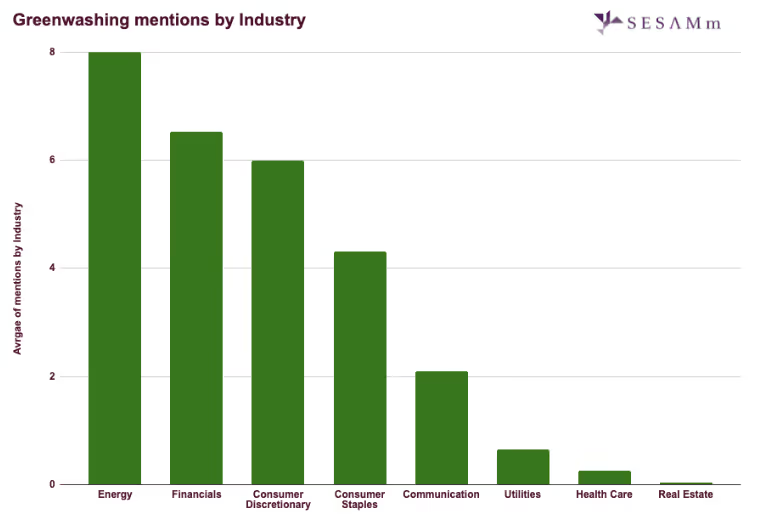
How do we know? Let's take a look at greenwashing mentions by industry.
We analyzed greenwashing mentions in web data. On the X-axis, we list the industries. The Y-axis measures the ratio of greenwashing mentions by N° of companies per industry (N=1166 companies) since 2015; this extraction method corrects sampling bias. Each industry is defined by a significant sample of large- and mid-capitalization-sized companies in developed countries.
This greenwashing mention chart clearly shows that the Energy industry has the highest ratio of greenwashing allegations. While many fossil fuel companies claim to be transitioning into clean energy, most mentions link these companies to advertisements and campaigns that don't align with the Paris Agreement goals. In contrast, fossil fuel companies are growing their carbon-intensive operations and products. It's a concerning trend because according to The Intergovernmental Panel on Climate Change (IPCC) report, "Climate Change 2021: The Physical Science Basis.", the data shows that emissions from fossil fuels are the primary cause of global warming, contributing up to 91% of global carbon dioxide emissions in 2018 as an example.
Second, on this chart is the Financial industry. It has fallen short of its commitments to climate action while continuing to finance fossil fuels. According to eMarketer, financial institutions have allocated $4.6 trillion for fossil fuels while promoting sustainable finance and supporting global energy transition.
Further, the mentions volume has grown year over year since 2015—when it was almost zero—to more than 1500 present day.
Clearly, this greenwashing problem is getting worse. So what can we do about it?
We need to talk about a solution
We don't have any control over what companies will do to fulfill their agreements, but we can understand their ESG data better and make better investment and portfolio decisions.
How? With AI.
AI, specifically natural language processing (NLP) algorithms, help us read billions of news articles, forums, and web text and extract unstructured data for analysis. With SESAMm's TextReveal®, we can see an entity's ESG controversies or events in near real time, providing a unique perspective to ESG data and details, filling the data gaps more accurately.
So when Company A reports on its ESG goals, we can help verify if the results are accurate and find any potential controversies that didn't make the report. We also don't need to wait until ESG reports come out; we can extract this data from the web on an as-needed basis. Moreover, we can look at all types of companies across the globe, public or private. As long as web data exists for an entity (or concept), we can analyze it.
My final thoughts
COP27 might be over, but our agreements and commitments carry on. We have an opportunity today to make a positive difference toward climate change while still maintaining profits. In fact, I think we can be even more profitable if we support green and sustainable initiatives.
I'd like to hear your thoughts; feel free to reach out on LinkedIn and share them with me.
About Alexandre Tiesset
Alexandre Tiesset is the Head of ESG at SESAMm. He's worked in finance for seven years in various ESG-related roles, such as Credit Analyst, Sustainable Investing Specialist, Index Product Specialist, and more. He holds a Master of Science degree in Finance and Financial Analysis. His passion lies in the intersection of finance and general knowledge and making new connections.
Reach out to SESAMm
SESAMm is a leading NLP technology company serving global investment firms, corporations, and investors, such as private equity firms, hedge funds, and other asset management firms, by providing datasets or NLP capabilities to generate their own alternative data for use cases, such as ESG and SDG, sentiment, private equity due diligence, corporation studies, and more.
To learn how you can generate NLP-enhanced ESG data for your firm, or to request a demo, reach out today.
Stay ahead with the latest in ESG and AI intelligence
Join our mailing list to receive new reports, event invites, and updates from SESAMm directly to your inbox.









.png)