ESG Data Trends: ESG Analysis on the Bike Market Using AI
September 20, 2023
•
5 mins read
Welcome to the latest article in our ESG Data Trends series. Today, we're turning our attention to the growing bike industry, specifically spotlighting Italy's Pinarello. Our aim is to illustrate how health-conscious and ecological trends, increased by the pandemic, have steered the world towards bicycles for both commuting and exercise. Pinarello, as well as many of its competitors, are private companies, which poses a particular challenge to analyze them in depth as the amount of data available is particularly sparse and harder to find. However, with the help of AI tools, this task becomes not only possible but also highly automated.
Bike Industry Trends: A General Overview
Long–term Momentum: Online mentions related to the bicycle market have exhibited a consistent upward trend since 2015, peaking in the last three years in the wake of COVID-19.
Figure 1: Bike market volume of mentions over time.
Government Initiatives: Notably, a spike in government investment in cycling infrastructure has paralleled the pandemic-induced behavioral changes.
Figure 2: Bike commuting VS. government focus on cycling infrastructure over time.
Type-specific Popularity: Among the various segments, E-bikes dominate online mentions, followed by mountain bikes and road bikes.
Figure 3: Bike market breakdown by type over time.
Digital Ecosystem: The digital facet of the trend reveals that sports data apps, especially those focusing on performance tracking, have gained considerable traction.
Figure 4: Sports data apps and their use mentions over time.
E-bikes: Riding the High Wave
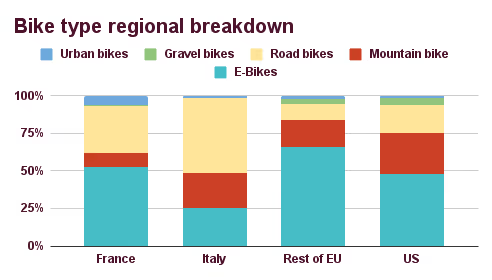
E-bikes have captivated attention across the board. They are now deemed a convenient solution to commuting, more so after the pandemic. Geographically, Europe outperforms the US in E-bike mentions, with France leading the charge on urban bikes. Italy, on the other hand, showcases a stronger inclination towards road bikes.
Figure 5: Bike type regional breakdown.
The Pandemic Effect on Road Bikes
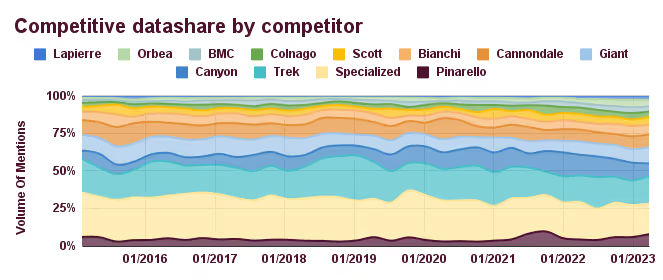
The road bike segment witnessed an unprecedented surge in mid-2020, corresponding with pandemic lockdowns. Major players like Specialized, Trek, and Canyon lead in online mentions, but Pinarello holds its ground with a stable and slightly growing competitive share.
Figure 6: Road bike market data share by competitor over time.
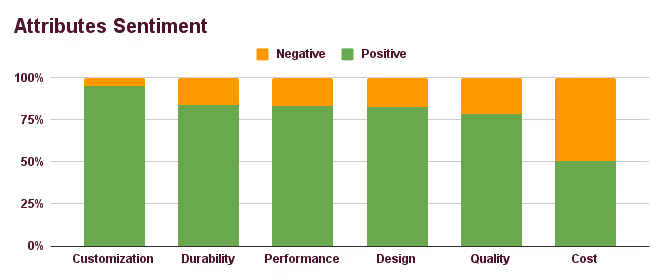
Consumer Preferences: Performance and quality emerge as the dominant positive attributes, whereas cost remains the primary consumer concern.
Attribute Sentiment: When analyzed based on sentiment, customization, and performance, score the highest, whereas cost ranks the lowest due to consumer complaints.
Figure 7: Road bike market attributes sentiment.
Case Study: Pinarello
Online Reputation Insights
The volume of online mentions for Pinarello has seen a steady climb, particularly after 2021. Quality and performance have risen as positive attributes, while cost remains a predominant negative sentiment, inflamed further by recent discussions about the brand's pricing strategy.
Figure 8: Pinarello attributes sentiment.
ESG Analysis of Pinarello and the Bike Industry
Low-risk ESG Profile: In general, the bike industry fares well in ESG evaluations. The risks usually center around social and governance aspects.
Social Risks: These primarily relate to product safety, with several recalls from various companies, including Specialized and Trek.
Governance Risks: Pinarello has faced patent infringement claims, while other brands like Giant have been accused of fraudulent behavior.
ESG Positive Impact Initiatives
The industry, by and large, is aligned with environmental sustainability goals. Trek stands out for its environmental initiatives and social opportunities, while Canyon demonstrates advances mainly in the environmental management of the supply chain.
As for Pinarello, the brand has undertaken ESG-positive initiatives, notably in environmental and social spheres. Product innovations like the Nytro E e-bike and high-performance 3D printed bikes signify their commitment to sustainable technology. Moreover, their partnerships and sponsorships aim to uplift local communities.
Navigating ESG Goals in the Bike Market
The bike market, led by brands like Pinarello, demonstrates significant strides in alignment with ESG goals. For private equity firms and asset managers, the value lies not just in financial returns but also in understanding ESG risks and opportunities that could influence long-term sustainability and risk mitigation.
How can SESAMm help you track ESG performance using AI?
We combined natural language processing with billions of textual web data related to the bike market to produce this analysis. Using NLP-powered models gives us an edge as we can extract ESG, SDG, and financial insights that aren’t necessarily obvious or easy to detect. These insights help investors make better investment decisions. SESAMm leverages AI and machine learning technologies to help you decipher and understand timely sentiment, trends, and ESG metrics on public and private companies to assist organizations in risk mitigation and profit generation strategies.
Reach out to SESAMm
TextReveal's web data analysis of over five million public and private companies is essential for keeping tabs on ESG investment risks. To learn more about how you can analyze web data or request a demo, contact one of our representatives.
Geopolitical events can quickly create ripple effects across global trade routes, supply chains, and corporate operations. For investors, commercial banks, insurers, and other organizations, identifying which portfolio companies or counterparties are exposed to these developments is a real challenge, especially when monitoring large universes of public and private companies.
SESAMm's thematic keyword search enables analysts to quickly discover controversies related to specific topics or emerging events across thousands of companies. This functionality allows them to filter results by theme without having to manually review large volumes of news and event data.
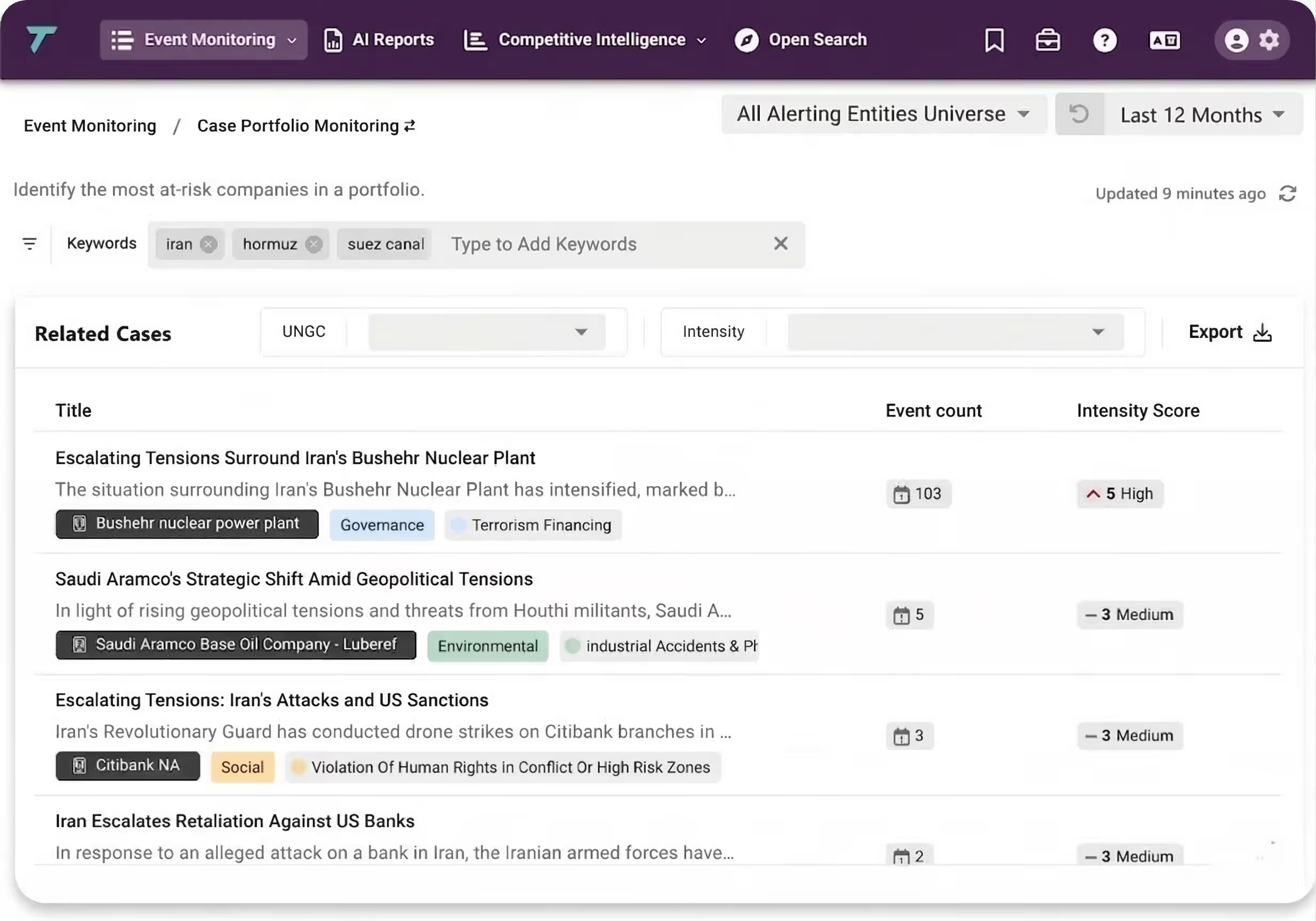
This functionality is particularly valuable when monitoring rapidly evolving geopolitical situations. To assess exposure related to the current conflict involving Iran, for example, users can run a thematic search across a broad company universe using keywords such as: Iran, Hormuz, and Suez Canal.
These keywords capture references to critical geopolitical locations and maritime chokepoints that may affect global shipping routes, energy markets, cybersecurity risks, and broader operational disruptions. Keywords can be tailored to any geopolitical scenario. Users can start broad and refine as the situation develops, or combine location-based terms with event-specific language to narrow results to the most relevant controversies.
When applied across a large company universe, the dashboard surfaces a range of related controversies ranked by severity. From high-intensity cases like escalating tensions around Iran's Bushehr Nuclear Plant, to medium-intensity signals such as retaliatory actions targeting US banks, offering clear visibility into which companies may face the highest risks.
Zooming In on Company-Level Exposure: The Example of Amazon
Alternatively, analysts can also use the same keyword approach to filter controversies associated with a specific company. This helps determine whether a particular portfolio holding, borrower, or insured entity may be affected by the same geopolitical developments.
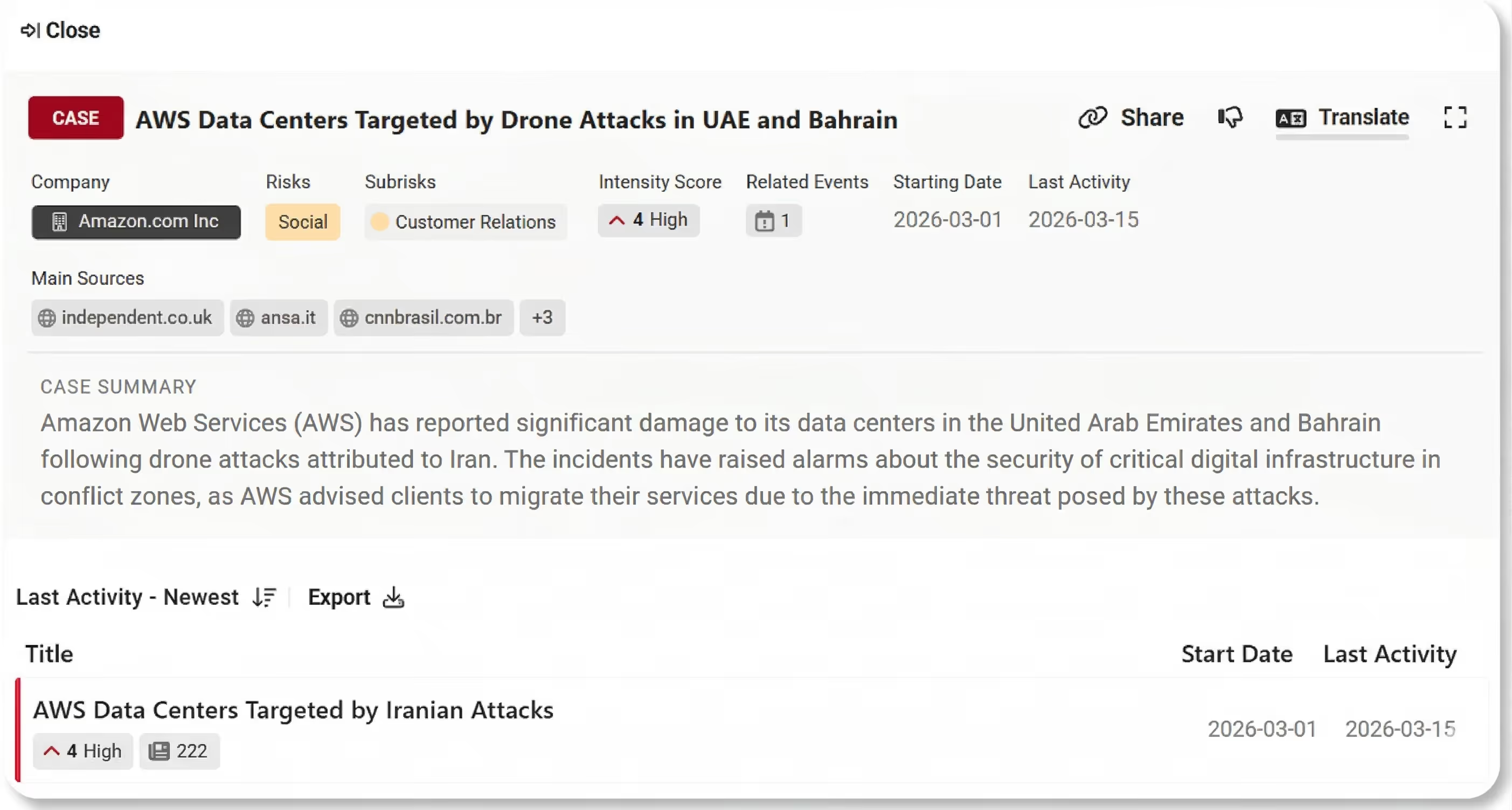
Applying this search to Amazon, for instance, surfaces a high-intensity case titled "AWS Data Centers Targeted by Drone Attacks in UAE and Bahrain." The case, rated 4/5 in severity and drawing on over 200 related news events, describes significant damage to AWS infrastructure in the UAE and Bahrain following attacks attributed to Iran, prompting AWS to advise clients to migrate services.
This kind of signal carries real weight for financial institutions. For investors, it highlights operational and geopolitical risks affecting a major technology provider. For banks and insurers, it may point to infrastructure vulnerabilities, operational disruption risks, or broader geopolitical tensions affecting clients' critical systems.
From Geopolitical Events to Portfolio Risk Signals
Geopolitical events rarely affect just one company. For financial institutions monitoring thousands of entities, they create complex, evolving risk exposures across entire portfolios, lending books, and insurance coverage.
Thematic keyword searches help bridge this gap, connecting macro-level developments to company-level controversies quickly and systematically. By combining automated controversy detection with flexible search capabilities, analysts can rapidly identify relevant signals, investigate affected companies, and prioritize follow-up work.
In practice, this means moving faster from emerging geopolitical events to actionable risk insights. Whether the trigger is a conflict in the Middle East, sanctions on a major economy, or rising tensions around a critical shipping lane, the same approach applies, giving investors, banks, and insurers a systematic way to stay ahead of geopolitical risk across their entire portfolio.
In recent years, consumers have become increasingly conscious about the impact of their purchases on the environment and society. As a result, many companies have jumped on the bandwagon of sustainability and green initiatives to attract consumers who prioritize ethical and environmentally friendly products. However, not all companies are authentic in their claims and practices, leading to a phenomenon known as greenwashing. In the first article of this two-part series, we gave an in-depth analysis of reputational laundering and greenwashing. In this article, we will explore the prevalence of greenwashing across various industries. We will also study the case of a company practicing greenwashing and a genuinely sustainable company.
Reputational Laundering by Industry
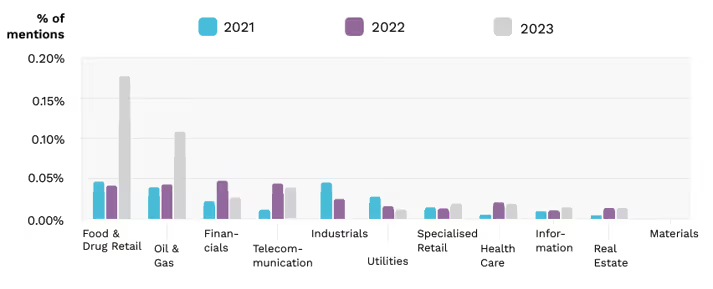
Reputational laundering is a common practice across various industries. Traditionally, the ‘Oil and Gas’ and ‘Financial’ industries have been identified as the main culprits. However, we have recently observed a substantial increase in the frequency of mentions in the ‘Food & Drug Retail’ industry, surpassing all other sectors by a significant margin. To evaluate this trend, we calculated the percentage of reputational laundering mentions in relation to the total number of mentions for each industry.
Reputational laundering over time
We looked at the last three years to find how each industry has evolved. Most industries have remained fairly static within a reasonable range. However, ‘Industrials’ have seen a significant decrease in mentions. Conversely, ‘Oil and Gas’ and ‘Food & Drug Retail’ significantly increased in 2023.
‘Food & Drug Retail’ more than tripled its mentions percentage due to a large number of mislabeled eco-friendly products (Walmart & Kohl’s) and green initiatives claims (Coca-Cola, Unilever, Amazon…).
The ‘Oil and Gas’ industry ranked second, and its recent spike can be associated mainly with greenwashing on actions such as their direct negative impact on the environment and the impact on local communities (TotalEnergies - Uganda & Tanzania). Another example is related to sportswashing with ‘Oil and Gas’ advertising heavily in sports events and even sponsoring sports clubs.
Figure 1: Reputation laundering by industry over time.
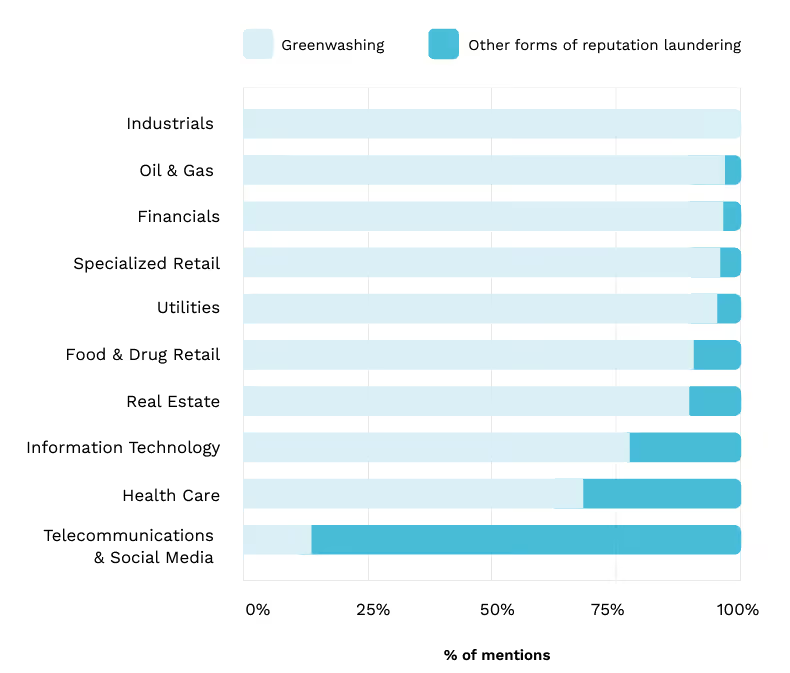
When examining the prevalence of reputational risks across sectors, greenwashing is the predominant concern in most industries. This is particularly evident in sectors like Industrials, Oil & Gas, and Financials, where greenwashing mentions are especially prominent. On the other hand, Telecommunications & Social Media stands out as an exception, with the bulk of its mentions skewing towards colorwashing, which encompasses specific practices such as blackwashing and sportswashing (Netflix accused of 'blackwashing' new docu-series Queen Cleopatra by casting black British actress).
Figure 2: Reputational laundering breakdown by industry.
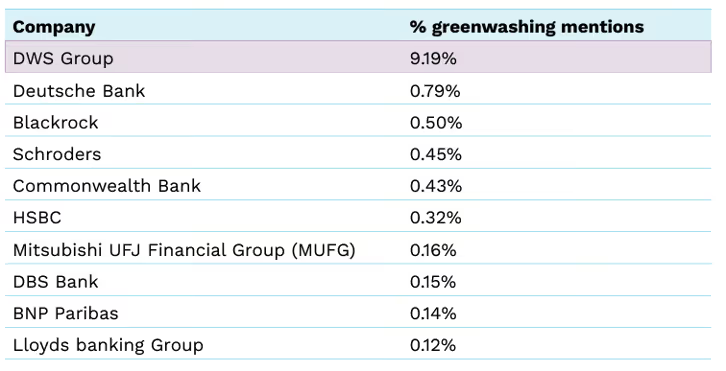
The financial industry's footprint in reputational laundering might not be the most pronounced in terms of direct mentions, but its influence stretches wide via its investment activities in other sectors. This means the ripple effect of the financial sector's actions can be substantially more impactful than those in other industries. Our investigation into this phenomenon included a rigorous examination of the frequency with which financial institutions are cited in discussions of greenwashing. Additionally, we assessed their efforts in driving positive impact initiatives. We scrutinized a group of 144 financial entities, arranging them on a scale from the greatest to the least number of greenwashing mentions in proportion to their overall volume of mentions.
Top financial firms by greenwashing claims
Below, we listed the financial firms with the highest relative volume of greenwashing mentions. Beyond the first two institutions on the list, which are related and had a big scandal in 2022, we can see many very recognizable names, such as Blackrock (investing in fossil fuels), JP Morgan (for fossil fuel investment policies), and HSBC (false advertising green claims) making our top ten list.
Case Study: DWS Group
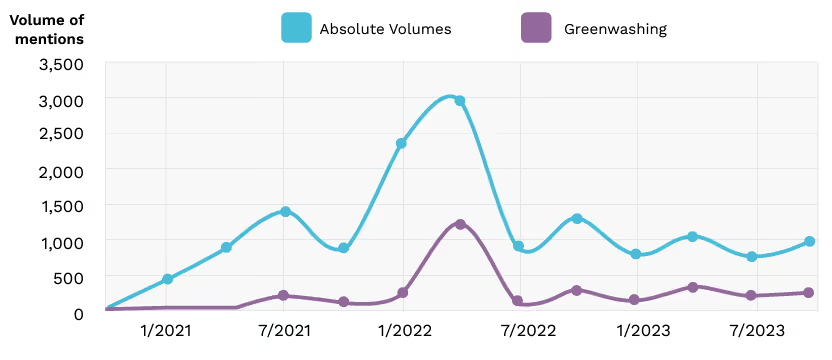
The DWS Group, previously known as Deutsche Asset Management, found itself in the spotlight for all the wrong reasons in 2022 and 2023. The scandal landed them at the top of our list, a position highlighted by the significant number of mentions they received — a figure that is an order of magnitude higher than that of any other entity on the list.
As a German asset management firm under the umbrella of Deutsche Bank, DWS was embroiled in severe greenwashing allegations. The last two years were marked by high-drama events: starting with greenwashing allegations at the end of 2021, their offices were searched in May 2022, which led to the resignation of the DWS chief in June 2022. The saga concluded with a substantial $25 million fine paid to U.S. regulators in September 2023.
The accompanying chart provides a visual representation of the timeline for these events, contrasting the number of absolute mentions with those specifically related to greenwashing. The alignment in the timing and scale of these mentions with the unfolding events is unmistakable.
Figure 3: DWS Group relative greenwashing mentions.
Best-in-class companies
In our effort to wrap up our study on an optimistic note, it's important to recognize that the heightened scrutiny of greenwashing and its associated initiatives ultimately serves a beneficial role by significantly raising our collective consciousness about crucial ESG issues.
While it's true that numerous companies have come under fire for greenwashing, it's equally important to highlight those that are genuinely advancing initiatives with positive environmental and social repercussions across the globe.
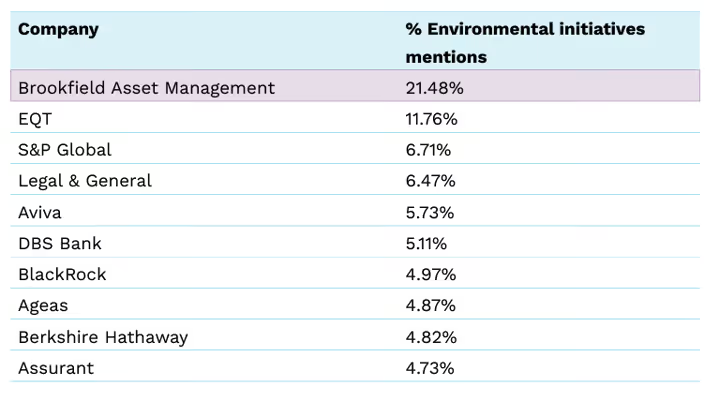
Employing the same method used to scrutinize financial firms implicated in greenwashing, we focused on the same group of 144 companies, honing in on the top 10 that stood out based on normalized mentions of their positive environmental actions.
The findings are quite encouraging: mentions of these positive initiatives dwarf those of negative impacts when viewed as a proportion of total mentions. Brookfield Asset Management (Brookfield) shines as the most notable, garnering almost double the mentions of its closest peer.
Also noteworthy is BlackRock's appearance on this list. Despite its presence on the greenwashing list, BlackRock has made strides in positive efforts, too. The company's initiatives—some counterbalancing the negative—have received more attention for their positive impact than for greenwashing, suggesting a complex but proactive ESG engagement.
Furthermore, companies like EQT, Berkshire Hathaway, and Standard & Poor's have actively engaged in initiatives that drive positive impact, earning them significant—and rightfully so—media coverage.
Figure 4: Brookfield sentiment vs environmental initiatives.
In terms of visibility, these environmental initiatives represent a significant portion of the company’s profile, surpassing 50% of total mentions in September 2022. This highlights the dominant role these actions play in the public discourse surrounding Brookfield.
The company’s polarity(1) — a measure of sentiment in mentions — shows a steady and positive trajectory beginning in late 2021. This trend points to a growing positive reputation and increased positive online discussions regarding the company.
Web Sentiment Analysis: Financial Industry vs. DWS & Brookfield
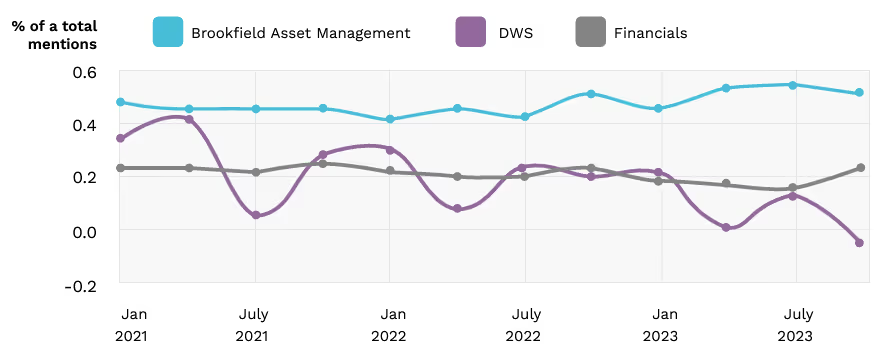
Figure 5: Sentiment over time.
When assessing the landscape of ESG engagement within the financial sector, we consider the comparative reputations of two key players: the leader in positive impact initiatives against the firm with the highest number of greenwashing mentions. How do they stack up against the broader sentiment within the financial industry?
The finance industry at large grapples with a challenging reputation shaped by various issues, including regulatory shortcomings, perceived corporate greed, opacity, and environmental impacts, among others.
Against this backdrop, we observe that:
DWS: The company's reputation trajectory is on a downward slope compared to the industry average, with the aftereffects of recent controversies culminating in a reputation low as of October 2023.
Brookfield: In contrast, Brookfield's commitment to the environment appears to buoy its reputation, maintaining a consistently positive trend that surpasses the market standard. Notably, from January 2023 onward, there is a discernible uptick in positive sentiment.
Conclusion
While the prevalence of greenwashing poses a considerable challenge within the corporate sphere, our study reveals a silver lining. The intensive scrutiny and debate surrounding environmental, social, and governance (ESG) issues have led to heightened awareness and, more importantly, action. Amidst the cacophony of claims, our analysis has found a discernible pattern of positive ESG initiatives overshadowing negative impacts, indicating a shift towards genuine sustainability efforts.
Particularly encouraging is the performance of certain frontrunners like Brookfield Asset Management, which has emerged as a beacon of positive action, outpacing its peers in driving meaningful change. This illustrates the potential for firms to lead by example and underscores the importance of rigorous analysis in distinguishing substantive ESG commitments from superficial ones.
Ultimately, this study underscores the transformative power of informed scrutiny and the pivotal role that advanced analytical tools play in propelling the ESG agenda forward. As the financial community continues to refine its approaches to evaluating ESG metrics, we can remain cautiously optimistic about the journey from mere green-tinted narratives to deeply rooted, impactful corporate practices.
(1) Polarity aggregates positive and negative sentiment (opinions, reviews) on a company. It ranges from -1 to 1. A 0 score means that positive and negative sentiment are equal. Well-regarded brands generally have polarity scores over 0.5.
At SESAMm, we used AI to study billions of articles and analyze greenwashing trends. Download this comprehensive ebook for an in-depth understanding of the evolving landscape of reputational laundering, notably greenwashing, and dive into its trends in the corporate world.
SESAMm’s AI Technology Reveals ESG Insights
Discover unparalleled insights into ESG controversies, risks, and opportunities across industries. Learn more about how SESAMm can help you analyze millions of private and public companies using AI-powered text analysis tools.
PARIS, January 28, 2021 — SESAMm, one of the leading providers of analytics and artificial intelligence solutions for investment professionals and enterprises, has concluded a Series B funding round for over €7.5M led by the Fintech VC fund of NewAlpha Asset Management and global investment firm The Carlyle Group (NASDAQ: CG).
The investment is intended to accelerate SESAMm’s global growth, allowing it to acquire talent and expand operations in Europe, Asia and North America. Plans for the funding also include developing AI-enabled research tools and dashboards for corporate customers, as well as continuing R&D investment in its Machine Learning and Natural Language Processing tools.
SESAMm will also extend its reach and address new market segments and use cases, including private equity sourcing and portfolio monitoring as well as Environmental, Social and Governance (ESG) investing and risk screening.
SESAMm’s sustained performance and this new funding confirm its leadership and technological edge in AI and alternative data for the investment management sector. SESAMm’s CEO and Co-Founder Sylvain Forté’s shares his confidence in the company’s future:
“We understand our customers’ needs and challenges in using Big Data and AI effectively in the investment process. We launched our products TextReveal and SignalReveal to provide clients with relevant and actionable data and models, and plan to continue to improve these products in terms of speed, features, and addressable use cases as we did with our ESG monitoring analytics”.
“We’ve been very impressed with the market traction SESAMm has gained in the last few years” said Lior Derhy, Managing Partner at NewAlpha Asset Management. “SESAMm’s cutting-edge technologies and analytical tools have proven their effectiveness in meeting financial institutions’ market needs.”
As one of SESAMm’s major clients, Carlyle quickly moved from pilot to scale and has had access to the company’s innovative alternative data solutions since the start of 2020.
“Expanding our partnership with SESAMm builds on Carlyle’s continued leadership in leveraging big data, data science, advanced analytics, and machine learning to further differentiate our investment platform,” said Matt Anderson, Chief Digital Officer and Managing Director at The Carlyle Group. “We look forward to continuing to work with SESAMm to provide additive insights for our deal sourcing, diligence, and to help guide our portfolio companies in value creation.”
Havenrock, AngelSquare, La Caisse d’Epargne, BPI, and Banque Populaire, all early investors in SESAMm, are again participating in this funding round.
“We are particularly pleased to see SESAMm grow steadily and acquire new clients in the US, Europe, and Asia. They have been able not only to adapt but to grow in these difficult times. Their next steps are now focused on scaling, recruiting, and most of all expanding internationally,” said Omar N. Barakat, President of Havenrock.
Located in Paris, New York, Tokyo, Tunis and Metz (France), SESAMm works for a large array of blue-chip clients including large asset managers, banks, and hedge funds to identify opportunities in both fundamental and quantitative investment strategies. The company recently welcomed Dale Richards (previously President of Enterprise Data Management at Sungard and board member of Quandl) and Jonathan Neitzell (former Chief Data Officer at Goldman Sachs AM) as new board advisors, joining Mark Garbin (Independent Director, US Funds) in supporting SESAMm’s strategic decision-making and market expansion in North America.
About NewAlpha Asset Management
Globally recognized as a leading investor in Emerging Manager investing, NewAlpha sources, analyses, selects and supports innovative investment funds and high potential Fintechs. NewAlpha offers its institutional clients a wide range of tailor-made products and services in the areas of Private Equity and Absolute Return strategies. In 2015 NewAlpha launched a Private Equity investment activity specializing in technology-driven sectors including Venture Capital (primarily FinTech, Insurtech and AMtech) and Growth Equity (TMT, health and industrial niches).
Regulated by the Autorité des Marchés Financiers (AMF), NewAlpha Asset Management is a subsidiary of La Française AM (Crédit Mutuel Nord Europe group)
The Carlyle Group (NASDAQ: CG) is a global investment firm with deep industry expertise that deploys private capital across three business segments: Global Private Equity, Global Credit and Investment Solutions. With $230 billion of assets under management as of September 30, 2020, Carlyle’s purpose is to invest wisely and create value on behalf of its investors, portfolio companies and the communities in which we live and invest. Carlyle employs more than 1,800 people in 30 offices across six continents. Further information is available at www.carlyle.com. Follow Carlyle on Twitter @OneCarlyle.
About SESAMm
Founded in 2014, SESAMm is an innovative company specializing in big data and artificial intelligence for investment. Its team builds analytics and investment signals by analyzing billions of web articles and messages using natural language processing and machine learning. With its NLP platform TextReveal and its quantitative data science platform SignalReveal, SESAMm addresses the entire value chain of alpha research. SESAMm’s 50+ person team in Paris, New York, Tokyo, Tunis and Metz (France) works with major hedge funds, banks and asset management clients around the world for both fundamental and quantitative use cases.