ESG Fintech Summit 2023: ESG Alerts and Monitoring
August 1, 2023
•
5 mins read
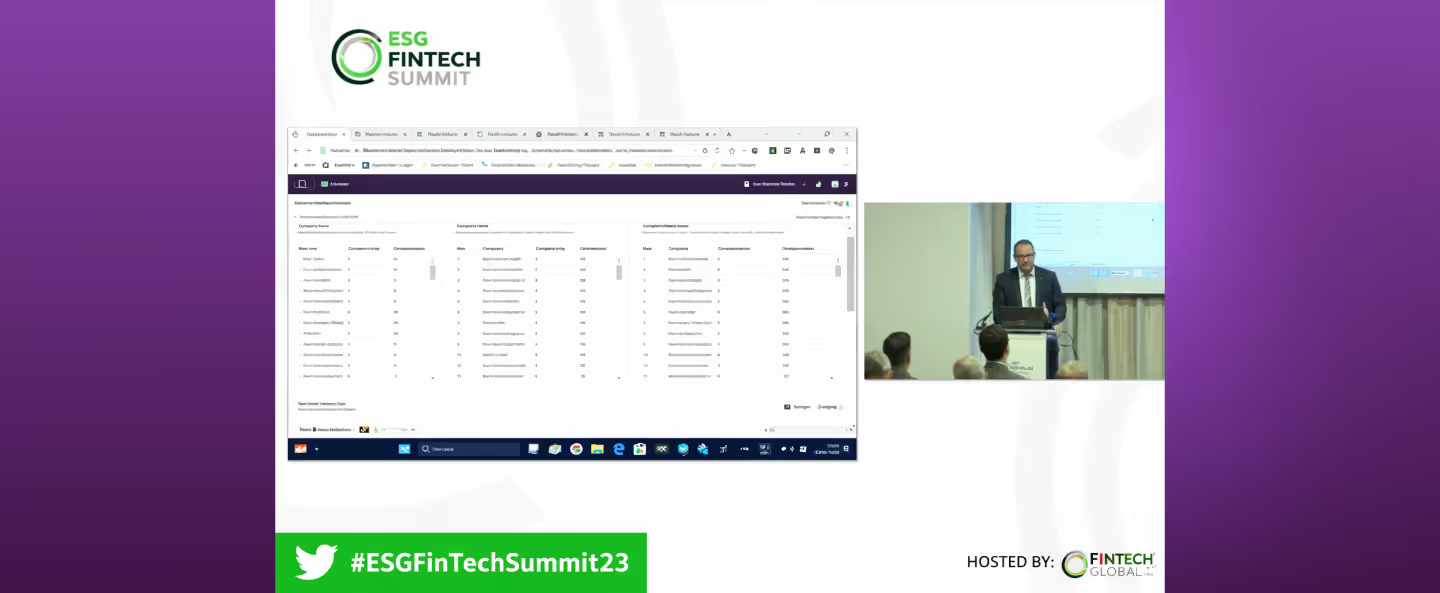
Navigating the finance sector requires technologies that offer precision and foresight. Watch Andrew Bernstein, Head of Global Sales, demonstrate SESAMm's ESG Alerts and Monitoring at the ESG Fintech Summit 2023 in London last June. This tool allows private equity firms and asset managers to stay ahead of emerging risks and opportunities.Watch the demo here:
Reach out to SESAMm
TextReveal’s web data analysis of over five million public and private companies is essential for keeping tabs on ESG investment risks. To learn more about how you can analyze web data or to request a demo, reach out to one of our representatives.
The aerospace and defense industry frequently faces ESG controversies, as these companies contend with high-exposure incidents that draw significant public and regulatory attention. In our recent webinar and ebook, we examined how AI-driven ESG evaluations enable early risk detection in these industries. Now, we want to explore what SESAMm's new Controversy Exposure Score (CES) can tell us about these same companies, including Boeing, SpaceX, Blue Origin, Raytheon, Lockheed Martin, and Airbus.
The aerospace and defense industry’s controversies mainly revolve around safety, labor issues, and regulatory concerns, which cause the CES scores to fluctuate considerably over time, influenced by both the volume and intensity of the events.
Boeing Analysis
Boeing has been consistently at the forefront of ESG controversies, experiencing fluctuating intensities that directly impact its CES score. These fluctuations are often tied to specific high-profile events. The company's high-intensity controversies, particularly related to deadly crashes and fraud allegations over safety concerns, have driven notable spikes in its CES score during the past few years.
Significant crash incidents and safety issues have recurred throughout the years. This has resulted in increased FAA scrutiny of Boeing in early 2021 following Boeing 787 inspections, followed by continuous inspections into the 2018 — 2019 crash scandals, which are reflected in the two CES spikes during 2021. In 2022, the CES score rose again as the company was sentenced to pay $2.5 billion for criminal charges and $200 million in settlements for SEC charges for misleading investors, both over the 737 Max scandal. In 2023, Boeing was ordered to appear in court for criminal settlements, an event classified as a high-intensity controversy, paired with significant media exposure reflected in the number of articles shared. This led to a surge in the CES spike despite the lower overall number of events during that period. In 2024, the U.S. urged Boeing to plead guilty to fraud charges related to the fatal crashes, further intensified by a whistleblower's release of additional safety concerns, resulting in further CES spikes. The most recent surge in the CES was triggered by a widespread employee strike over a contract offer, representing yet another setback for Boeing, whose reputation and finances have already been strained by manufacturing issues and federal investigations this year. Ultimately, both high-volume and high-intensity events related to Boeing’s controversies have contributed to the high CES score reflecting the company’s risks.
SpaceX Analysis
While SpaceX initially had relatively low controversy volumes and intensities in 2020, its CES score has steadily increased as well, aligning with the growth in controversies.
Notable peaks occurred in 2021, linked to controversies such as hiring discrimination concerns, an FAA investigation into test launches, and approval withholding for the Starship launch tower. Mid–2022 saw additional challenges, including CEO sexual harassment charges. Into 2023 and 2024, SpaceX’s scrutiny increased due to workplace environment-related lawsuits over hiring policy against refugees and sexual harassment and discrimination against women. Despite these events, SpaceX's controversies are less intense than Boeing's, so SpaceX has relatively lower CES scores.
Blue Origin Analysis
Blue Origin’s controversies have shown an increase over time. This surge was attributed to its conflict with NASA and SpaceX over the “Moon-landing” project. In 2022, Blue Origin faced FAA scrutiny over a flight anomaly and a workplace discrimination lawsuit. In 2023, further setbacks came from an espionage case, an engine explosion, and lawsuits involving discriminatory practices. The company experienced another wave of controversies in 2024, driven by an FAA investigation into parachute deployment failures and fresh allegations of workplace discrimination. Although Blue Origin’s controversies are relatively low in volume, occasional spikes have caused notable increases in its CES score.
Raytheon Analysis
Raytheon's CES score has remained moderate, with periodic surges between 2020 and 2021. These spikes were triggered by ESG risk events such as investor class action, violations of domestic preference laws, and the company’s involvement in Yemen's civil war. In 2022, the company faced another surge of controversies driven by an antitrust action lawsuit and further protests related to the situation in Yemen. In 2023, the CES score rose again amid backlash against the war in Gaza, the ongoing 2021 investors class action, environmental lawsuit, and FAA safety concerns for the company’s subsidiaries Pratt & Whitney, which also faced penalties for violating antiboycott regulations. Despite the diversity of ESG controversies, Raytheon’s overall CES score remains moderate compared to Boeing, thanks to the lower intensity of events it has encountered.
Lockheed Martin Analysis
Lockheed Martin's CES score has been relatively low and stable over time, with some fluctuations and few spikes. Mid–2021, the company had to pay a $10.28 million settlement for overcharging allegations; another notable surge occurred in 2022, triggered by FTC antitrust concerns over its Aerojet deal and an investor class action. The company’s involvement in war crimes in Yemen and Palestine during 2023 and 2024 has further fueled its controversies exposure hence the CES spikes. Though low in volume, Lockheed Martin’s controversies were marked by high-intensity events and media exposure, which contributed to significant spikes in its CES score.
Airbus Analysis
Airbus controversies events are relatively stable, with a slight decline overall and few spikes over time, as reflected in their CES score.
In early 2020, Airbus faced fraud and non-compliance allegations, along with a securities class action claim. By mid–2020, the company became embroiled in a bribery scandal. Toward the end of 2020 and into 2021, the long-standing Boeing-Airbus subsidy dispute resurfaced. In 2022, the bribery case remained unresolved, leading to Airbus agreeing to a $4 billion fine while also facing a $339 million class action lawsuit. The bribery allegations were still unfolding in 2023, accompanied by corruption claims in 2024. Compared to Boeing, Airbus has experienced fewer controversies in terms of volume and less severe high–intensity events. As a result, its CES score has remained relatively stable over time, with only minor fluctuations, primarily driven by legal investigations.
Conclusion
In the aerospace and defense industry, ESG controversies continue to shape the reputational and operational risks of leading companies. Boeing, SpaceX, Blue Origin, Raytheon, Lockheed Martin, and Airbus each face unique challenges that are reflected in their CES scores. While Boeing and Airbus have seen higher volumes and intensities of events, others like SpaceX and Blue Origin have witnessed moderate to low exposure but still face periodic scrutiny due to high–impact incidents. As these companies navigate evolving regulatory landscapes, labor concerns, and public perception, their CES scores will remain a critical indicator of their ESG performance. Download the ebook “The Boeing Scandal: Can AI Predict Controversies Before Traditional Tools?” to learn more about the Boeing scandal.
Reach out to SESAMm
TextReveal’s web data analysis of over five million public and private companies is essential for keeping tabs on ESG investment risks. To learn more about how you can analyze web data or to request a demo, reach out to one of our representatives.
It’s been an action-packed year at SESAMm, and being the data lovers that we are, we ran the numbers and found that we:
Added 9 million documents to our data lake...every day!
Identified 600,000 ESG controversies
Enriched and added 4 new languages (Albanian, Serbian, Croatian, and Hungarian) to the data lake, which already includes Chinese, Russian, French, and more.
Check out this infographic below for more stats.
SESAMm’s AI Technology Reveals ESG Insights
Discover unparalleled insights into ESG controversies, risks, and opportunities across industries. Learn more about how SESAMm can help you analyze millions of private and public companies using AI-powered text analysis tools.
The NZBA's announcement comes after a series of high-profle departures that began in late 2024. What started as a coalition of 43 banks at its 2021 launch had grown to over 140 institutions representing $74 trillion in assets by 2024. However, political pressure, particularly from Republican politicians in the US, warning of potential legal violations, triggered a mass exodus.
The departures followed a predictable pattern: Goldman Sachs led the way in December 2024, followed rapidly by all major Wall Street peers within weeks. Canadian banks soon followed, and the bleeding continued through 2025 with HSBC, UBS, and Barclays all exiting. Barclays' departure statement was particularly telling, noting that "with the departure of most of the global banks, the organisation no longer has the membership to support our transition."
Proposed Restructuring
The NZBA has now proposed transitioning from a membership-based alliance to what it calls a "framework initiative." This fundamental change would essentially transform the organization from an active coalition with binding commitments to a more passive guidance provider. The steering group believes this approach would be "the most appropriate model to continue supporting banks across the globe to remain resilient and accelerate the real economy transition in line with the Paris Agreement."
A member vote on this restructuring is currently underway, with results expected at the end of September. However, given the exodus of major institutions, the outcome seems predetermined.
Broader Climate Coalition Collapse
The NZBA's troubles reflect a wider crisis affecting climate-focused financial coalitions:
A member vote on this restructuring is currently underway, with results expected at the end of September. However, given the exodus of major institutions, the outcome seems predetermined.
Recent developments include a 23-state coalition warning the Science Based Targets initiative (SBTi) about potential antitrust risks, demonstrating that the pressure extends beyond banking to other ESG frameworks.
Market Implications
The NZBA's effective dissolution has several implications:
Fragmented Approach
Without coordinated frameworks, banks will likely develop individual approaches to climate commitments, potentially leading to:
Inconsistent standards and methodologies
Reduced transparency and comparability
Weakened collective bargaining power with policymakers
Regulatory Response
The vacuum left by voluntary coalitions may accelerate regulatory intervention:
Mandatory climate disclosure requirements
Government-imposed transition standards
Regional divergence in approaches
Investment Impact
For investors, this development signals:
Increased difficulty in assessing bank climate commitments
Greater need for individual due diligence
Potential opportunities in banks with strong standalone commitments
Looking Forward
The NZBA's pause represents more than just one organization's troubles; it symbolizes a broader retreat from coordinated climate finance at precisely the moment when such coordination is most needed. With climate risks accelerating and the urgent need for massive capital deployment, the financial sector's inability to maintain collective action represents a significant setback.
However, this may also create opportunities for more resilient, legally defensible approaches to climate finance. Banks that remain committed to transition goals may find competitive advantages in developing robust standalone frameworks, while regulatory bodies may step in to fill the coordination gap.
SESAMm’s AI Technology Reveals ESG Insights
Discover unparalleled insights into ESG controversies, risks, and opportunities across industries. Learn more about how SESAMm can help you analyze millions of private and public companies using AI-powered text analysis tools.
Stay ahead with the latest in ESG and AI intelligence
Join our mailing list to receive new reports, event invites, and updates from SESAMm directly to your inbox.