SESAMm, a leading provider of Big Data and Artificial Intelligence technology for investment managers, has been recognized with the Best of Show Award at Finovate Europe 2022, which took place on March 22nd and 23rd in London. The award was granted to SESAMm following a demonstration conferred by CEO and Co-founder Sylvain Forté, during which he showcased the company's marquee product TextReveal®.
"Finovate Europe represents a unique opportunity for best-in-class Fintech companies to showcase their innovations in front of leading institutions. It was great to demonstrate our product in front of an elite audience and win the Best of Show award." Said Sylvain Forté, CEO of SESAMm,"We are proud to say that this event was a big success for SESAMm, judging by the level of interest in our technology and its applications to the current ESG topic."
SESAMm is a fintech company that specializes in Big Data and Artificial Intelligence. Through its product, TextReveal®, the company provides analytics and investment signals to finance and corporate professionals by analyzing over 17 billion web articles and messages using natural language processing and machine learning. TextReveal® is a ready-to-use alternative data platform; its NLP (Natural Language Processing) powered engine provides daily sentiment and ESG data mapped to public and private companies to fuel investment strategies.
Finovate Europe, one of the most awaited annual events, sheds light on innovative fintech startups and helps them gain more recognition. It brings together over 1,000 senior finance and tech experts, including “demoers” and insightful speakers.
"We love to see companies like SESAMm join us at Finovate demonstrating their cutting-edge technologies. It really underscores our commitment to provide a platform to promote innovative startups in the financial ecosystem." Said Greg Palmer, VP of Finovate. "Congrats to the SESAMm team for winning Best of Show, it’s clear they really resonated with our audience!"
SESAMm's successful appearance at Finovate Europe once more confirms the great reception the company is getting in the industry, as just a few weeks ago, it was announced that SESAMm was the recipient of the HFM award for Best use of Artificial Intelligence.
TextReveal® Streams emphasizes SESAMm's goal to provide future investors with the accurate and necessary data to make decisions accordingly. Find out more here.
About SESAMm:
SESAMm is a leading company in alternative data and artificial intelligence, delivering global investment firms and corporates data-driven insight and investment analytics. It owns a proprietary 13 years historical data lake containing over 17 billion articles publicly sourced from more than 4 million sources (blogs, forums, social networks, etc.). This represents 10 to 100 times more information than that of our competitors.
Forced labor remains a critical challenge for global businesses. Recent scandals across industrial and consumer sectors have shown how quickly hidden labor abuses can surface, sparking regulatory action, investor backlash, and lasting reputational damage.
Watch this webinar replay to hear Emily Day, Global Sustainability Specialist at Diginex, and Andrew Bernstein, Chief Commercial Officer at SESAMm, share data-driven insights and real-world lessons on how to anticipate and manage these risks effectively.
You’ll learn:
The evolving regulatory landscape and its implications for investors and corporations
Real-world case studies of forced labor controversies and their financial impact
How leading firms are strengthening risk detection and due diligence to stay ahead of compliance and reputational challenges
Allianz Commercial oversees underwriting for a highly diversified global client base, including a vast ecosystem of large and medium-sized enterprises and infrastructure projects.
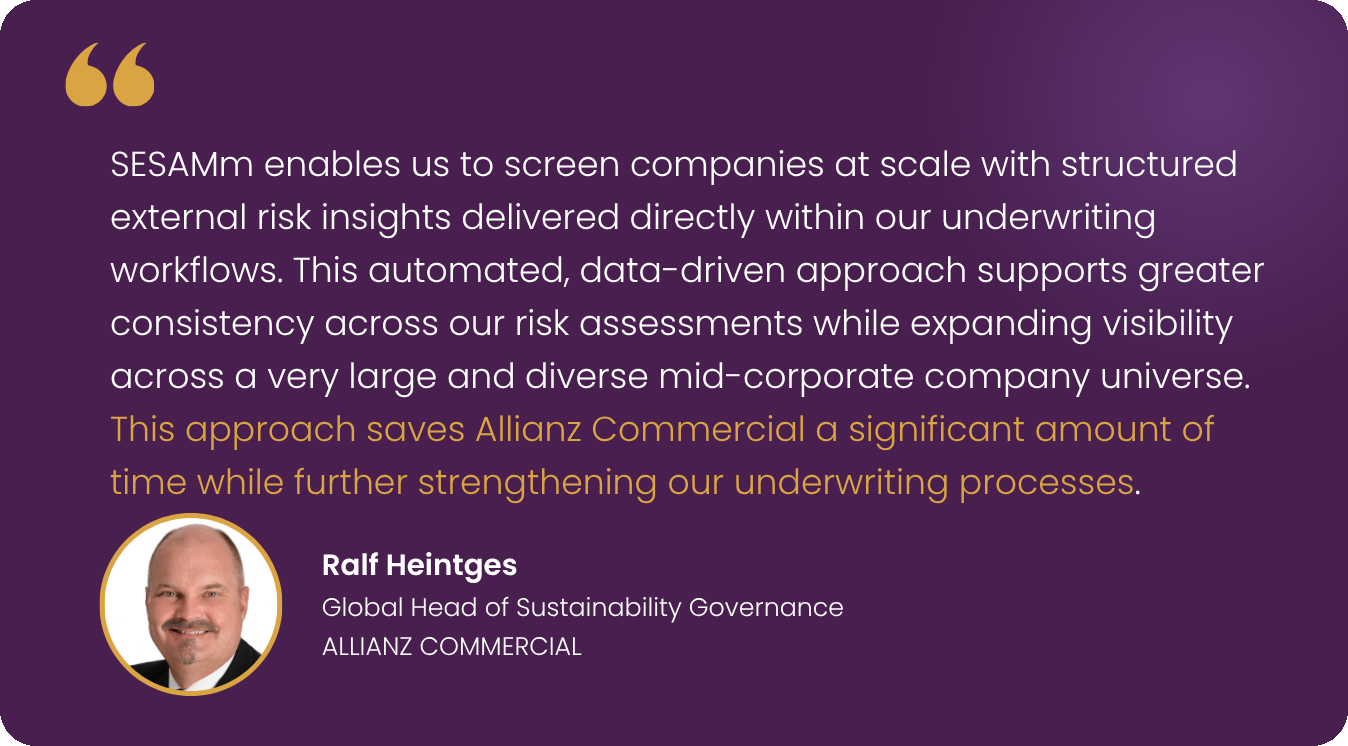
To enhance visibility into underwriting risks at scale, Allianz Commercial partnered with SESAMm to implement an automated sustainability and reputational risk due diligence capability directly integrated into underwriting workflows. SESAMm now automates the assessment of hundreds of thousands of companies each year, delivering structured insights on sustainability and reputational risk in seconds via a real-time API-driven workflow.
This deployment functions as a fully integrated component of daily underwriting activities across global teams, supporting high-volume decision-making processes without adding operational burden.
Key Benefits at a Glance
Efficiency: Transformed a manual, multi-step process into a fully automated, real-time underwriting check delivered in seconds.
Going Beyond Data: Automatically completes the sustainability and reputational due diligence questionnaire rather than simply delivering raw risk event data, saving time and enabling faster referral decisions.
Dedicated Corporate and Infrastructure Projects Coverage: Comprehensive global coverage across corporate coverage and infrastructure projects.
Tailored Approach: Risk logic configured to Allianz Commercial’s underwriting policies and decision frameworks, delivering assessments tailored to its specific requirements rather than requiring adaptation to an off-the-shelf product.
The Objective: Consistent Risk Visibility at Scale
Underwriting teams had sustainability and reputational risk data for large listed companies from an existing data provider, but required broader coverage across SMEs and privately held companies. To fill this gap, underwriting teams relied on a combination of internal processes and external research to identify potential risks. As volumes increased, ensuring consistent and timely access to sustainability impacts became a key challenge, particularly during onboarding and renewal cycles.
As part of this process, SESAMm delivered significant additional value by providing direct answers to each sustainability and reputation due diligence questionnaire question in a systematic way, enabling Allianz Commercial to fully automate the process, which was not feasible with other solutions.
Allianz Commercial aimed to:
Provide underwriters with immediate access to structured risk data.
Align with internal sustainability and reputational risk guidelines.
Support efficient onboarding and renewal workflows at high volumes.
Allianz Commercial needed a solution that could deliver real-time, standardized, and scalable risk insights directly within underwriters’ workflows.
The Solution: SESAMm’s Enterprise Underwriting Automation
SESAMm partnered with Allianz Commercial to deploy a fully integrated risk intelligence layer embedded within its proprietary underwriting environment. Underwriters now access SESAMm insights directly within their existing interface.
When underwriters enter a company identifier, the system uses Dun & Bradstreet’s D‑U‑N‑S® Number to anchor the search in a globally recognized, trusted, and data‑rich company record. With that foundation, the SESAMm API can instantly retrieve and deliver a structured sustainability and reputational risk assessment, supporting both precise entity matching and scalable discovery across millions of companies.
The SESAMm API evaluates external data over a multi-year period and automatically answers predefined due diligence questions across sustainability and reputational risk categories. Each response includes:
Clear yes/no determinations
Supporting justification and context
Supporting evidence, compliant with Allianz Commercial audit track requirements
The output is aligned with internal reputational risk and sustainability guidelines and supports transparent, auditable underwriting decisions without adding operational complexity.
Results & Impact
Since deployment, SESAMm has enabled Allianz Commercial to evaluate corporate coverage and infrastructure projects underwriting with consistent, real-time external risk intelligence. A process that previously required multiple research and validation steps can now be completed in under a minute through automated API-driven checks embedded directly within underwriting workflows.
The solution supports the assessment of hundreds of thousands of companies annually for Allianz Commercial and provides underwriters with documented sustainability and reputational risk insights at the point of decision. With expanded visibility across privately held and smaller companies globally, Allianz Commercial benefits from a far more consistent risk coverage while maintaining the speed and reliability required for high-volume onboarding and renewal processes across global operations.
The OECD Guidelines for Multinational Enterprises on Responsible Business Conduct are built into EU sustainable finance rules. The EU Taxonomy's minimum safeguards are based on them, and investors reporting under the Sustainable Finance Disclosure Regulation (SFDR) must show how much of their portfolio contains companies that break them. But the organization behind these Guidelines is better known for its economic forecasts and international education rankings.
The Organization for Economic Co-operation and Development (OECD) is a forum where governments compare policies, review each other's work, and agree on shared standards. This overview covers how the OECD works, what it does, and why its responsible business conduct rules matter for ESG screening and due diligence.
What the OECD is
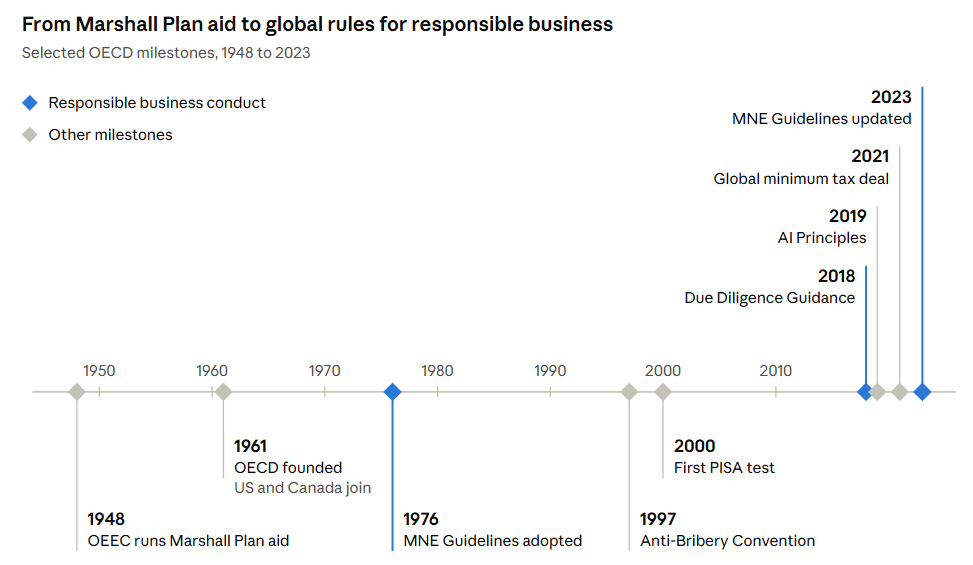
The OECD is based in Paris and has 38 member countries. Rather than lending money or enforcing laws, its role is to set standards that countries agree to follow. It began in 1948 as the Organization for European Economic Co-operation (OEEC), set up to manage Marshall Plan aid. In 1961, it became the OECD, added the United States and Canada as full members, and took on a wider, global economic role. Membership is still growing: Argentina, Brazil, Bulgaria, Croatia, Indonesia, Peru, Romania and Thailand are in the process of joining, with Romania and Bulgaria furthest along as of early 2026.
Three features explain how it has influence:
Decisions by consensus. Decisions are made by the OECD Council, where every member government has a seat, usually by mutual agreement.
Soft law. Most OECD instruments are recommendations, guidelines and declarations, not binding treaties. Their power comes from governments, regulators and markets choosing to adopt them.
Data and peer review. The OECD publishes statistics that can be compared across countries and regularly reviews members' policies. Peer pressure is its main tool for getting countries to comply.
Mathias Cormann has been Secretary-General since 2021. The Council renewed his mandate for a second and final five-year term starting 1 June 2026.
The responsible business conduct framework dates back to 1976, but much of its practical detail is newer, including the 2018 Due Diligence Guidance and the 2023 update of the Guidelines.
What it does
The OECD's work follows the same pattern. Committees of government officials, supported by OECD analysts, first gather comparable data on a policy problem. They then compare how countries deal with it and, when they agree, turn the best approaches into formal instruments. Countries outside the OECD, groups like the G20, and companies often adopt these instruments too, so their reach goes well beyond OECD members. Four flagship instruments show how this works:
Agreed through the OECD/G20 Inclusive Framework and backed by more than 130 jurisdictions. It moves some taxing rights between countries and sets a minimum tax rate, so companies can't shift profits to low-tax places
Education
PISA (Programme for International Student Assessment)
2000
Tests 15-year-olds in reading, maths and science every few years. Countries compare results, and many have reformed their schools because of them
Requires signing countries to make bribing foreign officials in international business a crime. Countries check each other's progress through strict peer review
The first standard agreed between governments on trustworthy AI. Updated in 2024, it has shaped many national and regional AI policies
Behind these instruments is a steady stream of economic analysis: the twice-yearly Economic Outlook, country economic surveys, and statistical databases that governments, central banks and investors all rely on.
Why it matters for ESG Investors
For ESG professionals, the OECD's most important contribution is its framework for responsible business conduct. It sets out what companies are expected to do and how they should show they are doing it. Key elements include:
The MNE Guidelines. First adopted in 1976 and last updated in June 2023, the Guidelines cover human rights, labor relations, the environment, bribery, consumer interests, disclosure and taxation. The 2023 update added clearer expectations on climate change, biodiversity, technology, business integrity and supply chain due diligence, and changed the rules for National Contact Points.
National Contact Points (NCPs). Every government that signs up to the Guidelines runs an NCP. It is a non-judicial complaints process where trade unions, NGOs and others can file a "specific instance" claiming a company has not followed the Guidelines. These cases are public, so they often become ESG controversies themselves. Under the EU Taxonomy's minimum safeguards, an NCP finding against a company counts as a sign of failure.
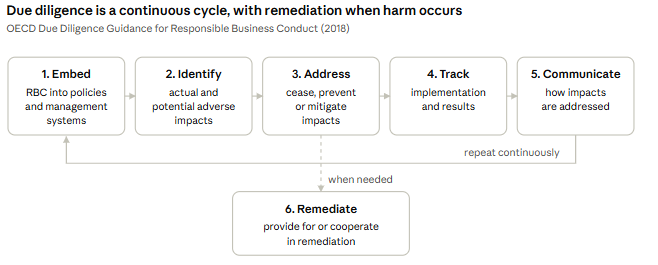
The Due Diligence Guidance. Published in 2018, the OECD Due Diligence Guidance for Responsible Business Conduct turns the Guidelines into a six-step, risk-based process. Companies, and by extension their investors, are expected to follow it.
From soft law to legal requirement. More and more, the framework is the basis for binding rules. The EU Taxonomy's minimum safeguards are directly based on the Guidelines. Two of the SFDR's social principal adverse impact indicators cover breaches of the Guidelines and the lack of processes to check compliance with them (Nordea). The EU Corporate Sustainability Due Diligence Directive also builds on the OECD framework, though OECD Watch says the two only partly match (OECD Watch).
Where controversy data fits. Good due diligence means seeing what is really happening inside a company and its value chain, not just relying on what the company says about itself. AI-driven analysis of public web content at scale can provide that view. SESAMm uses AI on news, NGO reports, blogs and forums to spot ESG controversies as they are reported. This helps investors find adverse impacts (step 2). Its UNGC violation screening is also aligned with SFDR PAI 10, which covers violations of both the UN Global Compact principles and the OECD Guidelines.
Takeaway
The OECD rarely makes headlines, but its standards shape how responsible business conduct is defined, assessed and, more and more, regulated. As the Guidelines become part of EU sustainable finance rules, investors need to back up their assessments with evidence, not just company policy statements. Ongoing, systematic controversy monitoring is one practical way to get that evidence.
Coming soon: OECD Guidelines screening. SESAMm is extending its violation screening to flag controversies linked to the OECD Guidelines for Multinational Enterprises. Request a demo to see it in action.