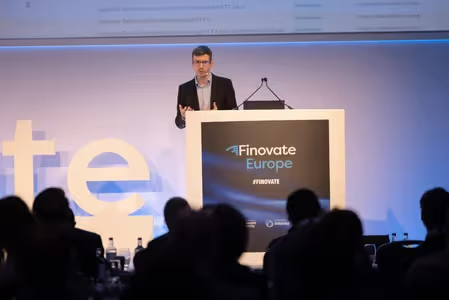


SESAMm recently announced its successful Series B2 fundraising round. The news was covered by TechCrunch, a popular technology news website known for its comprehensive coverage of the latest developments in the tech industry.
SESAMm, a French startup that helps financial firms and corporates adhere to their ESG goals by using natural language processing (NLP) to generate insights from digital content, has raised €35 million ($37 million) in a round of funding to expand internationally.
Despite a growing backlash against ESG efforts from some politicians and vocal executives, companies are still cognizant of the reputational and commercial risks of ignoring their environmental, social, and corporate governance (ESG) responsibilities — this applies both to their internal practices and those of third-parties they do business with.
With that in mind, SESAMm enables businesses to track textual data from across the web — including news portals, NGO reports, and social networks — and convert this into actionable insights.
SESAMm has amassed a fairly impressive roster of clients from across the financial realm specifically, including U.S. investment giant Carlyle Group, French corporate and investment bank Natixis, Japanese multinational insurance holding company Tokio Marine, and U.K.-based asset management firm Unigestion.
Companies can access SESAMm’s flagship product, TextReveal, via several conduits, including an API that brings SESAMm’s NLP engine into their own systems. But on top of that, SESAMm also offers a web-based dashboard where companies can access data analysis, visualizations, and push notifications for various due diligence, compliance, and ESG scenarios.
For example, a company that wants to keep tabs on its supply chain partners can use SESAMm to track anything related to those partners that hits the public domain, such as emerging fraud litigation or other lawsuits. This allows them to proactively respond the instant they receive an alert via SESAMm — these ESG alerts, which SESAMm launched a few months back, can be delivered by email or system integrations, for example a customer relationship management (CRM) application.
Elsewhere, private equity firms can use SESAMm for due diligence on potential acquisition or investment targets. Indeed, SESAMm boasts a “20 billion article data lake” which it applies its NLP algorithms to to identify mentions on any type of company, with the data sliced, diced, and categorized into user-friendly dashboards.
“Private equity firms usually engage with consulting firms to perform due diligence on target companies,” SESAMm co-founder and CEO Sylvain Forté explained to TechCrunch. “The cost of doing this is very high, and the result is suboptimal as the amount of data on the web is enormous for individuals to go through it. Therefore frequently, the results are not comprehensive enough, leading to inaccuracies.”
However, the SESAMm platform can be configured for any number of use-cases, such as “share of voice” competitor analysis, or any other theme that might be relevant to a company.
“With the current attention on ESG in the industry, many of our use-cases are focused on that — however, we provide insights into several types of information,” Forté said. “This includes sentiment on brands, thematic stock baskets and indices, company leadership reputation, and web insights on macro-economic indicators such as inflation, among others.”
According to Forté, SESAMm pre-trains large language models, similar to that of ChatGPT, the generative AI poster child of the moment — on all the data it hoovers up, and fine-tunes the algorithms on its own datasets, which are annotated across the 100-plus languages it supports.
“SESAMm integrates a variety of data — over 20 billion articles in 100 languages with 14 years of history,” Forté said. “Data sources include highly-vetted news organizations, expert blogs, and social media. SESAMm also manages licenses for proprietary data sources from premium news channels.”
“Raising a significant amount during challenging market conditions highlights the relevancy of SESAMms focus on two key trends — AI and sustainability,” Forté said. “In turn, these tools enable organizations to make better decisions and fill the data gaps, particularly in ESG, on both public and private companies.”

As scrutiny of corporate supply chains intensifies, investors are demanding more than policy statements and third-party audits. In this webinar, SESAMm and Inrate explore two powerful lenses for evaluating risks and sustainability impacts across global supplier networks: SESAMm’s real-time controversy detection and Inrate’s impact-driven sustainability data and ratings. Together, these approaches cover both public and private companies, go beyond self-disclosures, and enable assessments across a wide range of suppliers.
Watch this instant replay to dive into:
Emerging trends shaping how investors assess ESG risks and impacts across supply chains
The expanding role of AI in identifying hidden exposures and mapping sustainability outcomes
Proven strategies for combining controversy signals, ESG ratings, and emissions data to drive more informed decisions
Identifying environmental, social, and governance (ESG) controversies is a complex challenge. The large amount of data that is added to the web daily makes it difficult to analyze, leaving important insights hidden among irrelevant information. Traditional risk identification methods struggle with this, making it difficult to uncover critical issues that could impact investments.
This article explores the intricacies of ESG data trends. As businesses worldwide strive to adopt more sustainable and ethical practices, the importance of ESG metrics has risen to the forefront of strategic planning and public discourse.
Identifying Controversies with AI
Traditional controversy detection methods often need help uncovering hidden risks buried within unstructured sources like social media, local news, and niche industry reports. This section explores the advantages of using AI tools—such as natural language processing and machine learning—to detect these risks more accurately and efficiently. By leveraging AI, firms can gain deeper insights and respond proactively to emerging ESG issues, ensuring more robust risk management and informed investment decisions.
Key Challenges in Identifying ESG Controversies
In the finance world, especially when dealing with small companies, sometimes private, identifying ESG controversies presents significant challenges. These companies often lack extensive public records, and the data that is available can be sparse, fragmented, or hidden within vast amounts of irrelevant information. Traditional methods of risk identification struggle to navigate this sea of digital noise, making it difficult for private equity firms to uncover critical issues that could impact their investments.
One of the primary hurdles is the lack of valuable, structured data on smaller firms. Unlike large corporations, which are often required to disclose detailed financial and operational information, small private companies might operate with minimal public visibility. This opacity complicates the identification of potential ESG risks, as relevant data is often buried in unstructured sources like social media, local news, or niche industry reports. The challenge is not just about finding information but also about extracting meaningful insights from a diverse array of sources that may not adhere to standardized reporting practices.
Additionally, the diversity in language and terminology used by smaller firms further complicates the identification of ESG controversies. Risks are often discussed in context-specific ways, using industry jargon or localized expressions that do not easily translate into a standard risk assessment framework. This linguistic variation can lead to misunderstandings or even the complete overlooking of critical ESG issues. Therefore, private equity firms require advanced tools capable of interpreting and standardizing this information to ensure comprehensive risk identification.
Artificial Intelligence vs. Traditional Methods
Artificial Intelligence (AI) has emerged as a game-changing tool for identifying ESG controversies, offering significant advantages over traditional methods. While conventional approaches rely heavily on structured data from formal reports and disclosures, AI technologies, such as natural language processing (NLP) and machine learning, can analyze vast amounts of unstructured data from diverse sources. This capability is particularly crucial for private equity firms focused on small companies, where relevant information may be scattered across social media posts, obscure local news articles, and other non-traditional outlets.
Traditional methods often fall short in dealing with the unstructured and fragmented nature of data related to smaller firms. These methods might miss emerging controversies discussed informally in niche blogs or industry-specific forums. In contrast, AI-powered tools can continuously monitor these sources in real time, identifying potential ESG risks before they escalate. This proactive approach allows firms to address issues early, providing a more comprehensive and nuanced understanding of the risks associated with their investments.
Moreover, AI's ability to process and analyze diverse languages and terminology offers a significant edge. By decoding industry-specific jargon and translating localized expressions into a standardized risk framework, AI helps private equity firms overcome the linguistic barriers that traditional methods struggle with. This capability ensures that no critical ESG controversy is overlooked due to language differences, thereby enhancing the accuracy and effectiveness of risk assessments.
To sum it up, while traditional methods have their place, AI technologies provide a more robust, dynamic, and precise approach to identifying ESG controversies. By leveraging AI, private equity firms can better navigate the complexities of data sourcing, interpretation, and risk management, ultimately leading to more secure and informed investment decisions.
Streamlining ESG Controversy Detection with AI
Detecting ESG controversies with AI involves several crucial steps, each contributing to the precise identification of potential risks. The attached diagram illustrates a generalized AI-driven approach to detecting ESG controversies.
Step 1: Data Collection
The first step in this AI process is collecting vast amounts of web-based information to create a comprehensive data lake. This data lake acts as a repository, storing raw data in its original format. AI systems thrive on large datasets to enhance accuracy, and the data lake ensures that this requirement is met by allowing real-time data ingestion. By preserving historical information, the system can perform trend analyses that are crucial for identifying emerging controversies.
Step 2: Organizing & Cleaning the Data
Once collected, the data undergoes an essential organization and cleaning process. This step involves standardizing and categorizing the data to make it more accessible for analysis. By filtering out irrelevant information and tagging essential data points, the system can quickly and efficiently process large datasets. This organization allows for faster analysis and ensures that only the most relevant information is considered, eliminating the noise that can obscure critical insights.
Step 3: Connecting the Dots
With the data organized, the AI system creates a Knowledge Graph (KG) that maps the relationships between key entities, topics, and themes. This step is crucial for understanding how different companies, products, and brands are interconnected. The Knowledge Graph is continuously updated to reflect new data, ensuring that the system remains accurate and relevant in its analysis.
Step 4: Adding Contextual Understanding
The AI system then moves on to interpret the text, employing various techniques such as Named Entity Recognition (NER) and lemmatization. These tools help the system identify and classify key elements within the data, allowing it to grasp the context and main points of the information. This step is vital for accurately understanding the specific topics and issues related to each company, enabling the system to group related articles and monitor the evolution of controversies.
Step 5: Analyzing with Algorithms
In this step, the AI applies sophisticated algorithms to the organized and contextualized data. These algorithms focus on uncovering insights such as sentiment analysis, ESG controversies, and impacts of Sustainable Development Goals (SDGs). The system continuously refines these algorithms to maintain high levels of accuracy and performance, ensuring that the analysis remains relevant as new data becomes available.
Step 6: Turning Analysis into Actionable Insights
Finally, the AI system transforms the analysis into actionable insights. By delivering these insights in a fast and easy-to-understand format, the system empowers users to make informed decisions quickly. For example, a controversy intensity score might be used to prioritize which issues require immediate attention, allowing users to focus on the most significant risks in their portfolios.
This AI-driven process, depicted in the attached diagram, showcases the streamlined approach to detecting ESG controversies, providing private equity firms with the tools they need to manage risks effectively and maintain a competitive edge in the market. For more detailed information on how SESAMm identifies insights with AI, please efer to this document.
Conclusion
To sum up, identifying ESG controversies, particularly in smaller, less visible companies, presents significant challenges for traditional risk assessment methods. However, integrating artificial intelligence offers a transformative solution. AI tools can effectively analyze vast amounts of unstructured data, revealing hidden risks and enabling informed investment decisions. As the demand for sustainable and ethical practices grows, leveraging AI will enhance risk management and foster responsible investment approaches, allowing firms to navigate the complexities of ESG data more effectively.
Reach out to SESAMm
TextReveal’s web data analysis of over five million public and private companies is essential for keeping tabs on ESG investment risks. To learn more about how you can analyze web data or to request a demo, reach out to one of our representatives.
Tokio Marine & Nichido Fire Insurance Co., Ltd. (TMNF) tapped SESAMm for a joint research venture to predict future stock price movements and discovered two key findings:
NLP data from news and social networking websites can have strong relationships with investor behavior. Thus, it’s possible to forecast investors’ rational reactions to changes in data and price movements based on those relationships.
NLP data proved to help anticipate tail events. For example, given the macroeconomic environment of the last 10 years, the stock market performed well. So in this context, investors are sensitive to negative narratives in times of uncertainty, such as the 2015 market sell-off, the U.S.-China trade war, the coronavirus pandemic, and the start of the Ukraine-Russian war, and post their concerns online.
Providing safety and security since 1879
Tokio Marine Insurance Company was first established in 1879. Over the years, it has added products and services, acquired other businesses, and merged with other companies to eventually become Tokio Marine & Nichido Fire Insurance Co., Ltd. Commonly called Tokio Marine Nichido today, the company is a property and casualty insurance subsidiary of Tokio Marine Holdings, the largest non-mutual private insurance group in Japan. Its products and services provide safety and security to its clients and partners, contributing to more fulfilling lifestyles and business development.
One of the company’s philosophies is to be a good corporate citizen and fulfill its social responsibilities, including protecting the global environment, promoting human rights, creating a responsible working environment, and contributing to society and individual local communities. Recently, the Emperor of Japan awarded Tokio Marine Holdings, Inc. the Medal with Dark Blue Ribbon for donating to the Japan Student Services Organization to support students who face financial difficulty during the COVID-19 pandemic. Individuals, corporations, or organizations are awarded the Medal with Dark Blue Ribbon for their outstanding contributions to the public.
Transforming and accepting the challenge to grow
According to TMNF, “The business environment surrounding the insurance industry is changing at a faster pace than ever due to changes in demographics, advances in technologies, such as autonomous driving and AI, and longer-term trends, such as the intensification and frequent occurrence of natural disasters, as well as further progress in digitalization due to the COVID-19 pandemic.”
“The business environment surrounding the insurance industry is changing at a faster pace than ever…”
“While these changes in the business environment pose a threat, we consider them to be excellent opportunities for transformation and the creation of new value.” So they’ve adopted the concept, “Transformation (“X”) and Challenge to Growth 2023: Aiming to be the company most chosen for quality and its passion.” Ultimately, it strives to support customers and local communities in times of need while contributing to social responsibility. Five social issues that it will prioritize are:
Global climate change and the increase in natural disasters
The increased burden of long-term care and healthcare due to the aging of society and advances in medical technology
Technological innovation and its effects on the environment
Symbiotic society and responding to the novel coronavirus
Industrial infrastructure and how it supports economic growth and innovation
Leveraging a partner with the right technology
To secure and protect its clients’ assets while elevating social issues, Tokio Marine Nichido sought out an edge in the stock market. Under these circumstances, it was fortunate that TMNF discovered SESAMm in 2020 through the Plug and Play Japan program, a platform with an event that connects Japan to markets abroad. SESAMm had presented its NLP alternative data solution, TextReveal®, to which TMNF considered the platform for access to alternative data and sought collaboration with the SESAMm team for a research project.
“SESAMm has the technology to extract text sentiment from news data with a neural network.” – Tokio Marine & Nichido Fire Insurance Co. Ltd representative
Extract relations between NLP data and the financial market
In 2021, Tokio Marine Nichido Insurance began collaborating with SESAMm to develop an AI analytics model for alternative data. It models the impact of news and social networking data on investor behavior for stock and bond markets, transforming text information into knowledge usable by TMNF. For instance, when the model detects a negative narrative raising uncertainty in the market, investors can use this signal to reduce their risk exposure.
Predicting future stock price movements from news and social media data
Tokio Marine Nichido and SESAMm’s joint research found that natural language data from news and social networking sites effectively predict future stock price movements. In the case involving the pandemic, for example, there was a time lag of as long as a month between the time COVID-19 became news and the time it affected the U.S. stock market (Figure 1). By using SESAMm’s technology to analyze news data during this period, the team found that US news and social networking sentiment had already deteriorated sharply before stock prices reacted. This sentiment deterioration is due to the fear of the coronavirus-spread effect on the global economy. In an all-time high S&P 500, U.S. investors did not initially consider this risk. In comparison, HSI companies were closer to the coronavirus spread risk, resulting in HSI investors reacting ahead of those in the U.S.
Figure 1: In 2020, U.S. news sentiment falls ahead of the stock market in response to COVID-19 concerns.
The model can calculate sentiment for each company by analyzing the news of individual companies. It’s also possible to create a composite to measure the sentiment related to a stock index. The sentiment data also helps management and investor relations because it provides a quantitative means of understanding the extent to which investors are concerned about certain news about their company.
Verifying the results
Verification using Japanese has revealed that the timing of bottoming and ceiling of text sentiment precedes those of stock prices. The collaborating team compared the performance of:
A model that uses only orthodox financial and economic data as inputs
A model that considers NLP and financial and economic data, confirming that the latter could generate higher alpha
Figure 2: Back-testing confirms that SESAMm’s equity model can predict a market downturn, capturing changes in text sentiment and reducing positions ahead of market crashes.
Since measuring sentiment is mean reversionary by nature, the TMNF team believes it provides good support for position management during rallies and crashes. It’s also valuable for avoiding forced loss-cut at the bottom when liquidity temporarily evaporates and the market crashes.
Expanding the research to other use cases
In addition to analyzing the stock market, Tokio Marine Nichido also expanded the scope of the research to include R&D on using natural language data in trading U.S. high-yield bonds. Research shows that NLP data can help provide a hedging signal for the negatively skewed high-yield market (Figure 3) by capturing deteriorating text sentiment (Figure 5). For example, these signals can inform investors to reduce positions before market reactions.
Figure 3: NLP data can help provide a hedging signal by capturing deteriorating text sentiment.
Figure 4: An NLP-informed high-yield strategy can outperform the U.S. high-yield total return index and a strategy without NLP. Same volatility level for the three back-tests.
TMNF is also applying the research to estimate the Fed’s stance—hawkish or dovish—using natural language data, too. It hypothesizes that the market will be focused on the Fed’s stance on interest rate hikes in the next few years.
“The model developed in collaboration with SESAMm is simple in structure, yet, it’s an orthodox and robust model that uses valid data as input.”
Summarizing the collaboration
In developing models, Tokio Marine Nichido believes it is essential to consider “what data to consider” and to keep it simple. And TMNF achieved these tenets. The model developed in collaboration with SESAMm is simple in structure, yet, it’s an orthodox and robust model that uses valid data as input which is preferable to a risky over-fitting by increasing complexity.
Figure 6: The joint Tokio Marine Nichido and SESAMm NLP alternative data model: Simple yet robust.
Get in touch with SESAMm
To learn more about Tokio Marine Nichido’s case study or to request a TextReveal demo, reach out to us here:
Stay ahead with the latest in ESG and AI intelligence
Join our mailing list to receive new reports, event invites, and updates from SESAMm directly to your inbox.