

Top ESG Controversies in 2023: Analyzing the Top 5 Governance Controversies
December 20, 2023
•
5 mins read
As the year comes to an end, we wanted to highlight the most relevant ESG controversies during 2023. This article zeroes in on these risks, showing their critical role in corporate ethics and responsibility. Throughout the year, we've seen a variety of governance-related challenges that highlight the urgent need for corporate accountability.
Governance Risks: Focus 2023
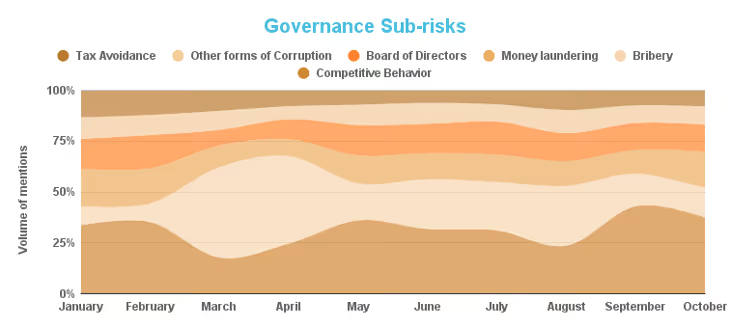
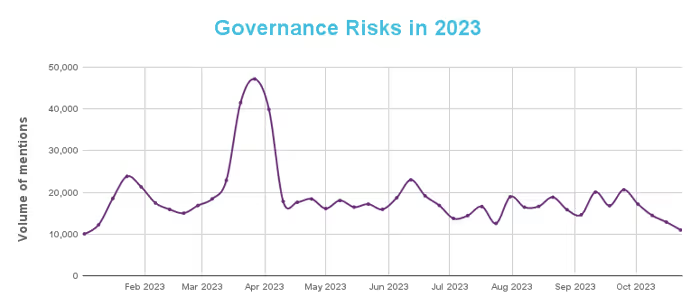
We highlighted the most significant governance risks in 2023. From tax evasion to ethical breaches such as bribery, these issues highlighted the growing importance of strong, ethical governance in corporate conduct.
Governance Controversies of 2023
Governance risks, though often overlooked, play a pivotal role in shaping corporate responsibility and ethical conduct. In 2023, several governance controversy trends emerged:
Money Laundering
Tax evasion was a major topic of discussion in the first quarter, highlighting the need for greater transparency and accountability within corporations.
Bribery
There was a significant increase in mentions related to bribery cases, underscoring the challenges in maintaining ethical governance standards.
These controversies are ranked by relative volume*.
FTX
Volume of mentions: 8,085
Relative volume: 40%
FTX, a notable entity in the financial sector, found itself at the center of governance controversies. A significant portion of the discussions surrounding FTX's governance risks in 2023 pertained to allegations of its founder's involvement in bribery schemes. (source)
Apple
Volume of mentions: 3,162
Relative volume: 28%
Apple, a tech giant, faced scrutiny as a third of its governance risk mentions revolved around antitrust violations reported in October 2023. (source)
Microsoft
Volume of mentions: 4,429
Relative volume: 25%
Microsoft encountered legal challenges with its deal with Activision. The company had to approach the court to reject the FTC's request to halt the deal. (source)
X (formerly Twitter)
Volume of mentions: 2,251
Relative volume: 18%
X/Twitter, another major player in the tech industry, faced legal challenges when a judge dismissed a shareholder lawsuit against Elon Musk concerning a Twitter buyout. (source)
Google
Volume of mentions: 3,920
Relative volume: 13%
Google faced judicial sanctions for allegedly destroying evidence in an antitrust case, further emphasizing the critical governance challenges even major tech giants face. (source)
Conclusion
In 2023, governance issues, particularly tax evasion and bribery, significantly impacted the ESG landscape, challenging corporate integrity and highlighting the importance of strong ethical standards. For private equity firms and financial institutions, these developments emphasize the value of AI-powered governance analysis in identifying risks and promoting transparency and accountability. The insights gained from this year's governance controversies are important for steering towards more responsible and sustainable business practices in the future. Remember to check out the top 5 environmental and social controversies of 2023.
Relative volume*: Relative to the total volume of E, S, or G risks for the company during the same period.
SESAMm’s AI Technology Reveals ESG Insights
Discover unparalleled insights into ESG controversies, risks, and opportunities across industries. Learn more about how SESAMm can help you analyze millions of private and public companies using AI-powered text analysis tools.

Wednesday, September 14, 2022, a16z (Andreessen Horowitz), a large, well-known VC firm, funded Flow, a new startup led by a seemingly scandalous entrepreneur, Adam Neumann, the founder infamously known to have been ousted as WeWork CEO.
Why did a16z invest in Flow and, by proxy, Adam Neumann?
In his blog post about “Investing in Flow,” Andreessen acknowledges the U.S. housing crisis in the first sentence, and here’s what he has to say about Neumann: “Adam is a visionary leader who revolutionized the second largest asset class in the world—commercial real estate—by bringing community and brand to an industry in which neither existed before.” Andreessen continues, “[I]t’s often underappreciated that only one person has fundamentally redesigned the office experience and led a paradigm-changing global company in the process.”
So that gives us a clue as to what Andreessen thinks. But what does the public web have to say, and what is its overall sentiment?
In this edition of Alternative Data Trends, we dig into public web data before, during, and after a16z announced that it would fund Flow. Does the public web agree with Andreesen’s view? If not, how does it differ? And how can this information inform an investor and other VC firms?
Let’s find out.
a16z web mention volume and polarity (Nov. 2015 to Jun. 2022)
Figure 1: Andreessen Horowitz mention volume and polarity chart.
Mention volumes spike in mid-June 2021
TextReveal® uncovered 181,620 articles and messages from SESAMm’s data lake about Andreessen Horowitz (Figure 1). Mention volume remains consistent until late 2020, at which time a16z invests in a bunch of new companies and startups, such as:
Beacons
Clubhouse
Dapper Labs
Eco
Helium
Labster
Maven
Nansen
OpenSea
Skydio
SpotOn
Tackle.io
Valon
Zus Health
a16z also focused on the NFT market and, as a result, launched the world’s biggest crypto-fund valued at $2.2 Billion in June 2021. Moreover, Andreessen Horowitz launched its own media property, Future.com, in mid-2021.
Andreessen Horowitz web mentions further spike after it doubles down, announcing $4.5B crypto fund IV in May 2022. Additional news increased mention volume because of its investment in Neumann’s new startups, Flowcarbon and Flow.
Polarity (positive and negative sentiment) dips
Sentiment toward a16z remained relatively stable over time with only minor dips until mid-2021, when it began falling, a trend driven by mentions of Flow investments news, the Uniswap related lawsuit, and suspected CoinSwitch Forex law violations (Figure 2).
Figure 2: Uniswap and CoinSwitch events affected a16z’s polarity as early as July 2022. As it rebounded, Flow began influencing polarity negatively by mid-August.
Why was Flow affecting a16z’s polarity so much?
Figure 3: Newsclips about a16z investing in Flow.
Despite Andreessen’s reasons for giving Flow and Neumann a chance, the public’s opinion seems to disagree, leaning toward a negative sentiment (Figure 3). Overall, the public doesn’t seem to trust that Neumann is worth a second chance and that his choices are beyond forgiving. Moreover, the public criticizes a16z’s choice to overlook women and people of color. This The Guardian article highlights tweets of these differences in opinion:
In summary, TextReveal’s web data analysis tells us that it’s essential to keep an eye on the latent ESG risks this investment could bring to a16z’s portfolio, particularly on the social side.
Andreessen Horowitz, from an ESG perspective
a16z ESG initiatives
Figure 4: a16z’s governance initiatives exceed environmental and social.
From a mention volume perspective, a16z’s ESG initiative numbers remain stable (Figure 4). Andreessen Horowitz has a good share of ESG initiatives shares with the highest percentage for governance driven by partnerships and collaborations, followed by the environmental aspect that has been increasing over the last two years.
ESG risks, from a portfolio perspective
Figure 5: a16z’s aggregated portfolio’s ESG risks over time.
Figure 6: a16z’s portfolio’s social risk spikes in January 2020.
Figures 5 and 6 cover 160 companies in Andreessen Horowitz’s portfolio in the venture and growth stage. Overall, a16z’s portfolio represents a lower ESG risk (<15%) over time, except for the occasional moderately higher ESG risks score (<35%) indicated by two prominent spikes, one at the end of 2016 (Q4) and the second at the beginning of the year 2020 during the pandemic (Q1). The first spike is mainly a governance risk related to Soylent’s products being recalled and supply-chain-shortage risks. The spike is also caused by another top executive resigning from Magic Leap. In contrast, the second spike is a social risk driven by Instacart’s employees’ strike upon working conditions and safety concerns during the Covid-19 pandemic.
Note: Very low risk is <5%, low risk is <15%, moderate risk is <=35%, high risk is <=50%, and very high risk is >50%. Also, note that this scale is for demonstration only and does not indicate actual risk values.
Figure 7: A deeper look into the top companies in a16z’s portfolio generating mention volumes shows Instacart and MakerDAO in the moderate risk range. In contrast, the others are low to very low in risk in comparison.
Does the public’s view of a16z’s investment of Flow have merit?
Maybe, maybe not.
Looking at Andreessen Horowitz’s company and portfolio through the lens of web data, it is, if anything, consistent with its ESG initiatives and has experienced very few controversies. Should investors ignore the potential red flags that come with Flow and Adam Neumann? Of course not. But they should feel assured that a16z has exhibited a pattern of making sound investments. For example, if we compare the firm’s SDG initiatives to those in its portfolio (Figure 8), they are almost identical.
Figure 8: Andreessen Horowitz portfolio companies are focusing on the Sustainable Development Goals with specific attention toward goal 9: Industry, Innovation, and Infrastructure and Goal 17: Partnerships for the Goals, followed by Goal 4: Quality Education and Goal 15: Life On Land.
It’s possible that maybe Marc Andreessen and a16z et al. see something in Flow that the general public does not. After all, it’s why they’re a successful venture capital firm that consistently “backs bold entrepreneurs building the future through technology,” controversies and all.
The modern world is in a peculiar place right now. We’ve got the technology and resources to improve our planet, but we often don’t know how to use them despite our best intentions. Or, at the very least, we don’t know where to put our efforts. Consequently, some investors are looking into Sustainable Development Goals (SDGs). Not only do they want their investments to earn more, but they also want them to do good. If you’re also interested in doing good with your investments, it’s essential to understand the SDGs and their meaning for your portfolio. In this article, we’ll break down the SDG basics, SDG scores, their relevance to investing, and how SESAMm can help you get and read SDG metrics. But first, a quick review of SDGs.
What SDG means
SDGs, or Sustainable Development Goals, are a set of 17 goals that the United Nations set in 2015 to be achieved by the year 2030, a framework that “provides a shared blueprint for peace and prosperity for people and the planet, now and into the future.” The global goals and the 2030 Agenda for Sustainable Development cover issues such as human rights, poverty, health, education, gender equality, and environmental sustainability, and they were designed to be universal across countries and continents worldwide. Here are the 17 UN Sustainable Development Goals:
SDG 1: No Poverty: Striving to end poverty in all its forms everywhere. This goal underscores the importance of equitable resource distribution and access to basic needs.
SDG 2: Zero Hunger: Aiming to end hunger, achieve food security, improve nutrition, and promote sustainable agriculture, thereby ensuring that everyone, everywhere, has enough quality food to lead a healthy life.
SDG 3: Good Health and Well-being: It emphasizes the need for universal healthcare access, including reproductive, maternal, and child healthcare, and combats health threats by supporting research and development of vaccines and medicines.
SDG 4: Quality Education: Envisioning inclusive and equitable quality education and lifelong learning opportunities for all, this goal recognizes education as the foundation of empowerment and prosperity.
SDG 5: Gender Equality: Achieving gender equality and empowering all women and girls to participate fully in societal, economic, and political spheres
SDG 6: Clean Water and Sanitation: This goal aims to ensure the availability and sustainable management of water and sanitation for all, recognizing the essential role of water resources in sustaining life and ecosystems.
SDG 7: Affordable and Clean Energy: Promoting access to affordable, reliable, sustainable, and modern energy for all; this goal underscores the critical nature of energy in achieving other SDGs and the transition towards renewable energy sources to combat climate change.
SDG 8: Decent Work and Economic Growth: It focuses on promoting sustained, inclusive economic growth, full and productive employment, and decent work for all, highlighting the role of the private sector in initiating impactful initiatives.
SDG 9: Industry, Innovation, and Infrastructure: Aiming to build resilient infrastructure, promote inclusive and sustainable industrialization, and foster innovation, this goal recognizes the importance of a robust infrastructure and an innovative ecosystem as drivers of economic growth and development.
SDG 10: Reduced Inequalities: This goal seeks to reduce inequality within and among countries, focusing on policies designed to achieve greater equity and involve stakeholders from all sectors of society in decision-making processes.
SDG 11: Sustainable Cities and Communities: It aims to make cities and human settlements inclusive, safe, resilient, and sustainable, emphasizing the need for green public spaces, improved urban planning, and sustainable construction practices.
SDG 12: Responsible Consumption and Production: Focusing on promoting resource and energy efficiency, sustainable infrastructure, and providing access to a better quality of life for all, this goal underscores the importance of adopting sustainable practices and reducing waste.
SDG 13: Climate Action: Taking urgent action to combat climate change and its impacts, this goal underscores the necessity for countries, stakeholders, and the private sector to collaborate in reducing emissions and enhancing renewable energy usage.
SDG 14: Life Below Water: Aimed at conserving and sustainably using the oceans, seas, and marine resources for sustainable development, this goal addresses the critical importance of our aquatic ecosystems.
SDG 15: Life on Land: Protecting, restoring, and promoting sustainable use of terrestrial ecosystems, sustainably managing forests, combating desertification, halting and reversing land degradation, and halting biodiversity loss.
SDG 16: Peace, Justice, and Strong Institutions: Promoting peaceful and inclusive societies for sustainable development, providing access to justice for all, and building effective, accountable, and inclusive institutions at all levels.
SDG 17: Partnerships for the Goals: This goal recognizes the importance of revitalizing the global partnership for sustainable development and the role of strong partnerships in achieving the SDGs, involving governments, the private sector, civil society, and others.
The UN’s 17 Sustainable Development Goals. Image courtesy of UN.org.
What are SDG scores?
Each Sustainable Development Goal has specific targets or indicators that help measure progress toward achieving those targets over time. SDG scores are numerical values given to each entity (country, company, person, etc.) based on their performance in meeting specific targets or indicators for each particular goal. Incorporating these evaluations into the decision-making process is crucial for stakeholders across various sectors, including the private sector, healthcare, financial services, and more. These stakeholders can leverage insights from SDG scores to prioritize initiatives that address critical issues like climate change, emissions reduction, and ecosystem preservation.
How do SDGs relate to ESG?
The environmental, social, and governance (ESG) framework is a tool to achieve and comply with the SDG goals. From a company’s perspective, ESG and SDG frameworks emphasize the importance of measuring and reporting progress. Companies incorporating ESG criteria into their operations often report on their sustainability performance, which can directly show their contribution towards achieving specific SDGs. For investors, ESG metrics provide a tangible way to evaluate companies' potential risks and opportunities related to sustainability, which can also align with the broader objectives of the SDGs.
The SDGs primarily focus on global challenges such as poverty, inequality, climate change, and environmental degradation, which represent the environmental and social pillars of ESG.
Within the same principles, several of these goals directly relate to the governance pillar of ESG. On the one hand, goal 16 aims to reduce corruption and bribery, develop effective and transparent institutions, and ensure inclusive and representative decision-making. On the other hand, goal 17 strives to enhance international cooperation, encourage effective public, public-private, and civil society partnerships, and ensure that policies are coherent and integrated, all of which are governance-related issues.
While the SDGs might not explicitly label these aspects as 'governance' in the way the ESG framework and regulatory landscapes do, the inclusion of these goals demonstrates a clear recognition of the importance of governance in achieving sustainable development. SDGs and ESG also have different purposes. ESG measures companies’ environmental, social, and governance performance risks and initiatives, while SDGs evaluate any entity’s performance in reaching its goals. Put another way, SDGs represent the goals, while ESG concerns methodology and processes.
At the company level, SDGs help align corporate strategy with society’s needs. Because the UN designed SDGs to be measurable, countries, companies, and people can hold themselves accountable for progress toward achieving them. And because the goals are measurable, we can score a company’s efforts, giving you an indicator to invest responsibly by aligning your portfolios with SDGs.
According to a publication by McKinsey & Company, sustainable investing appears to have a positive effect, if any, on returns. In other words, investors care about SDGs not only because they benefit society but also because they measurably support better investment decisions. For example, by incorporating SDGs into company assessments, investors can identify well-run businesses that are better positioned to benefit from the positive effects of improved social and economic conditions. SDGs also allow investors to make better-informed decisions within a defined investment time horizon by focusing on a company’s business exposure toward them. Investors can thus better measure and track a company’s opportunity exposure as a result of its achievement of the SDGs.
How to measure an entity’s SDG score
There are tools available to measure progress toward each goal—and those tools will play an essential role in helping investors decide which entities they want to invest in and which ones they don’t want to support. For example, SESAMm’s platform, TextReveal®, can analyze web data to generate SDG scores for virtually any entity in our data lake.
How SESAMm provides SDG scores
SESAMm provides SDG scores through its platform, TextReveal, a platform that allows investors to gain insights into companies, people, or topics. Specifically, we use artificial intelligence (AI) to track entities’ contributions toward SDGs, including public and private companies.
We track the 17 Sustainable Development Goals and the 169 underlying targets to detect negative news and positive events, using a similar algorithm we use for ESG alerts and gathering alternative data. Each UN SDG item displays a score from 0 to 5 to show the intensity of the company’s positive impact. Then, we translate the information into multiple languages.
This dashboard view example shows some SDG scores for Aker Carbon Capture.
We queried the Norwegian carbon capture company, Aker Carbon Capture, using our SDG positive impact dashboard over the past three years. As you might notice, Aker contributes to the goals associated with Partnerships, Climate Action, Clean Energy, and Sustainability. Maybe they could do more regarding Decent Work and Economic Growth, and Responsible Consumption and Production, but overall, the company’s online data shows a positive contribution.
See how SESAMm can help you with your SDG research
SESAMm is the leading provider of AI solutions and analytics for investment firms and corporations.
Analyzes text in billions of web-based articles and messages
Generates investment insights, ESG and SDG analysis used in systematic trading, fundamental research, risk management, and sustainability analysis
Enables a more quantitative approach to leveraging the value of web data that’s less prone to human bias
Addresses a growing need in public and private investment sectors for robust, timely, and granular sentiment and SDG data
SESAMm’s AI Technology Reveals ESG Insights
Discover unparalleled insights into ESG controversies, risks, and opportunities across industries. Learn more about how SESAMm can help you analyze millions of private and public companies using AI-powered text analysis tools.
Monitoring controversies is key in the analysis of ESG company performance. Information on social climate, company reputation, incidents, and accidents is now crucial to enable banks, financial institutions, and insurers primarily to monitor the risk in their client companies' portfolios (credit risk, claims risk, reputation risk, etc.).
Since the official announcement of their partnership on controversy-detection and scoring of listed companies in December 2021, EthiFinance, the European specialist in risk analysis and financial and ESG rating, has partnered with SESAMm, an innovative company specializing in alternative data and artificial intelligence for investment, to launch EthiMonitor powered by SESAMm.
With EthiMonitor, these two industry-leading companies have together developed a co-branded ESG controversy analysis solution for any SME universe.
EthiMonitor will access SESAMm’s ever-growing data lake through its proprietary NLP technology to provide timely ESG information. The EthiMonitor product categorizes information and highlights a company’s risk and compliance with international standards (e.g., UNGC Principles, OECD Guidelines, etc.) based on EthiFinance’s controversy assessment methodologies.
The solution provides tailored coverage to clients who need to monitor controversies in SME universes (banks and financial institutions, insurance companies, asset managers, local governments, corporations, ESG associations, or regulatory bodies).
"With EthiMonitor, we bring to the market a rigorous, proprietary, and unique SME controversy analysis solution that secures risk monitoring and decision-making for all types of counterparties and stakeholders, including but not limited to financial institutions, insurers, and investors. EthiMonitor strengthens EthiFinance's ability to inform decisions that help build a sustainable economy," said Xavier Leroy, Head of Advisory Services at EthiFinance.”
“Working with EthiFinance has been a great experience as we have been able to marry our cutting-edge technology to their deep expertise in ESG,” said Sylvain Forté, CEO of SESAMm “The synergy attained by the two companies is evident in how much value EthiMonitor, powered by SESAMm offers to our mutual clients.”
Who to contact about the new EthiMonitor powered by SESAMm
SESAMm is an innovative company specializing in alternative data and artificial intelligence for investment. Its team builds analytics and indicators, such as Sentiment Analytics, ESG Indicators, and investment signals, by analyzing billions of web articles and messages using natural language processing and machine learning. With its NLP platform TextReveal®, SESAMm addresses the entire value chain of alpha research. With six offices, including Paris, New York, London, and Tokyo, SESAMm works with major hedge funds, banks, private equity firms, and corporate and asset management clients worldwide for fundamental or quantitative investment use cases, market analysis, and competitive insights.
About EthiFinance
EthiFinance is an independent European financial and non-financial consulting, research, and rating services group. EthiFinance is recognised for its methodological rigour and its original approach to double materiality, and promotes informed decision-making. EthiFinance creates trust between investors, stakeholders, and companies to support them in their societal and environmental transformations.
"EtthiFinance, a guarantee of trust for a sustainable economy."
Locations: Paris, Lyon, Madrid, and Granada - More than 100 employees - More than 300 clients worldwide