

Unveiling the Best of SESAMm: Top 8 Blog Posts of 2023
December 8, 2023
•
5 mins read
As the year closes, it's time to reflect on some of your favorite pieces of content, so we've compiled a list of the top 8 blog posts highlighting the most popular and insightful content we've published. From investor guides to detecting greenwashing practices, these posts have resonated with you, our readers, and hopefully, continue to provide valuable information and inspiration. Join us as we look back at the top 8 posts of the year and see what made them stand out.
This piece explains the pivotal role of knowledge graphs in enhancing text analysis for investors. It clarifies how these graphs contribute to a more nuanced understanding of data, aiding in investment decisions. Readers appreciated the clear, practical insights into how knowledge graphs strengthen SESAMm’s cutting-edge AI technology.
In this article, Sylvain Forté presents an optimistic view of the future of AI in the financial sector, focusing on the rapid advancements in AI. He discusses how these technologies are evolving and what this means for investors and companies alike. Readers were captivated by the forward-looking perspective and practical implications of these innovations.
This article serves as a guide on the relationship between Sustainable Development Goals (SDGs) and AI. It explains how AI facilitates the identification and tracking of SDG-aligned investment opportunities. Our audience found the straightforward approach and practical examples particularly enlightening for understanding the intersection of sustainability and technology.
Highlighting SESAMm's innovative approach, this piece details the incorporation of generative AI into ESG risk mitigation. It underscores the significant improvements in process efficiency and accuracy, which resonated well with our audience, particularly those keen on technological advancements in finance.
This guide offers a practical look at how AI is revolutionizing and simplifying ESG data for investors. It provides real-world examples and strategies, making it a favorite among readers for its direct application in their investment processes.
This article addresses the increasingly relevant issue of greenwashing, showcasing how AI tools are employed to detect and mitigate it. The relevance of this topic in today’s sustainability-focused investment landscape made this article highly popular among our readers.
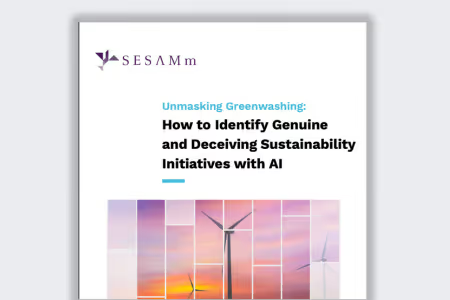
This comprehensive ebook gained popularity for its detailed exploration of AI’s role in distinguishing between genuine and deceptive sustainability initiatives. It provided readers with a deeper understanding of the intricacies involved in evaluating sustainability claims, making it a valuable resource. Download the ebook.
Topping our list is the announcement of SESAMm’s Series B2 funding. This milestone article not only signifies SESAMm's growth and success but also reflects the increasing importance of ESG and sentiment analysis in the financial world. The article’s blend of business success and industry relevance made it the year’s highlight for our readers.
Thank you for reading through this year's eight most popular blog posts. Which is your favorite, and how would you rate them?

It’s a valuable tool that’s become a standard measurement in sustainable finance for corporate stakeholders.
However, due to the growing demand and need for accurate and timely ESG data in investment decision-making and the ESG finance field, it’s also difficult to attain.
And if you’re reading this, it’s because you likely use ESG data regularly and are looking to improve your data or insights into the data. Or you’re new to ESG data and want to understand it better and how to get accurate and timely data using AI. Whatever your reason, we’ve got you covered.
But before we dive into these points, let’s cover a quick history of ESG.
Who created ESG (plus when and why)
Kofi Annan, former United Nations Secretary-General, invited a group of financial institutions to develop policies and guidance on how to better incorporate ESG issues in securities brokerage services, asset management, and associated research functions. In 2004, this joint initiative published “Who Cares Wins: The Global Compact Connecting Financial Markets to a Changing World,” a report that the UN later shared in the 2006 United Nations Principles for Responsible Investment (PRI) report. It would be the first time ESG criteria are incorporated in companies’ financial performance evaluations.
Stronger, more resilient, and sustainable
According to the “Who Cares Wins” report, the contributors were convinced that “in a more globalized, interconnected, and competitive world, the way that environmental, social, and corporate governance issues are managed is part of companies’ overall management quality needed to compete successfully.” The report goes on to state that “Companies that perform better with regard to these issues can increase shareholder value by, for example, properly managing [ESG risks], anticipating regulatory action or accessing new markets, while at the same time contributing to the sustainable development of the societies in which they operate.”
The cohort believes ESG issues can significantly affect a company’s reputation and brand, an essential part of its value. And as the report puts it, “Endorsing institutions are convinced that a better consideration of environmental, social, and governance factors will ultimately contribute to stronger and more resilient investment markets, as well as contribute to the sustainable development of societies.”
As a standard measurement, ESG becomes a way for companies to demonstrate accountability, trust, and transparency in their ESG goals to appeal to customers, employees, and investors. But how is this data produced and seen?
Where does ESG data come from?
Besides implementing ESG principles and policies, companies are asked to provide information and reports on related performance in a consistent and standardized format. This ESG reporting includes identifying and communicating key challenges and value drivers through normal investor relations communication channels. Companies are also encouraged to mention ESG information in their annual reports.
As you might notice in this scenario, ESG data comes primarily from the very companies we want to evaluate. See a conflict here?
Today’s ESG data challenges
At their core, ESG metrics capture a company’s performance on a given ESG issue. When this aim is achieved, investors can use the data to evaluate and hold companies accountable for their ESG performance. But how would you know whether ESG data accurately capture a firm’s performance?
ESG measuring, data, and how companies report them are inconsistent.
Lack of benchmarking transparency undermines the reliability of peer performance ranking.
ESG data providers deal with “data gaps” differently, and their gap-filling approaches could lead to significant discrepancies.
Interpretation differences among ESG data providers are considerable and are growing with the quantity of data becoming publicly available.
“Although 92% of S&P companies were reporting ESG metrics by the end of 2020, according to a 2020 BlackRock survey of clients, 53% of global respondents cited ‘poor quality or availability of ESG data and analytics; and another 33% cited ‘poor quality of sustainability investment reporting’ as the two biggest barriers to adopting sustainable investing.” — Deloitte
Artificial intelligence (AI) to meet rising ESG data demands
Even as investors consider ESG one of many major market factors, sourcing and analyzing data remains a problem. “The absence of standardized ESG datasets and reporting methodologies makes it difficult for issuers to disclose meaningful information on sustainability,” according to a post on WorldQuant.
But despite the ESG data limitations, ESG investing demands continue to grow. For instance, in its 2021 Key Findings, RBC Global Asset Management found that 75% of respondents of 800-plus institutional investors had integrated ESG principles into their investment approach, an increase from 67% since 2017.
Machine learning helps with this demand. For instance, advances in natural language processing (NLP) in machine-learning techniques have made it possible to extract unstructured data from web sources, like news, blogs, forums, and social media, to gain timely and accurate ESG insights. This alternative data has been integral for seeing an entity’s ESG controversies or events in near real time, providing a unique perspective to ESG data and details, filling the data gaps more accurately.
How to get ESG data using natural language processing (NLP)
NLP algorithms can read billions of news, articles, and text-based web data. It categorizes extracted data and can determine positive and negative sentiments, producing potential predictive indicators. Investors and researchers can use NLP to mine keywords and categories of underlying data to evaluate portfolio companies or see their exposure to ESG factors.
Some ESG rating agencies are now integrating or outsourcing NLP-derived datasets into their processes to extrapolate ESG scores. Likewise, investment firms, like asset managers, are incorporating NLP-enhanced web data into risk management, especially when looking into private-equity-type assets. Many are meeting their needs with NLP companies, such as SESAMm and others.
SESAMm is better at extracting ESG-related data for many reasons. First, it has one of the largest data collection sources to extract data from (data lake). Second, its NLP machine learning algorithms are tuned specially to key indicators.
1. SESAMm’s massive data lake
What makes SESAMm’s data lake unique and ideal for investment research and advanced analytics? SESAMm’s data lake is:
Broad and large
Includes more than 100 languages
Updated in near real time
Including data since 2008, the data lake consists of more than four million data sources made up of more than 20 billion articles, forums, and messages, such as professional news sites, blogs, and social media, increasing by an average of six million per day. The data lake is also updated hourly to give investors near real-time insights into their investment interests.
Moreover, the coverage is global, with 40% of the sources in English (U.S. and international) and 60% in multiple languages, including Japanese, Chinese, and Eastern European. We select and curate these sources to maximize coverage of both public and private companies, focusing on quality, quantity, and frequency to ensure a consistently high input value.
SESAMm’s developers tune the machine-learning algorithms for key indicators such as mention volume, sentiment analysis and emotion, ESG, and SDG. Additionally, they optimize the structure and schema for optimized SQL queries.
For example, our knowledge graph, a digital representation of a network of real-world entities, puts the schema in context through semantic metadata and linking, providing a framework for analytics, data integration, sharing, and unification. In other words, we map and label the concepts, entities, and events and connect and identify their relationships for quick and accurate recall.
Effectively managing environmental, social, and governance (ESG) risks is important, especially for private equity firms focusing on small or private companies. These firms often lack the detailed public data available for larger corporations, making it challenging to identify hidden ESG controversies that could impact investments. Traditional methods, heavily reliant on structured data and formal disclosures, often fall short when dealing with unstructured and fragmented information found in diverse sources like social media, local news, and niche industry reports. This is where Artificial Intelligence (AI) comes into play.
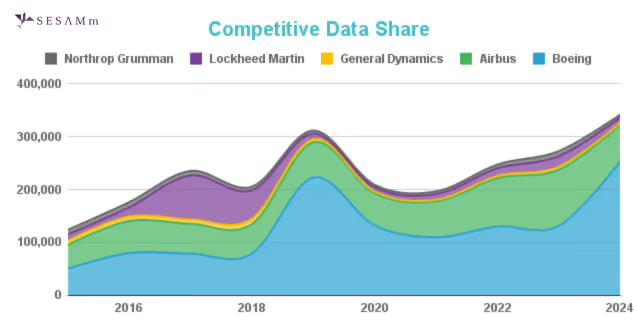
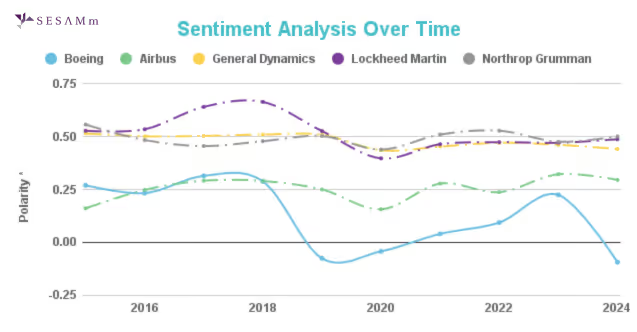
Our ebook, "The Boeing Scandal: Can AI Predict Controversies Before Traditional Tools?," explores the transformative role AI can play in enhancing ESG risk assessment processes. It explores the limitations of conventional methods and demonstrates how AI technologies, such as natural language processing (NLP) and machine learning, offer a more effective solution for identifying ESG risks. By analyzing vast amounts of unstructured data from various sources, AI gives firms access to the early detection of potential controversies, providing a more comprehensive and proactive approach to risk management.
A key highlight of the ebook is a detailed case study on Boeing, a major player in the aerospace industry. Through AI-driven analysis, we identified early signs of emerging controversies surrounding Boeing's safety practices and governance issues. The case study illustrates how AI can sift through complex data, uncover hidden patterns, and provide early warnings that allow stakeholders to act before these issues escalate into major crises.
The ebook outlines a step-by-step AI-driven process for ESG risk detection, from data collection and filtering to advanced sentiment analysis and actionable insights. This comprehensive guide empowers private equity firms to move beyond reactive strategies and adopt a proactive stance in ESG risk management.
Reach out to SESAMm
TextReveal’s web data analysis of over five million public and private companies is essential for keeping tabs on ESG investment risks. To learn more about how you can analyze web data or to request a demo, reach out to one of our representatives.
November 11, 2022, FTX, a $32 billion cryptocurrency exchange company that many believed would “change the world,” filed for bankruptcy. This news shook the crypto and financial communities, compelling many to debate the future of the crypto market and its platforms.
How did FTX collapse?
You could say that FTX’s collapse began before the news broke, but here’s a summary of events as The New York Times and ABC News details:
Breaking news
In early November, CoinDesk, a crypto publication, broke the news on a leaked document from FTX. The balance sheet showed that the hedge fund run by Sam Bankman-Fried (SBF), Alameda Research, held a substantial amount of FTT tokens. In short, SBF had set up Alameda (his trading firm) and FTX (his exchange firm) in such a way that if one unit experienced trouble, such as dropping cryptocurrency prices, the other experienced it, too.
First domino falls
By the way, FTT is used for various functions, including traders’ payment of operation fees. Also, by the way, Changpeng Zhao, Binance’s Chief Executive, sold his stake in FTX to SBF in 2021, partially with FTT. So, “due to recent revelations,” Binance (Zhao) announced on November 6, 2022, that it would sell its FTT tokens.
Other dominos follow
Traders responded; they hurried to pull funds out of FTX out of fear, and FTT’s price fell. Meanwhile, FTX processed withdrawal requests over three days, amounting to an estimated $6 billion. The liquidity crunch was upon it.
Then, on November 8, Binance said it would bail out FTX. But on November 9, Binance backtracked and announced in a Tweet that it would not “as a result of corporate due diligence,” while also citing regulatory investigations and reports of mishandled funds.
Things get worse
The next day, November 10, the Securities Commission of the Bahamas froze FTX’s assets, citing the public statement about potentially “mishandled” and “mismanaged” customer funds. On November 11, FTX filed for Chapter 11 bankruptcy protections, and SBF resigned as CEO. John J. Ray III—famously known as the CEO who headed the infamously known energy company, Enron, through its collapse in the 2000s—replaced SBF on November 17.
Fallout
Today, FTX faces federal investigation for securities laws violations based on a report by The Wall Street Journal regarding FTX lending customer deposits to Alameda Research for liabilities, of which the company’s top executives were aware. Investors have suffered loss, traders have suffered loss, and the greater crypto community and regulators are asking questions.
FTX and SBF web data analysis
News about FTX’s collapse generated tons of web data for us to scour. With this data, here’s what we aimed to find out:
How did the public web react to FTX’s collapse?
Could we have seen red flags before the news broke?
What was FTX’s collapse’s effect on the cryptocurrency market’s sentiment?
Is it possible to evaluate cryptocurrency exchange companies’ ESG risks and opportunities?
Was FTX’s collapse unprecedented? If not, what does web data tell us about that?
FTX and Sam Bankman-Fried mentions analysis
Web public sentiment for FTX and SBF was consistently positive until Q1 of 2022. As mentions volume increased, their sentiment polarity decreased (Figure 1). The mentions spike for both in November when CoinDesk broke the news. Likewise, polarity dips into the negative range for both.
Definition: Polarity represents the aggregate of positive and negative sentiments (opinions or reviews) on a company. A 0 score means there is as much positive as negative sentiment expressed. The dotted and dashed lines represent sentiment in the following charts.
Figure 1: FTX and SBF mentions and sentiment over time.
Looking closer at Q1 (Figure 2), we find that mentions affecting sentiment increased for FTX and SBF during this period. What are the mentions about, and why did they affect polarity negatively?
Figure 2: FTX and SBF pre-bankruptcy mentions and sentiment.
It turns out that SBF is linked to other keywords—we call these co-mentions—and between January 2022 and November 2022, SBF/withdrawal co-mentions (Figure 3) spiked in July when SBF defended Terra Luna’s founder, who was accused of peddling a Ponzi scheme.
Figure 3: FTX and SBF withdrawal co-mentions.
If withdrawal co-mentions brought up possible reasons why SBF and FTX experienced dips in sentiment, what other co-mentions could give us more insight? How about donations, SEC, and U.S. elections?
Figure 4: Donations, SEC, and U.S. elections co-mentions with SBF.
Corporate governance stands out when evaluating SBF’s ESG risks, but his social risks are nothing to ignore either.
Figure 5: SBF governance risks over time.
Two areas of governance risks to note are money laundering and board of directors (Figure 5). Money laundering as a co-mention has been an issue as early as February 2022, but it became a bigger issue in October. These risks may be popping up due to allegations of manipulating the price of the APT token and a securities violations probe.
If you’ve read this far, you by now get an impression of FTX and SBF, from mention volume to sentiment analysis and ESG risk. But how did FTX’s collapse affect the overall cryptocurrency market? Let’s find out.
In comparing the sentiment polarities for FTX and the crypto market from January 2021 through November 2022 (Figure 6), the sentiment for crypto remains relatively steady despite FTX’s sentiment taking a hit.
Figure 6: Effect of FTX collapse on the crypto market.
When comparing other cryptocurrency exchanges to FTX (Figure 7), sentiment polarity for them is hardly affected, except Binance, because of its connection with FTX. Oddly enough, eToro experienced a boost in sentiment, possibly because of its core values around openness and transparency, the fact that they’ve been around since 2007, its early compliance with regulations (i.e., AMF, FCA, ASIC, BaFin, and ACPR), and that it also proposes investing in stocks and ETFs, a contrast to most other crypto market exchanges. Bitfinex has its own issues, so its dip in sentiment might not be correlated.
Figure 7: FTX sentiment comparison across competitors.
At this time, FTX’s ESG risks based on the mention volume are only surpassed by Bitfinex (Figure 8), which its risks are based on many other reasons we won’t get into in this article.
Figure 8: FTX and competitors ESG risks by mention volume.
Centralized vs. decentralized crypto exchange platforms
FTX’s collapse also affected sentiment around the centralized vs. decentralized debate. Since October 2022, sentiment for centralized exchange platforms, such as FTX and its competitors, has fallen (Figure 9).
Figure 9: Centralized vs. decentralized mentions and sentiment over time.
Likewise, the mention volume for self-custody has more than doubled in the last couple of months (Figure 10). Although centralized platforms offer quicker and easier access to crypto trading, traders are considering complex but more secure options such as crypto wallets and keys because, like banks, centralized exchanges can do what they will with cryptocurrency while it’s in their possession. With self-custody, owners are in control.
Believe it or not, FTX was not the first crypto exchange to collapse. In 2014, Mt. Gox—the biggest crypto exchange at the time—lost half a billion dollars worth of Bitcoin due to a hack. How did Mt. Gox’s collapse affect sentiment for the crypto market then? The short answer is: It didn’t.
Figure 11 shows that while Mt. Gox’s sentiment polarity fluctuated, even reaching negative territories, the sentiment for the crypto market remained relatively stable and positive.
Figure 11: Mt. Gox and crypto sentiment comparison.
Is FTX’s collapse a warning for investors?
Our analysis is that investors should treat cryptocurrency exchanges like any investment opportunity. Do your due diligence and monitor your portfolio with tools like SESAMm’s TextReveal®.
As for the cryptocurrency market, data shows that sentiment for it remains level and positive. We speculate that cryptocurrency and centralized exchanges are here to stay. However, based on historical data and current news, we suspect conversations about crypto regulations to increase.
Reach out to SESAMm
For a deeper analysis of FTX’s collapse and access to all charts and supportive-article links, reach out to a representative today.
Stay ahead with the latest in ESG and AI intelligence
Join our mailing list to receive new reports, event invites, and updates from SESAMm directly to your inbox.