
Insights & Updates

Blog thumbnail

Packers Sanitation Services Inc. : When the Warning Signs Were There All Along

April 9, 2026
5 mins read
Forced labor is often assumed to be a problem of distant supply chains. The case of Packers Sanitation Services Inc. (PSSI) dismantles that assumption entirely.

Forced labor is often assumed to be a problem of distant supply chains. The case of Packers Sanitation Services Inc. (PSSI) dismantles that assumption entirely.

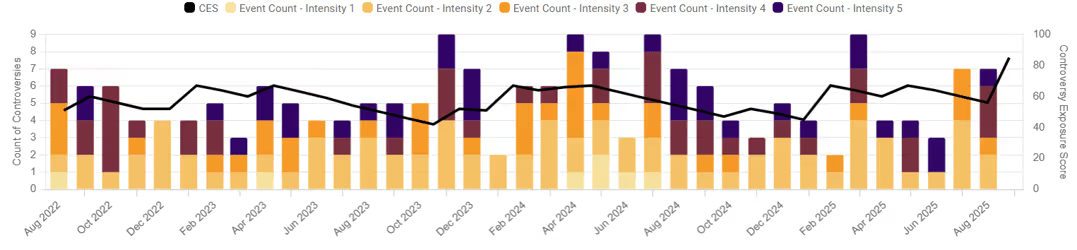
PSSI was a leading U.S. industrial cleaning contractor, servicing major meatpacking plants and backed by a top-tier private equity firm. Yet between 2022 and 2024, it became the center of one of the most significant child labor scandals in the U.S., one that had been quietly signaling its risks for years. SESAMm's controversy monitoring platform captured those early signals long before regulators intervened.

The Scandal

In November 2022, the U.S. Department of Labor discovered that PSSI had employed minors as young as 13 in hazardous overnight roles across 13 locations in 8 states. A federal investigation confirmed 102 children had been illegally employed, many handling dangerous chemicals and machinery. Three years earlier, in 2019, PSSI had already been sued for wage violations. The signal was there. It went unheeded.

The Fallout

The consequences were swift. A $1.5 million DOL fine. Contract terminations by Cargill and JBS. A DHS trafficking investigation. A replaced CEO. By late 2024, PSSI had shut its corporate office entirely. Even the private equity owner, Blackstone, faced direct scrutiny from pension funds, a reminder that labor violations travel up the ownership chain.

The Lesson

Every warning sign in this case was publicly visible before the crisis broke out. Wage lawsuits, labor complaints, and media coverage are all available in the public domain. Real-time controversy monitoring can surface these signals early, giving companies and investors the chance to act before exposure becomes unavoidable.

Forced labor is not only a humanitarian crisis. It is a material risk that demands better data, earlier detection, and stronger accountability.

Download the full case study infographic to see the complete timeline of events and key takeaways

Read More

In a significant policy reversal, Britain has officially abandoned its plans to develop a "taxonomy" for green investments, marking a notable shift in the country's approach to sustainable finance regulation. The decision, announced by the UK Treasury on July 15, 2025, signals growing concerns about the practical implementation of ESG frameworks and reflects broader challenges in sustainable finance regulation.

The Abandoned Framework

The UK's green taxonomy, first proposed in 2020, was designed to provide clear definitions of environmentally sustainable economic activities. Similar to the EU's taxonomy, it aimed to create standardized criteria to help investors identify genuine green investments and combat greenwashing. However, after extensive consultation, the Treasury concluded that the taxonomy "would not be the most effective tool to deliver the green transition."

Following a comprehensive review process, HM Treasury determined that alternative approaches would be more suitable for advancing the UK's green finance objectives. The decision represents a departure from the EU model and highlights the ongoing challenges in developing effective sustainability frameworks.

Market Implications

The abandonment of the taxonomy creates immediate challenges for investors and financial institutions operating in the UK. Without standardized official definitions, financial institutions must navigate a more complex landscape of varying private sector standards and frameworks.

For asset managers, the absence of official guidance means continued reliance on existing voluntary standards and third-party frameworks. This fragmentation could complicate investment decision-making, particularly for institutions operating across multiple jurisdictions with different regulatory requirements.

The decision may also impact the UK's position in global sustainable finance markets, where standardized taxonomies are increasingly seen as important tools for directing capital toward environmentally beneficial activities.

Industry Response

The decision has generated significant discussion within the financial sector. The UK Sustainable Investment and Finance Association (UKSIF) expressed disappointment with the announcement. Oscar Warwick Thompson, Head of Policy and Regulatory Affairs at UKSIF, called for "swift delivery of commitments on transition plans and sustainability reporting standards" as alternative measures to support the green transition.

Industry stakeholders have emphasized the need for clarity on what alternative approaches the government will pursue to support sustainable investment and address greenwashing concerns in the absence of the taxonomy.

Regulatory Context

The UK's decision reflects broader challenges facing regulators worldwide in developing effective sustainability frameworks. Creating standardized criteria that can effectively span multiple economic sectors while remaining practical for implementation has proven complex across various jurisdictions.

Key implementation challenges that have influenced regulatory approaches include:

  • Compliance costs and administrative burden for businesses
  • The technical complexity of standardizing criteria across diverse economic activities
  • Ensuring frameworks drive meaningful environmental outcomes rather than just compliance
  • Balancing comprehensiveness with practical usability

Future Direction

While stepping back from the taxonomy approach, the UK government has indicated its continued commitment to supporting sustainable finance through alternative mechanisms. The Treasury has suggested that other policy tools may be more effective in driving the green transition, though specific details of these alternative approaches have not yet been fully outlined.

For companies and investors, this development underscores the importance of developing robust internal ESG assessment capabilities and maintaining familiarity with multiple sustainability frameworks. It also highlights the continued role of market-led initiatives and private sector standards in establishing credible sustainability criteria.

The decision may prompt other jurisdictions to reassess their own approaches to sustainable finance regulation, particularly as questions about the effectiveness and implementation of various frameworks continue to evolve.

As the sustainable finance landscape continues to develop, finding the optimal balance between regulatory guidance and market flexibility remains an ongoing challenge for policymakers and financial sector participants worldwide.

SESAMm’s AI Technology Reveals ESG Insights

Discover unparalleled insights into ESG controversies, risks, and opportunities across industries. Learn more about how SESAMm can help you analyze millions of private and public companies using AI-powered text analysis tools.

Luxury brand Loro Piana, owned by LVMH, has been placed under a one-year judicial administration by an Italian court after a labor exploitation investigation uncovered serious abuses within its supply chain. According to Reuters, workers at a subcontracted factory were paid as little as €4 per hour and subjected to 90-hour workweeks, often living inside the premises. One worker was reportedly attacked after requesting unpaid wages, requiring 45 days of medical treatment.
The case highlights the growing scrutiny of labor conditions in Italy’s fashion manufacturing sector, especially among high-end labels. Loro Piana is now the fifth luxury brand, joining Dior, Armani, Valentino, and Alviero Martini, under court supervision due to supplier-related violations.

A Complicated Web of Subcontracting

What sets this case apart is the complexity of the supply chain. Loro Piana did not contract directly with the workshop where the violations occurred. Instead, it worked through two front companies, both of which lacked actual manufacturing capacity. These intermediaries then subcontracted the work to a network of unregistered or poorly monitored producers. All the firms involved in this chain have been swept up in the investigation.

This multi-tier outsourcing structure made it difficult to detect violations and raises questions about accountability. The Milan court noted that Loro Piana "culpably failed" to supervise its partners, prioritizing cost and output over due diligence.

Why It Matters

Luxury brands trade on trust and exclusivity. Consumers expect not just quality, but integrity, especially regarding sourcing. When serious labor violations are revealed, the reputational risks extend far beyond one product or supplier. They affect brand credibility, investor confidence, and long-term consumer loyalty.

This incident also reinforces a trend: regulators are increasingly willing to intervene when voluntary monitoring fails. Judicial administration isn’t just symbolic; it’s a legally binding oversight mechanism aimed at forcing systemic change.

The Path Forward

For fashion brands, this is a clear signal that supply chain governance must go deeper. That includes mapping indirect suppliers, improving transparency around subcontracting, and enforcing ethical standards at every level. Simply trusting the next link in the chain is no longer enough.

In a sector built on craftsmanship and heritage, safeguarding those values behind the scenes is just as important as what ends up on the runway.

SESAMm’s AI Technology Reveals ESG Insights

Discover unparalleled insights into ESG controversies, risks, and opportunities across industries. Learn more about how SESAMm can help you analyze millions of private and public companies using AI-powered text analysis tools.

The European Union is trying to tackle a big problem: imported goods that drive deforestation. A new Deforestation Law, planned to take effect at the end of 2025, would require companies to prove that products like cocoa, coffee, soy, and timber are not linked to forest loss. It’s an ambitious effort to make supply chains more sustainable and to hold global companies accountable.
But not everyone is on board.

Why the Law Matters

The law is rooted in a clear goal. Agriculture and forestry are responsible for the vast majority of global deforestation, and many of the products linked to this destruction end up in European markets. The EU hopes to slow forest loss, protect biodiversity, and reduce climate impact by tightening import standards. The regulation also reflects growing demand from consumers and investors who want more responsible sourcing and transparency.

Who’s Pushing Back and Why

Over the past few weeks, opposition has gained steam from both industry leaders and EU governments.

On the corporate side, food companies like Mondelez, Mars, and Hershey are asking the EU to delay the rollout. They argue that the regulation could raise costs, cause supply disruptions, and hurt competitiveness. With cocoa prices already hitting record highs, many producers say they lack the tools and infrastructure to meet the new requirements.

At the same time, 18 EU countries, including Italy and Austria, have written to the European Commission urging revisions. Their concerns echo industry concerns: the law might be too complicated, costly, and difficult for small suppliers to navigate.

What It All Means

This growing pushback highlights a real tension. On one hand, the EU wants to lead on environmental issues and use its market power to drive global change. On the other hand, companies and governments are warning that good intentions could come with serious trade-offs.

The next few months will be key. If the EU weakens the law too much, it could undermine its climate credibility. But if it presses ahead without flexibility, it risks creating economic strain and cutting off small producers from the European market.

SESAMm’s AI Technology Reveals ESG Insights

Discover unparalleled insights into ESG controversies, risks, and opportunities across industries. Learn more about how SESAMm can help you analyze millions of private and public companies using AI-powered text analysis tools.

As the global sustainability conversation matures, so does the language. Concepts like blue bonds, carbon leakage, and financed emissions are no longer the domain of climate policy insiders; they’re now central to decision-making in boardrooms, supply chains, and marketing teams. Yet, as climate finance grows more complex, many professionals lack the vocabulary to keep up.

That’s where Vogue Business comes in. The publication has released a Climate Finance Glossary designed to decipher the technical terms reshaping corporate sustainability. While Vogue may be best known for fashion, this initiative acknowledges the deep financial implications of sustainability, particularly in industries like apparel, where environmental impact is closely tied to sourcing and production decisions.

From Carbon Budgets to Just Transition

The glossary includes more than two dozen terms, covering core themes like green and blue bonds, carbon border adjustments (CBAM), nature-based solutions, and the Just Transition. It also addresses frameworks that investors and regulators are now embedding in policy and disclosures, such as double materiality, ESG integration, and science-based targets.

The definitions are not oversimplified; they’re clear but grounded in academic and policy expertise. Contributors include researchers from the University of Exeter and Oxford’s Smith School of Enterprise and the Environment, lending credibility to what could otherwise be seen as a lightweight effort.

The result is a tool that helps close the gap between sustainability and finance teams, especially in companies navigating incoming ESG regulations like the EU’s Corporate Sustainability Reporting Directive (CSRD) or the Green Claims Directive.

Why This Glossary Matters

Many sustainability professionals, especially those outside the finance world, are overwhelmed by ESG jargon. At the same time, finance teams often lack the environmental literacy to assess risks in areas like biodiversity loss or Scope 3 emissions. This glossary offers a shared language.

More than just a communications tool, it’s a strategic enabler. With greater climate disclosure, rising litigation risks around greenwashing, and investor expectations for transparency, understanding climate finance is no longer optional. It’s a baseline requirement for leadership.

This glossary arrives not a moment too soon for industries like fashion and retail, where storytelling, brand purpose, and supply chain transparency intersect.

Final Thoughts

The Vogue Business Climate Finance Glossary signals something larger: climate finance is no longer niche. It’s becoming a mainstream business competency. And when major business media take steps to make it more accessible, they’re not just informing; they’re helping shape the future of corporate sustainability.

As climate risk becomes investment risk and ESG moves from marketing to materiality, shared understanding will be the foundation of credible action.

SESAMm’s AI Technology Reveals ESG Insights

Discover unparalleled insights into ESG controversies, risks, and opportunities across industries. Learn more about how SESAMm can help you analyze millions of private and public companies using AI-powered text analysis tools.

Held from June 21–29, London Climate Action Week (LCAW) 2025 brought together over 45,000 participants across 700+ events, emphasizing London’s role as a global hub for climate finance and leadership. As geopolitical uncertainty clouds climate ambitions, this year’s event signaled a broader market pivot: investors are now prioritizing regions with regulatory clarity and policy momentum, namely Europe and Asia.

A joint survey from Bain & Company and the World Business Council for Sustainable Development, released during the week, found that 75% of global firms now prefer to invest in Europe or Asia for climate-related initiatives. Over half reported a declining appetite for U.S.-based projects, citing inconsistent federal climate policies and rising political risk.

Policy Signals from the UK

UK Energy Secretary Ed Miliband used the event to announce a bold step forward: the government will invest £30 billion annually in clean energy infrastructure through 2035. His remarks positioned the UK as a “clean energy superpower,” with a dual focus on energy security and economic renewal.

He also outlined plans for new corporate sustainability reporting standards, a move intended to improve transparency, build investor confidence, and ensure alignment with the UK's net-zero targets. These commitments were part of the UK’s post-Brexit green industrial strategy, distinguishing it from recent ESG policy slowdowns in Brussels and Washington.

Climate Finance and Market Confidence

 One of the most prominent themes throughout the week was capital mobilization. At the “Finance Live” forum, asset managers, banks, and insurers debated how to align their portfolios with net-zero goals while navigating geopolitical instability and rising greenwashing scrutiny. Key discussions included scaling blended finance vehicles, investing in transition technologies, and strengthening ESG data governance.

Meanwhile, sessions like the Nature Hub spotlighted biodiversity and natural capital, moving beyond carbon to more holistic definitions of environmental value. This reflects a growing consensus that an effective climate strategy must include nature-based solutions and ecosystem restoration.

The Broader Message: A Shift in Global Climate Leadership

While the U.S. backtracks on core climate regulations, London and Europe are entering a leadership void. For global investors, that means that developing a climate strategy now includes not only where to invest but also where to trust. In that context, LCAW 2025 offered both policy and finance updates and a credibility reset.

The takeaway is clear: in an age of fragmented regulation and climate politicization, market trust flows towards stability. London Climate Action Week didn’t just reflect that shift; it helped define it.

Held from June 21–29, London Climate Action Week (LCAW) 2025 brought together over 45,000 participants across 700+ events, emphasizing London’s role as a global hub for climate finance and leadership. As geopolitical uncertainty clouds climate ambitions, this year’s event signaled a broader market pivot: investors are now prioritizing regions with regulatory clarity and policy momentum, namely Europe and Asia.

A joint survey from Bain & Company and the World Business Council for Sustainable Development, released during the week, found that 75% of global firms now prefer to invest in Europe or Asia for climate-related initiatives. Over half reported a declining appetite for U.S.-based projects, citing inconsistent federal climate policies and rising political risk.

Policy Signals from the UK

UK Energy Secretary Ed Miliband used the event to announce a bold step forward: the government will invest £30 billion annually in clean energy infrastructure through 2035. His remarks positioned the UK as a “clean energy superpower,” with a dual focus on energy security and economic renewal.

He also outlined plans for new corporate sustainability reporting standards, a move intended to improve transparency, build investor confidence, and ensure alignment with the UK's net-zero targets. These commitments were part of the UK’s post-Brexit green industrial strategy, distinguishing it from recent ESG policy slowdowns in Brussels and Washington.

Climate Finance and Market Confidence

One of the most prominent themes throughout the week was capital mobilization. At the “Finance Live” forum, asset managers, banks, and insurers debated how to align their portfolios with net-zero goals while navigating geopolitical instability and rising greenwashing scrutiny. Key discussions included scaling blended finance vehicles, investing in transition technologies, and strengthening ESG data governance.

Meanwhile, sessions like the Nature Hub spotlighted biodiversity and natural capital, moving beyond carbon to more holistic definitions of environmental value. This reflects a growing consensus that an effective climate strategy must include nature-based solutions and ecosystem restoration.

The Broader Message: A Shift in Global Climate Leadership

While the U.S. backtracks on core climate regulations, London and Europe are entering a leadership void. For global investors, that means that developing a climate strategy now includes not only where to invest but also where to trust. In that context, LCAW 2025 offered both policy and finance updates and a credibility reset.

The takeaway is clear: in an age of fragmented regulation and climate politicization, market trust flows towards stability. London Climate Action Week didn’t just reflect that shift; it helped define it.

SESAMm’s AI Technology Reveals ESG Insights

Discover unparalleled insights into ESG controversies, risks, and opportunities across industries. Learn more about how SESAMm can help you analyze millions of private and public companies using AI-powered text analysis tools.

In a recent interview with Climate Action, Maha Chihaoui, ESG Analyst at SESAMm, discussed how SESAMm’s AI-powered solutions are reshaping ESG analysis. Maha, who leads ESG research and methodology development at SESAMm, outlined how the company addresses the challenges of self-reported ESG data, which can be inconsistent, biased, and outdated.Discover Maha’s take on how AI-driven insights and risk detection transform ESG analysis below.

1. Many ESG datasets rely on company self-reporting. What are the main limitations of that approach, and how does AI help address them?

Self-reported ESG data can be incomplete, inconsistent, or subject to bias, as companies may selectively disclose positive information while downplaying or omitting negative impacts. This lack of standardization also makes it difficult to compare ESG performance across different firms or industries. Additionally, self-reporting often lags behind real-time events, reducing the timeliness and relevance of the data.

At SESAMm, we take a complementary, “outside-in” approach using AI. Our state-of-the-art AI algorithms analyze millions of public documents every day, including news articles, NGO reports, legal filings, and more, to detect ESG-related controversies and risks. This allows us to surface controversies in near real-time, helping investors get a more accurate and timely picture of actual behavior.

2. One of SESAMm’s latest innovations is real-time UNGC violation screening. Why is the UN Global Compact such a critical framework for investors and corporates today?

The UN Global Compact (UNGC) holds critical importance for investors because it carries strong global credibility as a United Nations–endorsed initiative, signaling alignment with universally accepted norms that enhance corporate reputation and stakeholder trust.

The framework provides holistic ESG guidance across key areas—human rights, fair labor practices, environmental sustainability, and anti-corruption—enabling companies to manage risks and opportunities comprehensively. By committing to UNGC principles, companies proactively mitigate legal, operational, and reputational risks associated with violations in these areas.

For investors, especially those subject to SFDR, the UNGC is directly linked to regulatory obligations. PAI indicator #10 specifically asks whether a company has violated the principles of the UNGC or other international norms. Our tool is built on a clear and concise methodology that enables thorough screening, and with the support of advanced AI models, it makes the assessment faster, more consistent, and scalable—efficiently identifying violations or risks of violating the UN Global Compact principles across thousands of companies, thereby supporting both compliance and active risk management.

3. How does SESAMm's AI-driven UNGC screening work in practice?

The SESAMm's AI-driven UNGC screening identifies and classifies ESG controversy events based on their potential breaches of the UN Global Compact Principles into three risk levels:

  • Violator (clear and severe breaches),
  • Watchlist (possible but unconfirmed violations),
  • Low Risk (concerns without clear evidence).

These risk statuses are dynamic, reflecting changes in a company’s behavior over time. The system emphasizes transparency by providing detailed explanations and audit trails for each event, enabling clients to investigate further rather than relying on opaque “black box” results. Ultimately, event-level flags can be aggregated to guide company-level decisions, such as exclusions from investment universes.

Clients can filter and explore these events within our dashboards or receive alerts and reports as part of their risk monitoring workflows. What makes this unique is the combination of speed, granularity, and global scale—we’re able to capture and classify relevant controversies days or even weeks before they appear in traditional ESG data sets.

4. Based on your experience, how are investors using real-time controversy data in their decision-making processes?

We’re seeing investors use real-time controversy data in several key areas. During due diligence, it helps identify hidden risks in acquisition targets or portfolio companies, especially in private markets where traditional ESG data is sparse. For ongoing monitoring, firms use our alerts to track emerging controversies that may affect their holdings or counterparties, from suppliers to borrowers.
We also see it integrated into ESG scoring models, exclusion lists, and engagement strategies. In some cases, controversy data prompts further investigation or direct conversations with company management. It enables investors to act sooner and with greater confidence—before a risk becomes reputational or regulatory damage.

5. SESAMm recently launched new AI ESG Assessment Reports. How do these differ from traditional ESG ratings?

Traditional ESG ratings are often backward-looking and based largely on disclosed information. Our AI ESG Assessment Reports take a different approach—they’re built entirely on public data analyzed by AI in near real-time. The reports cover company-level ESG controversies, regulatory and industry pressures, sanctions screening, and more.
What makes them powerful is the speed and coverage. Users can generate a detailed ESG report on any public or private company—globally—in under 30 minutes. That includes small or mid-cap firms that may not be covered by major rating providers. It’s an accessible, scalable solution for firms that need faster, more flexible ESG insights in today’s fast-moving environment.

SESAMm’s AI Technology Reveals ESG Insights

Discover unparalleled insights into ESG controversies, risks, and opportunities across industries. Learn more about how SESAMm can help you analyze millions of private and public companies using AI-powered text analysis tools.

U.S. banks have dramatically increased fossil fuel financing in a notable contradiction with the narrative established after COP26. According to the 2025 Banking on Climate Chaos report, compiled by the Rainforest Action Network and its partners, global banks significantly scaled up their support for the fossil fuel industry in 2024, with a staggering $162 billion increase, pushing total financing to $869 billion.

U.S. institutions are at the forefront of this backslide. JPMorgan Chase, Bank of America, Citigroup, and Wells Fargo accounted for one-third of global fossil fuel financing, approximately $289 billion. JPMorgan alone provided $53.5 billion, a 35% rise in funding that placed it at the top of the global list. Bank of America and Citi each contributed over $44 billion, while Barclays led among European banks, increasing its lending by 55% ($35.4 billion).

Why the Sudden Surge?

This resurgence coincides with the political shift in the U.S. following the Trump administration’s departure from the Paris Agreement and weakened climate policies. In parallel, several major banks have exited the Net-Zero Banking Alliance, prompting environmental groups to accuse them of “walking away from climate commitments.”

What This Means for Climate Risk

The spike in fossil fuel financing carries profound implications. First, it increases banks’ exposure to climate liability risk. A Financial Times analysis cites growing concerns that banks may face litigation due to their financing practices in relation to climate change. Second, funneling money back into carbon-intensive sectors undermines global efforts to limit warming to 1.5 °C; long-term goals rest on systemic transitions away from fossil fuels.

Public Relations vs. Funding Reality

Banks have defended their actions by emphasizing fossil fuels and clean energy investments. JPMorgan, for instance, claims it invested $1.29 in green energy for every dollar in fossil fuel financing. Nevertheless, critics argue that green financing claims ring hollow when fossil fuel funding is simultaneously ramping up.

Rebuilding Credibility in Sustainable Finance

The disconnect between words and actions is a challenge for the financial sector. With growing scrutiny on climate claims, stakeholders demand greater transparency and accountability. Greenwashing has evolved from a reputational issue to a regulatory one, impacting trust and market access. Banks that emphasize climate commitments while increasing fossil fuel investments risk losing credibility. To maintain stakeholder confidence, a genuine transition to clean energy financing is crucial. Trust now hinges on consistent actions rather than just marketing promises, allowing us to build a sustainable future together.

SESAMm’s AI Technology Reveals ESG Insights

Discover unparalleled insights into ESG controversies, risks, and opportunities across industries. Learn more about how SESAMm can help you analyze millions of private and public companies using AI-powered text analysis tools.

BNP Paribas has released its 2025 ESG Global Survey, revealing how institutional investors are adapting their sustainability strategies in the face of shifting market dynamics, rising regulatory scrutiny, and increased public skepticism. The report surveyed 420 asset owners, asset managers, and private capital firms across 29 countries, representing a combined $33.8 trillion in assets under management, and paints a complex but ultimately optimistic picture of ESG’s evolution.

Resilient Commitment Amid a Changing Landscape

Despite growing political backlash and accusations of greenwashing in various markets, investor commitment to ESG remains strong. A large majority, 87%, said their ESG or sustainability objectives have remained stable, and fewer than 3% expect to scale back their commitments. Furthermore, 84% anticipate that their organizations will continue to progress on sustainability goals through 2030.

However, this confidence is paired with a new sense of caution. Forty-one percent of respondents reported a more restrained approach to publicly promoting their ESG activities. This shift reflects broader concerns about reputational risk and regulatory ambiguity, particularly in markets where ESG has become politicized. Still, the underlying momentum toward long-term ESG integration appears undeterred.

From Broad ESG to Thematic and Impact Strategies

The report also signals a shift from general ESG investing toward more targeted strategies, especially thematic investing. Eighty-five percent of participants now apply sustainability criteria to investment decisions, and 59% actively pursue thematic strategies such as climate resilience or social equity.
Top investment priorities over the next two years include increasing allocations to the energy transition, divesting from carbon-intensive assets, and using active ownership to push portfolio companies toward improved ESG outcomes. This thematic focus suggests a maturation of ESG strategies, with more precise goals and performance expectations.

Emergence of ESG “Pacesetters”

A standout insight from the survey is the rise of “pacesetters,” the 19% of respondents that have achieved the highest levels of ESG integration. These advanced investors have already embedded ESG factors across portfolios, including metrics related to social impact, biodiversity, and “The Just Transition Mechanism”. Nearly all pacesetters are actively decarbonizing their portfolios and report alignment with broader societal and environmental goals.

This group is not only more sophisticated in managing ESG risk but also more likely to view ESG as a long-term value driver. Their practices highlight what comprehensive ESG adoption can look like when paired with sufficient resources, internal alignment, and robust data.

Private Capital’s Expanding ESG Role

Private capital managers are also emerging as key ESG players. More than half are using active ownership strategies, while 76% emphasize social impact, and 63% are engaged in just transition initiatives. These firms see ESG as an opportunity to generate alpha, align with stakeholder expectations, and lead in sustainability-driven innovation.

The Critical Role of Data and Partnerships

Finally, the survey underscores the growing importance of ESG data and trusted partners. Nearly half of all respondents expect to increase budgets for ESG data acquisition and analysis. When selecting financial partners, ESG reputation and expertise are increasingly decisive factors.

Overall, the 2025 survey shows that institutional investors remain deeply committed to ESG, but are evolving in how they execute and communicate these strategies. The future of ESG appears less about bold declarations and more about targeted, data-driven action.

SESAMm’s AI Technology Reveals ESG Insights

Discover unparalleled insights into ESG controversies, risks, and opportunities across industries. Learn more about how SESAMm can help you analyze millions of private and public companies using AI-powered text analysis tools.

Stay ahead with the latest in ESG and AI intelligence

Join our mailing list to receive new reports, event invites, and updates from SESAMm directly to your inbox.