SpaceX has spent the past three years in the news for reasons that have little to do with rockets. The company has been in court with a neighboring company in Texas, is at odds with the FAA, and has been quietly dropped by more than one European pension fund. In June 2026, shortly before its record 75 billion dollar public listing, MSCI gave the company its lowest corporate responsibility rating, a CCC.
We took a look at SESAMm’s data on SpaceX’s and pulled its record to see what three years of coverage actually holds. Between September 2023 and September 2026, we detected 139 distinct controversy cases involving the company, assembled from news reporting and other public sources. Four of them sit in the most severe tier, and between them they carry most of the story.
SpaceX and FAA in Regulatory Turmoil
UNGC: WatchlistSeverity 5 · Very High
CategoryEnvironmentalGovernanceSocial
17 events | February 2023 to June 2026
The first case in the record is a disagreement with the regulator. Conflict between SpaceX and the Federal Aviation Administration (FAA) intensified over time, with multiple proposed fines and significant penalties for data submission failures and safety oversight. Elon Musk publicly criticized the agency's management and called for reforms. What the case also notes is that none of this severed the relationship: through the same years, SpaceX continued to unveil ambitious plans for Mars and to collaborate with the FAA.
SpaceX's Environmental Challenges and Legal Battles
UNGC: WatchlistSeverity 5 · Very High
CategoryEnvironmentalGovernanceSocial
123 events | August 2019 to August 2026
SpaceX faces increasing scrutiny over its expansion and launch activities, with numerous environmental lawsuits and regulatory challenges emerging. The concerns range from habitat destruction and pollution to safety violations, and have prompted protests and legal action from environmental groups and local communities. As the company pushes forward with its plans, the balance between innovation and environmental responsibility remains contentious.
SpaceX Faces Scrutiny Over Workplace Safety Violations
Severity 5 · Very High
CategoryEnvironmentalGovernanceSocial
13 events | November 2023 to June 2026
SpaceX is under scrutiny following a series of workplace safety incidents, including a death and multiple injuries at its facilities. OSHA has imposed significant fines and opened investigations, citing trends in injury rates and unreported incidents, raising questions about the company's safety practices.
SpaceX's Starship Program: A Journey of Triumphs and Setbacks
Severity 5 · Very High
CategoryEnvironmentalGovernanceSocial
59 events | May 2020 to July 2026
The FAA has navigated a complex relationship with the Starship program, closing multiple investigations while mandating corrective actions after a series of explosive test failures. Set against those failures are significant milestones, including successful test flights and the development of new prototypes. Regulatory scrutiny and environmental concerns have continued through both.
What Investors are doing about it
Beyond these four, the record runs heavily to labor and employment litigation, as well as to Starlink's military use and security exposure.
Investors have already acted on it. Danish fund Akademiker Pension blacklisted SpaceX in March 2025. In August 2026 the Swedish state pension fund AP7, which manages savings for roughly six million people, ruled out investing at all, citing corporate governance and human rights risk management. Both decided on evidence that had been public for years. After the listing, the stock fell 27 percent.
Takeaways
The record does not point to one isolated controversy, or even to one particular part of the business. It points to a pattern. SpaceX’s exposure sits at the intersection of the risks that come with operating at extraordinary speed and scale: safety, environmental impact, labor practices, regulatory compliance and the governance of increasingly consequential technology.
That pattern matters more than any single headline. These cases are different in substance, but they share a common feature: the underlying disputes have persisted.
The exposure is not just something of the pastl. SESAMm’s Controversy Exposure Score* for SpaceXis currently 82 (considered “Very High Risk”) f, in its “Very High Risk” band, compared with an average of 67 (HIgh Risk) over the preceding year.
This ongoing exposure shows that controversy has become a recurring feature of SpaceX’s expansion story. For investors, regulators and other stakeholders, the question is increasingly whether the company’s governance and risk controls can scale as quickly as its rockets, satellites and ambitions.
*The Controversy Exposure Score (CES) is a continuous score from 0 to 100 measuring a company's exposure to ESG controversies over time, based on the severity of incidents and their media volume.
This is an unsolicited rating: it is not commissioned by the rated company. The company is notified before its score is first issued, does not take part in the rating, and SESAMm has no access to its management or non-public documents. Ratings are produced only from public and licensed sources. Methodology: https://www.sesamm.com/methodology
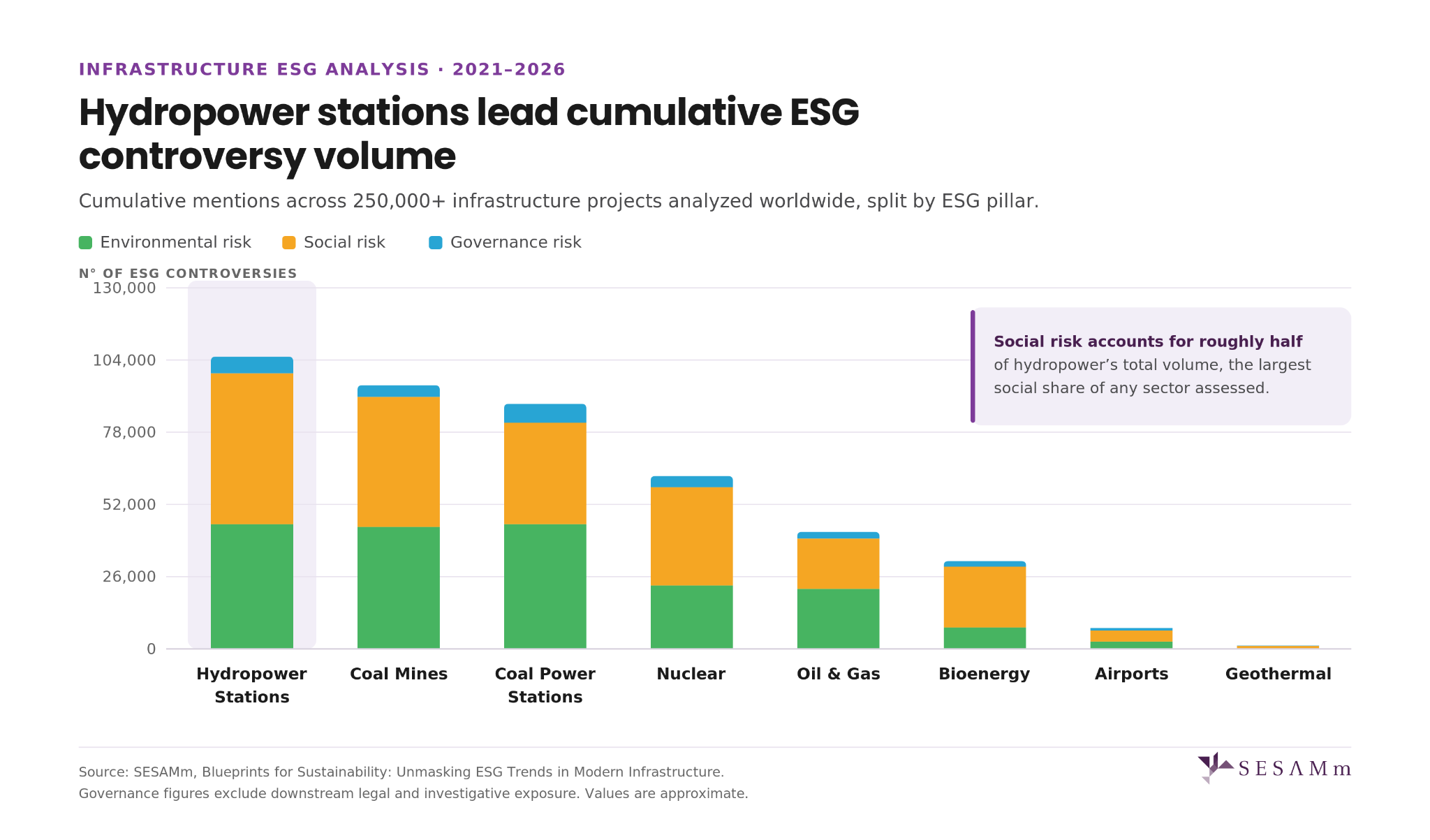
An analysis of over 250,000 infrastructure projects reveals that the sector most often filed under "clean energy" carries the heaviest environmental and social controversy footprint of any asset type assessed.
In the taxonomy of energy infrastructure, hydropower occupies a comfortable position. It is renewable, dispatchable, and long-lived, and it enters transition frameworks, green bond eligibility criteria, and net-zero roadmaps with minimal friction. Where coal is a legacy liability to be managed down and nuclear invites a specialized debate, hydropower is largely treated as settled. What these projects have actually done does not support that treatment.
Belo Monte, an 11,233 MW complex on the Xingu River in Pará, Brazil, is the sharpest test of the point, because it was built to answer this exact objection. Approved after decades of opposition to a far larger design, it was engineered as a run-of-river plant to minimize flooding, and its reservoirs cover 478 km², of which 274 km² was already river channel at high water, a 61% reduction compared with the 1980s proposal, according to the operator's own regulatory filing. The mitigation was designed from the start, and everything that follows happened regardless.
Biodiversity: the cost of a physical footprint
Environmental controversy across infrastructure concentrates on industrial accidents, water pollution, and biodiversity, and hydropower leads the third, outright, because dams require the permanent conversion of river systems and the land around them. Mexico's Federal Electricity Commission won environmental approval in September 2014 for the Las Cruces dam on the San Pedro Mezquital, upstream of Marismas Nacionales, a Ramsar-protected wetland, even though the project's own impact statement conceded that the damage to Indigenous ceremonial sites could not be mitigated. Along the Mekong River, river health and fish populations fell as dam construction spread through the basin. In Brazil, the Doce River carried a mass release of toxic material after an upstream failure. Elsewhere, the record includes violations of the Endangered Species Act and documented disruption to rainfall patterns.
At Belo Monte, the consequences have been measured rather than projected. The plant diverts water into a canal that bypasses a 130-kilometer stretch of the Xingu known as the Volta Grande, which has received less than 30% of its natural annual discharge since 2019, and some 86% of the stretch's seasonally flooded vegetation, 30,748 of 35,600 hectares, can no longer be inundated at all. The gap lies in the regulator's own file: IBAMA's technical staff called for 10,900 cubic meters per second in February, the historic peak month, compared with the 1,600 that the operating regime actually releases. Seven years of underwater video survey data published in Scientific Reports recorded total fish species richness falling from 62 to a post-operation average of 51, with the steepest losses near the dam and in the rocky rapids, which hold roughly 2.6 times as many species as sandy reaches. The zebra pleco, whose entire known range lies inside the dewatered stretch, now sits on Brazil's national list of threatened species as critically endangered.
None of this is an accident or a failure of operation. It is a structural consequence of the asset. A well-run dam still floods a valley, and a dam engineered specifically not to flood one still dewater the river below it.
When engineering fails: hydropower's physical risk profile
Coal mining leads infrastructure on industrial accidents, where the record is dominated by human tragedy and safety negligence: explosions, collapses, fires, and repeated, incremental failures. Hydropower ranks second, but its accidents take a different form, because in this sector, industrial failure means catastrophic engineering failure at scale. The record includes pipe ruptures causing severe land erosion, oil leaks, and dam collapses that killed and displaced people across whole regions, while PG&E's settlement over damages to the Middle Fork American River Hydroelectric Project and the litigation still running in Brazil after dam collapses give a sense of the exposure a single event can generate. For anyone underwriting these assets, the distinction is financial as much as physical: a coal mine's safety record is a rising cost curve, while a dam's structural integrity is a low-probability, near-unbounded loss.
At Belo Monte, that exposure has so far been financial. The project was budgeted at R$28.9 billion when Brazil's development bank approved a then-record R$22.5 billion loan in November 2012, and by late 2017, actual investment had reached R$38.6 billion, roughly 34% over. The operator owed R$28.3 billion to lenders and debenture holders at the end of 2024. Aliança Norte Energia Participações, the Vale and Cemig vehicle holding a stake in the project, discloses a possible loss of R$3.05 billion from a single construction-delay claim and describes the operator's liquidity as its principal point of attention and a source of investor alert. Neoenergia wrote off its own 10% holding by R$482 million in the fourth quarter of 2021.
The physical risk has been closer than the absence of a collapse suggests. In October 2019, the operator wrote to the national water regulator declaring an emergency, because reservoir levels had fallen far enough to expose an unprotected section of the Pimental dam's earthfill base to wind-driven wave erosion and, in the company's own words, structural damage. It cut outflow below the level agreed with the environmental regulator to protect the structure, and the letter surfaced only through investigative reporting.
Beyond the environment: displacement, water, and chronic corruption
Right to property
Hydropower ranks first among infrastructure sectors for property disputes, a direct function of the footprint a dam and reservoir require. The record shows land seizures, forced displacement, compensation that arrives short or not at all, communities never consulted before ground was broken, and blasting that cracked the foundations of nearby homes. Those affected are frequently the least equipped to hold an operator to account.
Fifteen years after Belo Monte broke ground there is still no audited count of who lost their homes. Estimates run from 20,000 to 40,000 depending on the definition used, against the operator's account of rehousing some 6,000 urban families. Landowners say expropriations are priced at unadjusted 2013 values while the project's own construction boom inflated the market, and as of 2025 none of the land required for the riverine resettlement program had been bought. A petition filed with the Inter-American Commission in 2011 still has no ruling.
Community health and safety
Hydropower sits alongside coal and nuclear as a leading source of community health disputes, but it arrives by a different route. Coal delivers PM2.5, nuclear delivers radioactive anxiety, and hydropower delivers water mismanagement: overconsumption that strips farmers of a livelihood, contaminated water reaching local crops. The grievance is agricultural rather than industrial, which widens the affected population considerably.
On the Volta Grande, catch per fisher fell from 11.1 kilograms a day between 2001 and 2008 to 4.53 kilograms between 2020 and 2023. A randomized household survey found 38.5% of residents in Belo Monte's resettlement neighborhoods living with moderate or severe food insecurity, against 28.3% across the surrounding city. In June 2026, federal prosecutors sought as interim relief for 635 families along the reduced-flow stretch the emergency delivery of three and a half to five liters of drinking water per person per day.
Corruption and bribery
Corruption and bribery accounts for close to 30% of governance controversy across infrastructure. What separates hydropower is the pattern. In airports, nuclear, and coal, corruption surfaces as discrete scandals: a probe opens, executives are charged, attention fades. In hydropower it keeps returning, tied repeatedly to falsified records and payments to local officials to secure land and water rights. Isolated scandals point to isolated actors. A pattern that recurs points to how these projects get permitted.
Brazilian prosecutors alleged that Belo Monte's construction contracts carried bribes worth 1% of their value, and three contractors admitted cartel conduct and kickbacks under leniency agreements that carried immunity. Everything after that was procedural closure rather than a finding of liability: the principal defendants were acquitted and the acquittal upheld on appeal in 2024, the competition authority archived its bid-rigging case in 2025, and no individual has been convicted in connection with the project. An investor screening for enforcement outcomes would have found a closed file. The costs landed elsewhere, in permitting delay, financing conditions, and a minority stake that has been for sale since 2022 without a buyer.
Hydropower's risk concentration: what this means
Hydropower's classification as clean energy is accurate on the metric it was designed to measure, because generation is low-carbon. But carbon intensity is one dimension of sustainability, and it is not the dimension that produces operational friction, legal exposure, or the loss of a social license.
What drew sustained opposition to these projects was water rights, displaced communities, cracked foundations, converted wetlands, and permits secured through local payments. None of it appears in a carbon accounting framework.
For investors, insurers, and lenders seeking transition-aligned infrastructure exposure, that is a material blind spot: an asset class that screens well on the primary criterion while carrying the heaviest social burden in the dataset, and carrying it on behalf of people who have no employment relationship with it. Belo Monte was engineered to avoid precisely that outcome and produced it regardless, which suggests the exposure is not a function of how a dam is built but of what a dam is.
The label is not wrong. It is simply measuring something other than risk.
Wildfires used to be a summer story. For most of the last decade, they arrived with the Northern Hemisphere dry season, dominated a few weeks of headlines, and receded once the rains came. That is no longer a safe assumption. Los Angeles burned in January 2025, a month that has historically been the quietest of the year for wildfire news anywhere in the world. Canada lost more forest in 2023 than in any year in its recorded history. Greece, Spain, and Portugal now post record-breaking fires in years that are not supposed to be their worst.
Given how much the pattern itself seems to be changing, we wanted to look past the headlines and into the data: how has coverage of wildfires actually moved over the past seven years, what does the aftermath of these fires look like once the smoke clears, and which countries, and companies, keep reappearing in the story. The analysis below sets out what the data shows, and, where it helps to understand it, what was actually happening on the ground at the time.
Executive summary
This analysis reviews global wildfire mentions between 2019 and 2026 across three lenses: quarterly mention volume, ESG sub-risk classification, and country-level geographic distribution, cross-referenced against documented public reporting. Three findings stand out: (1) wildfire coverage has shifted from a seasonal pattern to a sustained, year-round baseline since 2023; (2) coverage volume tracks proximity to population centers and identifiable liable parties more closely than it tracks the physical scale of the fire itself; and (3) the dominant subject matter in wildfire-related ESG coverage is the aftermath (casualties, contaminated water and air, insurance exposure, litigation) rather than the fire event in isolation.
1. Mention volume over time: a seasonal story becomes a year-round one
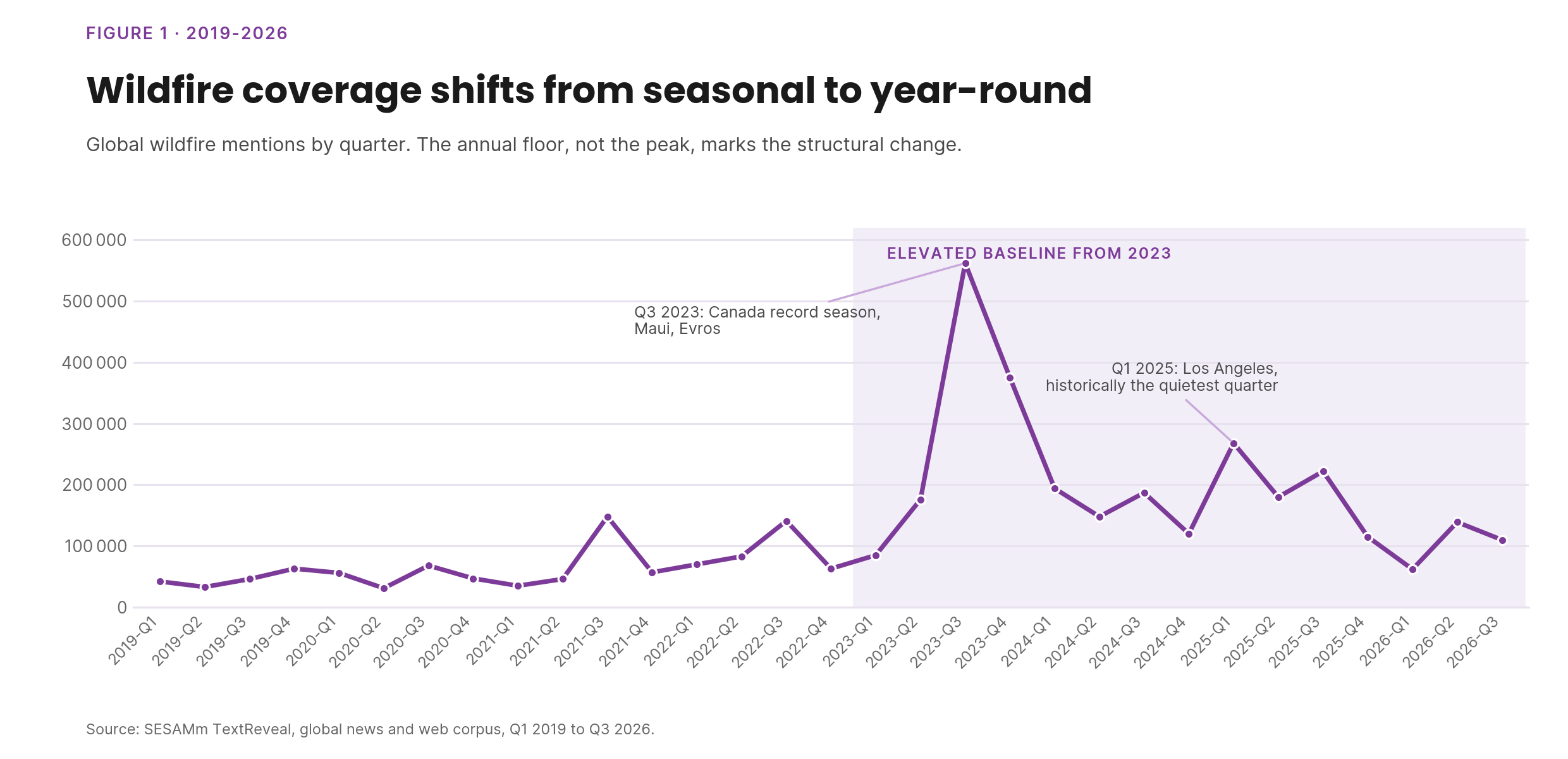
For most of the period, the data follows a predictable four-quarter cycle: Q1 is the annual low, Q2 shows a moderate rise, Q3 spikes with the Northern Hemisphere dry season, and Q4 falls back. That cycle breaks in two places, and both breaks mark a structural change rather than a one-off event.
Q4 2023 does not return to baseline after the Q3 peak: coverage stays elevated into the final quarter for the first time in the dataset.
Q1 2025, historically the lowest-volume quarter of the year, reaches roughly 270,000 mentions, more than several previous Q3 peaks.
The floor is the more telling number. In the quarters before 2023, non-peak volume rarely exceeded 80,000 mentions. From 2023 onward, even the quietest quarters do not fall below roughly 110,000–190,000. Wildfires have moved from a seasonal hazard to a year-round subject of coverage.
It's worth noting what does not explain this shift: acreage burned. 2020 through 2022, the years directly before this data climbs, include some of the largest fires by area in modern US and European history, yet register comparatively modest mention volume, partly because those years overlapped with the COVID-19 pandemic, which absorbed a large share of global news capacity.
The years that do dominate the chart, 2023 and 2025, are not necessarily the years with the most land burned; they are the years fire reached population centers and produced an identifiable party to blame. The Lahaina, Marshall, and Los Angeles fires are all comparatively small by area next to the 2020 US West Coast season or Canada's 2023 season, but generated substantially more coverage because of death toll, structures destroyed, and utility liability. Acreage, in short, is a weak predictor of coverage; proximity and blame are strong ones.
What was happening on the ground behind each peak
Each Q3 peak in the dataset lines up with a specific, documented cluster of events:
Q3 2022: fires threaten the Yosemite region and Sequoia groves in California; Spain and Portugal report wildfires during a European heat wave; a federal review attributes a New Mexico wildfire to a botched prescribed burn.
Q3–Q4 2024: a wildfire cuts power to Labrador; another burns near Suncor's Firebag oil-sands site in Alberta; Jasper, Alberta is significantly damaged; Greek investigators attribute the country's worst fire of the year to a faulty power cable.
Q1 2025 (the anomaly): a 14-fire outbreak tears through Los Angeles and San Diego County over January 7–31 on Santa Ana winds; the Palisades and Eaton fires alone destroy more than 18,000 structures and kill at least 31 people, with over 200,000 evacuated. Property-value loss is estimated at roughly $31 billion by CoStar, with total economic loss estimated between $250–275 billion by AccuWeather. Days later, the European Forest Fire Information System reports more than 100,000 hectares burned across the EU by the end of March, three months ahead of the typical season.
Across every year in the dataset, the same mechanism converts a fire into a sustained story: ignition (lightning, arson, or utility equipment failure) combines with drought and wind to produce the initial event, but litigation and identified liability sustain the coverage long after the fire is contained. PG&E, Southern California Edison, PacifiCorp, and Hawaiian Electric recur as named defendants across separate fires and separate years.
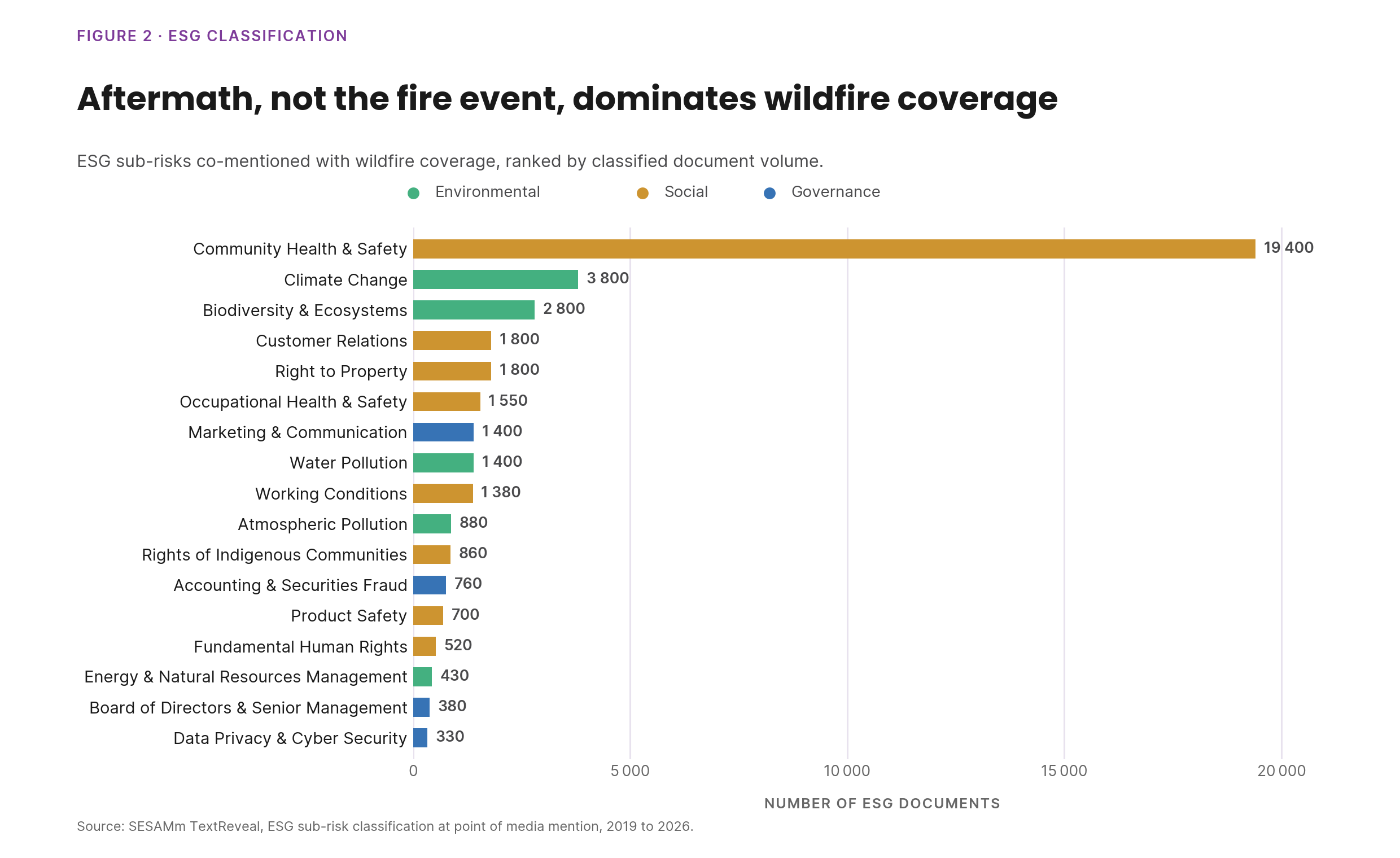
Wildfire-related controversies were classified into ESG sub-risk categories at the point of media mention. The ranking below runs from highest to lowest mention volume, with a documented, sourced example behind each category.
Climate Change: wildfires are framed as both symptom and accelerant. Canada's 2023 season burned at roughly seven times the historical average; researchers found climate change had tripled the underlying fire risk in the country's boreal forest, and the season released an estimated 1.5 billion metric tons of CO2, comparable to a decade of Canada's typical wildfire emissions.
Customer Relations: reflects the California property-insurance crisis: State Farm nonrenewed roughly 72,000 California policies in the two years before the January 2025 fires, then faced a state investigation into claims handling, including denial of hygienic smoke-damage testing, after the fires it did cover. A $1 billion FAIR Plan assessment was subsequently levied on insurers operating in California.
Right to Property: tied to the scale of destroyed real estate, an estimated $31 billion in property value destroyed in the January 2025 Los Angeles fires, and to litigation over responsibility for that loss, including Los Angeles County's lawsuit against Southern California Edison and Edison's countersuit against the county.
Marketing & Communication: covers corporate communications during active disasters, including relief pledges, the Recording Academy and MusiCares pledged $1 million to Los Angeles wildfire relief in January 2025, and utility crisis messaging, which came under renewed scrutiny after Edison International executive pay continued to rise during the period the company faced Eaton Fire liability claims.
Working Conditions: wildland and municipal firefighting workforce strain during extended, overlapping fire seasons across multiple continents.
Atmospheric Pollution: principally the June 2023 Canadian smoke event: New York City's air quality index peaked at 465, with a 24-hour PM2.5 average nearly three times the US regulatory standard, and follow-on research linked the event to a 44–82% increase in asthma-related emergency-department visits in the city.
Accounting & Securities Fraud: the Edison International shareholder class action filed after the Eaton Fire, alleging the company misrepresented the readiness of its power-shutoff program; Edison's share price fell approximately 34% following the fire, and the suit names CEO Pedro Pizarro and CFO Maria Rigatti as defendants.
The remaining categories (Product Safety, Fundamental Human Rights, Energy & Natural Resources Management, Board of Directors & Senior Management, and Data Privacy & Cyber Security) account for smaller shares of classified documents and were not tied to a comparably documented recurring event pattern in this dataset.
3. Geographic distribution of coverage
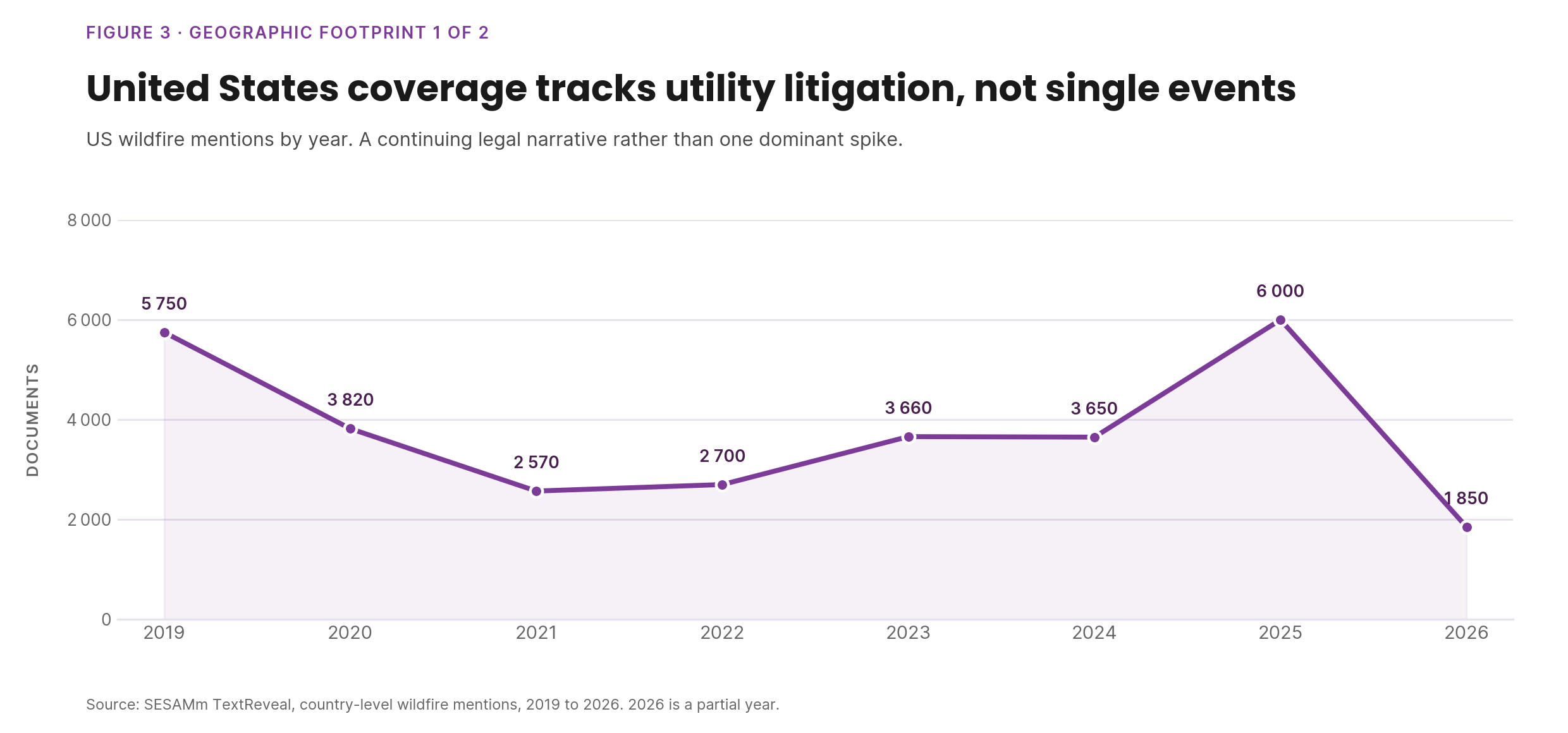
The United States accounts for the largest share of country-level mentions throughout the period, without a single dominant spike: volume rises through 2023–2025, peaks around 2025, then falls sharply into 2026. That shape fits a continuing sequence of named utility liability cases (PG&E, Southern California Edison, PacifiCorp) more than it fits a single event.
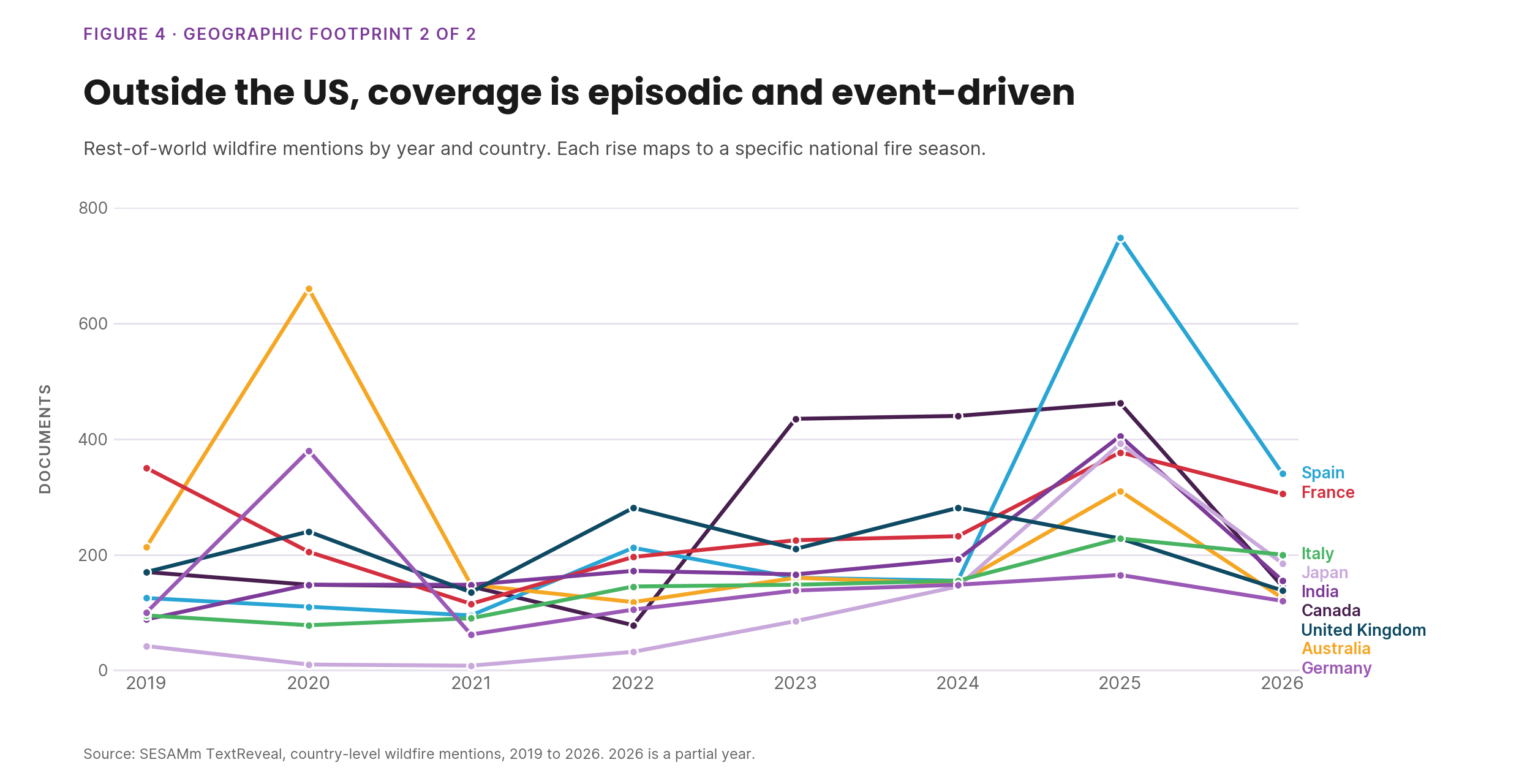
Outside the US, coverage is more episodic, clustering around identifiable national events rather than building a sustained baseline:
Australia peaks sharply around 2019–2020, matching Black Summer (24 million hectares burned, 33 deaths, an estimated three billion animals affected), then recedes.
Canada rises from 2022 and peaks around 2025, matching the record 2023 season (roughly 15–18 million hectares, eight firefighter deaths, up to 232,000 evacuated) and the continuation of large fires in 2024, including Jasper.
Greece shows a sustained late-period rise, matching the 2023 Rhodes evacuation and the Evros fire, followed by continued fire activity in 2024, including the faulty-power-cable fire investigators called the country's worst of the year.
Spain shows its highest point at the end of the series, consistent with the unusually early 2025 season (100,000+ hectares burned across the EU by end of March) and recurring summer wildfire and heat-wave coverage in 2022.
France, Germany, India, Italy, Japan, and the United Kingdom register comparatively low, stable volumes throughout, with modest increases around 2024–2025 in line with the broader post-2023 elevated baseline rather than country-specific events.
Read together, US coverage behaves like an ongoing institutional and legal narrative anchored by utility litigation, while rest-of-world coverage behaves like a series of discrete, event-driven spikes tied to specific fire seasons.
Conclusion
Across mention volume, ESG classification, and geography, the evidence points to a consistent mechanism. Coverage volume is driven primarily by three factors: proximity of the fire to population centers, the presence of an identifiable liable party, typically a utility, and how much a competing global news cycle is absorbing attention capacity at the same time. The physical scale of a fire is, on its own, a comparatively weak predictor of how much coverage it receives. On that basis, the next spike in wildfire coverage is more likely to come from an urban-interface fire with a clear liability story than from the largest fire by area.
Northern Trust is the latest name on a growing list of managers losing business over the same issue. Since early 2025, several asset owners have reallocated capital away from managers that stepped back from climate coalitions:
For risk and ESG teams, the lesson isn't about picking a side in the US-Europe ESG divide. Instead, it's that a governance decision made for one audience can create material commercial exposure with another. Northern Trust's exit was a defensible response to conditions in its home market, but that still cost the firm a nine-figure mandate.
Coalition memberships and public commitments used to be treated as background credentials, not something clients actively screened for. However, asset owners are now treating a manager's stewardship posture as a live signal, and they're willing to act on it.
NZAM officially relaunched on February 25, 2026, with softer requirements (the updated commitment dropped references to the 2050 net zero investment goal) and without most large US managers. More than 250 asset managers, including Amundi, signed on. The managers who didn't rejoin are now operating with a visible, trackable gap between their public stance and what a growing subset of clients expect.
The takeaway
Climate coalition membership has become a proxy that a segment of asset owners actively screen for, and reversing course is now a reputational event with a dollar figure attached. Whether that logic holds up for managers with less European or sustainability-focused client exposure is a separate question. But for those who do, the message from this string of mandate losses is clear: walking back a public commitment doesn't just draw criticism, it costs money..
SESAMm helps ESG, risk, and secondaries teams monitor and screen for ESG and reputational risk across public and private companies, drawing on a data lake of 30+ billion documents in 100+ languages. Screening criteria, whether regulatory (SFDR, EU Taxonomy), LP-driven, or values-based, are fully customizable to a firm's own policy. Learn more about SESAMm's approach to controversial business involvement screening and secondaries exclusion diligence.
By Sylvain Forté (SESAMm) and Mariya Peykova (Scientific Climate Ratings)
Picture two infrastructure assets.
The first carries obvious physical exposure, sitting right where the climate is changing fastest. The second is operationally robust and is considered sustainable, but it generates a steady stream of fines, local opposition, and headlines.
Which one is riskier to investors?
The answer depends on which question you're asking.
Viewed through a climate model lens, the first asset appears more exposed. Viewed through real-time controversy monitoring, the second demands more immediate attention. Neither assessment is wrong. Each captures a different dimension of risk.
That's why leading infrastructure investors increasingly rely on multiple perspectives rather than a single measurement. Climate risk doesn't reduce to a single definitive answer. It unfolds across different time horizons, different datasets, and different types of evidence. Looking through multiple lenses provides a richer understanding of an asset's resilience and the risks that may shape its performance throughout the investment lifecycle.
Four complementary lenses help build that picture: physical, transition, controversy, and regulatory.
The first two, physical and transition, are forward-looking. They use models and scenarios to estimate how climate change and the low-carbon transition may affect an asset over years and decades. The other two, controversy and regulatory, are grounded in today's reality, tracking emerging events, stakeholder concerns, enforcement actions, and changing policy as they happen.
Together, these lenses provide a more complete understanding of risk. Physical and transition analysis explain where an asset is heading over the mid and long term. Controversy and regulatory monitoring reveal what is happening today and how quickly new issues are emerging. Rather than competing, they complement one another.
We explored exactly this approach during a recent live session co-led by Sylvain Forté, CEO of SESAMm, and Mariya Peykova, Sales Director at Scientific Climate Ratings, where they put a real infrastructure asset, a coal-fired power plant operated by LEAG, through each of the four lenses. The session demonstrated how decision makers can integrate Scientific Climate Ratings’ and SESAMm’s products to capture climate risk from all angles. Below, we’ve recapped key takeaways from that analysis.
The Long View: Physical and Transition
Start with the lenses that look across the life of the asset: physical and transition. Both are the domain of Scientific Climate Ratings, which translates climate science into financial metrics that investors can act on. Its Climate Exposure Rating runs on a standardized A to G scale (A is climate-resilient, G is structurally vulnerable), combines physical and transition components, and is forward-looking offering various time horizons from 2035 to the end of an asset's operational life. Each grade is benchmarked against a stable universe of more than 6,000 private infrastructure assets across 25 countries, and the methodology is deliberately transparent, with no black boxes.
The physical lens asks what a changing climate does to the asset itself. For the Schwarze Pumpe plant, the answer is reassuring. Its headline physical exposure rating is A, the most resilient grade, with asset-equivalent damage of just 0.09%. What little exposure there comes mainly from manageable flood risk, with heat stress limited.
However, the model flags one hazard that needs monitoring: drought. It rates F, with water demand projected to be four times the available supply and drought conditions covering three months of the year, for an asset that, like much heavy industry, depends on water. That signal does not yet include a financial damage figure because a peer-reviewed drought damage function is still being developed, but it is a real exposure that the model is flagging for the future.
The transition lens asks a different question: how does the asset perform as the economy decarbonizes? Here, the same plant tells a starkly different story. Under a net-zero pathway toward 2035, it rates G, the worst grade on the scale. The pressure intensifies sharply from around 2030, driven by Germany's legislated coal phase-out under the KVBG, with projected revenue approaching near-total devaluation. Both sub-components sit at the bottom of the scale: direct carbon costs, as carbon prices climb toward roughly $700 a tonne under net zero, up from today's levels near $76, and market demand, which collapses to the point of total demand destruction. On this trajectory, the asset is, in effect, stranded.
To be fair to LEAG, this is not a company simply waiting to shut down. Backed by the federal government, it is already planning an 850-megawatt hydrogen-ready gas plant at the same site to replace half of the retiring coal capacity. That is a genuine transition story, and exactly the kind of forward plan the modeled lenses are built to weigh.
These grades are not abstract scores. They translate physical and transition exposure into comparable financial metrics, such as annualized expected damage and revenue at risk, projected forward to 2050 and beyond, so one asset can be weighed against thousands of others on the same terms.
Taken together, these long-term perspectives paint a nuanced picture. The Schwarze Pumpe plant is physically resilient today, yet its economic model faces a steep, policy-driven decline within the decade.
What they don't capture is what may already be unfolding around the asset right now.
Scientific Climate Ratings already offers Climate Risk Ratings (CRR), the next step beyond the Climate Exposure Rating (CER) featured here. Where the CER quantifies climate exposure and potential average annualized damage, the CRR translates it directly into impact on key financial metrics: revenues, cash flows, probability of default, and enterprise value. The step from 'how exposed is this asset?' to 'what does this cost?' in the financial language that investment committees can act on.
The Signal View: Controversy and Regulatory
Now switch to the lenses that focus on the present: controversy and regulatory.
Both are the domain of SESAMm, which uses AI to detect ESG controversies on private assets, often before they surface in traditional ratings. Drawing on one of the industry's largest data lakes, it reads more than 35 billion documents (news, regulatory filings, local press, NGO, and court reports) and distills them into a Controversy Exposure Score on a 0 to 100 scale. Individual events are aggregated into cases, each with a timeline, its sources, and a severity rating that reflects how material the issue is: financially, legally, and by the number of stakeholders affected.
The controversy lens, then, monitors how the outside world is responding to an asset in real time, surfacing meaningful developments as they emerge.
For LEAG, that real-time read is substantial. The operator carries a high Controversy Exposure Score spanning environmental, social, and legal topics. There is proven legal action against one of its mining operations, flagged at the highest severity as a potential UN Global Compact violation, alongside criminal complaints over environmental breaches and a record of legal, regulatory, and community pressure built up over the years. A notable cluster of those signals concerns water, both consumption and pollution, including challenges and complaints over groundwater pumping and water permits.
That last point is telling. Recall the drought exposure the physical model flagged but could not yet price. Here it is, already materializing as legal and community pressure on the ground, picked up in real time. None of this appears in a physical climate model or a transition scenario, yet each development can influence permitting timelines, financing conditions, operational flexibility, or reputation.
This is where real-time signals become especially valuable. Controversies often emerge long before they are reflected in annual ratings or financial models. Public opposition, regulatory investigations, and stakeholder disputes can develop over months or even years before they result in fines, project delays, or impairments.
Alongside controversy monitoring sits the regulatory lens, which captures how policy is evolving and being enforced on the ground. For infrastructure investors, this may include relicensing requirements, water rights, environmental compliance, or expanded disclosure obligations such as the CSRD. In many ways, the regulatory perspective bridges long-term transition trends with today's operational reality.
These lenses answer a different set of questions from climate models. Rather than forecasting where the asset is heading decades from now, they reveal what requires attention today.
Four Lenses, One Richer Understanding
The Schwarze Pumpe plant is, at the same time, physically resilient, economically stranded on a net-zero path, and under active legal, regulatory, and community pressure today.
Each lens highlights a different aspect of the same asset, operating across different timescales and using different types of information. Physical and transition analysis explain long-term structural resilience and exposure. Controversy and regulatory monitoring reveal how emerging issues are unfolding in real time.
It's tempting to combine these perspectives into a single score, but doing so risks losing the context that makes each valuable. The four lenses aren't multiple measurements of the same phenomenon. They're answers to different questions.
Viewed together, however, they become considerably more powerful. The drought finding captures it: a hazard the physical model can flag but not yet price, becomes far easier to weigh once real-time monitoring shows the water-related legal and community pressure already building around the asset. Long-term climate modeling helps investors understand whether a controversy reflects a temporary challenge or an early signal of structural risk. Conversely, real-time controversy and regulatory monitoring provide context for long-term scenarios by indicating whether projected risks are already beginning to materialize.
No single lens tells the whole story.
Together, they provide a far clearer picture of infrastructure risk.
[SESAMm and Scientific Climate Ratings operate as independent platforms. This analysis reflects a collaborative session designed to illustrate how complementary approaches to climate risk can be combined to provide a holistic risk assessment across both short-term and signals and long-term risks.]
Most data companies lead with what their product can do. SESAMm's public methodology does that, and then goes a step further. It defines, in plain terms, exactly what the Controversy Exposure Score measures and where its boundaries lie. That precision, now public and free to access under the EU ESG Rating Regulation that entered into force on 2 July 2026, is what makes the score dependable.
The logic is straightforward. A number is only as useful as the user's understanding of it. SESAMm would rather its clients understand the score completely than take it on trust, because a well-understood score is a score that can be used with confidence.
Built From the Public Record
The CES is built entirely from public and licensed media and web content. That foundation gives it a clear and well-defined scope, and SESAMm is precise about what that scope includes.
Coverage is richer for some entities than others. Large and high-profile companies generate far more reporting than small or private ones. SESAMm addresses this directly by rebasing each event against an entity's own media history rather than absolute volume, so a company is measured against its own baseline rather than penalised for simply attracting more press. For entities with a persistently low profile, the methodology is explicit that the underlying signal is thinner, which tells a user precisely where to bring additional sources to bear.
Language and source access define the rest of the scope. The pipeline reads a broad and growing set of languages and ingests an extensive range of public and licensed sources. Where a controversy is reported mainly in a language or a publication outside that set, the methodology says so plainly. Defining these edges is what allows a user to place the score accurately within a wider process.
The Discipline of Not Guessing
One principle deserves particular attention, because it sets SESAMm apart from a common industry habit. Where direct coverage of an entity is thin, SESAMm does not fill the gap with proxy data, sector benchmarks or estimated values.
This is a deliberate quality choice. Substituting averages would produce a tidier-looking dataset, but it would manufacture information that does not exist. SESAMm reports only what the evidence supports. For a low-visibility entity, that means a low score reflects the controversies actually detected, and the methodology is clear that this is a measure of detected exposure rather than a clean bill of health. The result is a number a client can stand behind, because nothing in it is invented.
This alo clarifies how the score is best read. The CES measures exposure to negative controversies, which makes it a sharp, single-purpose instrument. It is designed to surface risk, not to certify virtue, and pairing it with positive-performance data is exactly how SESAMm intends it to be used.
An Early Signal, Drawn From Public Reporting
The CES reflects controversies as reported in public sources, which can include allegations that are still moving through the courts. The methodology is precise about what this means: the score records the existence and salience of reporting, and it is built to give risk teams an early signal rather than a legal conclusion.
This is one of the score's most valuable properties. Reputational and ESG risk very often crystallises long before any legal process concludes. A measure that captures reported exposure as it emerges, while being clear that reporting is not a verdict, gives a risk team time to act early and to weigh the signal appropriately. That combination of timeliness and precision is precisely what makes it useful in practice.
Rigorously Engineered, Openly Documented
Because the score is produced by an AI pipeline, SESAMm documents both how that pipeline works and the controls that keep it accurate. The engineering is the headline here, and it is substantial.
A language-model filter screens for false positives before any event is surfaced. A dual-layer human quality-assurance process, run daily by SESAMm's Research and Analytics team and escalated where needed to the Methodology Lead, reviews accuracy, corrects confirmed issues at the source, and feeds recurring patterns back into the training corpus so the system improves over time. Before any material change to the methodology is deployed, it is backtested against a historical event database, reviewed on the entities it most affects, and signed off by the Methodology Lead. The methodology is formally reviewed at least once a year.
SESAMm also names the structural properties of statistical models openly, because describing a system you understand and control is what gives these safeguards their meaning. The point is not that any model is flawless. It is that the controls are designed for exactly the points where models need them, and that the whole arrangement is documented for anyone to inspect.
Why Defining the Boundaries Builds Trust
There is a quiet truth in ESG data. The providers willing to define the edges of their product are often the ones most worth trusting, because they are describing a system they genuinely understand and operate. A score presented as all-seeing invites misuse. A score presented with its scope clearly marked can be integrated thoughtfully, weighted sensibly, and combined with other inputs exactly as the methodology intends.
SESAMm's view is that this clarity is part of doing AI well, not a step back from it. The same analysts who design the methodology are the ones who test and refine it every day, and the new regulation now gives the whole market a reason to hold itself to the same standard. Precision about what a score means is not a limitation on its value. It is the foundation of it.
To read the full methodology, including how the Controversy Exposure Score is built and the safeguards that keep it accurate, visit sesamm.com/methodology.
A single number is a powerful thing. It can summarise months of reporting across dozens of sources into something a risk team can act on in seconds. It can also hide more than it reveals, if no one explains how it was built. When the same company receives very different ESG scores from different providers, the usual reason is not bad data. It is undisclosed method.
SESAMm has published the full methodology behind its Controversy Exposure Score, free to access, following the entry into force of the EU ESG Rating Regulation on 2 July 2026. This article walks through what the score measures, how it is constructed, and the two design choices that most distinguish it.
What the Score Measures
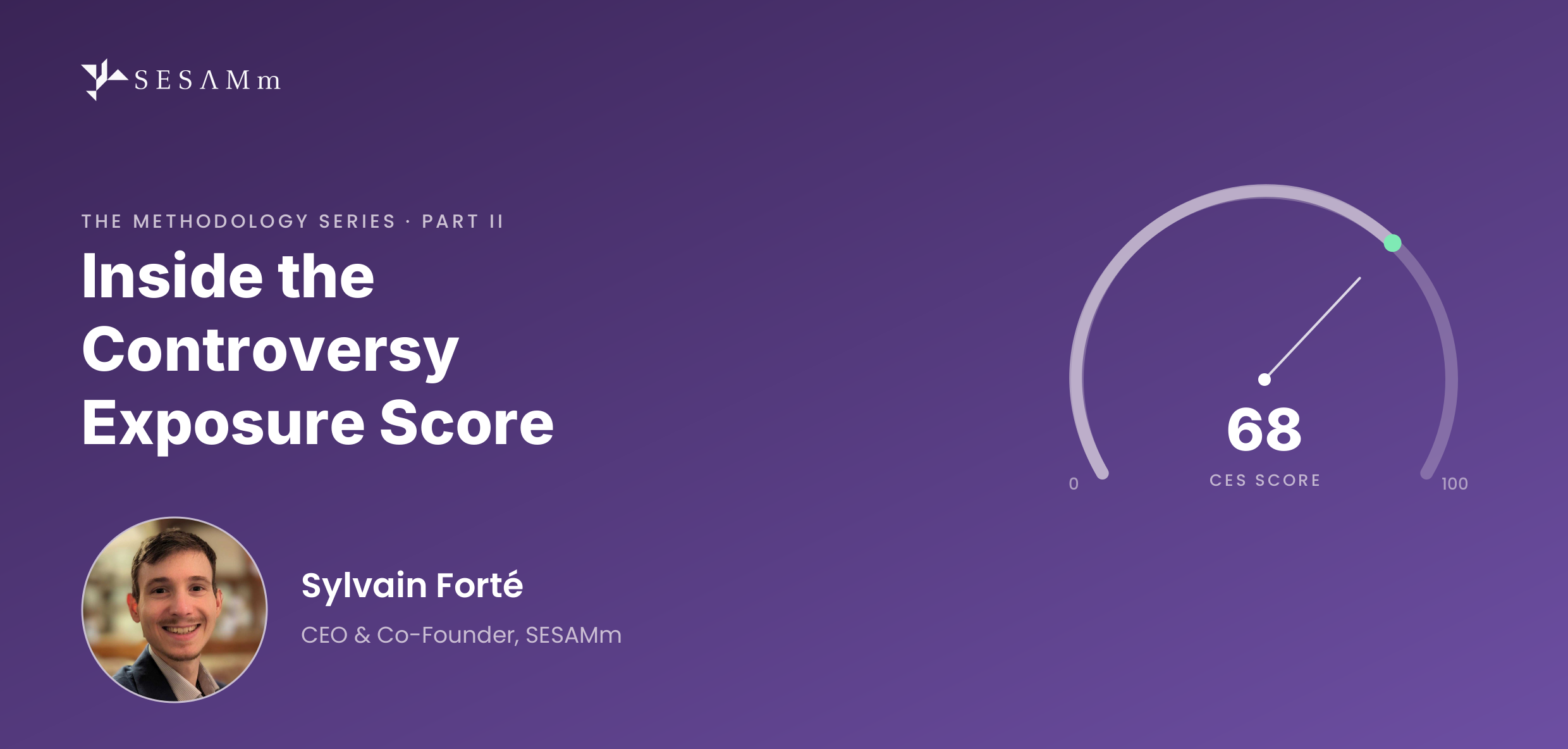
The Controversy Exposure Score, or CES, runs on an absolute scale from 0 to 100 and is grouped into five risk bands, from Very Low to Very High. It has a single, deliberately narrow objective: to measure an entity's exposure to ESG controversies, meaning adverse events and conduct attributed to that entity as reported in public sources.
Three points define its scope from the outset. The CES is an impact-materiality measure. It looks at the negative footprint of an entity's activities on people and the environment, not the financial effect of ESG issues on the company itself. It is backward-looking. It reflects controversies that have already been reported, over a rolling 24-month window, rather than forecasts or transition pathways. And it is built only from public and licensed public-domain information, never from private, confidential or self-reported data.
From Millions of Articles to a Single Case
Before any score can exist, raw coverage has to become structured information. This is where most of the engineering sits.
SESAMm's pipeline first attributes each document to the right entity and screens it for genuine ESG relevance against a multilingual taxonomy, removing low-quality, duplicate or non-editorial content. It then addresses a problem familiar to anyone who monitors the news: media echo. A single real-world incident can generate dozens of near-identical articles. To prevent that from inflating the picture, related documents are grouped into Events, and related Events into Cases, so that a controversy unfolding over time is tracked as one continuous case rather than many separate items.
A validation step then confirms that each candidate event is a genuine ESG controversy concerning the entity, acting as a control against false positives before anything enters the score. Only after this sequence does scoring begin.
Design Choice One: Severity Before Volume
The most important question about any controversy is not how many articles it generated. It is how serious it is. SESAMm assesses severity first, through a feature called Event Intensity, scored on a 1 to 5 scale.
Severity is judged on two axes. The first is reversibility, the permanence of the harm, from a procedural or technical breach at the low end to irreversible damage such as fatalities or permanent ecosystem destruction at the high end. The second is reach, the scale of the impact, from an effect confined to a single facility up to systemic or national-level harm.
Two principles govern how these combine, drawn from the UN Guiding Principles approach to identifying severe impacts. Permanence takes priority over breadth, so an irreversible harm weighs more than a widespread but remediable one. And grave, irreversible events are designed not to slip into low-severity tiers simply because their reach was limited, so that isolated but serious events stay visible. The structured severity is then adjusted for the entity's actual responsibility, from direct involvement through its own operations to indirect involvement through its value chain.
Media coverage does play a role, but a disciplined one. The level of coverage contributes to the score as a signal of salience, and it is rebased against each entity's own historical media baseline rather than counted in absolute terms. This stops high-profile companies from looking riskier simply because they attract more press, and it keeps the engine sensitive to genuine spikes at less-covered entities.
Design Choice Two: Worst-Of, Not Average
The second defining choice is how the pillars combine. Most ESG scores apply percentage weights to Environmental, Social and Governance factors and blend them into a weighted average. SESAMm deliberately does not.
The reason is a structural flaw the company calls dilution bias, or data masking. When pillars are averaged, strong administrative compliance in one area can mathematically conceal a catastrophic breach in another. A company with excellent governance disclosures could see a severe environmental controversy diluted into a comfortable middle score.
Instead, the CES uses a rule-based maximum-severity, or worst-of, logic. The entity's most serious controversy drives the score, regardless of which pillar it sits in, and it cannot be watered down by stable metrics or an absence of alerts elsewhere. The five bands that result are fixed in absolute terms rather than calculated relative to a peer group, so a company's score is not flattered or punished by the behaviour of its sector. A score above 80 reflects critical, often irreversible breaches. A score of 20 or below reflects negligible or minor isolated issues.
A Number You Can Interrogate
Taken together, these choices produce a score with a clear logic behind every point on the scale. Severity is assessed before volume. The gravest event leads. Coverage is normalised so it informs rather than distorts. And the bands mean the same thing for every entity, in every sector, anywhere in the world.
None of this requires a user to take the result on faith. The objective, the taxonomy of 44 sub-risks, the severity model, the aggregation rule and the interpretation of each band are all set out in the public methodology. A score is only as useful as the method that produced it, and that method is now open to read.
To see exactly how the Controversy Exposure Score is constructed, visit sesamm.com/methodology.
A familiar debate has followed ESG data for years. One camp argues that the field generates too much information for any human team to handle, so the work should be left to machines. The other argues that ESG judgments are too consequential to automate, so humans should review everything. Both positions contain a real concern. Neither describes how a credible rating is actually produced.
With the publication of its full Controversy Exposure Score methodology, now public and free to access following the entry into force of the EU ESG Rating Regulation on 2 July 2026, SESAMm is making the answer explicit. A trustworthy rating is not a choice between artificial intelligence and human expertise. It is the disciplined combination of the two, with each doing the part of the work it does best.
The Scale Problem Is Real
Teams that monitor ESG controversies rarely suffer from too little information. They suffer from too much. A single incident can generate dozens of articles within days, in multiple languages, across outlets of very different quality. Multiply that by a global investment universe and the volume becomes impossible to track by hand.
This is the part of the problem that machines are built for. SESAMm's pipeline ingests more than 10 million documents a day, drawn from an input layer of over 30 billion documents that includes licensed global news, public web and media feeds, NGO publications, and public regulatory and judicial filings. It screens controversies for millions of public and private companies, alongside infrastructure projects, state-owned entities and sovereigns. No analyst team could read at that scale, and none should try. Asking people to do machine work is how important signals get missed.
So artificial intelligence carries the load. Natural language processing and machine learning models, including large language models, attribute documents to the right entity, filter for genuine ESG relevance, and group related articles into discrete events and events into continuous cases. This is what allows a controversy that unfolds over weeks to be tracked as one developing story rather than a hundred disconnected headlines.
Why Scale Alone Is Not Trust
A system that reads everything will also, inevitably, misread some of it. SESAMm is direct about this in its methodology, because pretending otherwise would be the opposite of transparency.
Probabilistic language models can misinterpret a historical or hypothetical reference as an active controversy. Automated clustering can occasionally merge two distinct incidents or split one prolonged crisis into fragments. Model accuracy varies across languages, and lower-resource languages or heavily idiomatic content raise the risk of misclassification. These are structural properties of statistical systems, not bugs to be wished away.
This is precisely where scale stops being enough and human expertise becomes indispensable. A number that informs how capital is allocated cannot rest on automation alone.
Where Human Judgment Enters
SESAMm operates a dual-layer human quality-assurance process, and it runs every day.
At the first layer, a dedicated Research and Analytics quality-assurance team reviews data accuracy, both reactively, when a question is raised about a case, a score or a classification, and proactively, by reviewing generated alerts. Where an issue is confirmed, the correction, whether a reattributed entity, a corrected sub-risk tag or the removal of an irrelevant event, is applied at the source, logged, and the affected scores are recomputed on the standard daily cycle.
At the second layer, complex cases and recurring structural issues are escalated to the Methodology Lead, who can update the underlying training corpus so that a category of error becomes less likely in future. This is the detail that matters most. Human review is not a final rubber stamp on top of the machine. It is a feedback loop that teaches the system, so that today's corrections improve tomorrow's automated output.
The same expertise sits at the front of the process, not only the end. Analysts define the 44 ESG sub-risks, design how severity is assessed, and fine-tune the models. The methodology is a human construction that machines then apply consistently at scale.
A Division of Labor, Not a Contest
Seen this way, the old debate dissolves. The question was never whether AI or people should produce ESG ratings. The question is which part of the work belongs to which.
Machines provide reach, consistency and speed. They apply the same rules to every entity, every day, without fatigue or favor.
People provide judgment, correction and improvement. They decide what the system should look for, they catch what it gets wrong, and they raise the standard of the model over time.
The result is a rating that is both broad enough to cover the real world and rigorous enough to be relied upon. Scale without rigor is noise. Rigor without scale never reaches most of the companies an investor actually holds. The value is in the combination.
What This Means Going Forward
The EU ESG Rating Regulation asks providers to disclose how their ratings are built. SESAMm has chosen to disclose the full pipeline, including the role of AI, the points where it can fail, and the human controls that contain it. The aim is not to claim the technology is flawless. It is to show, in detail, why the output can be trusted anyway.
As artificial intelligence becomes more capable, the temptation to remove the human layer will grow. SESAMm's position is the opposite. The more powerful the models become, the more valuable the people who direct them, check them and teach them become. That is the architecture of a rating worth trusting, and it is now open for anyone to read.
To explore the full methodology behind the Controversy Exposure Score, visit sesamm.com/methodology.
SESAMm's ESG data shows FIFA's Controversy Exposure Score has stayed High to Very High since 2020. See why continuous monitoring beats the four-year cycle.
With the 2026 World Cup now underway, FIFA is back in the global spotlight, and its risk profile is once again being narrated in four-year cycles, as though controversy arrives with the tournament and recedes with the closing ceremony. The data points to a different pattern. Across the period from January 2020 to June 2026, the large majority of FIFA's most serious controversies were recorded outside any World Cup window. Tournaments concentrate global attention on FIFA's existing liabilities, but the evidence suggests they do not drive the underlying volume. Many of the substantive events, including court verdicts, regulator rulings, fund decisions, and bid matters, occur in the periods between tournaments.
For investors, sponsors, and anyone screening exposure to football's governing body, this distinction matters. If controversy were cyclical, it could be assessed around the calendar. Because the data indicates it is closer to continuous, it is better suited to ongoing monitoring. To examine this, the analysis below draws on SESAMm's controversy data, which captures and classifies FIFA's reputational, regulatory, and operational controversies.
Context: How FIFA's Structure Shapes Its Risk
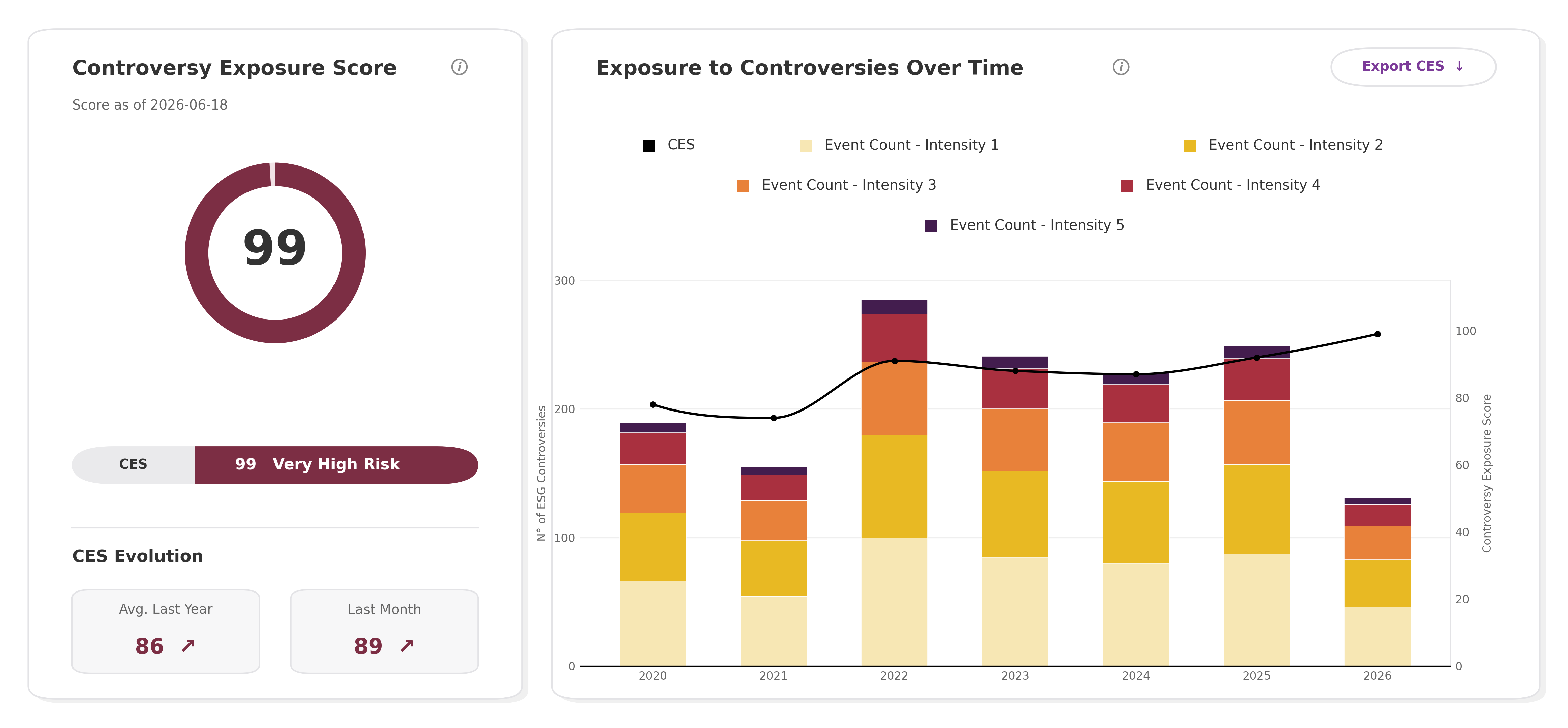
Controversy Exposure Over Time
*Unsolicited ratings - produced from public sources, not commissioned by the rated company. For more information, visit here.
It helps to start with how FIFA is organized, because its governance structure has a direct bearing on the type of risk it carries. As a Swiss-law association, FIFA answers to a membership rather than to shareholders or a securities regulator, and its decision-making body, the FIFA Council, is composed of representatives from the regional confederations whose commercial interests the Council also oversees. This means the regulatory functions of sanctioning, eligibility, and integrity sit close to the commercial function of awarding and selling tournaments. Arrangements of this kind tend to produce a steady stream of governance-related questions as part of normal operations, which is consistent with SESAMm’s controversy data.
One useful illustration is procedural rather than criminal. The Blatter and Platini proceedings span the entire time period without reaching a clear resolution, running from a 2020 complaint through a fraud indictment, an acquittal, a prosecutorial appeal, and a second acquittal, before Platini opened a fresh action against FIFA and Infantino in June 2026. As a corruption narrative, the sequence is inconclusive. As a governance observation, it illustrates a broader dynamic in which matters are litigated and re-litigated over long periods, in part because resolution often depends on external courts operating on their own timelines. The result is a long-running procedural footprint rather than discrete, time-bound events.
The CES is an aggregate, entity-level score (0–100) that measures an entity's overall exposure to ESG controversies over time. It's built from individual ESG events and their intensities, synthesizing both event volume and severity into a single trackable figure. The intensity score, by contrast, operates one level down: it's applied at the event level, measuring how severe or important each individual ESG event is on a scale from 1 (least severe) to 5 (most severe). In short, the CES tells you how exposed an entity is overall, while the intensity score tells you how serious each underlying event is.
ESG Risk Over Time
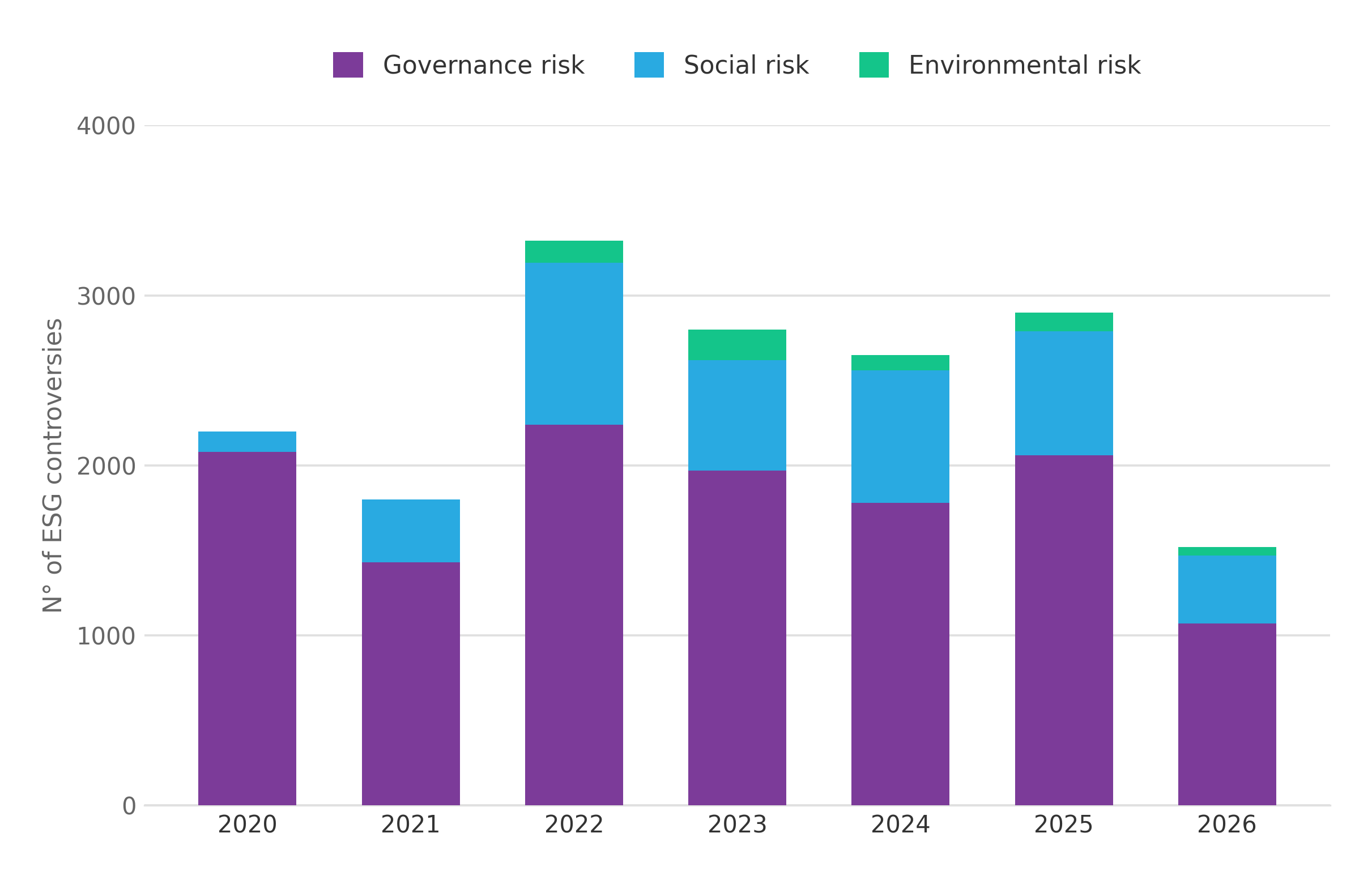
This chart tracks FIFA's ESG controversies per year from 2020 to 2026, stacked by risk pillar. Governance dominates every bar, with social forming a secondary band and environmental barely visible. Volume climbs from a governance-heavy opening year to a clear peak in 2022, then holds at a stable plateau through 2025 before the short 2026 bar. The shape is driven by a handful of major events. The 2020 corruption investigations kept the opening-year baseline elevated and were almost purely governance-related, following a US DOJ indictment unsealed that April, which alleged bribes were paid for the votes that awarded Russia and Qatar the 2018 and 2022 World Cups.
The 2022 Qatar World Cup marked the clear inflection point, drawing sportswashing accusations and pushing total controversies to their peak, while migrant-worker conditions and human-rights coverage around Qatar thickened the social band into a permanent quarter-to-third of each bar from 2022 onward. Rather than reverting, controversies settled into a post-2022 "new normal," plateauing well above the pre-tournament level.
Underneath it all, corruption-and-bribery and legal/investigative exposure account for the bulk of total risk across 2020 to 2026, while environmental risk stays statistically negligible throughout.
ESG Risk by Type
Environmental Risks
Environmental risk accounts for a small share of FIFA's total controversy volume, but that low frequency masks cases of genuine severity. The Swiss Fairness Commission ruled against FIFA's Qatar 2022 carbon-neutrality marketing, turning a greenwashing accusation into a formal regulatory matter still active in June 2026. Related controversies extend the theme, including criticism of the Saudi Aramco and Coca-Cola sponsorships, the cooling and water-use controversies at Qatar, and the animal-welfare outcry over stray-dog culling ahead of Morocco's 2030 hosting.
Beyond these, FIFA has drawn criticism over its marketing and communications, notably branding the 2022 Qatar World Cup as "carbon neutral," and has dealt with fraud and embezzlement, exemplified by the case of former FIFA and CONCACAF official Chuck Blazer. Issues tied to its board and senior management leadership round out the picture, though the overall pattern is one of an organization reacting to the weight of its legal and ethical past rather than getting ahead of it.
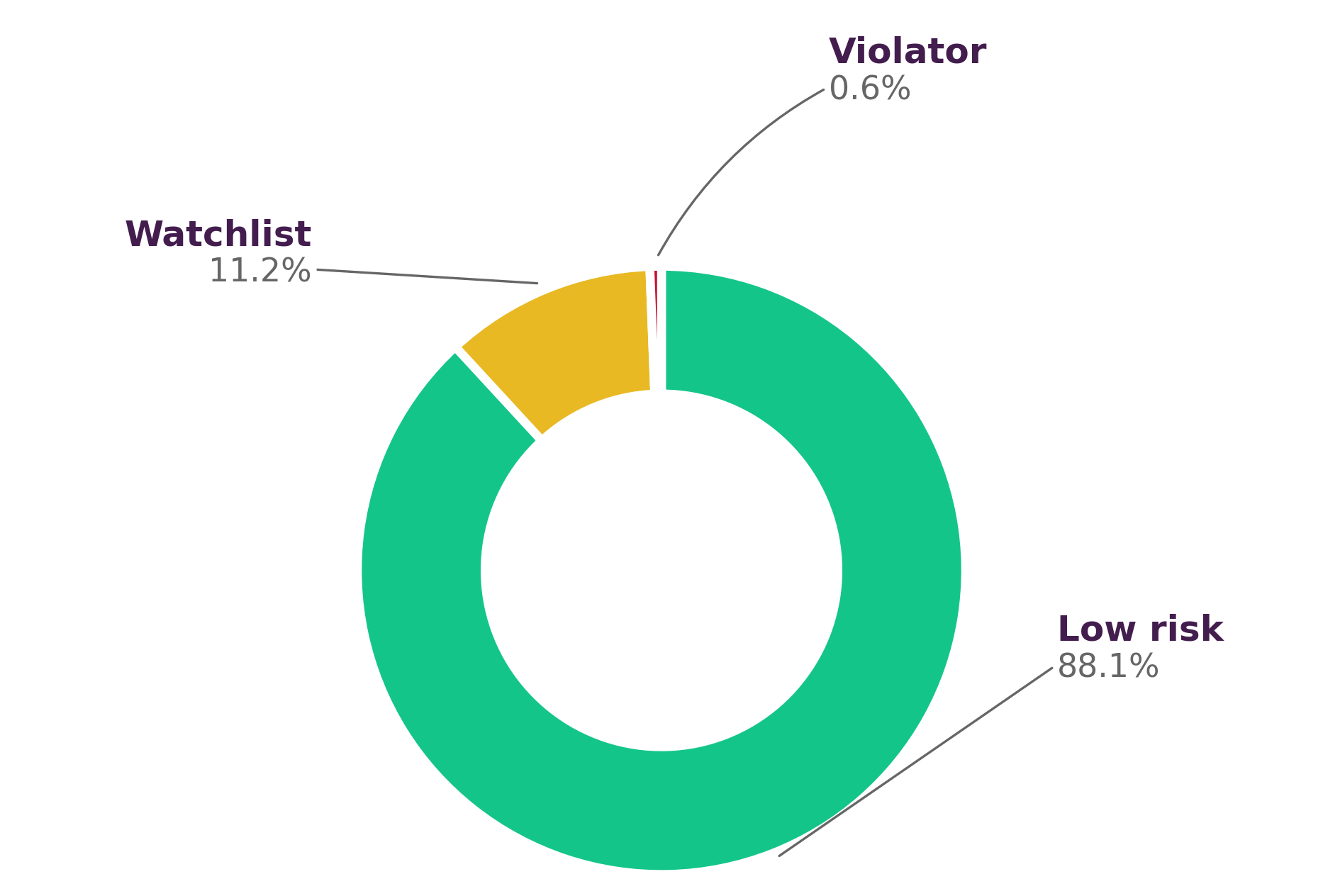
As the breakdown above shows, the overwhelming majority of FIFA's screened ESG events fall into the low-risk tier (1,294, or 88.1%), with 165 (11.2%) on the watchlist and 9 (0.6%) classified as Violator, the highest-risk tier under SESAMm's UN Global Compact screening. That tier is assigned only where there is clear evidence of a breach, such as formal sanctions, court findings, or regulatory condemnations, rather than unresolved allegations. For investors with SFDR Article 8 or 9 obligations, or internal exclusion policies tied to UNGC compliance, a Violator flag on a core holding or counterparty is a material signal rather than a monitoring note, which is why the profile is best read as governance-led: the nine Violator events reflect adjudicated breaches concentrated in FIFA's governance history, not the live controversies surrounding the current tournament.
The composition that emerges is a governance core of long-running legal cases, a Qatar-rooted social overlay that has proven durable, and a small but genuinely high-severity environmental tail now being contested through formal channels.
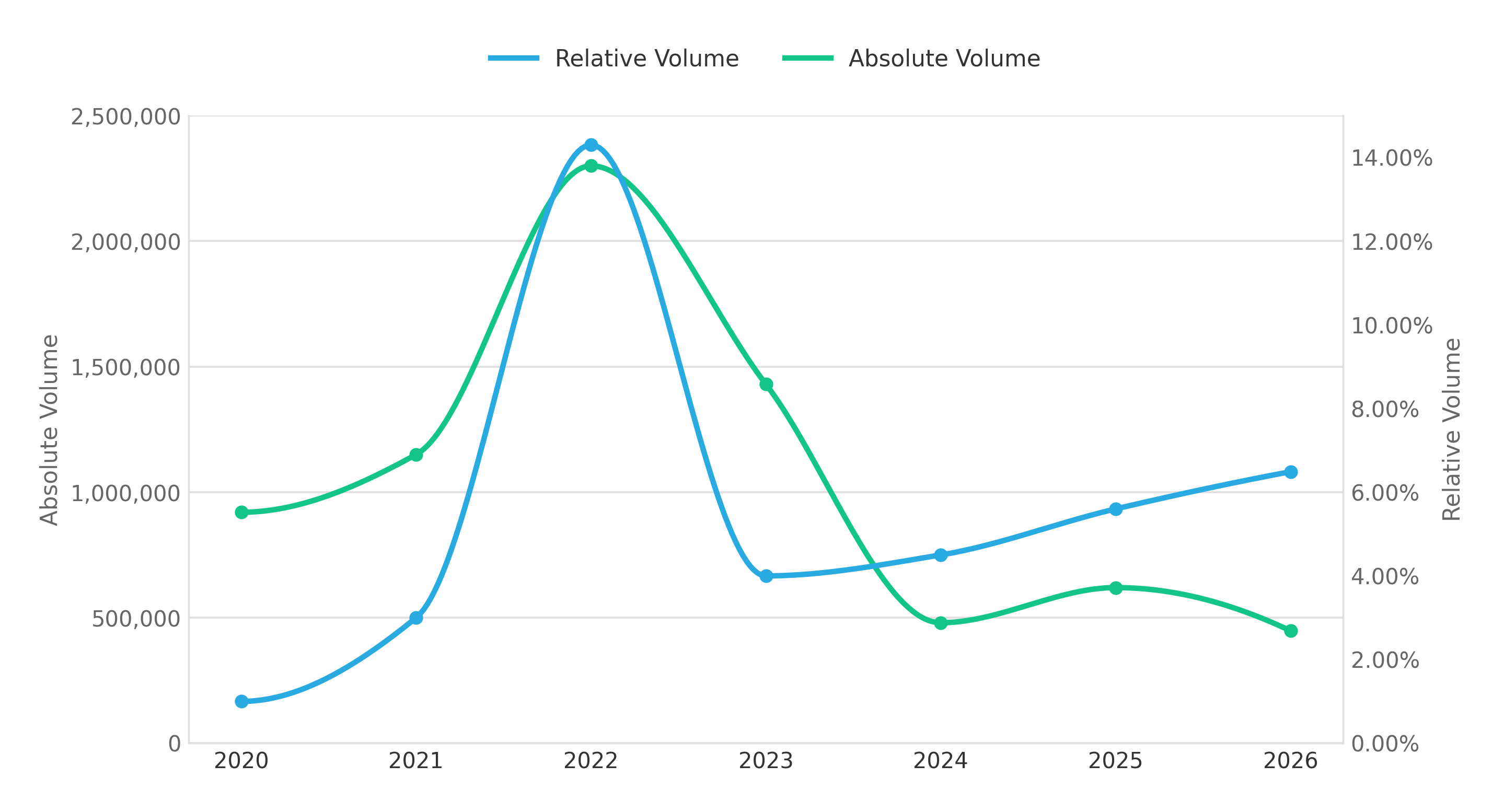
Both lines explode together, but unevenly: absolute volume roughly doubles while the relative share more than quadruples, briefly making Qatar roughly one in seven of all FIFA-related items, because nearly every controversy fires at once. The spike packs in wider labor abuses, and the jailing of whistleblower Abdullah Ibhais; the OneLove armband ban and Qatar's criminalization of same-sex relations and the broader sportswashing and carbon-neutral greenwashing charges; and the unresolved bribery allegations over the 2010 hosting vote. On its own, this acute cluster would suggest a controversy that lives and dies with the tournament.
Phase 3: Off-Season Accumulation (2023–2026)
This is where the two lines part ways, and the accumulation shows itself. After the tournament, the relative share deflates sharply in 2023, the acute spike clearing, but it never returns to baseline; instead, it grinds steadily upward every subsequent year, ending in 2026 at roughly four-and-a-half times its pre-tournament level. Over the same stretch, the absolute volume collapses, from 1.43M in 2023 to around 448K in 2026, under a fifth of the 2022 peak. The two movements together are the key finding: even as total FIFA coverage shrank dramatically, the Qatar migrant-worker case captured a larger and larger share of what remained. Driving that residual are post-tournament findings: The non-payment of the migrant workers during the 2022 World Cup, the campaign for a migrant-worker compensation and remedy fund, and Amnesty's continued push for FIFA to fund remediation.A storyline that merely echoes the event would fade with the falling volume; one that accumulates does the opposite. The controversy is no longer powered by the match calendar but by its own momentum.
The Case Underneath
Underneath that residual sits the report's single heaviest case: the human-rights strand of 135 events running from 2020 to 2026, the longest-running and most densely populated case in the dataset. What stops it fading is that each turn of the hosting cycle reactivates it: the 2026 uptick to 6.49%, the highest reading outside the tournament year itself, coincides with the 2026 World Cup now underway in North America, which revives retrospective scrutiny of Qatar, and the emerging human-rights questions around Saudi Arabia's 2034 tournament, which carries the same migrant-labour lens straight to the next host. The case is not simply failing to fade; it is being actively topped up by each new host, which is why the social exposure reads as structural rather than event-bound.
Key Takeaways
Taken together, the data describes a profile that is primarily governance-related, with the most severe and persistent cases concerning legal exposure, corruption, and bribery, supported by a durable Qatar-rooted social overlay and a small but high-severity environmental tail. All three pillars reach maximum case intensity, so severity is not confined to any single dimension.
The most consistent feature is persistence. FIFA's Controversy Exposure Score has remained in the High-to-Very-High band throughout the period and sits at 99 today. The largest cases run continuously from 2020 to 2026, and a significant share of binding decisions occur outside tournament windows. None of this reduces the significance of the World Cup, which clearly concentrates attention and scrutiny. But the underlying controversy is produced across the quarters between tournaments, and several of FIFA's most consequential outcomes are set during lower-attention periods. For those screening FIFA, the practical implication is that continuous monitoring suits this profile better than event-triggered review, because much of the relevant activity occurs between tournaments rather than during them.
The data suggests that for an entity like FIFA, a four-year review cycle misses most of what matters. Request a demo to see how SESAMm supports the kind of ongoing monitoring this profile requires.
*The Controversy Exposure Score (CES) is a continuous score from 0 to 100 measuring a company's exposure to ESG controversies over time, based on the severity of incidents and their media volume. This is an unsolicited rating: it is not commissioned by the rated company. The company is notified before its score is first issued, does not take part in the rating, and SESAMm has no access to its management or non-public documents. Ratings are produced only from public and licensed sources. The methodology is available here.
Teams that monitor ESG controversies usually have the opposite of an information shortage. A single incident can generate dozens of articles within a few days, each covering the same underlying event, often repeating the same facts with a few new details. At a certain point, the sheer number of articles makes it hard to tell which developments are material and which are just the same story told again.
The volume is the part that breaks traditional approaches. Millions of articles are written every day across hundreds of languages, more than any team of analysts could read, let alone reconcile into a clear timeline of an evolving controversy. This is not a problem you solve by adding more people; the scale is on a different order of magnitude from human reading speed.
What changed is that language models can now read, categorize, and evaluate. They cover that volume in every language, judging whether two articles describe the same incident, whether one marks a new development, and how incidents link into a single controversy over time. Leveraging the latest AI models is the only way to structure this much material and generate daily updates.
SESAMm runs this across the ten million documents it ingests each day, from more than four million sources in over 100 languages, including premium news wires, NGO bulletins, company communications, and discussion forums. The result is ESG controversies organized into three layers: articles, events, and cases.
From Articles to Events to Cases
Each layer builds on the one below it, and each answers a different question an analyst needs answered.
Articles are individual news articles or documents: the raw material.
Events group the articles that describe the same specific incident or development. When forty outlets cover the same supplier labor issue, those forty articles become a single event, with the underlying coverage attached. Articles published close together in time and describing the same development are grouped; an article describing a genuinely new development, even on the same broader topic, forms a separate event. A strike in 2022 and a similar strike in 2024 at the same supplier are recorded as two events, because they are distinct incidents rather than a continuation of one.
Cases sit above events. A case ties together the events that belong to the same underlying controversy as it unfolds, with no fixed time limit. An oil spill, the regulatory investigation that follows it, and the settlement that closes it months or years later are three separate events but one case.
Articles tell you what was written, events tell you what happened, and cases tell you how a controversy is developing. All three sit in the same view: one entry per controversy, with the chronology of events nested inside it and the source articles a click below that.
Why the Underlying Data Matters
A three-layer structure is only as good as the data underneath it. To capture a controversy from start to finish, that data has to include the early signals that appear in regional press, NGO bulletins, or non-English sources before larger outlets report them, sometimes days later.
SESAMm's coverage spans more than 100 languages and extends well beyond mainstream news wires, so its cases are built on a wider base than most monitoring platforms screen. A controversy that starts in a local-language outlet, moves through regional media, and reaches the international press is captured as a single continuous case, rather than surfacing as disconnected alerts or being missed altogether in its early stages.
What Does This Change in Practice?
Three things change in day-to-day work.
The count starts to mean something. A rise in the number of cases reflects new controversies emerging, not an old one being picked up by more outlets.
Trajectories become visible. As a case accumulates new events over the months, the progression from complaint to investigation to hearing to settlement is easy to follow, rather than being buried in hundreds or even thousands of articles.
Analysts spend their time differently. Less of it goes to clearing duplicate headlines, and more to the important judgment calls.
What This Looks Like in the SESAMm Dashboard
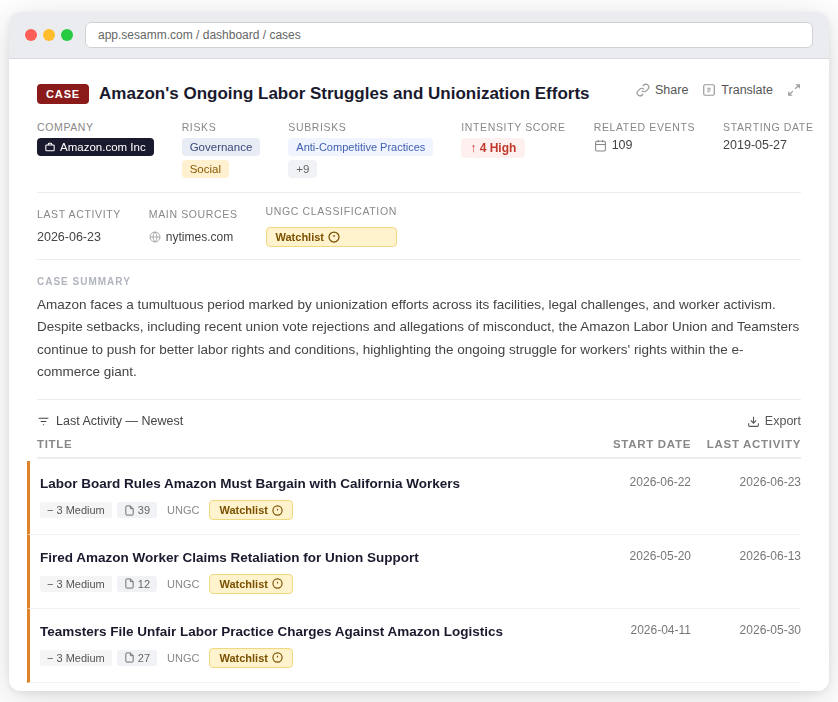
In the dashboard, a company appears as a single entity with its related cases listed beneath it. Each case includes a controversy summary, an ESG risk classification, and an intensity score, with related events nested underneath and the original source articles just a click away. A case that draws on hundreds of articles becomes a short, readable list instead of hundreds of separate incidents.
Every case is fully traceable. Analysts can drill from a case down to its events, and from any event to the articles that produced it. The time period is set from the top of the dashboard, so older incidents do not crowd the view when the focus is on recent activity.
Reducing Noise in Adverse Media Monitoring
In practice, those forty articles collapse into one event, and that event sits inside a single case that is still developing, caught early and drawn from sources most platforms never see.
Grouping articles into events removes duplication caused when many outlets cover the same incident. Grouping events into cases keeps a controversy intact as it develops, rather than scattering it across months of separate alerts. Because this runs across ten million documents a day in more than a hundred languages, it holds up even for controversies that start far from the mainstream press.
The result is a view where the numbers carry meaning, the direction of an issue is clear, and the underlying articles stay one click away for full validation.








.png)