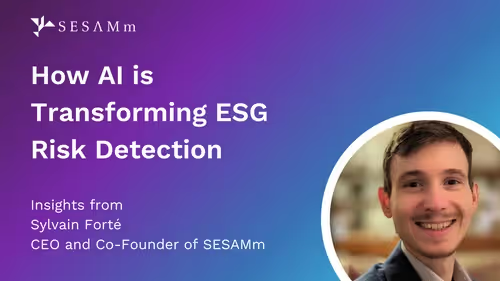
In a recent interview, CEO Sylvain Forté spoke with Fintech Global about how the SESAMm has evolved, the role of AI in transforming ESG risk detection, and what's next for the industry.
Can you tell us about SESAMm's origins and how the company has evolved since 2014?
SESAMm started with a focus on analyzing sentiment and reputational signals on social media to understand how narratives influenced financial performance. We began by working with asset managers and quickly realized that reputational risks were not only impacting public equities but were becoming critical in other asset classes.
As we evolved, we discovered a much broader blind spot in private markets. ESG and reputational data simply didn't exist for private companies, infrastructure projects, or suppliers, yet these made up a significant share of global exposure. This expansion was supported by Carlyle, a leading private equity firm and a SESAMm investor, which helped us deepen our expertise in private markets. Since then, we've expanded to supply chain and procurement use cases as well.
The name SESAMm stands for "open sesame." We were designed to unlock this missing layer of insight, opening access to critical ESG risks across public, private, and supply chain assets.
How is AI transforming the way financial institutions detect and understand ESG risks?
AI is a fundamental enabler of SESAMm's platform. We cover over 5 million companies, public and private, across more than 4 million sources, making it the largest private asset ESG coverage in the industry. This would be impossible to maintain with traditional manual workflows.
But our AI enables not just massive scale; it delivers quality. We aggregate documents, match events over multiple years, classify and score controversies properly, and do all of this in real time. There is no lag between detection and delivery.
We've gone further than data delivery. With AI agents, we've moved from surfacing insights to solving real problems. For example, for an insurance company, our AI agents don't just provide controversy data; they fully complete underwriting risk questionnaires. This is not just enhanced ESG; it's a workflow transformation.
Can you share an example where SESAMm caught an ESG signal that others missed?
One example is Loro Piana, an LVMH company, where we were able to surface early signals from regional news and filings before they became broadly visible.
For private markets, some of our clients, including major US private equity firms, have used our insights to stop due diligence processes early, saving millions of dollars by identifying major ESG risks at the pre-deal stage. These events were buried in local reports or niche sources and would have gone undetected using traditional tools. This is where SESAMm's multilingual, real-time coverage delivers immediate and material value.
How does SESAMm's global, multilingual scope lead to better ESG insights?
SESAMm's reach is a key differentiator. We process content from over 100 languages and 4 million data sources, including local news, NGO reports, legal documents, blogs, and more. For global private investment firms, this makes it possible to monitor hundreds of portfolio companies and thousands of credit lines every single day, without human intervention.
Due diligence becomes instant. Customers can type a company name into the platform and get immediate access to source data, scores, and an auto-generated report. This level of coverage and automation is only achievable with AI. Without multilingual processing, most of these risks would remain hidden in local languages and never surface in English datasets.
What role does Generative AI play in turning complex data into actionable intelligence?
GenAI allows us to go beyond raw data or filtered alerts. SESAMm now delivers fully automated ESG due diligence reports in under 30 minutes, complete with citations, severity levels, and multi-language source integration. These are dynamically built with real insights. The same applies to legal reports, private equity and M&A deal screening, secondary and credit due diligence, and more.
Teams no longer need to sift through events, tag them, write memos, or manually structure reports. We also accelerate regulatory workflows by automatically flagging potential significant harm, governance issues, and controversial activities, enabling clients to meet disclosure requirements more quickly and focus their time on high-impact actions.
SESAMm has announced partnerships with Clarity AI and Sayari. How do these enhance your offering?
These partnerships are both strategic and complementary. SESAMm offers comprehensive data coverage, particularly for private firms and complex events, which many partners utilize to enhance their own offerings. Sayari enhances the mapping of supply chains and tier-N suppliers. Clarity AI provides a full ESG analytics platform. SESAMm plugs into each of them, either as a source of controversy intelligence or to enrich end-user offerings.
In return, they help our clients go further, from data to action, whether through real-world audits, regulatory support, or deeper portfolio insights. The goal is to offer an ecosystem of ESG solutions that go beyond alerts and into implementation.
Why are financial institutions now treating ESG and reputational risk as strategic intelligence rather than just compliance?
The stakes are higher than regulation. Of course, frameworks like SFDR and PAI 10 are important, but firms come to us because they need actionable insight. Corporates monitor their suppliers and group entities. Investors track portfolio companies, screen for risk during deal flow, and respond to reputational events.
ESG controversies now have direct financial implications, influencing deal approvals, investment decisions, and valuations. This is especially true in private markets. We work with both LPs and GPs to integrate controversy detection into due diligence and ongoing monitoring. In many cases, ESG insights are the trigger for early engagement or the reason to walk away from a deal.
What do you see as the next frontier for AI in ESG and reputational risk?
The next frontier is clearly AI agents. SESAMm is already building and deploying agents that automate entire workflows, from detection and classification to full reporting. This includes ESG due diligence in 30 minutes, secondary screening, good governance screening, controversial activity screening, legal risk reports, and more.
For secondary funds, this means being able to screen hundreds of underlying assets in hours, not days. For compliance teams, it means automated risk reports with source evidence and scoring. For ESG professionals, this means saving time to focus on engagement, strategy, and impact, rather than data wrangling.
We believe AI agents will power the next generation of ESG intelligence, providing seamless, embedded, and action-ready solutions.
Click here to access the full ESGFintech100 2025 report.
Reach out to SESAMm
TextReveal’s web data analysis of over five million public and private companies is essential for keeping tabs on ESG investment risks. To learn more about how you can analyze web data or to request a demo, reach out to one of our representatives.






.png)