
Insights & Updates

Blog thumbnail

Packers Sanitation Services Inc. : When the Warning Signs Were There All Along

April 9, 2026
5 mins read
Forced labor is often assumed to be a problem of distant supply chains. The case of Packers Sanitation Services Inc. (PSSI) dismantles that assumption entirely.

Forced labor is often assumed to be a problem of distant supply chains. The case of Packers Sanitation Services Inc. (PSSI) dismantles that assumption entirely.

PSSI was a leading U.S. industrial cleaning contractor, servicing major meatpacking plants and backed by a top-tier private equity firm. Yet between 2022 and 2024, it became the center of one of the most significant child labor scandals in the U.S., one that had been quietly signaling its risks for years. SESAMm's controversy monitoring platform captured those early signals long before regulators intervened.

The Scandal

In November 2022, the U.S. Department of Labor discovered that PSSI had employed minors as young as 13 in hazardous overnight roles across 13 locations in 8 states. A federal investigation confirmed 102 children had been illegally employed, many handling dangerous chemicals and machinery. Three years earlier, in 2019, PSSI had already been sued for wage violations. The signal was there. It went unheeded.

The Fallout

The consequences were swift. A $1.5 million DOL fine. Contract terminations by Cargill and JBS. A DHS trafficking investigation. A replaced CEO. By late 2024, PSSI had shut its corporate office entirely. Even the private equity owner, Blackstone, faced direct scrutiny from pension funds, a reminder that labor violations travel up the ownership chain.

The Lesson

Every warning sign in this case was publicly visible before the crisis broke out. Wage lawsuits, labor complaints, and media coverage are all available in the public domain. Real-time controversy monitoring can surface these signals early, giving companies and investors the chance to act before exposure becomes unavoidable.

Forced labor is not only a humanitarian crisis. It is a material risk that demands better data, earlier detection, and stronger accountability.

Download the full case study infographic to see the complete timeline of events and key takeaways

Read More

Executive Summary

The physical infrastructure powering the AI boom (the data centers that house it, and the hardware that runs it) has become one of the most ESG-exposed sectors in the global economy. As demand for computing accelerates, so does the scrutiny on the companies enabling it.

This scorecard examines three major players across the AI infrastructure stack: Equinix and Digital Realty, two of the world's largest data center operators, and Supermicro, a leading manufacturer of high-performance AI server hardware. Despite their different roles, all three are navigating the same storm: a convergence of governance failures, environmental friction, and national security risk that is reshaping how investors, regulators, and communities assess the sector.

Our analysis reveals three defining pressure points: governance failures spanning accounting manipulation, board instability, and fraud; environmental and social friction from community opposition, resource strain, and safety violations; and national security exposure through data breaches, export control violations, and supply chain risk.

Together, these risks represent a fundamental shift for the sector. ESG in AI infrastructure is no longer about carbon reporting - it is about fiduciary integrity, operational transparency, and the social license to keep building.

Supermicro: Fraud, Malware & Supply Chain Violations

With a controversy exposure score (CES) of 80/100, Supermicro’s ESG profile is dominated by extreme governance risks centered on systemic accounting failures and geopolitical compliance breaches. The company is currently battling a U.S. Justice Department probe, Nasdaq delisting threats, and a series of securities fraud lawsuits following a 2024 accounting scandal that forced the search for a new CFO and echoed a prior $17.5 million SEC fine from 2020. 

Beyond financial integrity, the firm faces severe national security scrutiny over the alleged smuggling of restricted Nvidia AI chips to China, alongside 2025 investigations into "spy chips," unremovable motherboard malware, and multiple patent infringement claims from competitors like AMD and Lenovo. Socially, the company’s risk is compounded by a 2025 whistleblower retaliation suit and labor rights violations involving Filipino workers at its semiconductor supply chain partners, as well as multiple OSHA safety penalties for workplace hazards.

Equinix: Accounting Manipulation & the AI Infrastructure Backlash

Similarly, Equinix’s CES of 79/100 is defined by a volatile combination of intensifying community opposition, environmental resource strain, and severe governance scrutiny. Socially and environmentally, the company faces a "Global AI Arms Race" backlash, where massive 340-acre proposals on local farmland in Minooka and "green belt" developments in South Mimms have sparked significant resident opposition over air pollution and traffic, while regulators in Dublin have begun blocking gas-powered facilities that violate national climate targets. These operational hurdles are compounded by a lack of transparency regarding massive water consumption and a series of high-profile safety and security failures, including data center fires in São Paulo and Madrid and a recurring "cybersecurity blind spot" in building systems. On the governance front, Equinix is navigating a severe trust deficit following a $41.5 million settlement over allegations of "major accounting manipulations" and the systematic over-selling of power capacity.

Digital Realty: Board Instability, Gas Leaks & Cybersecurity Breaches

Although it has a lower CES of 48/100, Digital Realty’s ESG profile is defined by governance instability and intensifying environmental friction in key urban hubs. The abrupt 2022 termination of its CEO and the 2023 resignation of its Chairman, who alleged bias against female directors, highlight deep-seated board-level conflicts, further exacerbated by 2026 investigations into director bias and a $3.4 million loss of tax breaks in Hillsboro. 

Environmentally, the company faces formal legal notices in Marseille over fluorinated gas leaks and "imminent dangers to health," as well as noise complaints in Chicago and a 2024 fire in Singapore. Socially, the firm is navigating a Biometric Information Privacy Act (BIPA) lawsuit over scanning workers' fingerprints without consent, a major 2025 "Salt Typhoon" hacking breach, and mounting federal scrutiny over the industry's role in driving up local electricity and water costs.

Conclusion 

The ESG challenges facing AI infrastructure operators are no longer peripheral concerns; they have become central to the sector's long-term viability. As the cases of Equinix, Supermicro, and Digital Realty illustrate, the consequences of their unchecked growth range from community backlash and environmental violations to governance failures and national security breaches. The AI infrastructure industry stands at an inflection point: continued expansion without proportional investment in transparency, accountability, and sustainability risks eroding stakeholder trust, inviting heavier regulation, and ultimately undermining the very infrastructure it seeks to build.

Discussions around nuclear weapons and defense have recently highlighted how differently investors interpret weapons exclusions. In particular, Russia’s invasion of Ukraine has brought security considerations back into focus across Europe and prompted some investors to revisit long-standing exclusion policies.

At the same time, regulatory frameworks such as the Sustainable Finance Disclosure Regulation (SFDR) encourage investors to screen portfolios for controversial activities and disclose how those risks are managed. However, these frameworks do not impose a single global definition of weapons exposure. As a result, policies can vary widely between institutions.

Controversial Weapons

What Do We Mean by Controversial Weapons?

In responsible investment policies, the term “controversial weapons” has a relatively clear meaning. It refers to weapons that are prohibited or heavily restricted under international conventions because of their indiscriminate or humanitarian impacts.
Typical examples include:

  • cluster munitions
  • anti-personnel landmines
  • chemical weapons
  • biological weapons
  • nuclear warheads

Because these weapons are banned or widely condemned under international treaties, investors usually apply strict zero-tolerance exclusions. Any company involved in producing these weapons, or supplying critical components for them, is typically excluded from ESG-focused portfolios.

What Counts as Weapons Exposure?

The broader category of weapons exposure is more complex and is where investor interpretations often begin to diverge. Recent discussions across Europe’s sustainable finance community have focused on whether defense companies should remain excluded from ESG portfolios, particularly in light of renewed security concerns following Russia’s invasion of Ukraine.

Many exclusion frameworks distinguish between controversial weapons and other forms of military-related activity. Companies may be involved in conventional weapons manufacturing, such as firearms, missiles, bombs, or military electronics. Others produce defense systems and equipment, including radar, communications technology, or aircraft components. Civilian firearms are also frequently treated as a separate category within exclusion policies.

In these cases, investors often rely on revenue thresholds rather than absolute bans. A company may be excluded if more than five to ten percent of its revenue comes from weapons manufacturing, while smaller or indirect exposure may still be permitted depending on the investor’s mandate.

A key challenge in these screenings is that a company’s weapons exposure is not always obvious from its core business description. A firm may supply components, software, or materials used in weapons systems or operate as part of a broader defense supply chain. This is particularly difficult to identify in private markets, where companies are not required to disclose detailed segment revenues or defense-related contracts.

As a result, defining and detecting weapons exposure requires clear policy definitions and structured screening logic. What counts as weapons involvement, and where the exclusion threshold lies, ultimately depends on each investor’s mandate and risk tolerance.

What's Different Now?

These questions are no longer abstract. Since Russia's invasion of Ukraine, major asset managers have visibly shifted their positions. Allianz Global Investors, for instance, updated its Article 8 fund policies in 2025 to allow defense companies. Global Trading UBS and Franklin Templeton made similar moves, each removing revenue-based weapons thresholds that had been standard practice for years. At the regulatory level, Hortense Bioy, Head of Sustainable Investing Research at Morningstar Sustainalytics, noted that "since the start of the war in Ukraine in 2022, it has become increasingly clear that geopolitics plays a more significant role in shaping the boundaries of sustainable investing than ethics." What these shifts share is a common thread: the thresholds and definitions that once felt settled are now being redrawn, which is precisely why screening frameworks need to be flexible enough to reflect each investor's current policy, whatever that may be.

Customizable Screening

Because exclusion policies are defined at different levels, it’s rarely as simple as establishing a generic exclusion list. Limited partners often impose their own restrictions or revenue thresholds, which general partners must apply alongside the fund’s internal ESG policy and regulatory restraints. In some cases, LP requirements may further restrict or override the fund’s baseline approach.

As a result, acceptable levels of exposure to activities such as conventional weapons can vary significantly across portfolios.

Screening frameworks, therefore, need to adapt to the investor’s policy rather than forcing the policy to adapt to the tool.

In this case, SESAMm’s AI-generated exclusion screening report can be customized to match each investor’s requirements. Threshold-based classifications help identify different levels of involvement, allowing investors to distinguish between companies with no exposure, limited exposure, or significant involvement in controversial activities. Each classification is supported by underlying evidence and source documentation, allowing analysts to verify the reasoning behind the flag.

This approach makes it possible to apply a consistent methodology across both public and private companies while remaining aligned with the investor’s specific exclusion framework.

Discussions around defense and responsible investment will continue to evolve as geopolitical and regulatory contexts shift. Recent debates around nuclear deterrence and defense participation illustrate how differently investors can interpret weapons exclusions, even when they operate under the same regulatory frameworks.

For investors, the challenge is therefore not only defining exclusion policies but ensuring that those policies can be applied consistently and transparently across portfolios. As definitions of weapons exposure vary, and as supply chains and private market structures add further complexity, screening frameworks must be capable of translating policy into clear, operational rules.

Geopolitical events can quickly create ripple effects across global trade routes, supply chains, and corporate operations. For investors, commercial banks, insurers, and other organizations, identifying which portfolio companies or counterparties are exposed to these developments is a real challenge, especially when monitoring large universes of public and private companies.

SESAMm's thematic keyword search enables analysts to quickly discover controversies related to specific topics or emerging events across thousands of companies. This functionality allows them to filter results by theme without having to manually review large volumes of news and event data.

This functionality is particularly valuable when monitoring rapidly evolving geopolitical situations. To assess exposure related to the current conflict involving Iran, for example, users can run a thematic search across a broad company universe using keywords such as: Iran, Hormuz, and Suez Canal.

These keywords capture references to critical geopolitical locations and maritime chokepoints that may affect global shipping routes, energy markets, cybersecurity risks, and broader operational disruptions. Keywords can be tailored to any geopolitical scenario. Users can start broad and refine as the situation develops, or combine location-based terms with event-specific language to narrow results to the most relevant controversies.

When applied across a large company universe, the dashboard surfaces a range of related controversies ranked by severity. From high-intensity cases like escalating tensions around Iran's Bushehr Nuclear Plant, to medium-intensity signals such as retaliatory actions targeting US banks, offering clear visibility into which companies may face the highest risks.


amazon

Zooming In on Company-Level Exposure: The Example of Amazon

Alternatively, analysts can also use the same keyword approach to filter controversies associated with a specific company. This helps determine whether a particular portfolio holding, borrower, or insured entity may be affected by the same geopolitical developments.

Applying this search to Amazon, for instance, surfaces a high-intensity case titled "AWS Data Centers Targeted by Drone Attacks in UAE and Bahrain." The case, rated 4/5 in severity and drawing on over 200 related news events, describes significant damage to AWS infrastructure in the UAE and Bahrain following attacks attributed to Iran, prompting AWS to advise clients to migrate services.

This kind of signal carries real weight for financial institutions. For investors, it highlights operational and geopolitical risks affecting a major technology provider. For banks and insurers, it may point to infrastructure vulnerabilities, operational disruption risks, or broader geopolitical tensions affecting clients' critical systems.

From Geopolitical Events to Portfolio Risk Signals

Geopolitical events rarely affect just one company. For financial institutions monitoring thousands of entities, they create complex, evolving risk exposures across entire portfolios, lending books, and insurance coverage.

Thematic keyword searches help bridge this gap, connecting macro-level developments to company-level controversies quickly and systematically. By combining automated controversy detection with flexible search capabilities, analysts can rapidly identify relevant signals, investigate affected companies, and prioritize follow-up work.

In practice, this means moving faster from emerging geopolitical events to actionable risk insights. Whether the trigger is a conflict in the Middle East, sanctions on a major economy, or rising tensions around a critical shipping lane, the same approach applies, giving investors, banks, and insurers a systematic way to stay ahead of geopolitical risk across their entire portfolio.

Deal Screening: ManTech

March 18, 2026
5 mins read

This is from SESAMm’s Deal Screening AI report. These reports are usually used by private equity deal teams and M&A teams to conduct pre-commercial due diligence on any company or project in minutes, and they contain insights and risks on the target company as well as a full competitive and market analysis.

ManTech International Corporation is a U.S.-based defense contractor specializing in cybersecurity, data analytics, and systems engineering solutions for national security and government agencies. Founded in 1968 and headquartered in Herndon, Virginia, the company operates globally. It primarily serves U.S. defense, intelligence, and homeland security clients, delivering technology services that support mission-critical operations such as cybersecurity protection, artificial intelligence and analytics, and intelligence, surveillance, and reconnaissance capabilities.

The broader defense and intelligence services market in which ManTech operates is expanding rapidly due to rising global defense spending, geopolitical tensions, and increasing demand for advanced digital and cyber capabilities. Within this context, ManTech has recently secured several growth signals, including a $200 million cybersecurity contract with the National Oceanic and Atmospheric Administration, partnerships to deploy secure AI technologies, and major analytics and systems contracts with the U.S. Army, reflecting continued demand for its technical expertise.

The report identifies several legal and reputational risks that could be relevant in a due diligence context. The most significant relate to labor and human rights issues, including allegations by former employees that the company confiscated passports and imposed hazardous working conditions under a U.S. Army contract in Kuwait, with a U.S. court allowing human-trafficking claims to proceed. Other previous issues include whistleblower retaliation claims linked to military contract billing practices and a civil fraud settlement involving misrepresentation of security clearance status. Environmental risks appear limited, with no major pollution or climate-related incidents identified.

In the competitive landscape, ManTech operates alongside firms such as Booz Allen Hamilton, Leidos, CACI International, SAIC, and General Dynamics Information Technology. While not the largest player in the sector, it is regarded as a capable provider of secure IT and cybersecurity solutions for classified government missions. Overall, the report concludes that ManTech benefits from strong demand for defense technology and cyber capabilities but faces reputational exposure primarily tied to labor practices and contract-related compliance risks.

Deal Screening Report - ManTech

Reach out to SESAMm

SESAMm’s AI Deal Screening Reports analyze web data across over five million public and private companies to help investors quickly identify legal, ESG, and reputational risks during due diligence. To learn more about how you can generate these reports or to request a demo, reach out to one of our representatives.

Chinese companies face elevated ESG risk exposure as scale, rapid growth, and cross-border operations intersect with tighter regulations and geopolitical pressures. Social risks cluster around worker rights and customer harm: “996” overwork and layoffs in tech, safety failures in new technologies and EVs, and severe labor allegations in global supply chains.

Governance risks are the dominant theme, reflected across multiple jurisdictions and industry sectors: recurring regulatory enforcement and compliance failures, litigation-heavy operating models, weak internal controls, and heightened disclosure, audit, and listing pressure in overseas markets. A major amplifier is data-security and national-security risk, with allegations of illegal data collection or leaks and intensifying foreign scrutiny over potential military ties and state influence.

Environmental risks cluster around manufacturing pollution and emissions compliance, alongside chemical-product safety and carbon-intensive logistics footprints in fast fashion and e-commerce.

What are the most pressing ESG challenges currently facing Chinese companies? Read on to find out.

Alibaba: Navigating Controversies and Governance Challenges

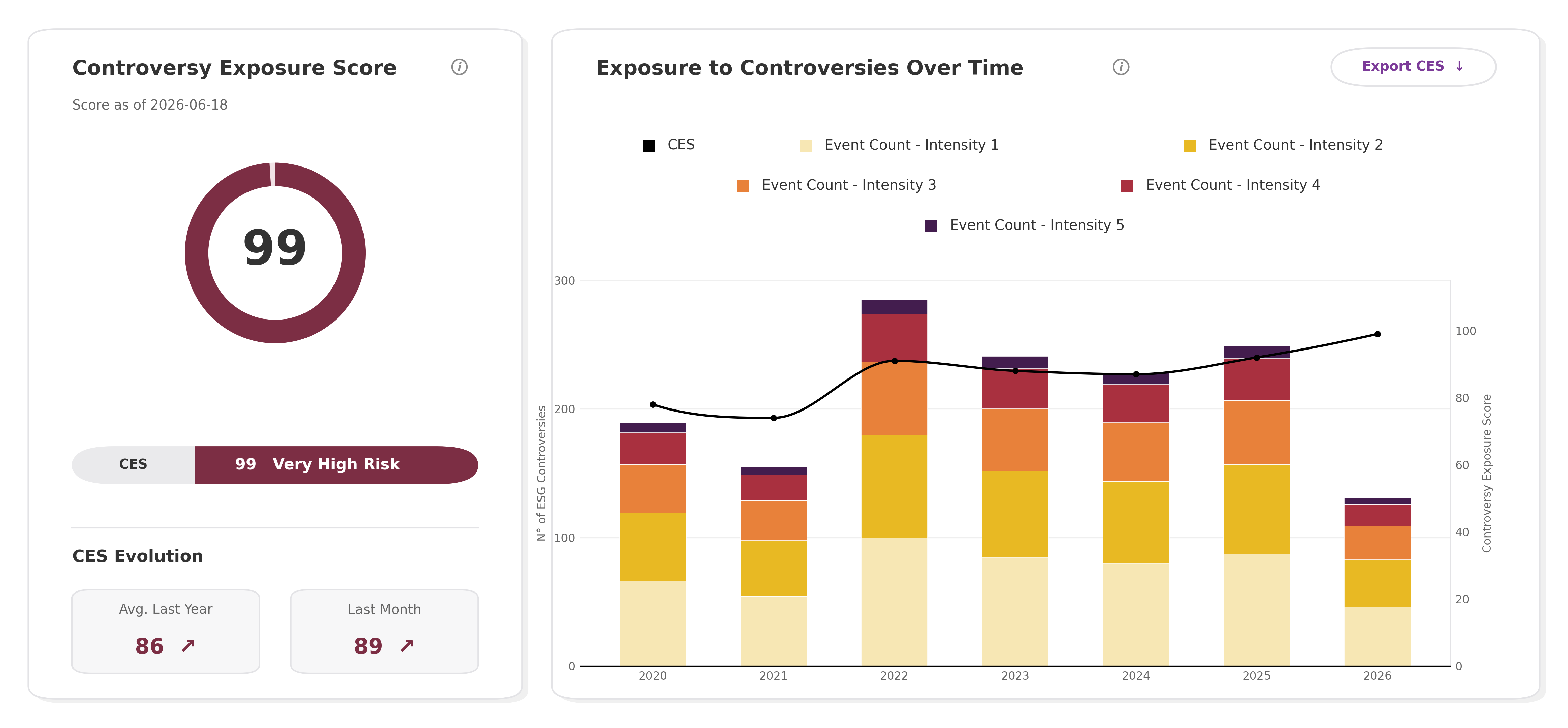
Alibaba’s ESG risk profile remains elevated, reflected in its controversy exposure score (CES) of 99/100. Social risks include persistent criticism of “996” work practices, workplace conduct controversies, layoffs, and reputational fallout from marketplace safety incidents, and rising customer complaints. Governance risks, meanwhile, are multi-jurisdictional, spanning U.S. audit scrutiny and past NYSE delisting threats, alleged filing irregularities in India, EU DSA pressure on AliExpress, and ongoing counterfeit and patent litigation.

In parallel, integrity and geopolitical risks heighten scrutiny, notably through a police investigation into alleged supply-chain corruption at Ele.me, U.S. probes related to data privacy and alleged military links, and a $433.5 million investor lawsuit recovery. Environmental exposure remains primarily supply-chain and footprint-driven, including a 2025 pesticide finding and emissions-related criticism in Belgium. Based on SESAMm’s UNGC screening, we found that several of Alibaba’s controversies show potential alignment concerns with UN Global Compact principles, reinforcing the need for continuous monitoring.


Shein: Heavy ESG Scrutiny Amid Legal and Environmental Challenges

Similarly, Shein faces sustained ESG pressures across governance, environmental, and social dimensions, reflected in its high CES of 89/100, indicating material and ongoing exposure. Social risks include allegations of exploitative factory conditions, disclosed child-labor cases, and reputational backlash linked to cultural appropriation and marketing practices, alongside integrity concerns such as reported coordinated bot activity to defend the brand online.

Governance risks are multi-jurisdictional and litigation-heavy, spanning a $100 million U.S. lawsuit, repeated IP disputes, and a RICO suit alleging systematic design theft, as well as data and marketing compliance failures that resulted in a $1.9 million fine and major enforcement actions in Europe, including France’s $176 million cookie fine. Meanwhile, environmental exposure remains structurally tied to Shein’s fast-fashion model, with recurring hazardous chemical findings breaching EU limits, scrutiny over air-freight emissions, and greenwashing enforcement, including a €1 million fine in Italy.

BYD: Risks and Controversies Demand Ongoing Monitoring

BYD’s ESG profile reflects sustained controversy exposure, with a CES score of 89/100, indicating material and ongoing risk. Social risks include product-safety concerns, notably the Atto 3 receiving the lowest-ever assisted-driving safety score and a recall of more than 16,000 EVs; more critically, Brazilian authorities shut down a factory site over alleged “slavery-like” labor conditions and battery mineral sourcing linked to human-rights abuses, culminating in a $50 million lawsuit.

Governance risks are cross-border and multifaceted, spanning tax-fraud allegations, IP disputes such as BMW’s “M6” trademark case, EU scrutiny over potential unfair Chinese subsidies at BYD’s Hungary plant, concerns in South Korea regarding possible in-vehicle data leakage, a securities-fraud investigation notice, and U.S. designation activity linking BYD to Chinese military-affiliated entities. Meanwhile, environmental exposure centers on factory pollution at Changsha tied to reported health impacts and heightened emissions-compliance scrutiny following accusations of emissions cheating.

From a UNGC perspective, a number of BYD’s controversies show potential alignment concerns with UN Global Compact principles, particularly around labor rights and governance, and reinforcing the importance of ongoing monitoring.


roche holding

 Conclusion

Taken together, Alibaba, Shein, and BYD illustrate how scale, speed, and global expansion can amplify ESG exposure when governance, labor oversight, and compliance controls lag behind operational growth. High CES scores across all three companies underscore that these risks are not isolated incidents but structural and recurring in nature.

For decades, private market investors have relied on upfront due diligence as the primary moment to assess ESG, reputational, and operational risk. The logic was straightforward: conduct a thorough review at acquisition, document the risks, and manage the asset from there. That model is now under increasing strain. Not because due diligence is no longer important, but because the environment in which private investments operate has changed fundamentally.

This shift was a central theme of a recent 2026 webinar on private markets featuring Benjamin Krusche, Strategy Director at Clarity AI, and Sylvain Forté, CEO at SESAMm. Both speakers emphasized that one-off ESG due diligence no longer reflects how risk actually emerges over the life of an investment, and why continuous monitoring is becoming essential.

Due Diligence Hasn’t Disappeared - The World Around It Has Changed

Upfront due diligence has always been a cornerstone of private market investing, and it remains essential. What has changed is not the role of diligence itself, but the assumptions that once made a point-in-time assessment sufficient.

Historically, many ESG and reputational risks were relatively static. If an asset appeared clean at entry in terms of governance, compliance, or industry exposure, it often remained so long enough to exit. ESG due diligence, in that context, was largely about establishing a baseline. Today, risk behaves differently.

A recurring theme throughout the webinar was that some of the most material ESG and reputational risks can emerge after acquisition rather than at deal close, especially as holding period durations increase. These risks surface through litigation, regulatory enforcement actions, labor and human rights incidents, or reputational controversies. Signals that rarely align neatly with due diligence checklists.

In private markets, where disclosure remains fragmented, the absence of information at entry does not imply the absence of risk. It simply delays visibility. That said, continuous monitoring is not a complete solution to this opacity. Many private portfolio companies, particularly mid-market industrials, have minimal media footprints and limited public disclosure. Monitoring signals that do not exist produces no insight. Effective coverage, therefore, requires triangulating across multiple data sources, including direct company engagement.

Risk Is No Longer Static - It Is Event-Driven and Fast-Moving

Many of today’s ESG and reputational risks are triggered externally and unfold quickly, often outside management’s direct control. While management-provided information remains important, it is no longer sufficient on its own.

Today, many material risk signals emerge from:

  • Media reporting
  • Regulatory actions
  • NGO investigations
  • Court proceedings
  • Employee and labor disputes

These signals often appear well before issues are formally disclosed, if they are disclosed at all. As a result, relying solely on point-in-time information captured at acquisition creates blind spots that widen over time.

Longer Holding Periods Increase the Cost of Being Late

Longer holding periods amplify these challenges. Issues that were immaterial (or invisible) at acquisition can surface years later, well beyond the scope of an initial due diligence exercise. When that happens late in the holding period, the consequences can be significant: delayed exits, repricing, or friction during refinancing. But the pressure is also coming from the other direction. Large institutional LPs are increasingly embedding ongoing ESG reporting and monitoring requirements directly into side letters and limited partnership agreements, making continuous visibility not just prudent risk management but a contractual obligation for many GPs.

As SESAMm CEO Sylvain Forté explained during the webinar, “As companies tend to be held in portfolios for a longer period of time, that need for information has increased. Oftentimes, there was a perspective that for direct investment, deal teams would provide sufficient information and management would provide sufficient information on portfolios. But as the timescale is expanding and expanding, and the duration of these investments continues to grow, we see that this has been a real change in terms of making sure that there are no emerging operational risks that would not have been captured at the diligence stage, emerging governance risk, litigation, and reputational risk exposure.”

Scale Has Changed the Equation

This challenge is compounded by scale. Private market portfolios today are larger, more global, and more heterogeneous than in the past. Secondaries transactions make this particularly visible: investors may need to assess and monitor hundreds of assets under tight timelines, often with limited access to underlying companies, making point-in-time ESG assessments particularly fragile and extremely time-consuming in inherited portfolios.

Manual, human-led monitoring processes that once worked no longer scale. The issue is not a lack of expertise; it is a lack of continuous, consistent visibility across portfolios.

From Static ESG Snapshots to Continuous Risk Visibility

What is replacing point-in-time ESG due diligence is not simply “more data,” but a different operating model.

ESG information is increasingly integrated into investment decision-making as a continuous input rather than a one-off compliance step. Benjamin Krusche, Strategy Director at Clarity AI, described this shift clearly: “The classical point-in-time due diligence really is breaking down, and what people are moving towards is a much more continuous updating of the initial thesis, a continuous monitoring of this risk as well.”

Continuous monitoring allows investors to track emerging issues across portfolios, reassess risk as conditions change, and compare exposures consistently over time, something static due diligence packs were never designed to do.

Why This Shift Matters Now

The move away from point-in-time ESG due diligence reflects a convergence of structural forces:

  • Faster-moving, event-driven risk
  • Greater reliance on external signals
  • Longer holding periods
  • Larger and more complex portfolios

Taken together, these forces fundamentally change the role ESG due diligence can play in private markets. It is no longer just a gate at entry but an ongoing input into investment and risk decisions.

As Benjamin Krusche commented, by the end of 2026, “the idea that you conduct due diligence once at acquisition and treat it as a finished product will look very outdated. The market is moving toward continuous, fluid monitoring of risk - not a one-off assessment that sits untouched in a data room until exit.”

For private market investors, the implication is not to abandon due diligence, but to recognize its limits, and to complement it with continuous, portfolio-level risk visibility that reflects how risk actually behaves today.

In theory, a portfolio with no ESG controversies signals low risk. In practice, experienced analysts treat it as a warning sign. The absence of alerts often reflects not resilience, but limited coverage, fragmented data, or incomplete aggregation. What looks like reassurance may instead point to a gap in visibility.

This dynamic came up repeatedly during our recent webinar, Private Markets in 2026: Macro Trends, ESG Shifts, AI Innovation and What It Means for Deal-Flow. The discussion highlighted how gaps in coverage and aggregation can shape investor perception, particularly when portfolios appear “quiet,” not because risks are absent, but because relevant information is not being captured.

This dynamic matters more than ever as private market due diligence intensifies. With fewer deals, longer holding periods, and higher selectivity, investors are spending more time scrutinizing assets before acquisition and monitoring them for longer after entry. Yet the informational foundation behind many ESG assessments has not caught up with these expectations.

“Most of our clients in private equity or banking would come to us because they haven’t found a solution that properly covers their portfolio of assets. And so when nothing happened on that portfolio, that was not perceived as a positive thing.” Sylvain Forté.

When "No Data" Becomes "No Risk"

Private assets operate under persistent disclosure constraints. Unlike public companies, most private firms do not produce standardized, recurring ESG disclosures, nor do they benefit from consistent analyst coverage. These gaps are structural and unlikely to disappear in the near term.

In this context, silence is ambiguous. A clean ESG screen may indicate the absence of material issues, but it may just as easily signal that no relevant information was captured. Language limitations, fragmented sources, and uneven coverage across geographies and asset types all contribute to this uncertainty.

This dynamic is particularly visible in secondary transactions. Deal teams often need to assess large portfolios under tight time pressure, with limited access to management and incomplete identifiers. In such cases, relying on the absence of signals can create false confidence rather than reduce risk.

How Weak Coverage and Duplicated Signals Create Blind Spots

Even when information exists, it is not always immediately actionable. Adverse media has become a valuable substitute where structured ESG data is limited, offering outside-in visibility into private assets. However, it is not without challenges. Without robust aggregation and cross-language consolidation, the same issue can appear repeatedly across multiple articles, jurisdictions, and languages, creating duplication rather than clarity. At the same time, gaps in coverage or weak filtering can allow other material risks to go undetected.

At the same time, some portfolios appear unusually quiet simply because the underlying assets fall outside the scope of traditional datasets. ESG and reputational expectations in private markets remain fragmented, with bespoke workflows driven by LP-specific requirements. This lack of convergence makes it difficult to distinguish between genuinely low exposure and analytical gaps.

More data does not automatically resolve this problem. Without traceability, source quality, and a way to assess financial, legal, or operational materiality, increased volume can add noise without improving decisions. In that environment, silence can be just as misleading as signal overload.

What Meaningful ESG Visibility Looks Like Under Disclosure Constraints

A core takeaway from the webinar was that point-in-time ESG assessments are no longer fit for purpose in private markets. A single diligence exercise conducted at entry cannot capture emerging governance failures, litigation, reputational issues, or supply chain risks over multi-year holding periods.

Instead, meaningful ESG visibility combines three elements:

  • Broad coverage, to avoid portfolios appearing "low risk" simply because assets are not captured.
  • Aggregation and severity assessment, to separate isolated news from controversies with real financial or operational implications.
  • Continuous monitoring, so the original risk thesis evolves as new information emerges rather than remaining static.

This approach reframes ESG from a compliance exercise into a source of informational advantage. Rather than concluding that no alerts mean no risk, investors use ESG signals to guide follow-up questions, prioritize deeper diligence, and identify issues that were not visible at entry.

Replacing False Comfort with Informed Uncertainty

Private markets will continue to operate with imperfect information. Disclosure gaps, opaque supply chains, and bespoke reporting demands are inherent to the asset class.

Treating “no issues detected” as a conclusion creates false comfort. Treating it as a hypothesis, contingent on coverage quality and monitoring depth, aligns ESG analysis with how risk actually emerges in private assets.

SESAMm’s AI Technology Reveals ESG Insights

Discover unparalleled insights into ESG controversies, risks, and opportunities across industries. Learn more about how SESAMm can help you analyze millions of private and public companies using AI-powered text analysis tools.

ESG Assessment: Eureden

February 18, 2026
5 mins read

Eureden is a large farmer‑owned French agri‑food co‑operative headquartered in Brittany, combining upstream agricultural inputs and advice with downstream vegetables, eggs, meat/charcuterie, dairy, retail chains and labs across roughly 40 industrial sites in France, Germany, Spain and Hungary and generating about €3.7–3.8bn in annual revenue, according to its website and latest integrated report.

Eureden’s main ESG risks stem from legacy health‑and‑safety failings at Triskalia/Nutréa pesticide and feed sites, where French courts repeatedly recognised work accidents and occupational diseases as due to the employer’s “inexcusable fault” in pesticide‑exposure cases, including a worker suicide linked to workplace conditions, alongside other labour tensions, recurring though mostly precautionary food and allergen recalls, an environmental enforcement order against an ICPE site, and structural exposure to climate, biodiversity, animal‑welfare and chemical‑use risks from intensive livestock, pesticides and Seveso‑classified storage. At the same time, the company reports a relatively advanced CSR framework, high levels of external certifications (100% of industrial sites under at least one food‑safety/quality standard), externally assured integrated reporting with group‑wide ESG KPIs, CSR‑linked financing and programmes on pesticide reduction, non‑deforestation soy, climate, water and waste, while stating alignment with UN Global Compact principles without being a listed signatory; no international sanctions listings or OECD complaints involving Eureden were identified in public sources.

2026-01-28_2053_esg_ai_screening_report_Eureden.pdf

Reach out to SESAMm

SESAMm's web data analysis of over five million public and private companies is essential for keeping tabs on ESG investment risks. To learn more about how you can analyze web data or to request a demo, reach out to one of our representatives.

BNP Paribas has passed a significant milestone in its energy financing strategy, with more than 80% of its energy production financing now directed toward low-carbon energies.

The increase marks a notable acceleration compared with previous periods. Low-carbon energy financing accounted for approximately 65% of BNP Paribas’ energy production exposure in 2023, rising to around 76% in 2024, before surpassing the 80% threshold in 2025. The category includes renewable energy sources such as wind, solar and hydropower, as well as nuclear energy, which the bank classifies as low-carbon.

At the same time, BNP Paribas has continued to reduce its exposure to fossil fuel energy production. Credit exposure linked to oil and gas projects has declined as financing volumes for renewables and other low-carbon technologies increased, reflecting the bank’s longer-term commitment to rebalancing its energy portfolio in line with climate objectives.
Beyond energy production financing, the bank has also reported progress against its broader transition finance ambitions. By the end of 2025, BNP Paribas had mobilized more than €250 billion in financing supporting the low-carbon transition, exceeding its initial €200 billion target ahead of schedule. The bank has since confirmed updated objectives, including a target to reach 90% low-carbon energy financing by 2030.

While the figures relate specifically to energy production financing exposure, rather than BNP Paribas’ total lending activity, they nonetheless highlight the pace at which large financial institutions are reshaping their energy strategies. As regulatory scrutiny, investor expectations, and transition risks continue to intensify, the composition of energy financing portfolios is increasingly viewed as a key indicator of alignment with long-term climate goals.

Stay ahead with the latest in ESG and AI intelligence

Join our mailing list to receive new reports, event invites, and updates from SESAMm directly to your inbox.