Research & Reports

Blog thumbnail

Webinar: Secondaries Investing

March 13, 2026
5 mins read
Inside Secondaries Investing: Risk Screening, Workflows, and the Role of AI

Secondaries investors evaluate large, diversified portfolios under compressed timelines, with the level of detail and underlying company visibility differing by transaction type.

In this context, screening is embedded in the underwriting workflow, not a one-off exercise: it helps apply investment guidelines, support LP opt-outs, prioritize follow-up diligence, and enable ongoing monitoring over the life of the investment.

Watch this webinar replay to hear Jessica Huang, Private Equity and Secondaries ESG Lead at Ares Management, and Sylvain Forté, CEO at SESAMm, discuss:

  • The operational and data challenges secondaries teams face
  • How screening is applied in secondaries investing in practice
  • How AI helps teams scale screening and support ongoing monitoring workflows
Read More

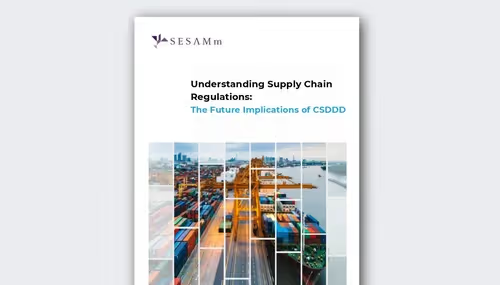
The Corporate Sustainability Due Diligence Directive (CSDDD or CS3D) is a significant European Union initiative, shifting businesses from voluntary environmental and social practices to legally binding obligations. Companies must align with stringent standards to address issues like child labor, modern slavery, and environmental degradation. The directive's phased implementation starts in 2026 and focuses on companies with extensive operations and revenues.

CSDDD requires companies to proactively identify, prevent, and mitigate adverse impacts across their value chains. It mandates transparency and public reporting, enhancing trust with consumers and investors. The directive also imposes financial penalties for non-compliance, highlighting the importance of sustainable practices for business stability.

Fill out this form to download our ebook and explore the Corporate Sustainability Due Diligence Directive (CS3D) to ensure your business is compliant with the latest EU regulations.

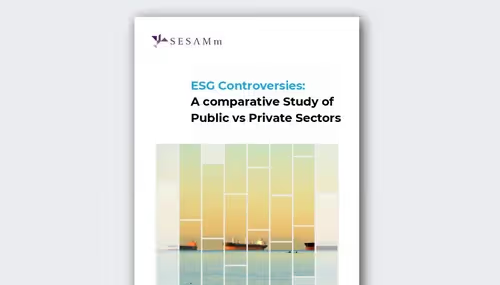
In our newest research, "ESG Controversies: A Comparative Study of Public vs Private Sectors," our ESG and Research & Analytics teams present an exhaustive study on the nuances of ESG controversies across public and private sectors. We combined artificial intelligence with our extensive dataset of over 25 billion documents to extract ESG controversies in both sectors. This research highlights the increased visibility and scrutiny of public companies compared to the more discretion in private companies. A case study on IKEA uncovers challenges in product safety and human capital, underlining the importance of proactive sustainability practices. The study examines these sectors' alignment with major ESG frameworks, including the UN Global Compact and Sustainable Development Goals, offering invaluable insights for enhancing corporate ESG strategies.

Key takeaways:

  • Public companies are under constant observation, leading to higher exposure to ESG risks such as pollution, labor disputes, and governance failures. This visibility is partly due to regulatory requirements for transparency, making every aspect of their operations subject to public and investor scrutiny.
  • Private companies, while benefiting from less regulatory oversight, encounter substantial repercussions from ESG controversies. These can manifest as sudden shifts in investor confidence, challenges in securing financing, or damage to reputation, underscoring the critical need for comprehensive risk management approaches that encompass environmental, social, and governance factors.
  • The case study on IKEA provides an in-depth look at specific issues like product recalls due to safety concerns and the complexities of managing a global workforce. It highlights IKEA's efforts to implement forward-thinking sustainability initiatives and human capital management practices as key components of its corporate strategy, demonstrating the tangible benefits of such measures in mitigating ESG risks.

ESG controversies and breaches of SDG goals vary notably between public and private sectors. Public companies frequently encounter more visible and consistent ESG risks, while private companies, although subject to less scrutiny, experience significant impacts when controversies occur.

Dive deeper into ESG controversies and uncover strategies for navigating these challenges effectively. Download "ESG Controversies: A Comparative Study of Public vs Private Sectors" and equip your organization with the insights needed to enhance your ESG practices for a sustainable future. Fill out the form below to access your copy and lead the way in corporate sustainability.

Fill out the form to download the ebook.

In our recent webinar titled "ESG Controversies: A Comparative Study of the Public and Private Sectors," Sylvain Forté, CEO, and Alexandre Tiesset, Head of ESG, explored the transformative impact of Artificial Intelligence (AI) on understanding and evaluating ESG controversies, especially in the context of public versus private sectors. This in-depth discussion provided unique insights into the challenges and opportunities presented by ESG data analysis.

One of the primary challenges highlighted was the disparity in data availability between public and private companies. Public entities are subject to stricter disclosure requirements, which often results in a wealth of data facilitating ESG assessment. In contrast, the opacity of private companies complicates the evaluation of their ESG performance, creating a demand for innovative solutions to ensure equitable and accurate comparisons across the investment spectrum.

SESAMm, with its pioneering AI-powered text analysis tool TextReveal, stands at the forefront of tackling these challenges. By analyzing billions of documents, TextReveal extracts crucial ESG insights, addressing the data scarcity in the private sector and enabling a more nuanced understanding of ESG controversies.

The webinar underscored the importance of data normalization to counteract biases, allowing for more precise comparisons across sectors and companies. With the help of AI, SESAMm can conduct analyses across a vast number of entities, offering investors a comprehensive view of potential risks and controversies.

The Ikea case study served as a prime example of SESAMm's capability to perform deep dives into specific companies. The analysis revealed Ikea's slightly higher environmental controversies than the consumer discretionary sector average, including accusations of greenwashing related to deforestation. On the social front, Ikea faced challenges with product safety, human rights breaches, data leaks, and privacy violations, such as the 2021 lawsuit against Ikea France for alleged privacy violations of staff.

Furthermore, the webinar touched on the challenges Ikea faces under specific Sustainable Development Goals (SDGs), including health and well-being (due to product recalls and workforce health concerns), Sustainable Cities, and Responsible Consumption and Production. Despite these issues, Ikea shows fewer problems related to industry innovation and infrastructure, and peace, justice, and strong institutions, indicating areas of better risk mitigation.

In conclusion, the integration of AI into ESG evaluation marks a significant advancement in investment analysis. As the demand for sustainable investment options grows, the need for sophisticated tools to analyze ESG controversies becomes increasingly evident. The webinar's insights highlight AI's potential to enhance our understanding of ESG risks and opportunities, paving the way for more responsible investing.

Watch the webinar replay now:

Dive deeper into ESG controversies and uncover strategies for navigating these challenges effectively. Download "ESG Controversies: A Comparative Study of Public vs Private Sectors" and equip your organization with the insights needed to enhance your ESG practices for a sustainable future. Fill out the form below to access your copy and lead the way in corporate sustainability.

Reach out to SESAMm

TextReveal's web data analysis of over five million public and private companies is essential for keeping tabs on ESG investment risks. To learn more about how you can analyze web data or request a demo, contact one of our representatives.

In our most recent webinar, "Unmasking Greenwashing: How to Identify Genuine and Deceiving Sustainability Initiatives with AI," Sylvain Forté, SESAMm’s CEO and Co-founder, discussed our recent ebook entitled with the same name focusing on the vital role of AI in identifying and understanding ESG controversies, focusing on greenwashing and reputational laundering.

Greenwashing, the act of misleadingly portraying products or services as environmentally friendly, and reputational laundering, where companies create a facade of ethical behavior, are increasingly prevalent challenges. These practices mislead investors and consumers, obscuring the reality of a company's environmental impact. Our webinar highlighted the complexity of these issues and their relevance across various industries.

We discussed how AI technology is revolutionizing the detection of greenwashing and reputational laundering. By analyzing vast amounts of web data, including news articles, social media, and public records, AI uncovers patterns and red flags that might indicate deceptive practices. This is particularly pertinent for stakeholders in the financial sector, such as private equity firms, who must navigate the intricate landscape of ESG compliance and sustainability.

Our recent research study underscored the importance of this technology. We found that mentions of greenwashing and related controversies have grown exponentially over the years. This increase aligns with a rising global awareness of environmental issues and the demand for corporate transparency. AI's ability to sift through and analyze this growing body of data is invaluable in providing accurate, timely insights into potential ESG risks.

We also noted an interesting trend: while greenwashing mentions are increasing, their growth rate is slowing down. This suggests that as regulatory frameworks around ESG become more formalized and the market becomes more educated, instances of unintentional greenwashing decrease. It's a sign that clearer rules are helping companies avoid these pitfalls.

Our analysis also revealed that different industries experience varying levels of exposure to greenwashing claims. Sectors like food, drug retail, and oil and gas have seen significant increases in accusations of reputational laundering. However, we also observed a positive trend in the fashion industry, where regulatory frameworks have led to a decrease in greenwashing mentions.

Lastly, we highlighted the importance of distinguishing between negative and positive ESG mentions. While it's crucial to identify and monitor greenwashing allegations, it's equally important to recognize and support genuine sustainability initiatives. Our analysis showed that positive ESG initiatives often have a more significant impact on public perception than negative ones.

Watch the webinar replay now:

Reach out to SESAMm

TextReveal's web data analysis of over five million public and private companies is essential for keeping tabs on ESG investment risks. To learn more about how you can analyze web data or request a demo, contact one of our representatives.

In our latest research, “Unmasking Greenwashing with AI” our ESG and Research & Analytics teams provide a comprehensive analysis of greenwashing trends using AI-powered text analysis.

  • Notable increase in mentions of greenwashing, with a 3.3x rise since 2021.
  • This increase suggests both a real growth in deceptive sustainability practices and a rise in public awareness.
  • Greenwashing represents 55% of all reputational laundering, underscoring a major shift towards environmental deception.
  • Surge in climate lawsuits with over 3x increase in climate change lawsuits since 2020, highlighting legal risks for misleading practices
  • It underscores the financial sector’s dual role in both contributing to and fighting against greenwashing through its investment practices
Greenwashing volume

Submit this form to download your ebook now

AI | Video

Unlock the Future of Risk Mitigation with AI-Driven Insights

November 3, 2023
5 mins read

SESAMm recently hosted a webinar led by Lead Solutions Engineer Leo Shamash. The session focused on the critical role of Artificial Intelligence in identifying and managing ESG (Environmental, Social, Governance) risks and controversies, especially in private companies.

During the webinar, Leo Shamash shared insights on how SESAMm’s advanced AI technologies analyze millions of daily articles to provide accurate ESG risk assessments.

Why is this important for private equity firms? Because traditional methods of risk assessment are often labor-intensive and limited in scope. SESAMm’s AI-driven approach offers a scalable, efficient solution. The webinar also touched on SESAMm's extensive data lake comprising over 20 billion documents, making it one of the largest repositories for tracking ESG risks and controversies.


Watch the webinar replay now:


Join us for our next webinar on November 15 at 4 PM Paris time/10 AM New York time, and watch Sylvain Forté share his insights into how artificial intelligence can help distinguish between genuine sustainability efforts and greenwashing. Book your spot.

Reach out to SESAMm

TextReveal's web data analysis of over five million public and private companies is essential for keeping tabs on ESG investment risks. To learn more about how you can analyze web data or request a demo, contact one of our representatives.

The landscape of the finance sector is evolving rapidly. A few weeks ago, SESAMm announced a new addition to its technologies, Generative AI. This tool is key to enhancing decision-making, streamlining operations, and staying ahead in the industry.

During our recent webinar, CEO Sylvain Forté sheds light on SESAMm’s integration of Generative AI for private equity and asset managers. If you missed the session or need a refresher on the key takeaways, watch the replay here:

For in-depth insights into the future of finance powered by Generative AI, check out our Generative AI series.

Reach out to SESAMm

TextReveal's web data analysis of over five million public and private companies is essential for keeping tabs on ESG investment risks. To learn more about how you can analyze web data or request a demo, contact one of our representatives.

ESG | risk management | portfolio monitoring

VIDEO: Monitor Clients and Suppliers Using AI - FinovateSpring 2023

June 22, 2023
5 mins read

CEO Sylvain Forté demonstrates SESAMm’s NLP platform TextReveal® ESG Alerts and Monitoring for public and private companies at FinovateSpring 2023. He uses Wirecard, a German FinTech company that went bankrupt following a fraud accusation, as an example to illustrate the platform's ability to identify potential controversies and assign them severity scores automatically.

Furthermore, he demonstrates another use case with Twilio, an API messaging and phone services provider, which had previously been exposed to major cybersecurity issues. TextReveal ESG Alerts and Monitoring was able to immediately identify the controversial events, providing valuable insights to users.

In this video, Sylvain Forté also showcases what differentiates our solution from competitors while shedding light on our massive 20-billion article data lake, our advanced AI technology and algorithms, and how we combine both to provide major financial institutions, private equity funds, and banks with timely and accurate data to help them detect any issues with investments, suppliers, or clients.

Watch the full recording:

Reach out to SESAMm

TextReveal’s web data analysis of over five million public and private companies is essential for keeping tabs on ESG and other investment risks. To learn more about how you can analyze web data or to request a demo, reach out to one of our representatives.

risk management | Alerts | supply chain

VIDEO: Supply Chain and Client Reputational Risk Monitoring

May 10, 2023
5 mins read

Watch CEO Sylvain Forté discuss SESAMm’s solutions for corporations focused on supply chain and client reputational risk monitoring during an interview with FF News at FinovateEurope last March.

Watch the full recording:

Stay ahead with the latest in ESG and AI intelligence

Join our mailing list to receive new reports, event invites, and updates from SESAMm directly to your inbox.